

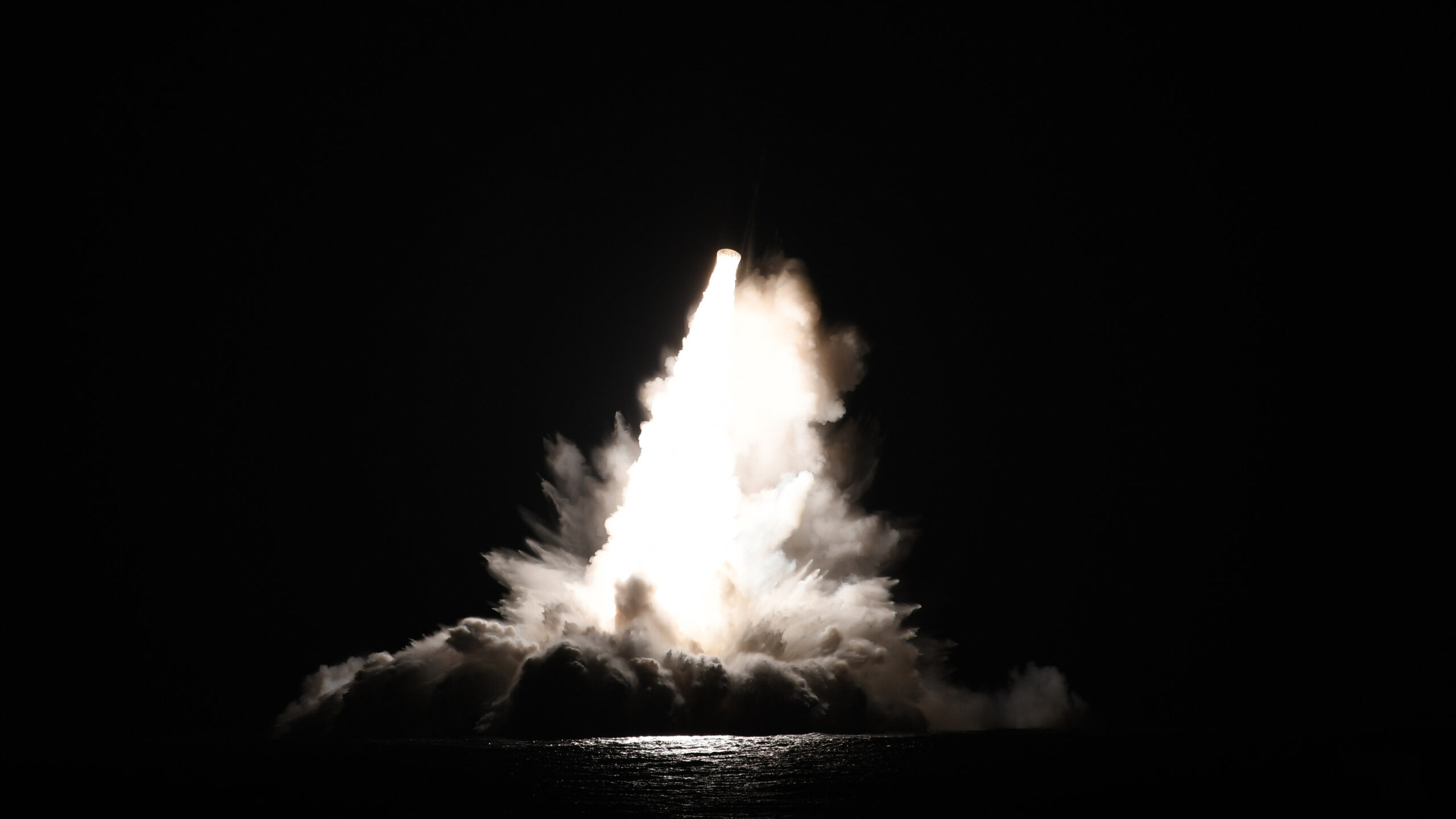
The Astraea programme passed its System Design Review in August 2025, a step the Ministry of Defence describes as significant for the design, safety, performance assessment and manufacturability of what will be the first new British nuclear warhead since the early 1990s, according to the Defence Nuclear Enterprise annual update to Parliament.
The government has committed £15 billion from 2025/26 to 2029/30 to the warhead programme, which includes development of Astraea.
The update states that Astraea “will be the first new UK warhead since the Mk4 warhead (subsequently upgraded to Mk4A) entered service in the early 1990s, and the first to be designed in the Comprehensive Test Ban Treaty (CTBT) era without explosive nuclear testing”.
Designing a warhead without the ability to test it is the central technical challenge of the programme, and the update lists the capabilities delivery depends on, covering products and technology, advanced manufacturing, warhead physics, materials, mission effectiveness, hardness and vulnerability, scientific computing, radiation protection and regulatory science, and criticality safety and non-destructive assay.
AWE is to publish an updated warhead science, engineering and technology strategy this year, compliant with the test ban treaty.
The organisation designs, manufactures and maintains British nuclear warheads, was brought back into government ownership in 2021 and marked its 75th anniversary in 2025. The update says it is undergoing a transformation including major recapitalisation of its infrastructure and nationwide investment across its supply chain and its science, engineering and technology base.
The current warhead remains the Mk4A, fitted to Trident missiles and maintained by AWE at Aldermaston, with the design sovereign to Britain. AWE assures the effectiveness and performance of the warheads along with the safety and security of the stockpile.
The update describes delivery of Astraea as a national endeavour drawing on expertise across government, industry, academia and international partners, with sovereign capability enhanced by partnerships with the United States under the Mutual Defence Agreement and the Polaris Sales Agreement.
The Mutual Defence Agreement, extended indefinitely in 2024, enables cooperation between the two countries on atomic energy for mutual defence purposes, including the exchange of nuclear materials and technology, the transfer of non-nuclear components and collaborative scientific exchanges on technology and nuclear threat reduction.
The missiles the warhead sits on are American built, with Trident and its supporting systems manufactured in the United States, with Britain having bought title to a number drawn from a shared pool of assets under the 1963 Polaris Sales Agreement as amended for Trident in 1982, and the system is operated independently by both the Royal Navy and the United States Navy.







This is the main area the UK should invest in, it’s the most important counter to Russian aggression and the only thing no one else in ENATO can do.
We need a general increase up to 500 warheads as well as complete nuclear triad with an air launched cruise missile available for nuclear sharing and a MRBM that can be either submarine or land launched along the lines of Dark Eagle.
Plenty of countries in Europe are willing to share these costs with us, all we lack is the will.
Jesus wept, nuclear tipped cruise missiles are not happening. The reasons have been explained time and time again.
Will it be boomier than the last one?
Likely about the same ~100kt
The warhead is reported to be based on the Americans New W-93 warhead .!.Considered to be in the 300kt range..??.
Needs a pointy end so they don’t bounce back
I know that we will never get the breakdown but that seems an insane amount of money for a 5 year investment. I assume that’s likely for apox 250 warheads.
Will this Warhead be operational on F-35As ??
No because it’s not for a cruise missile.
I guess it comes down to how many Trident missiles are needed. With 4 Dreadnaughts, that’s 48 operational Trident missiles. If each Trident mssile has 3 RVs, which seems to be the current practise, that only requires 144 warheads.
Suspect they reduced the Missiles from 16 to 12 per Vessel but increased the Warheads from 3 to 4 on Normal Trident loads…!
Thus Leaving them at the Same operational Number…!
It seems a lot but the bulk of it is to completely modernise the infrastructure of Aldermaston & Burghfield which has been starved of funds for 3 decades. Without that investment it just can’t be done.
Same applies to the entire DNE from one end to the other, one Government after the other ever since Major spent nothing and kicked the problem down the pitch to the next and so on !
What makes it even more expensive is we also have to increase the industrial capacity.
My view is that had Russia played ball Britain under Tory/Labour would have Tropt The Deterrence some time this Century..!
This is absolutely brilliant news. My only reservation would be for the program to be totally independent of any foreign involvement, including that of the USA.
The Astraes warhead is based on the American W-93 warhead…!
Being based on the American W-93 may not be a problem if it is a matter of just design, but anything more than that could raise security issues if push came to shove. A policy more similar that that which The French have would be eminently more suitable for the UK don’t you think?
It’s far from clear if there are any majior differences between the Two Warheads..However Britain is ‘building’ the Astraea independently…!
That’s good news. Britain’s nuclear deterrent is supposed to be be operationally independent but that’s not good enough in this day and age. We must aim for total independence from Washington now they talk about the possibility of the US leaving NATO!
Britains ties Nuclear wise with America Runs Very Very Deep.. Missiles,Warheads,Launch Controls, Even Maintance, etc…your wish is sadly Impossible..!
I have heard that should the US pull out of NATO, Britains nuclear deterrent would be able to continue functioning operationally and independantly for several years without any US involvement at all – no software updates or resupply etc! That’s a great relief don’t you think? Also that to reach full and complete nuclear independance from America would take at least 10 years and about £100 billion.