

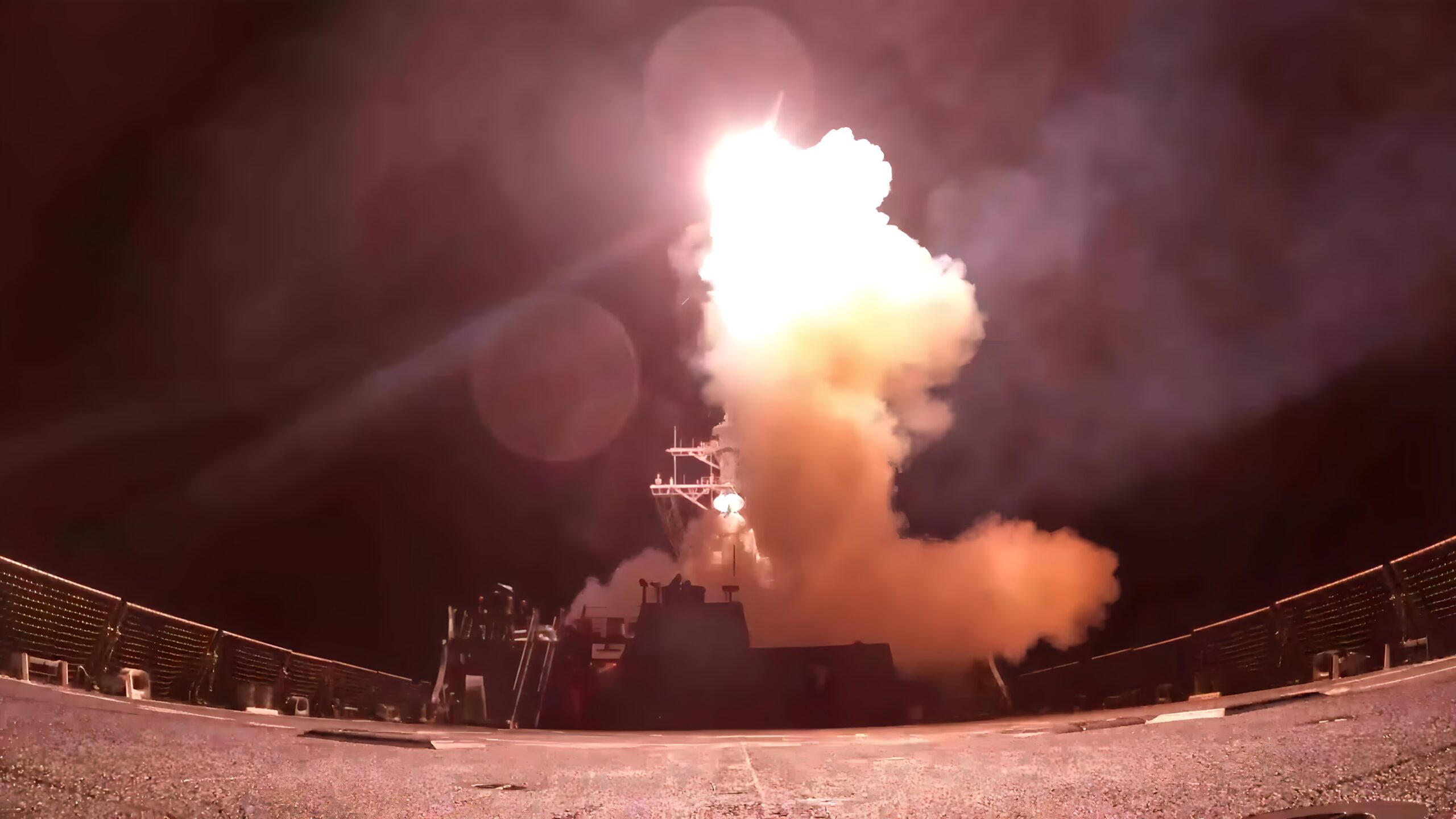
Footage released by the US Navy shows multiple American warships launching Tomahawk cruise missiles against targets in Iran as part of Operation Epic Fury.
The videos show Arleigh Burke-class guided-missile destroyers USS Milius (DDG 69), USS Frank E. Petersen Jr. (DDG 121) and USS Pinckney (DDG 91) firing Tomahawk Land Attack Missiles in salvoes from their vertical launch systems.
The strikes form part of the wider US military campaign following the escalation of conflict with Iran in early March, after US and Israeli strikes triggered retaliatory missile and drone attacks across the region. Since then, US forces have carried out sustained operations using both air and naval assets.
Cruise missile strikes from destroyers provide a stand-off capability, allowing targets to be engaged at long range without exposing crewed aircraft to contested airspace. The US Navy has not disclosed specific targets shown in the footage.
Footage released by the US Navy shows multiple American warships launching Tomahawk cruise missiles against targets in Iran as part of Operation Epic Fury. pic.twitter.com/DimdJSTOPw
— UK Defence Journal (@UKDefJournal) March 28, 2026
The missile
The BGM-109 Tomahawk Land Attack Missile (TLAM) is a long-range, all-weather, subsonic cruise missile developed in the United States for precision land-attack missions. It is operated by several navies, including those of the United States, United Kingdom, Australia and the Netherlands, and can be launched from both surface ships and submarines. The missile is designed to strike targets at extended ranges while maintaining low-altitude flight to reduce detection.
Physically, the Tomahawk measures just over six metres in length with its booster attached and weighs between 1,300 and 1,600 kilograms depending on configuration. It is powered by a turbofan engine supported by a solid rocket booster at launch, and travels at roughly Mach 0.74. The missile typically flies at very low altitudes, between 30 and 50 metres above ground level, to enhance survivability against air defences.
The Tomahawk has been produced in several variants with differing payloads. Early models included a nuclear warhead, now retired, while later versions carry a conventional unitary high-explosive warhead. Another variant, the TLAM-D, was designed to disperse submunitions, deploying up to 166 bomblets over a target area to engage multiple points within a defined footprint.
Guidance is achieved through a combination of systems, including inertial navigation, GPS, Terrain Contour Matching (TERCOM), and Digital Scene Matching Area Correlation (DSMAC). These systems allow the missile to compare preloaded terrain and imagery data with real-time observations during flight, enabling course corrections and accurate targeting over long distances.
Operational range varies by version but generally extends to around 1,600 kilometres or more, with some modern variants exceeding 900 nautical miles. The missile is launched via vertical launching systems or torpedo tubes, providing flexibility across a range of naval platforms and enabling its continued use as a key component of maritime strike capability.




Trump the mass murdering W⚓