

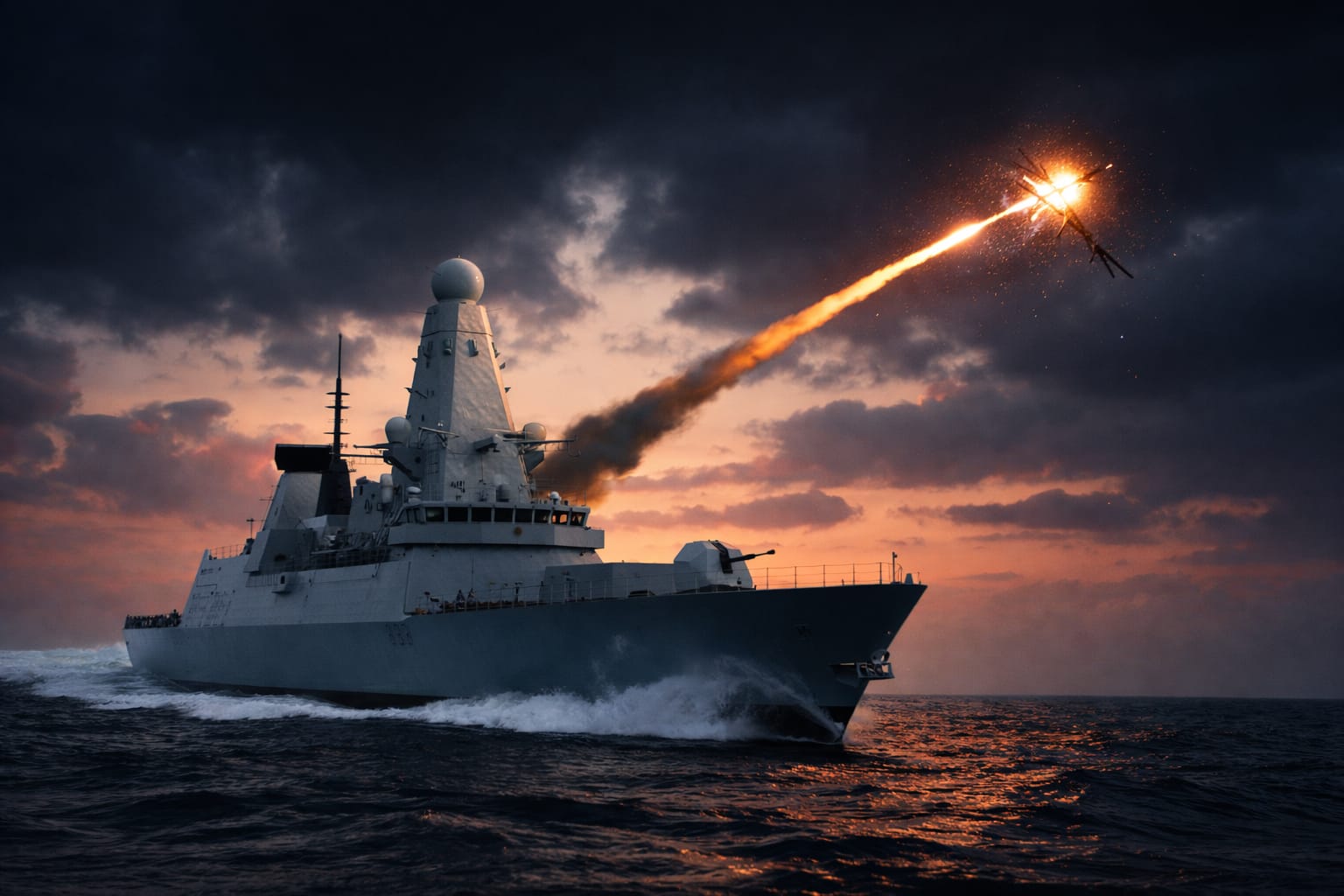
The Ministry of Defence is seeking industry input on low-cost systems to counter uncrewed threats as part of a wider effort to complement existing missile defences under Project METIS, the UK Defence Journal understands.
A Request for Information (RFI) published via Find a Tender outlines plans to develop scalable, modular “effectors” capable of addressing the growing volume of uncrewed systems across maritime environments. The initiative forms part of the Royal Navy’s shift towards a “Hybrid Navy” concept, where crewed and uncrewed platforms operate together with greater flexibility.
The requirement focuses on countering both airborne and surface threats using a mix of approaches, with the MoD indicating that solutions may include both electronic and physical methods. Systems are expected to be interoperable across platforms and domains, with an emphasis on rapid installation and minimal integration burden on host vessels.
Project METIS centres on the use of containerised Persistent Operational Deployment Systems (PODS), broadly aligned to standard 20-foot ISO container formats. These modules are intended to house mission systems that can be deployed across ships, land vehicles and potentially other platforms, with common interfaces for power, cooling and command and control.
The RFI also highlights a push towards greater autonomy, with solutions expected to operate with reduced operator input once engagements begin, while still being able to integrate cues from other systems. The approach reflects a wider effort to manage increasing threat complexity without significantly increasing crew workload.
Sustainability and scalability are key considerations, with the MoD stressing that solutions must be capable of production at scale and supported by resilient supply chains. Systems are also expected to operate for extended periods with minimal maintenance, including the ability to function continuously for up to 30 days without intervention.
The notice makes clear that the requirement remains at an early stage, with the RFI intended to refine requirements and inform future procurement decisions. No commitment to proceed has been made at this stage, and suppliers are expected to respond with potential solutions based on current market capabilities.








It’s should be pretty simple and cheap to put a few dozen octopus interceptor drones on a warship. If we are smart about it these would probably become perfect weapons for attacking small boats as well.
DSTL can jury rig a ASRAAM to fire off the back of a truck in months to become an effective GBAD system.
I’m guessing the navy will want to spend five years on this and go through multiple demonstrators and several clever titled acronym programs then just buy what ever Lockheed Martin is selling for £1 billion.
UK procurement in a nutshell.
Dragonfire and Octopus drones. If only I was an MoD consultant, could have charged £500,000 for that.
Worth every penny.
Andrew, Andrew, – you don’t get how this barrow boy economy wrks do you? 500K would be for ‘expenses’. ‘Advice’ would start @5 mil. matey!
That’s cheap for their consultancy… Charge by Gross Domestic Product, then you’ll be a real Arms supplier.
Jury Prize
Worth noting that jury rigging AMRAAMs to a Jackal works because if it goes wrong in Ukraine and blows up killing it’s crew it’s just an operational loss. If it does it on Salisbury plain it’s a rather different deal.
Refitting all the MSI 30mm to the current standard with dual feed for proximity ammunition for all ships.
40mm Bofors elsewhere…rivers perhaps…carriers..
Dragonfire all round…
Martlet…. peregrine with martlet….
Lots of options there requiring no extra comitee time.
To be honest, I couldn’t believe that the 30mm were being maintained to a 20 year old standard as detailed elsewhere.
AA
All sounds good to me. The extra mag and proximity fused ammunition for the 30mm should be a no brainer.
NL claimed that the 30mm were the same mid state as late ‘80’s so 40 year old tech. That isn’t true: the mod state has moved on and the electronics has moved on if nothing else. Mechanically they are the same.
TBh, at this point, the River class are pretty overworked that they will be retired in the next 5 years. That said, Uruguay is looking to buy the Batch 1, according to Navallookout.
Just crack on and swap the 30mm for the mk4 Bofor’s and drop the 30 and 20mm.
Erm, Not So Fast. Have a look at the NL article about this.
Countering drone threats, I hope MoD is considering this urgently with stationary aircraft on RAF airfields. Ukraine uses netting.
Netting supplied at Scottish fishermen at that. Can we have some please or does that need a Committee to work out the best mesh characteristics.
Cambridge Aerospace Skyhammer seems the obvious choice. Good range and balance of capability (if you believe the press). Rapid sentry type mounts for more close in defence. Lots of options really.
A bit fantasy fleets, but maybe it’s time for a new class of escort. In the vain of the original torpedo boat destroyer but for defence against low end saturation attacks. Less missile barge as per some type 91 concepts. More along the lines of BAE SEP perhaps. Looking forward to seeing how these concepts develop. If they ever do that is.
More projects more cost and as already said, probably when Labour are booted out, spending billions on some overpriced system from Lockheed. It would be interesting to learn who in the MOD is in charge of this and where they end up working !
In overall charge? That would be Rupert Pearce, National Armaments Director.
Yes the sooner we get back to the ‘tory way of doing things over the last 14 years the better!!!
This in a nutshell.
Ukraine is the perfect proving ground and we can get all the info we need for counter-drone systems for free by literally just asking them what works. They’ll happily share their knowledge and experience.
Just asking Ukraine and copying what they do, even if building our own versions, would save hundreds of millions of pounds.
They are building some of them here already, or soon will be so shouldn’t be too hard to get a heads up from the World experts. We are never going to be in a better place to calculate the best options and get the knowledge for free most likely as well as a de ent price on joint products.
Just ask ukraine what works best and use that as your foundation, no need to piss around for years and spend millions in the process.
If you want affordability and sustainability guns firing airburst rounds is the way to go. Forget missile systems for all but large drones, all an enemy has to do is swarm you until your missiles run out, then its effectively a mission kill as you have to dock to rearm.
PS Dragonfire, get a move with it, it’s supposed to be one of the answers to this very problem!
I must be going bonkers, I could have sworn we had this requirement a few weeks back.
Unfortunately Ukraine might not be best placed for this. Their solution probably doesn’t account for being at sea in a several thousand tonne ship.
The US have already started mounting Cayote mk2 drones on their Burkes and the mk3 with its EW warhead looks like a bit of a game changer, and it can be recovered via a net.
BAEs APKWS would be the cheapest option, F16s are using it over Iran to take out shahids.
Deck mounted Martlets in small launch canisters with an upgraded fire and forget seeker (work has already been done on this but RN went for the cheaper laser guided version)
Hi folks hope all is well with you..
Very interesting and this is going to be the future of warfare, and I was wondering how the uk is placed in this particular matter? Hopefully we’re at the cutting edge of the laser development. The only issue to bog these and other such products is the government of the day, and of course the MOD, pondering for years. Ajax comes to mind.
Cheers
George
Pardon my ignorance, but how would guns like the automatic 3″ on Tiger and Blake go against these drones? Wiki says they had a rate of fire of 60-120 shots per minute. I guess modern guns are better?
The problem will always be cost. Ideally you want something that can swat a shahid style drone out to 25k that doesn’t cost much more than the shahid does. Thats sea ceptor range and at around 500k to 800k its not feasable.
A proteus drone carrying 20 martlets would be great
Indeed but as we have so recently discovered Proteus isn’t even a prototype design just a capability demonstrator to inform for some future potential design… so probably the same timescale as humans landing on Mars then.
Pretty much any late war WW2 cruiser/destroyer will be better against these drones than most modern warships.
Medium calibre guns in the 30-76mm range with a mix of proximity fused air bust and guided rounds..
Point worth noting; even on this low stakes forum I have seen,
-Octopus Interceptor
-Dragonfire
-Upgrading 30mm with proximity fuses
-Bofors 40mm
-Peregrin with Martlet
-Martlet from decklaunch
-Nets
-Skyhammer
-AKPWs
-Coyote
-3 Inch guns
That’s 11 options, mostly suggested with the word “obvious” in front of them. Now if someone told the forum, collectively, to agree to raise money and fund just 2 of those, I think we’d pretty quickly see why “obvious” decisions sometimes aren’t taken immediately.
That’ll be millions wasted on an answer that’ll probably be worse than the simple one you’ll get from most people in these comments: proximity fused ammo for the 30mm and 40mm we already have.
I wouldn’t be surprised to see an MoD study on whether a wheel could serve in the role of a wheel, or if something else needs to be invented.
i think they should persist with the Martel light weight missile that has already been trailed . it can Engauge surface craft and drones . i believe the trials cause concerns of the rocket motor damaging the ship , i am sure they could deflect the flames or insulate the ship in the necessary parts . no need for much development either.
Issue with the hybrid navy is one of balance – looks like the MoD is moving towards a 50/50 split between RFIs and PoCs.
‘The requirement focusses on countering both air and surface threats…’. What about subsurface threats?
I would like to see a collaboration between MBDA and Thales on developing Martlet, as that’s a weapon already in use.
My thoughts are that Martlet is a proven system, Ukraine have used it to take out helicopters, Su25s, drones and the odd cruise missile, but it could be better. It has already been trialled on a ship (HMS Sutherland in 2019), where it performed as expected but the exhaust plume hitting the ship’s structure, was sufficient to shelf the idea. To get round this problem, I’d replace the hot tube launch with CAMM’s soft tube launch. Which is where a gas generator drives a piston to push out the weapon from the tube, with enough force in CAMM’s case to lift it some 30m, so its clear of any structure before initiating the rocket motor.
This could have two benefits, firstly allowing the container to be mounted to the MSI turret, without fear of the exhaust plume hit stuff it shouldn’t. Secondly, by incorporating some of the 1st stage booster in the 2nd stage sustainer, you should be able to eke out some more range, or conversely increase the terminal velocity.
A spiral development of Martlet following the introduction of the cold launch method, would including a data-link, along with CAMM’s tip-over jets. Both are necessary for lock-on before launch (LOBL). Which is where the missile is fed information on the targets location prior to firing. But for CAMM allows the weapon to fired vertically and then orientate itself post launch towards the targets direction. Where the data-link then gives it target position updates. If Martlet was fitted with these, then a stack of Martlets could be fitted together, say on a ship’s hangar roof. Which would then give the ship a 360 degree capability. A Martlet plus container weighs around 13kg, so a stack of 20, weighing around 260kg plus supporting structure, “shouldn’t” need significant if any, structural modifications to the hangar.
It could also be advantageous in the dismounted MANPAD role. Instead of shouldering the firing unit and missile combined. The Container could be separately linked via data-link or cable to the firing unit. Where the operator has 3 or more stacked vertically ready to go. When fitted to a Wildcat, the soft launch won’t hinder the firing of the weapon whilst flying at speed, the reaction jets don’t need to be used.
There are other upgrades to the guidance system that I could mention, but that’s for another day.