

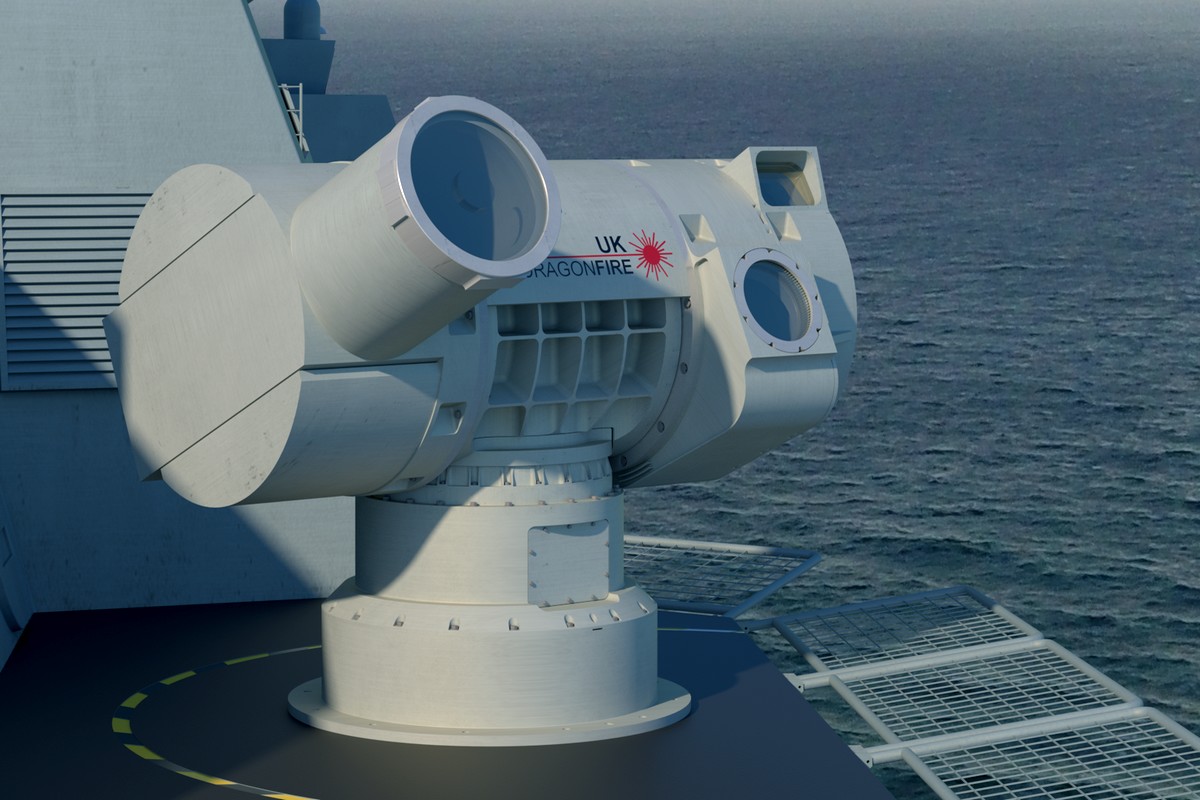
The UK DragonFire laser weapon programme remains in its demonstration and evaluation phase, with further trials underway to support installation on a Royal Navy destroyer from 2027.
Responding to a parliamentary question from James Cartlidge MP, Defence Minister Luke Pollard outlined that the programme is being delivered through what he described as a new procurement approach intended to accelerate timelines and introduce capability earlier in a limited form.
Pollard indicated that, following a successful demonstrator trial, DragonFire was moved forward for accelerated development, with additional trials now being used to shape what the Ministry of Defence terms a “minimum deployable capability”. This reflects a phased approach, where an initial operational system is fielded before being incrementally improved.
He stated that “we are on track to install this capability on a Royal Navy Type 45 destroyer in 2027”, suggesting that the current evaluation activity is aligned with that timeline rather than a fixed end date for trials.
DragonFire is a British-developed laser directed-energy weapon being built by a consortium including MBDA UK, Leonardo UK, QinetiQ and the Defence Science and Technology Laboratory. First revealed publicly in 2017, the system has undergone a series of trials in the UK, including testing at the Hebrides range where it has tracked and engaged aerial targets. The weapon is designed to counter threats such as drones and mortar rounds, using a high-energy laser in the 50 kilowatt class, according to previously released information.
The system combines multiple glass-fibre lasers into a single beam and is mounted in a turret alongside tracking sensors, including an electro-optical camera. Trials have demonstrated a high degree of accuracy, with the Ministry of Defence previously stating the precision is comparable to hitting a small coin at a distance of one kilometre. Its range remains classified, though it is understood to operate as a line-of-sight system.
One of the key features highlighted by the Ministry of Defence is the comparatively low cost per shot, which has been described as around £10, significantly lower than conventional missile interceptors. As an electrically powered system, DragonFire also reduces reliance on stored munitions, which may have implications for sustained operations where resupply is constrained.
The programme has been brought forward from an earlier in-service date later in the decade, following successful trials and additional funding. Beyond its initial deployment at sea, the technology is also being explored for use on land platforms and potentially in the air domain.









Good it’s confirmed.
I thought it had been confirned it was confirmed ages ago?
Still, good to get another confirmation!
Mmm Defence blog has just reported another GBAD system RapidRanger supplied to Ukraine by us! How many systems is that now?by my count it’s 3 isn’t it,pity we can’t seem to actually buy some for ourselves!
Funny. Rapid Ranger was strongly uggested in sevetal quarters as an interim replacement for the HVM Stormer we gave to UKR for 12 RA.
The then CGS was photographed touring the factory.
It then never happened for some reason.
Maybe they were always meant for UKR?
Apparently Patria is the chosen platform for our own Stormer replacement, when it gets ordered.
On another note that’s yet to be widely reported, the RAF Regiment has returned partly to a GBAD role using the same turret as the Rapid Ranger but dismounted from the vehicle and supposedly paired with those Giraffe 1X very short range radars we bought a while back.
That sounds like Rapid Sentry.
34 Sqn use it as part of 2 CAUS Wing.
Wonder if this Rapid Sentry mount could have naval application? For OPVs and RFA and the carriers. Complement the 30mm and or Phalanx’s.
😆 🤣!
One MOD project when I worked there was announced and renounced 7 times over a 3 year period.
SOP when experiencing bad news, reannounce an announced decision.
Oh,I know. Highlighted that myself here often enough.
I fully expect much of the fabled, mythical DIP to be full of such reannouncements.
It’s all “new” you know.
That and the endless rebranding of long established organisations, so they too are “new.”
Isn’t it more DAIP Defence Avoid Investment Plan at this point? I mean, it’s only six months late and everything is being pushed down the tracks because of it except for the NMH project because Leonardo did what they had to do and said order now or we are closing the factory.
On kit and any thoughts of even modest expansion, yes.
As others have said, the extra spending is on infrastructure and other needed support so far.
Indeed, and if I was still there, I’m sure my last 6 months would have been writing up a myriad of long announced and soon to be reannounced wunderwaffe into the Blue Book.
DIP will be more of the same, with some chocolate sprinkles to sweeten it.
‘Chocolate sprinkles’? Oh things like a ‘MOD will undertake programme to consider a ground based interceptor for the UK’ – sexy, long term and can be slid easily into the grass when the news of the moment calms down.
Nice to have some positive news for once when it comes to kit for our armed forces. Pleasant change.
Its actually pathetic. This is warmed up old news. One Destroyer. Big Deal. Labour should be toast right now. They are fabricators of truth. Don’t they know there isn’t just one war on but two! Both organised by the Terrible Twins, Putin and Trump!
I can’t bear to watch its a train crash for our services and the country as a whole.
Oh sure.. Agree, things are in a real mess, very frustrating and worrying. I just thought just for once there was a positive little bit of news to do with DragonFire. Lot’s to be sorted..
Worse still warnings that Europe can expect agreements and cooperations to develop between Trump and Putin not to far down the line… no doubt there’s a Committee for that. In all honesty present indicators are pointing in that direction what with sanction easing and sanctioned Duma visits to the Capitol. Only a matter of time unless the mid terms can thwart it.
ME too 🤔
How long before 2027 slides to 2030 like everything else?
Which bit of …”Responding to a parliamentary question from James Cartlidge MP …” did y’all not understand, methinks it’s “RESPONDING” : )
Victory has had new oak timbers fitted to take the weight….
So could these be mounted atop a tall Sanger at certain land based CNI/KP as part of anti Drone measures?
Plugged straight into the National Grid?
Rapid Sentry seems to be a quite elegant solution to this issue – defending point HVTs rather than wide areas like a battlefield. Looks cheap enough too, just add some ‘almost Special Forces’ RAF Rgt and you’re off.
RAF Regiment already operate Rapid Sentry
Yea but they are part of 1 squadron that deals with UAV protection and they utilize other kit as well, i.e. jamming so I doubt they many. Maybe 1 flight of 3? Pure guess though.
Given their successes in Iraq hopefully the use will be expanded.
Rapid Sentry though, surely needs a human on site to reload, where’s Dragonfire recharges.
The personnel and LMM needed to cover many KPs would be prohibitive.
This seems a more efficient solution? If it can be rolled out at may sites and works? I note the issues J mentioned regards the NG.
Rapid Sentry doesn’t need a sufficiently robust electrical grid connection, which might not be available in Iraq where it’s currently swatting Iranian drones.
Even in the U.K., Dragonfire deployment may be restricted until the National Grid capacity expansion is completed.
Yes, good points, there are pros and cons with each.
Both seem very effective, I’d like to see many more Rapid Sentry purchased, it was not publicised it was even purchased in 24 until Thales showed a photo of it with the RAFR.
Seems that Iraqi insurgent drones are swatting US helicopters and radars mind.
The US still has functioning radars in region? I thought Iranian ballistics had hit most of them in the first couple of days…
Dragonfire? Needs a lot more than that though. I’d say we’re looking at bolting that onto A HX 10×10 with an equipment cabin to run it and another manned truck to do the FCS.
It would still need the energy storage..National grid could power the flywheel capacitors ( FESS).. the one thing we don’t know is how many shots you get out of the FESS, before it needs to speed back up.
Poor pigeons and seagulls won’t know what hit them
Reportedly £120m a pop. Roughly the same amount as the Army bought an extra 6 Sky Sabre launchers for, last year. If we expect it to fire a lot of shots it might be worth it, but I think those would be expeditionary firing numbers, far away from the National Grid. Navy Lookout estimated an integrated shipset cost would be closer to £80m and I’m sure costs will fall over time. It will still be pretty expensive for low-use protection sites, where missiles or even the Raytheon 15kW laser system might be a better buy.
Thanks.
I thought I’d have a look at some other finger in the air estimated costs; none of these are any way official.
I think officially Rapid Sentry is just the Martlet-based hard-kill element, but the multi-layer system is how they are being deployed, and I can’t find a different official name for the whole thing. I’m getting a feel of £10m for the Rapid Sentry C-UAS layed system plus £50K per missile shot: Giraffe 1X radar £2m, Orcus C2 £5m, Ninja soft-kill C-UAS maybe £2m. Then add £500K a year for maintenance costs. Still not cheap if these estimates are half right, but significantly cheaper than Dragonfire. Orcus also uses passive RF sensing (Skyperion) and may use Leonardo’s Guardian “long-range” jammer. I think these are included in the headline costs, but still a lot of guesswork going on here.
Griraffe Saab, Orcus Leonardo UK, Ninja developed by USAF Research Labs integrated by Leonardo, Thales UK (and MSI) for Marlet launchers. There’s a significant UK proportion.
I hadn’t realised that the Rapid Sentry C-UAS has been credited with 50 UAS takedowns in the Middle East. I believe this is mostly in Iraq.
9 Adverts.
No wonder you’re stressed! 😉
Should we not be fitting Martlet onto all escorts and deployed RFAs as a priority. It’s clearly been hugely successful in UKR and in Iraq with the RAF Reg.
I know the RN likes to send it’s vessels with bare minimum in self defence so maybe this is too sensible.
Add in the River OPVs. With you. Yes, too sensible…lol. The French (Naval Group/Thales?) already have a multi-purpose naval mount that takes Martlet/Mistral and Rockets which might be good even for the carriers.
For God’s sake GET ON WITH IT
This is cutting edge stuff, with completely novel power management.. it’s not a get on with it sort of project.
I know lasers and high energy weapons take time but this is mainly known technology and Dragonfire was first shown in 2017, more trials and maybe we will have it on 1 ship in 2027. And now moved to accelerated development !
I’m showing my age but it’s “Brian the Snail” slow 🐌.
Contrast that with other “known technology” which required an unbelievable uplift in industry to produce a weapon and with a former partner doing everything they could to hinder us.
The “High Explosive Research” project was kick started in Jan 1947 after the US imposed the Mahan Act, we exploded the resulting Device in Oct 1952 and the UKs 1st Atomic Bomb delivered to the RAF 13 months later.
ABCRodney ~ Ambroise ~ Brian the Snail, (you might have to look that up.)
In 2017, it was essentially a collection of high-end industrial lasers combined in a static box to see if the math worked.
The 24/25’ trials in the Hebrides, where they downed drones at 650 km/h proved something much harder as they set about mastering Coherent Beam Combining (CBC). This isn’t known technology in the sense of a shelf-stable product. The UK is one of the only nations in the world to successfully synchronise dozens of fibre lasers into a single, needle-sharp point that can track a target moving at half the speed of sound.
The “Acceleration” is actually unprecedented, if this were “Brian the Snail” slow, we wouldn’t see it until the 2030s.
The original plan was to field this in 2032. Because of the drone crisis in the Red Sea, the MoD invoked a new ‘Integrated Procurement Model’ to skip years of red tape. By 27’, the RN aren’t just putting it on “one ship” for fun; they are deploying it as an operational weapon. Going from a successful high-power test 24’ to a front-line warship 27’ is a three-year window. In naval procurement, that is practically – warp speed.
Comparing it to the atomic bomb using 1940s Logic. Comparing it to the UK developing the atomic bomb in 5 years 47/52’ is a false equivalency. When the UK started its independent program in 47’, it wasn’t starting from scratch, British scientists aka “The British Mission” had been core members of the Manhattan Project. They already knew the recipe, they had the blueprints for the pits, the detonators, and the enrichment processes. None the less, with faced with sudden isolation by the US, PM Clement Attlee initiated an independent program under the cover name High Explosive Research. That led to the successful test of Operation Hurricane in October 52’ a breathtaking response to the US McMahon Act of 46’.
… in fairness after a series of catastrophic security breaches within the British mission to the Manhattan Project and the subsequent UK Atomic Energy Authority; Alan Nunn May / Klaus Fuchs / Bruno Pontecorvo / Guy Burgess / Donald Maclean / Kim Philby … convinced the CIA and the FBI that the British intelligence services were ideologically compromised at the very highest levels.
Those 5 years were spent building the factories to produce the ingredients. Building a 40’s bomb was an exercise in massive industrial scale and chemistry. In 2026 building a laser is an exercise in nanosecond-level software and optics, the target is the problem, an atomic bomb just has to fall, a laser has to stay focused on a specific 50mm spot on a drone moving at 400mph, while the ship is rolling in a 4-meter swell, and the air is full of distorting salt-spray.
While other nations have experimented with shipborne lasers, no one has yet fielded a standardised, high-power system using CBC at this scale. There is no off-the-shelf blueprint for what the UK is achieving. By moving beyond simpler ‘spectral’ lasers, the DragonFire consortium; QinetiQ, MBDA, and Leonardo, are solving complex physics problems in atmospheric propagation and adaptive optics that were considered theoretical only five years ago. They aren’t just building a weapon; they are pioneering a sovereign ‘precision-effect’ capability that puts the UK at the absolute cutting edge of directed energy.” … and for that I’m personally cutting them some slack, because in my eye’s they seem to be doing a ’sterling job’.
The term ‘acceleration’ isn’t just a buzzword, it’s a response to the fact that they are currently spending £1 million on Aster missiles to shoot down £10,000 drones (and we ain’t got the money to keep doing that). As of now, the UK has actually increased its ambition, instead of just one experimental ship, the £316 million contract awarded in late 25’ aims to equip “multiple” Type 45 Destroyers, at least two to start with by 27’.
The MoD is “getting on with it” because, economically, they have no other choice.
“C’est l’heure de dormir,” dit Zebedee (Zébulon).
TLDR.
Have you tried using a laptop? Big screen, almost no ads. Soooo relaxing.
Good post. Glad I read.
“Catastrophic security breaches .”
Didn’t our traitors get educated at the same elite schools as most of our present politicians.
No wonder UK defences have been reduced to a pitiful level. Our enemy’s playing the long game?
Anyone for a Chinese super embassy.
Great post, fascinating detail.
Thanks.
Martlet not Dragonfire. We are still spending less than 2% on defence if you deduct all the convenient bolt ons. UK is a disgrace whereas once it meant something. At the next Defence question in the Commons on Wednesday when Starmer tries to answer, all the Opposition benches should either all leave or stand and turn and face the back wall. He deserves disrespect doesn’t he?
What can be defined as defence spending by a member nation was defined by NATO in the 1950s. It hasn’t changed.
Stop spreading disinformation.
Perhaps it’s limited to being fitted to a Type 45 only after its had the PIP, or did they already have sufficient excess electricity for it? 🤔
Everything is for show only. What about fitting CAMM on the T45s? Its pathetic.
And while we are at it, what about fitting NSM ‘at Pace’? They are joking aren’t they?
Retard.
Interestingly the US is having a bit of a hiccup in its laser programmes with a lot of abandonment and restructuring.. they have essentially stopped their high energy programmes and seem to be focused on getting a 10kw system operational.
Do we know what went wrong?
They’re also desperately trying to restart their rail-gun programme which they previously abandoned.
Well after not getting it to work reliably and it being far to expensive to operate, Japan had gone down its own route and decides to make it work and although expensive its way cheaper than a missile.
They’re apparently trying to get details of how the Japanese succeeded… they just can’t stand others, even allies, having a technical superiority 🤷🏻♂️
It would require a black hole for a laser not to be a line of sight system. If there’s a black hole close enough to bend light, I suggest that is far more significant problem.
Well the Romulans use artificial singularities to power their ships, so a cloaked Warbird maybe… 😏
Great comment.
But I believe the MOD have already developed a black hole – it’s working title is ‘Defence Investment Plan’.
It might be better to put up a high flying drone fitted with a directional gravitation field as powerful as the Milky Way’s. That would bend the laser beam and have the advantage of not messing up time when operated.
They are probably bending light using a fibre optic cable instead, or a mirror. Much cheaper than Reeve’s £22bn black hole.
Just need some boats to put it on now.
So which T45 is it likely to be?
Defender or Diamond as both currently undergoing PIP?? Defender went into PIP earlier so more likely??
Gosport Ferry will list a bit but at least Pompey will be defended.
Do they have any plans to get some ships to fit them to
excuse my ignorance , at this point could this unit be rapidly manufactured as a containerised unit and deployed if need quicker. The way these deployments go 2027turns into 28 to 29 etc. i’ve minor issues. Don’t want to be late for WW3 😐