


The Royal Navy must reinvest in developing leaders who can debate, challenge assumptions and think critically if it is to remain effective in combat, a new study has warned, according to research by the University of Exeter.
Research by Dr Peter Roberts, a former Royal Navy warfare officer and now Honorary Senior Research Fellow at the University of Exeter, argues that the service has prioritised technology and diplomacy at the expense of warfighting culture.
The study calls for a shift in how future leaders are trained, warning that the Navy needs to place greater emphasis on argument, critical thinking and internal challenge.
Dr Roberts writes that “the belief in success through sophisticated equipment, rather than through the work of people or a way of fighting” has shaped decision-making within the service, affecting how personnel across roles have been valued.
The paper is sharply critical of senior leadership over several decades, stating that successive chiefs have shown “a failure in imagination, an inability to debate and win their cases” alongside a tendency to prioritise operational tempo over combat readiness.
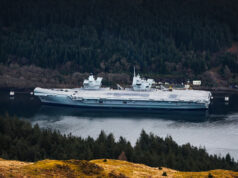
It also highlights what it describes as an enduring focus on carrier strike at the expense of wider fleet balance, arguing that naval leaders have “continued to sacrifice any and every part of the fleet to pay for the flat-tops.”
According to the study, these trends have contributed to a long-term erosion of capability, with declines in fleet mass and global presence traced back to the 1970s. The loss of experience following the retirement of Falklands War veterans is also cited as a factor.
Dr Roberts further argues that assumptions about prolonged peace and the decisive role of technology led to an underemphasis on preparing for high-end conflict, with the Navy increasingly viewing its role in diplomatic rather than combat terms. The paper concludes that reversing these cultural and structural trends will be necessary if the service is to restore combat effectiveness in an increasingly contested global environment.









Remain effective in combat, that’s a good one! 🤣 Is it April 1st? In order to remain one must actually be at that point to start from! Actually getting a useful number of vessels seaworthy would be a good starting point.
The whole of parliament has to redevelop a critical thinking culture if it believes that the (unsupported by any real scientific evidence) pursuit of net zero is more important than defence of the realm.
🤡
I guess the sudden increase in petrol prices and being dependent on non-domestic energy is something we should embrace with open arms then?
🤡 – seems they’ve added a custom emoji just for you.
Silly insults are not an argument.
The delusional pursuit of net zero is, itself, making Britain more dependent on overseas suppliers. The UK is now dependent on China for wind turbines and solar panels.
Britain’s government increased fuel duty by 46% between 1997 and 2010. Today, more than half of what drivers pay at the pump goes to the treasury. In cash terms, that’s around £42 of the £78 total bill every time the tank of an average petrol-powered family car (with a 55-litre tank) is filled up in Britain.
If Britain encouraged North Sea oil production, the spike in prices would increase the Government’s tax take, permitting it to temporarily reduce fuel duty at the pumps.
So no we shouldn’t embrace increased petrol prices. We should encourage domestic production and fracking as the U.S. has done.
The government has a great deal of leeway to reduce forecourt petrol prices but it chooses not to, preferring to accept higher tax revenues from higher prices.
We’ve increased our dependency so your bright idea is to… increase our dependency further?
Also, funny to out yourself so quickly as someone that doesn’t know what they’re talking about. North Sea oil does not dictate prices to the world. It’s output will ONLY fall for the next few decades, even if you wanted it to increase. I guess they didn’t teach economics back in your time, did they?
Place your bets – over the age of 55 maybe?
Silly insults are 100% an argument when the person I’m talking to is a moron.
Thank you. Evidence free, incoherent and insulting…which invariably indicates the wrong end of the argument.
Wind farms do not produce cheap electricity.
Wind (and solar) power has to be backed up, failing erratically and unpredictably. For modern gas plants that means burning gas at a rate of about 28% of the plants full-power fuel rate just to be hot, ready to go and producing zero electricity. For some older plants, it means as much as 40% of the full power load. The gas that these generators use is predominantly sourced from Norwegian gas fields right next to British territorial waters; quite mad. Britain plainly could and should be exploiting those fields itself.
The Renewable Energy Foundation estimates that the UK has spent approximately £220 billion (2024 prices) on renewable energy subsidies since 2002, with current annual costs running at £25.8 billion, now comprising roughly 40% of total electricity system costs.
Wind turbines also create (overlooked because overseas) huge environmental costs. A modern wind turbine can contain up to 600 kilos of neodymium that is used to make powerful permanent magnets (NdFeB – neodymium-ion-boron magnets). To produce one tonne of the material, it is estimated that up to 12,000 m3 of waste gas is produced along with a tonne of chronic radioactive residue. Up to 2,000 tonnes of toxic waste including slurry tailings mixtures that can leak into ground water supplies are produced.
Wind turbine blades also kill huge numbers of bats and raptors every year.
So if that is your answer, then you are asking entirely the wrong question.
A mix of nuclear, gas and renewables is the way forward. Pursuit of arbitrary and unevidenced net zero targets, given that Britain now has some of the highest electricity prices in the developed world, plainly is not.
“hey guys, our energy prices are criminally expensive, in large part because it’s linked to gas prices. I know! Let’s stay dependent on gas prices, that’s a good idea” – you, today.
“Wind turbine blades also kill huge numbers of bats and raptors every year.”
Lol lmao even.
You aren’t worth doing research for because you’ve clearly fallen for fossil propaganda. Good for you, halfwit.
The Renewable Energy Foundation estimates that the UK has spent approximately £220 billion (2024 prices) on renewable energy subsidies since 2002, with current annual costs running at £25.8 billion, now comprising roughly 40% of total electricity system costs.
There are other reasons why you cannot be bothered to do any research.
Gobbling Exxon’s wang is not a good look, sweetie.
But, by the way you talk, you’re probably a Boomer. Did you know that people from your era have a significantly higher incidence of lead in their brains, which is known to affect cognition?
Sure makes you think (well… Maybe not for you…)
Renewable Energy Foundation (REF) is a registered charity promoting sustainable development for the benefit of the public…
REF is supported by private donation and has no political affiliation or corporate membership. In pursuit of its principal goals REF highlights the need for an overall energy policy that is balanced, ecologically sensitive, and effective.
We aim to raise public awareness of the issues and encourage informed debate regarding a structured energy policy that is both ecologically sensitive and practical.’
The Renewable Energy Foundation estimates that the UK has spent approximately £220 billion (2024 prices) on renewable energy subsidies since 2002, with current annual costs running at £25.8 billion, now comprising roughly 40% of total electricity system costs.’
They go on to say: ‘…the current UK government is committed to accelerating the switch to reliance upon subsidised renewable generation, the inevitable consequence will be a further increase in the variability of market prices. This change will destabilize the wholesale market and undermine the basis on which retail electricity prices are regulated.’
👍
May I dive in?
I think @Monro is suggesting that if North Sea Oil/Gas were to be produced that would increase HMG’s tax take from the production side of the equation.
Those extra funds could then be ring fenced invested to provide green energy sources that are priced decoupled from gas – the rays of the sun don’t cost more when gas prices go up. Or used to keep fuel prices flat. Personally I would rather that they were used, *not* via subsidy but by providing cheaper capital, to keep electricity prices lower by making attractive finance available for companies to put solar onto warehouses and car ports/parks such that cheaper work EV charging was available etc.
I would be very happy with any of the above if there was the slightest shred of evidence that the, frankly mad, pursuit of net zero by this country would be likely to have any effect on the climate whatsoever.
I prefer to focus on reducing pollution and switching from ICE to EV is a component of that.
Heat pumps are a different matter and most people would be better off doing the preparation work
– insulation
– air tightness
– increasing radiator sizes
– reducing flow temperatures
– improving controls
I have a large Victorian house and spend under £450/yr on gas and it is nice and warm. I know a heat pump would cost me a lot more to run than that from experience – I’ve got one that runs on solar and off peak electricity but it doesn’t provide the oomph that a gas boiler can. The heat pump is good at night when it can keep the UFH and bedrooms ticking over for peanuts money or during the day when it can run on free solar electricity.
I’m all in favour of reducing pollution. The best way of doing that would be to take all diesel engined vehicles off the road.
Most EVs use Neodymium magnets. Neodymium is used to make powerful permanent magnets (NdFeB – neodymium-ion-boron magnets). To produce one tonne of the material, it is estimated that up to 12,000 m3 of waste gas is produced along with a tonne of chronic radioactive residue. Up to 2,000 tonnes of toxic waste including slurry tailings mixtures that can leak into ground water supplies are produced.
EV battery recycling is also a fraught process: ‘A series of explosions caused a large fire to break out at a battery recycling plant in North Ayrshire, Scotland on 9 April. The incident happened almost exactly a year after the factory, owned by Fenix Battery Recycling, was largely destroyed in another fire which took several days to extinguish… The fire service advised the public to remain indoors and to keep windows and doors closed while some nearby properties were evacuated…’ 2025
Just as cobalt is increasingly designed out of EV batteries so will other metals be designed out if the motors.
That said recycling the motors is a lot easier than recycling batteries.
Things is, as sensational stories apart, EV batteries have very, very long lives and are reused, already, in Datsun power systems where the weight/capacity ratio isn’t important.
When used to trickle charge and slow discharge whilst not being deep cycled EV batteries have and incredibly long 2nd life.
There is a frightening environmental cost to EVs which may reduce as the technology matures, as you say. But why have absurd government net zero targets in the first place? Net zero targets are based on faulty climate models that cannot even replicate the climate of the recent past. That is not an evidential basis upon which to embark on ruinous Paris Agreement targets
‘The scale of today’s energy transition requires approximately 700 exajoules of
new non-carbon energies by 2050, which needs about 38,000 projects the size
of BC’s Site C or 39,000 equivalents of Muskrat Falls.
• Converting energy-intensive processes (e.g., iron smelting, cement, and plas-
tics) to non-fossil alternatives requires solutions not yet available for large-
scale use.
• The energy transition imposes unprecedented demands for minerals includ-
ing copper and lithium, which require substantial time to locate and develop
mines.
• To achieve net-zero carbon, affluent countries will incur costs of at least 20
percent of their annual GDP.
• While global cooperation is essential to achieve decarbonization by 2050,
major emitters such as the United States, China, and Russia have conflicting
interests.
• To eliminate carbon emissions by 2050, governments face unprecedented
technical, economic and political challenges, making such a transition impossible’ Vaclav Smil
Support for net zero means becoming less dependent on imported energy! Hardly delusional. Regardless of anything else we have not been a net exporter of fossil fuels for several decades now.
Support for net zero means becoming more dependent on China for wind turbines and solar panels. It also means some of the highest electricity prices in the developed world. And it does little to reduce our reliance on fossil fuels for back up generation capacity.
Wind farms do not produce cheap electricity. Wind (and solar) power has to be backed up, failing erratically and unpredictably. For modern gas plants that means burning gas at a rate of about 28% of the plants full-power fuel rate just to be hot, ready to go and producing zero electricity. For some older plants, it means as much as 40% of the full power load.
The Renewable Energy Foundation estimates that the UK has spent approximately £220 billion (2024 prices) on renewable energy subsidies since 2002, with current annual costs running at £25.8 billion, now comprising roughly 40% of total electricity system costs.
Wind turbines also create (overlooked because overseas) huge environmental costs. A modern wind turbine can contain up to 600 kilos of neodymium that is used to make powerful permanent magnets (NdFeB – neodymium-ion-boron magnets). To produce one tonne of the material, it is estimated that up to 12,000 m3 of waste gas is produced along with a tonne of chronic radioactive residue. Up to 2,000 tonnes of toxic waste including slurry tailings mixtures that can leak into ground water supplies are produced.
Wind turbine blades also kill huge numbers of bats and raptors every year.
The pursuit of net zero is delusional because there is simply no evidence that it will make any difference to the climate.
But the evidence foes show that it is an economic and environmental disaster.
You are VERY misinformed, Turbines do not kill huge numbers of bats and raptors. They all have eyes and ears and there are no statistics that support that imaginary problem. What about the reduction in flying insects causing bat declines due to global warming? Bats do not roost anywhere near turbines. What about sea warming and overfishing causing loss of food for sea birds? Turbines also rotate slowly not like your nearly invisible desk fan! FYI net zero is ALL about reducing dependenc on fossil fuels which WILL run out some time. So the move to net zero is getting ready for that eventuality. There is plenty of evidence that it makes a difference. The lack of transport use during the pandemic demonstrates that. Yes there are environmental costs with anything to do with an industrialised society. Developing alternatives to rare metals and converting hydrocarbons into CO2 is also part of next zero. If we don’t develop we’ll never get there. Development costs, as did the transition from horse to steam, and steam to internal combustion. Human beings and todays wild and plant life did not evolve for such high levels of CO2 and stored heat. Using the flawed and distorted current funding modfels is not an argument against net zero. Yes we need backups but by using renewables when we can it means the fossil fuels can be eked out for longer! We are only dependent on China because western capitalist governments refused to do the development themselves. And not forgetting that the UK government has only yesterday put the brqaqkse on a manufacturing facility in the UK, on the fallacious grounds of security! Meaning several things, we spurn the investment so become even more dependent on foreign manufacturing, the loss of jobs goes along with that. Our electricity prices are caused by Government policy, and the need to import oil and gas at international prices. It would help if you looked at all the factsand not cherrry pick those to support your argument, especially when your choisen facts include lots of contradictions. Being dependent on imported energy should really have factored into your argument as the consequences of Trump’s latest escapade has not been factored into your thinking! If we don’t do renewables then the only alternative is the equally damaging use of nuclear power. Net zero is a multi-generation project, which has to start somewhere. The problem with the arguments in favour of retaining the status quo is they don’t look far enough ahead, well beyind the 3 or 5 year timescale of most politicians and bean counters.
Or not really….
‘The current interglacial is nothing special. It is currently still more than 3°C cooler than the peak of the last one about 130,000 years ago (which was by assumption entirely free of anthropogenic effect) and the degree of variability in this data is much the same now as then. Given then that a rise of 1.1°C is quite commonplace in this current interglacial and that none of the earlier occurrences could have been affected by anthropogenic activity, this raises the question of why we are trying to attribute the current rise to anthropogenic effects
as if it was unusual.
Funding: This study received no funding’
‘(Professor Hatton) was recently able to determine from ice core records that 100-year rises of 1.1°C in the current interglacial, which started 20,000 years ago, have occurred in one in six centuries. Going back 150,000 years, the frequency was around one in six to one in 20 centuries. None of these findings suggest that current warming is either unusual or primarily caused by human activity…’ 2026
‘…a total of 71 raptor deaths in Scotland, as a result of collision with onshore wind turbines…All these records, relate to onshore wind farms: collecting any data at sea due to collision with offshore wind farms presents a number of significant practical challenges.’ NatureScot 2024
One or two studies compared the hundreds of thousands? Human society and the environment was substantially different 130,000 years ago! It may have been warmer, but look at the CO2 concentrations then compared to now. You entirely miss the point. The massive shift in both climate and CO2 has occurred in the last 60 or 70 years, not over an evolution enabling timescale like hundreds of thousands. What was the human population then? You ignore the documented significant increase in large scale climate and subsequent weather events You may well not want to believe in that ongoing change (none of us do), but it is a fact. And regardless of all that, what do you propose we do when fossil fuels are exhausted in the next century or so (at the current rate)? The world will not be able to switch over to renewables overnight. While the statistics can be manipulated by individuals to suit whatever opinion of preference they wish, the fact is that the overwhelming majority of informed worldwide opinion, peer reviewed papers for many decades debunks the crackpot denial theories. I presume you also agree with vaccine deniers and flat earthers? Either way, what if you are wrong? What does the human population do then? If you are right the worst case is that we can make use of oil based products for much longer into the future than if we just burn it all and turn it into CO2, which we produce far quicker than nature can sequestrate it. And while CO2 goes up the proportion of free and usable oxygen goes down! Look at the ‘hockey stick’ graphs over the last few million years, compare that with the rise in stratospheric aviation since WW2, look at the global consumption of fossil fuels over the same period. What sort of society was around 40 to 100 thousand years ago, how many humans? This issue is one of gelogical timescales and evolution. Principally ask yourself what are we going to do when fossil fuels run out, you need to think decades ahead not just the next election cycle.
A 2026 study referenced to support one side of the discussion and how many referenced to support the other side? That would be none…
When fossil fuels start to run out, their price increases and other forms of energy become more competitive, attract investment.
Massive government subsidy, pushing electricity prices through the roof, is counterproductive, exports jobs…
When fossil fuels run out! When they do there won’t be any more! Development of alternatives cannot wait until they run out! We have been spending a couple of decades on the process already and still nowhere near enough yet. You produce lots of complaints some valid others not, but still haven’t explained how leaving that investment until the fossil stuff is all converted to CO2 is going to work! The current price of energy is largely down to government policy and its manipulation for whatever reason of the market. If fossil fuel companies are not thinking that far ahead why should it be left to the tax payer to pick up the pieces? Yes, fossil fuels will be needed for a long time yet, but that does not mean we don’t invest in parallel technology ready to take over.
‘Despite international agreements, government spending and regulations,
and technological advancements, global fossil fuel consumption surged by 55
percent between 1997 and 2023. And the share of fossil fuels in global energy
consumption has only decreased from nearly 86 percent in 1997 to approximately 82 percent in 2022.
• The first global energy transition, from traditional biomass fuels such as wood
and charcoal to fossil fuels, started more than two centuries ago and unfolded
gradually. That transition remains incomplete, as billions of people still rely on
traditional biomass energies for cooking and heating.
• The scale of today’s energy transition requires approximately 700 exajoules of
new non-carbon energies by 2050, which needs about 38,000 projects the size
of BC’s Site C or 39,000 equivalents of Muskrat Falls.
• Converting energy-intensive processes (e.g., iron smelting, cement, and plas-
tics) to non-fossil alternatives requires solutions not yet available for large-
scale use.
• The energy transition imposes unprecedented demands for minerals includ-
ing copper and lithium, which require substantial time to locate and develop
mines.
• To achieve net-zero carbon, affluent countries will incur costs of at least 20
percent of their annual GDP.
• While global cooperation is essential to achieve decarbonization by 2050,
major emitters such as the United States, China, and Russia have conflicting
interests.
• To eliminate carbon emissions by 2050, governments face unprecedented
technical, economic and political challenges, making such a transition impossible.’ Vaclav Smil
I’m not arguing against all your points, just the interpretation and wider consequences of doing nothing. I am taking a long term view, and specifically not ignoring the long term reality of fossil fuels running out. As well as investment in renewables against that certainty. Global dependency on fossil fuels is the problem.
Forget government intervention. Markets know best. You can see this in action right now. Fossil fuel prices dramatically increase in times of shortage, permitting shale gas producers, fracking, to increase output as marginal fields become profitable once more. The same price mechanism permits other technologies, modular nuclear, tidal to develop as the massive investment required becomes more attractive.
The first global energy transition, from traditional biomass fuels such as wood and charcoal to fossil fuels, started more than two centuries ago and unfolded gradually. That transition still remains incomplete, as billions of people still rely on traditional biomass energies for cooking and heating.
You are right, we still rely on fossil fuels, and some have no choice. But that doesn’t mean we shouldn’t transition. The earlier we start the cheaper it is overall. As most nations have industrialised, with the third world in particular since WW2 (another link?) the use of energy has expanded exponentially and along with that is the consequences of pollution and environmental change, All the evidence is that it is changing quicker than nature can cope or evolve to cope. Eighty years if huge change is far too quick for natural evolution and compensating measures. That evidence is all around us.
There is no convincing evidence of climate change caused man’s activity. If there was, you would have presented it. But you have not. Even ‘anthropogenic global warming ‘ (AGW) has been changed by net zero campaigners to ‘Cimate Change’ because of a lack of any evidence for AGW. Climate change is happening…because it has always happened. I have even referenced latest ice core research from this year as evidence of that. What evidence have you referenced?…Crickets…
I think Dr Roberts needs to develop his critical thinking too. Whether or not building carriers was the right move, it’s done, history, sunk costs. Of course they have to be deployed. That’s not a vanity project, it’s training at scale. Radiating power abroad is part of deterrence, itself a core part of the military’s raison d’etre. I don’t understand why there are a determined group of carriers ate defence enthusiasts. The numbers don’t support that theory.
I entirely agree. The carriers ought to be the jewel in the crown of an outward looking defence policy that projects Britain across the world as a trusted trading partner and ally with whom to do business. An MoD funded and crewed Royal Yacht should be very much part of that approach. Defence creates exports, creates jobs, encourages leading edge R&D. The last couple of weeks have been extremely damaging to Britain’s image as a permanent member of the U.N. security council. That must be swiftly remedied by a powerful statement of intent by the publication of the DIP.
Yes all very true. Schools need critical thinking and not critical race theory.
Agreed.
Ahhhh, the Royal Yacht….the debates we used to have on here about that idea, the Boris thing.
I totally agree, I thought it a fine idea myself and argued for it many times here with the usual left wing detractors who’d have the UK vanish up its own rear end.
Most are in hiding now, BTW….
The problem was never the Royal Yatch, per se, it was the building and operating it out of a stretched and fixed naval budget. Oh no, are we resurrecting a dead discussion? Forget I said anything.
Lol nothings dead here Jon. Paying for it os a good point. Crewed by the RN, paid for by the FCDO or DTI? As you say, it’s dead anyway.
Shame.
Of course, the only reason that we do not have a Roysl Yacht is because the public sector has become over mighty, prefers government to government deals via overseas ministerial visits (with an eye to future employment) rather than private sector deals facilitated via Royal Yacht hosted forums
Small wonder, then, that we are in our current economic predicament.
🤣
The whole Fleet is now catastrophically unbalanced.
Too much went to two huge carriers, and now the RN has the grand total of 4, yes 4 active surface warfighting units.
What happened to this dream and lies they told themselves of a deployed navy constantly bestriding the oceans like a minimi USN with this never got past powerpoint presentation dream?
Because yes, that was the plan – this little lot out and about full time in the latter half of the 2020’s
CSG –
1 x CV, 2 x DDG, 2 x FFG, 1 x SSN, 1x Fleet tanker, 1 X Solid Stores
LSG N – Atlantic
1x LPD, 1 x LSD, 2 x FFG, 1 x Fleet Tanker
LSG S – Indian Ocean
1x LHA, 1 x LSD, 2 x FFG, 1 x Fleet Tanker
Plus 5 OPVs deployed around the globe
Yes, they are there. But the point is not to argue about past decisions but to make sure we make the right ones for the future. Carriers may be useful for power projection on an expeditionary basis but tying up scarce resources when we cannot defend our homeland, one or two AD destroyers are not enough, in the face of peer on peer aggression is foolhardy. Russia, Korea, Iran and perhaps even China are increasingly aggressive and malevolent.
I’m not seeing a Royal Navy aggressively arguing for a large number of high end, highly lethal surface combatants. They are literally building very large frigates with less firepower than many 1,500-2000 tonne OPVs
Group think has become hard wired into MOD as a whole.
The promotion stream is now so narrow, no Officer dares get ‘off message’ –
The Royal Navy isn’t the problem it’s Labour the Conservatives and Lib Dem’s that are the major problem.
The legacy parties between them have decimated and vandalised the Royal Navy over the decades and Labour and Starmer continue to do so to this very day.
It’s criminal and disgusting what the legacy parties have done to the British military.
They have done what our enemies couldn’t and that’s to destroy the British military.
🤣
Agreed.
The PM at defence questions the other day got quite defensively blaming the state of our RN on the Conservative government lack of funding. It’s a pity no one asked the PM about how many ship’s have been took out of service and sold off on is watch .
Or asked how many ships and fast jets have been ordered under nearly 2 years of his dysfunctional government. Of course the answer is zero, yes that’s zero – in a world fast unravelling. In the meantime he continues to crash the economy. It’s not critical thinking needed – just thinking would be a start
Totally agree with the broad thrust of the study, and would also like to add that the assumption that we would never go into combat without the US/NATO needs to be looked at in light of present developments.
‘Carrier Strike’ criticism is way off the mark. Start by looking at the money and effort put into the Stategic Nuclear Deterrant. Look what’s left over and then you start to see the issues. That’s my ‘critical thought’!
A lack of emphasis on warfighting?
I’d agree 100% with this.
An exchange with the USN was shocking to behold, but in a good way, after the quiet life working with the Royal Navy.
Aggression and decisive action is hard wired into the Cousins DNA. They operate on a de facto war footing 24/7/365 – and when the trigger is pulled, hit you with the fury of a thousand suns. Any Officer who isn’t operating at that tempo is UNSAT and binned.
Brutal regime, but as the Iranians have found, when the Americans go at you, it’s like being attacked with buzzsaws, not a scalpel.
RN Officers? Often very thoughtful, but overthinking a simple problem is a problem – war is simple, kill him before he kills you. Kick him first, kick him hard, keep kicking him when he’s down.
We need to get back to a navy based around lots of deployed Destroyers and Frigates skippered by budding psychopaths out to win medals and a paragraph in a history book.
The destroyer Captain who sank Gunther Prien (U 47 ‘The Bull of Scapa Flow’) was a gentle chess player of immense patience. That allowed him to also out-wait U 101 and attack it when it finally broke cover, one U boat sunk, one badly damaged, all in the same night. I don’t think he really liked medal hunting psychopaths.
An even more famous destroyer Captain, Donald Macintyre, was also a highly intelligent but scholarly and self effacing post war author.
They both had the ‘Nelson touch’. I very much agree that a larger number of Royal Navy warships, a bigger Fleet Air Arm, led by such men would go at least some of the way to restoring this country’s international reputation, permanent member of the U.N. security council as we are…
Yes, a recurring feature of RN leadership over the centuries has been surprisingly gentle intellects who nevertheless apply themselves entirely to the task at hand when it comes to the crunch. The American brash leadership style has its uses but in terms of motivating crews and achieving long term results the RN has a much longer tradition and experience.
It also comes across in historical fiction of the RN, Hornblower and Captain Vallery of HMS Ulysses spring to mind.
In our modern Navy, Nelson would have bern out on his ear in short order and Byng would have been lauded for his wise council.
Mind you, Byng’s decision regarding Minorca today, in mid-summer? Exceptionally sound…
Agreed – Adm Cochrane’s mantra was hit first hit hard. I hope todays RN isnt too cowed by RoE and constrained by Legads?
We sack Skippers for misusing the ships car….
To achieve this we have to bring back thinking in schools. Go back to GCE style papers that required you to think a problem through rather than guided you through in a sequence of demanded answers.
Abandon the bullshit that we need everyone to have a degree, I am currently teaching and half the class can’t even sit still.
Scrap the age limits, many 60 odd year olds are more than fit enough for a ship and we are also capable of surviving ten seconds without a permanent break or 30 seconds away from our mum’s titie.
Then spend, we as a country need to get to the point of half if GDP on British built munitions, ships, planes, tanks etc al by next week to make up for over half a century of diabolical neglect. And yes that means building industry again, mining coal, drilling oil and gas, buying British for everything, cutting benefits raising tax on corporation’s and wealthy individuals with assets in this country.
Britain has already maxed out taxation. This is why so many high earners are leaving:
Research indicates that ‘the revenue-maximising tax rate on the highest earners would be 56.5%.
An employed high earner in England today pays a top income tax rate of 45%, plus 2% employee national insurance – and their gross wages are subject to 15% employer national insurance. That’s a total effective rate of 55% – rather close to the revenue-maximising rate; more if we take indirect tax into account.’
To grow the economy Britain needs cheaper electricity (abandon the absurd pursuit of net zero), a much smaller public sector (500,000+ civil servants doing the same job as 380,000 in 2019), lower taxes, less regulation. If the government would just get out of the way, economic growth would resume.
Net zero means becoming less dependent on imported fossil energy. Net zero is strategic thinking. Using fossil fuels for immediate needs and to facilitate transition is tactical. If we don’t prepare for net zero we will not be able to function when the crunch comes.
Strategy should be based on evidence. Net zero is based on faulty modelling that cannot even replicate the climate of the recent past.
The context within which any sensible national energy strategy should be developed has been set out as follows
‘Despite international agreements, government spending and regulations,
and technological advancements, global fossil fuel consumption surged by 55
percent between 1997 and 2023. And the share of fossil fuels in global energy
consumption has only decreased from nearly 86 percent in 1997 to approxi-
mately 82 percent in 2022.
• The first global energy transition, from traditional biomass fuels such as wood
and charcoal to fossil fuels, started more than two centuries ago and unfolded
gradually. That transition remains incomplete, as billions of people still rely on
traditional biomass energies for cooking and heating.
• The scale of today’s energy transition requires approximately 700 exajoules of
new non-carbon energies by 2050, which needs about 38,000 projects the size
of BC’s Site C or 39,000 equivalents of Muskrat Falls.
• Converting energy-intensive processes (e.g., iron smelting, cement, and plas-
tics) to non-fossil alternatives requires solutions not yet available for large-
scale use.
• The energy transition imposes unprecedented demands for minerals includ-
ing copper and lithium, which require substantial time to locate and develop
mines.
• To achieve net-zero carbon, affluent countries will incur costs of at least 20
percent of their annual GDP.
• While global cooperation is essential to achieve decarbonization by 2050,
major emitters such as the United States, China, and Russia have conflicting
interests.
• To eliminate carbon emissions by 2050, governments face unprecedented
technical, economic and political challenges, making such a transition impossible.’
You need to read far more widely. Why do you disagree with the vast majority of scientistific, statistical and analytical opinion? All models are only as good as the initial assumptions. You are wrong in that we can and have modelled past climates. Millions of scientists concur with the hypothesis that we have caused the climate to change, far more agree than a handful who disagree. All peer reviewed and replicated studies show the opposite of your opinion. The correlation between observed events and those models is way beyond the point of accepted proof. But, there will always be a few who cherry pick statistics to prove their case, and usually in the process disregard anything that might go against their preferred concept. Without copying you the millions of documents and studies (which you can do yourself) and engaging in the minutiae of statistics and tiinkering with models, there is one undeniable truth. And that is that fossil fuels, by definition, are finite – they WILL run out sometime. So in order to keep some semblence of human society viable we need to nbe ready for when that event happens. That requires investment and development and the earlier that is started the cheaper and more successful it will be overall. The concept of net zero as a goal may well be flawed but it is a move towards it rather that is important not trying to achieve that as a target. So arguing about the name is futile and a misdirection. To actually achieve net zero the human influence must be taken back to when we numbered in the hundreds of thousands not billions and we all lived in ‘harmony’ with nature. That is clearly not practical but that doesn’t mean we shoiuldn’t minimise as a far as possible our negative impact on the environment. And burning irreplaceable minerals and gases, ie converting them to carbon dioxide and other pollutants is not the best way of achieving that. The problem is that too many people see it as black and white. They are for or against, and as a result rarely consider the middle ground. Social media doesn’t help. So yes, until we have alternatives readily available we still need oil and gas, drilling and distribution. But another factor in this is that we are held to ransom via the middle east, so if absolutely nothing else removing that dependence on fossils is going to be beneficial to our own national security.
You haved cited no evidence to support your views. I, on the other hand, have. Furthermore, I agree with the U.S. Department of Energy. Their climate paper references all the scientists and scientific papers that you will ever need on this subject. Have you read it? Here’s a sneak preview:
‘Atribution of climate change or extreme weather events to human CO2 emissions is challenged by
natural climate variability, data limitations, and inherent model deficiencies. Moreover, solar activity’s contribution to the late 20th century warming might be underestimated.’ 2025
Why not read the U.S. DoE report, with references, and then come back with some credible reviewed evidence to support your point of view?
Weigh up the costs of you being right against of your being wrong? As is typical of those who cannot or refuse to think about all the aspects. Your singular tiny minority view which acts as a comfort blanket falls into the realms of cognitive dissonance. As with any scientific voew there are always shades of opinion and I am not actually taking sides. Doa cost-benefit review of the pros and cons of who is or isn’t right, and trhe potential outcomes. I am not going to index all the hundreds of thousands of documents, seminar discussions, plenary sessions, countless research from across the world just because you refuse to open your mind. There will always be a sceptic but the argument is not about scepticism or who is right but actually about the long term outcome of either option. Instead of deflecting and putting your head on the sand actually explain what you think the world can do when the fossil fuels run out? What happens when the climate warms up to an extent that vast areas of land are uninhabitable, weather extremes, lack of food and water? It may be that ultimately we can do nothing about it other than oput off the inevitable as long as possible, and no longer being held hostage to middle eastern theocracies and white house idiocy is a bonus. The first step in any investigation is look at the potential worst and best case outcomes. The worst case if you are right is that we have merely create a new energy infrastructure. The worst case if you are wrong is an existential threatening outcome. Weigh up the cost-benefit exercise between those and stop just jumping to an argument that shows the world you cannot weight this up. Who is more likely to be right? You and the tiny number of sceptics or the millions of scientists and reports over the many decades? The biggest thing to ask yourself is what happens if you are wrong? You really need to think about future consequences. That is called strategic planning and analysis!
It’s already been done for me:
‘In the period 2002 to the present, the total cost to the electricity consumer of those renewable electricity subsidy schemes that we can quantify has amounted to approximately £220 billion (in 2024 prices), equivalent to nearly £8,000 per household.
The annual subsidy cost is currently £25.8 billion a year, a sum equivalent to nearly fifty per cent of UK annual spending on defence.
Subsidy to renewable electricity generators now comprises about 40% of the total cost of electricity supply in the United Kingdom.
The total subsidy cost per unit of renewable electricity generated has risen by nearly 50% in real terms since 2005 and now stands at approximately £200/MWh. This contradicts government and industry claims that renewables are becoming cheaper but is consistent with expectations from the physics of energy flows, the empirical study of the capital and operating costs of both wind and solar, and the grid expansion and reinforcement and system management costs known to be imposed by renewables.
We conclude that these costs in large part explain falling electricity consumption in the UK, which has declined by 23% since 2005 when the cost of the subsidy schemes first became salient.
These findings shed valuable light, we believe, on both the cost-of-living crisis and the stagnation in UK productivity growth.
This outcome is extremely disappointing, though not unexpected to those who have reflected on the physical energy state of the fuel flows, that is wind flows, and also solar radiation as received at the earth’s surface. If subsidy on this scale has not after over twenty years delivered technology cost reductions it seems unlikely to do so in the future. It therefore appears that these subsidies will have to continue in perpetuity if high levels of renewable energy are to be delivered and maintained in the UK. This implies non-trivial and extremely controversial reductions in human wellbeing and is unlikely to be politically sustainable.
Signs of the onset of this deep economic harm are already visible. For example, we believe it reasonable to infer that the very high additional costs to all consumers are the principal driver behind the otherwise inexplicably sharp decline in UK electricity consumption
Renewable electricity generators have now enjoyed generous financial support for over twenty years without showing any significant progress towards independent economic viability. On the contrary, the requirement for such support seems to be rising. The public is surely entitled to ask when government will bring this extraordinary and insupportable level of subsidy to an end.’
The Renewable Energy Foundation 2025
Your response is short term and narrow thinking. NOBODY is saying there is no cost, of course there is. Think about the cost of not doing anything when the fossil fuels run out. You are acting like a bean counter, just considering the now, not long term ahead. You are thinking tactically not strategically.
And yes, the market is distorted but that is a political consideration which is not directly related to a) the reason or need for transitioning to new technology, and fundamentally b) the whole point of this article which is actually about modernising defence procurement.
All arguments aside, if we move to renewables (which may at a stretch include nuclear), then we are not dependent on imports of oil and gas, which is also a bonus since we can no longer rely on our own sources of fossil hydrocarbons. If we move civil society to renewables then it means the emergency services and military can make use of the flexibility of remaining fossil fuels. You need to think strategically not here and now tactically, which is also the point of the article!
The only way that you can ‘move civil society to renewables’ in a democracy is through the market. If you rig the market for electricity by massive subsidies to renewables, as I have shown, a combination of higher electricity prices and higher taxes gets you voted out of office.
Watch the local elections in May for democracy in action.
Furthermore, spending the tax dollar on crazy unevidenced green stuff starves national security of necessary funding. That also has electoral consequences.
Watch what happens at the next general election.
As I have already explained, as fossil fuel availability reduces, their cost increases and other forms of generation are priced into the market. We are nowhere close to that.
It is your ideas that are insupportable:
‘The scale of today’s energy transition requires approximately 700 exajoules of new non-carbon energies by 2050, which needs about 38,000 projects the size
of BC’s Site C or 39,000 equivalents of Muskrat Falls.
• Converting energy-intensive processes (e.g., iron smelting, cement, and plastics) to non-fossil alternatives requires solutions not yet available for large-scale use.
• The energy transition imposes unprecedented demands for minerals includ-
ing copper and lithium, which require substantial time to locate and develop mines.
• To achieve net-zero carbon, affluent countries will incur costs of at least 20 percent of their annual GDP.
• While global cooperation is essential to achieve decarbonization by 2050,
major emitters such as the United States, China, and Russia have conflicting
interests.
• To eliminate carbon emissions by 2050, governments face unprecedented technical, economic and political challenges, making rapid and inexpensive transition impossible’ Vaclav Smil 2024
You really are not lookign and thinking, or perhaps you are an accountant? Every time you are presented with something you come back with more and more narrow thinking arguments. Did I mention anything about those things? You argue for not doing anything. Think ahead strategically. Markets are one way but the inerta and vested interests in the staus quo do exactly what you are doing which is putting off what WILL be an essential move at some time in the future, much in the same way that defence procurement works! If it is difficult now to move with less than optoimal demand just think how much more complex, costly and disruptive if it is left to the last minute, or beyond, which is exactly how you are arguing. Yes of course there are difficulties and costs with doing it now, but nothing like the costs and difficulties when there is little time left. Development cannot be left until too late, it has to be invested in now. And if the Iranian stranglehold continues or gets worse what then? Politicians have to act, and the markets will not act until the companies involved see the need, and they are governed by day to day short term business considerations and if governments don’t start to push then the markets will not move.
You have not presented any evidence or even any facts to support your position. Presenting evidence is not accountancy. It is informed debate.
You will understand once democracy has its way.
If, in a democracy, the state tries to force people to do things that they do not want to do, then the government of the day gets vapourised at the polls. That just happened to the Conservatives. It is the Labour Party’s turn next.
If the Straits are not reopened, energy prices will rise further, inflation figures will increase and the British economy will go into an economic recession.
That will encourage the Government, too late, to abandon net zero, releasing funds to bring down the cost of living. In a perfect world, future governments will take note of the vapourisation of the Labour Party at the polls and dedicate more resources to national security in the future.
But I am not holding my breath…
You haven’t presented any facts either! All you have done is quote one item in contrast to the many thousands! Belief in a singular minority position is not overwhelming evidence other than an inability to think further or consider alternatives. And you have still NOT explained how we can stop expenditure on ‘net-zero’ activities and develop overnight new technologies to replace fossil fuels, at some indeterminate future point that you would deem acceptable. This train started off with observations about modernising MoD procurement, then an observation about how vulnerable we are to fossil fuel interruptions, then a pointless debate about net-zero, and then government v private (market) finance. Answering anything debateble with yet another deflection.
They aren’t leaving they are avoiding tax a because we aren’t taxing their income from UK assets, if we did that they would sell up their houses and other assets, dropping the prices and making them affordable. The rich do NOT pay reasonable tax. Ok, maybe a guy taking 30 million a year from a company is paying lore if a bum er than I am. But let’s face it, if I tax then at 90 percent they end up with 3 million to live in a year, that is STILL a good deal more than the 30k average salary
Take a trip to Portugal.
‘A record-breaking 142,000 millionaires are projected to relocate internationally this year, with the UK expected to see the largest net outflow of high-net-worth individuals (HNWIs) by any country since global wealth intelligence firm New World Wealth began tracking millionaire migration 10 years ago’
Taxation is not reasonable. It is just business. If governments try to take too much tax, the tax take reduces as per the Laffer curve.
Taxation rates of over 90% were tested to destruction in the Britain of the 1940s. Harold Wilson tried again in the 1960s and it is happening again today. The result is always the same, an exodus of business talent and highly qualified professionals. The professionals can be replaced from overseas through immigration. The entrepreneurs cannot. Economic stagnation, national decline, follows inexorably; flat or negative growth, increasing inflation, voter discontent; so pretty much where we are today…
And what is the issue with that? Million and worse billionaires arent that rich because they are generous, helpful or provide decent well paid jobs. We have been through this bullshit for 50 years and the extraordinarily rich are richer than ever and the rest of us much much poorer than ever.
I think you are attacking the wrong target.
‘Public officials do not currently spend the vast majority of existing tax revenue in ways that benefit the poor and provide public goods, and proponents of taxing billionaires have not shown that imposing an upper-limit on wealth would change this distribution of government spending.’
A great deal.of your taxes are spent on the public sector. Much of what is taken from you pays for the huge public sector pension liability. 550,000 + civil servants now do the jobs that were done by 380,000 in 2019…and those extra 170,000 will all have more generous pension provisions than those of the private sector.
High taxes impoverish us all. The government takes your money, extracts its cut and then gives it back to you in goods and services. But the government is no good at running anything so what you get from them in goods and services is all a bit rubbish. You would make better decisions spending that money for yourself. You know you would.
As for billionaires, forget about them. Their money will swiftly be returned to us all by their progeny…
As a country we need to accept we either pay more for our military and keep them at a near war readiness with equipment and supplies, ready to react to any threats, or just not bother and have a cheaper homeland defence force only.
I’d rather the international aid budget was spent on the military instead as they always go to disaster areas to render aid anyway. That way we get value for our money.
Also military pensions should not be taken out of the military budget as they are now. Im sure no other country budgets that way.
The article is spot on.
The admiralty deffo needs to rethink it’s strategy…I mean…we have so few ships and assets they have think of some other way of defeating the enemy.
AA
Time to employ people because they are capable of fighting and winning wars, not so they can make up numbers on some imaginary tick-list.
In a nutshell. The reason the RN is in the mess it is.
And I get slagged off for mentioning how useless the Admiralty is….