

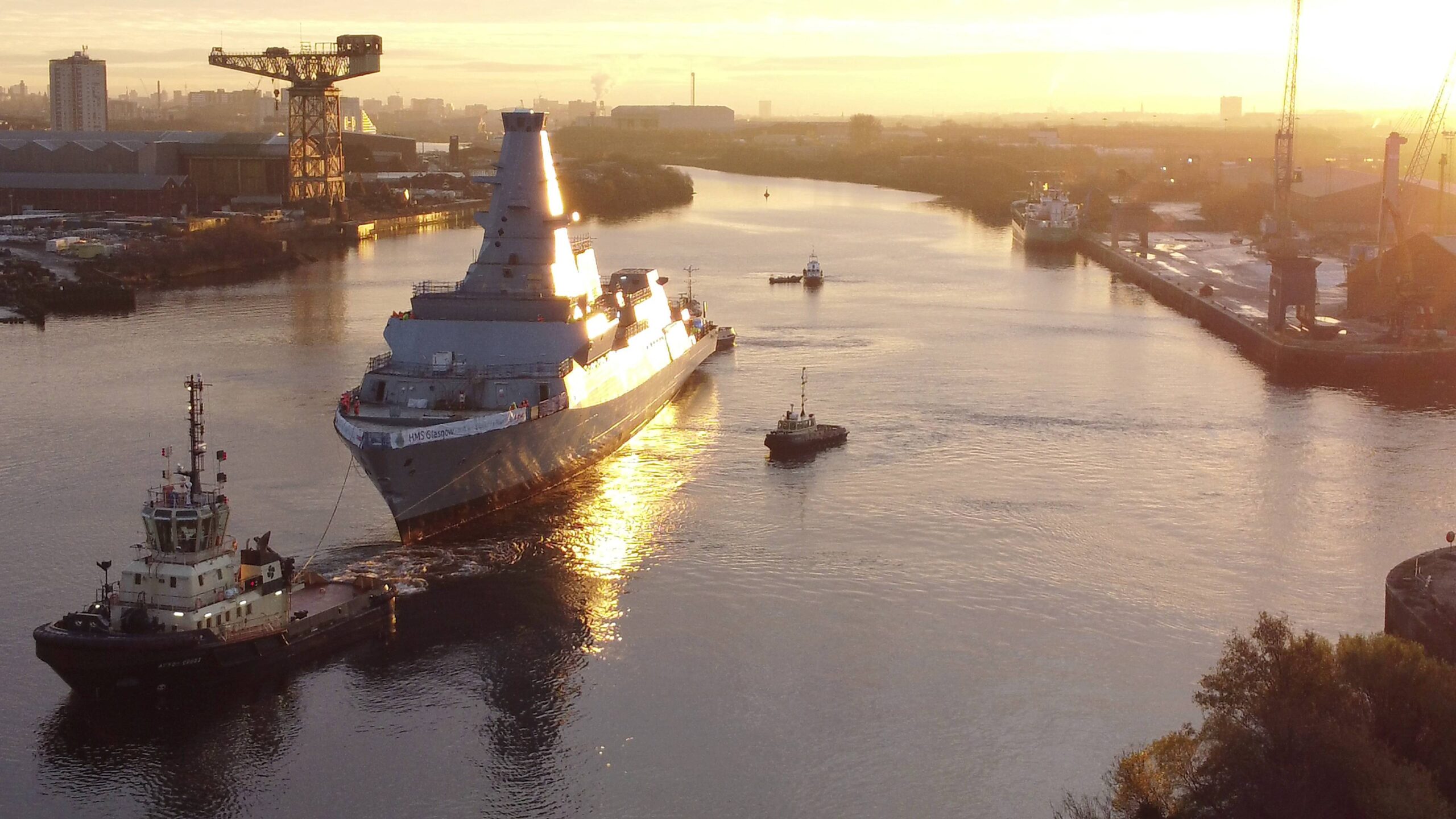
Royal Navy general-purpose frigates will play a central role in the UK’s emerging Atlantic Bastion concept for defending the North Atlantic, according to a written parliamentary answer from Defence Minister Al Carns.
Responding to questions from Labour MP Luke Akehurst, Carns said the ships will continue to provide maritime presence and security tasks while integrating with new autonomous systems. “Within the Atlantic Bastion concept, Royal Navy general-purpose frigates will continue to play an important role in providing maritime presence, patrol, escort and reassurance tasks,” Carns said.
He added that the vessels will also act as adaptable platforms capable of working alongside emerging uncrewed technologies. “[They will] also act as flexible platforms able to integrate with uncrewed systems,” he said.
Carns noted that the scale and pace of capability upgrades associated with the concept have not yet been finalised. “The exact pace and scale of capability enhancements delivered through Atlantic Bastion will be determined through the Defence Investment Plan.”
In response to a separate question from Akehurst on international cooperation, Carns confirmed that the UK has already discussed the concept with several key North Atlantic allies. “The Secretary of State for Defence and First Sea Lord have engaged with counterparts and senior officials from Canada, Norway, Denmark and the Netherlands on the Atlantic Bastion concept,” he said.
These discussions have taken place through bilateral contacts and multilateral forums, including NATO defence ministerial meetings and working groups focused on the North Atlantic.
“The UK will continue to work closely with these Allies to ensure the North Atlantic remains secure and resilient.”


That doesn’t read wuite right? Shouldn’t it be “ASW Frigates”, ie the T23/T26s that will be whats primariy used in the Atlantic Bastion? And “General Purpose frigates”, ie the T31s that will be primarily used for “maritime presence, patrol, escort and reassurance tasks” which sounds very like “non-Atlantic-Bastion” and likely for operations in other regions? If there were a few more T31s ordered maybe they could then be spread more widely.
*quite
At least 5 more frigates are needed.
We need more than one operational now, we look week.
When will all this happen, umm 2031 like every thing else?
Yep that’s probably when they defence investment plan comes out.
Coming up on halfway through March 2026 and despite the new war in the Middle East, nothing about the MoD spending.
Yep it’s pretty shocking all told.
Well, has the RN specified and costed all these new Atlantic Bastion elements yet? And reconciled.the budget figures with all the other things they want, like Proteus helicopters, Dragonfire lasers and whatever else?
Almost certainly not, as most of the transformational weapons sought exist only as concepts so far, with a shedload of staff and development work needed to pit any flesh on the bones.
In which case, how can anyone complete the DIP plan and budget – it must currently have a large AB/RN hole in it?
I think HMG and MOD should just publish the DIP without waiting for the RN’s heap of wished-for transformational capabilities. They can be addressed separately at a later date, when the RN has sorted out what it is pitching for – and the rest of the defence community has a chance to put this whole Atlantic Bastion Maginot line idea under a critical, objective microscope.
You’re acting like the Navy is the one holding up the DIP
Hopefully t31s will have been given some ASW capabilities by then as they currently are slated to be the new Bacchante class and therefore floating coffins as we’ve just seen off the coast of Sri Lanka
I think that is where drones will make the future different..l essentially your capability will be in the drone companions.. the frigate becomes essentially your mother hen and brain. The sword and shield will be the drones… stick your sensors on a couple of drone platforms as well as your kinetic effectors and you frigate essentially is your brains and stores to keep them all running.. your frigate needs to do is hide well, while the drones hunt kill and take the hits. A 21c frigate will not be one ship it will be a small fleet of vessels,
some good points. I’d be concerned that unless the mother hen is sufficiently equipped for defensive and offensive action then she becomes a centre of gravity. The host frigate needs to be a formidable asset and not a sitting duck – especially in the anti-submarine role?
To be honest.. I think air defence is the big one.. ASW work has always been about distributed sensor and kinetic platforms.. you don’t send your frigate to kill an SSN unless you want a dead frigate… what does ASW need..
1) good long range passive sensor capability.. so you know an SSN is in the area.. but that does not need to be on the frigate.. it’s just traditionally you had to have the tail on the frigate.. but why not stick it on a a drone ship it does not reduce the effectiveness of this capability.. infact it makes it more effective as you can have two one can drift and Listen as the other jogs into position ( one of the weaknesses of any ASW frigates listening is when it needs to quickly change position.. it’s why you can’t do ASW and AAW at the same time)
2) fix and track that ability to fix that contact… for this you want multiple sensors and you may need to use active sensors.. you need to move quickly and be closer to the SSN.. if the frigate tried to do this it’s essentially going to kill itself. Which is why small ship flights are core to ASW.
3) kinetic… launching the weapon.. you want to get it there quickly as soon as you have the fix and track part of the kill chain.. again your not sending your frigate.. small ship flights ( drone) are fast and risk free ways of delivering.. or you can use an ASW missile.. but these are all limited 20km range.. and your being attacked yourself if an SSN is within 20km.. so any frigate based ASW kinetic weapon is essentially the ASW version of a CIWS.
Essentially the Drones are the ASW defence of the frigate.. and you could probably make them a more effective defence than a single ASW frigate on its tod would ever have with its own towed array and single small ship flight… those 2 1000-2000 ton companions to a T31 would each have a towed array.. to allow constant loiter.. the T31 and both drones would have small ship flights ( so a medium rotor and 3-4 smaller ASW rotor drones).. that’s well beyond what any single ASW frigate could sustain.
What I would give the T31 it is a hull sonar, as well as some ASW weapons in its future MK41 silos.. just incase it gets ambushed by an electric boat or sub surface drones in enclosed seas…
What I do think is everyone is clicked onto the fact airborne drones now mean attrition air warfare is a thing again.. but they have forgotten that our sub surface kinetic effector are even more geared to very small numbers of high end targets than our AAW systems were ( we expected 10s of missiles.. but we only expect 1-2 submarines).. in a world of attrition sub surface drones we are going to need lots of sub surface effectors for low end sub surface attacks.. ( it would not surprise me if ASW rockets don’t make a comeback on frigates or drones)
For a hull sonar to be particularly useful, they should have at least rafted the primary machinery, especially the diesels. Babcock have said rafting the diesels is a standard option, but not a realistic retrofit option (it needs to be done at build). It should be noted that the IH frigate has a hull sonar & allowance for a towed array. Too much was done to make T31 as cheap as possible & some of it can’t easily be rectified.
In regards to hull sonar I was thinking more active use.. enclosed sea sterilisation etc.. passive is better on your purpose built drone..
I’m a bit unsure why each class has a single operational role, it seems silly that one ship needs another ship if not two to actually carry out it’s task… I think most escorts in Ww2 where a/S with good AA armament and now days they are somewhat bigger….
In WW2 AA just consistented of some extra guns.
Yes Ww2 was very simple… OK mate. Anyone with half a brain will understand what I am talking about.
Clearly you don’t if you think it’s just as easy to install AAW and ASW as it was then
You must be a fucking monkey mate.
Says the man who can’t come up with a single informed rebuke.
They don’t really they have a specialisation which they focus on.. also remember it’s not really possible to do ASW at the same time as AAW..
AAW ships need to dash to potential threat axis.. a ASW frigate spends most of its time loitering and listening..
But they can all support each role… a T45 has an active hull sonar.. it can use to scare a sub away, it can carry a Merlin which can hunt.. a T26 will carry 48 CAMM which can support the AAW screen..
The T31 is a low capacity frigate but what you add to it means it can support various functions.. it can operate a Merlin to support the ASW screen it has some CAMM and a good 3D radar.. it has lots of AAW guns for drones…
But if you try to make a high end ASW and AAW ship you will end up with HMS massive and a 2 billion bill.. the AAW element will require a massive hull for the big radar and deep magazines, it will need a high dash speed and lots of power for the radar.. that a very big expensive hull and system.. the ASW ship then wants electric drives for slow quite loiter and more power for that.. making the hull even bigger.. you then for ASW work need the massive machine space ( with its 3 drive systems, massive power generators) all rafted ( more weight and expense and finally you want to tile and quite that HMS massive hull… what you get is the beast the Italians are building two of 14,000 ASW/AAW cruisers… but even that cannot do AAW and ASW at the same time… because it needs to loiter for ASW and dash around for AAW…
Most ships have a mixed capability but do:
1) one thing well and the second not very well
2) both things OK
The Burkes are a classic example the US runs the Burkes to do everything as a multipurpose destroyer.. but it’s well recognised they are great AAW and ASuW platforms but utterly shite at ASW….
Great posts Jonathan. Just thinking with these 6 solo CAMM farms. Not exactly sure how big or heavy they are individually but if they joined two together into a bigger block, may the size of a 20′ container they could could get another 3 shots for 15, x 4 = 60. Or if they “milk crate” the design maybe could get 9-12 in the same footprint print. And if they go high cube they could get the CAMM-ER. Leaving mk41s for other missiles and not needing the ExLS. There’s got to be some potential here to evolve this farm design. The 4×6 for 24 on the T45s could have been even more, making the 6s into 8s for 32 for an 80 shot load all up.
Probably worth adding the context of the question
“To ask the Secretary of State for Defence, what role general-purpose frigates within the Royal Navy will have following the development of the Atlantic Bastion concept.”
The full response was
“Within the Atlantic Bastion concept, Royal Navy general‑purpose frigates will continue to play an important role in providing maritime presence, patrol, escort and reassurance tasks, while also acting as flexible platforms able to integrate with uncrewed systems. The exact pace and scale of capability enhancements delivered through Atlantic Bastion will be determined through the Defence Investment Plan.
The Secretary of State for Defence and First Sea Lord have engaged with counterparts and senior officials from Canada, Norway, Denmark and the Netherlands on the Atlantic Bastion concept through a range of bilateral and multilateral forums, including NATO Defence Ministerial meetings and North Atlantic-focused working groups. The UK will continue to work closely with these Allies to ensure the North Atlantic remains secure and resilient.”
The question was by a Labour MP.. which means it’s a friendly question, so the government wanted the role of the the GP frigate highlighted as valid in the Atlantic bastion concept.
So what I take from it…
1) Presence, clearly they have started to recognise that you cannot just fill up the Atlantic with a load of autonomous platforms without Presence..and presence means a frigate with a crew, a small ship flight, a commanding officer who can make decisions on the spot etc.
2) escort.. there would need to be some form of escort capability in Atlantic bastion again that needs a crewed platform…
3) reassurance.. I suspect this means they acknowledge that human beings will not psychologically see autonomous platforms in the same way as a crewed major surface combatant .. and I think you can flip this coin because the other side of reassurance is deterrence.. and I suspect they really mean deterrent when they say reassurance.
So I think from the the MOD many just be acknowledging that a physical presence major surface combatant.. that is not an ASW combatant may be a requirement component of a group of ASW drones..
Could it be that autonomous drones are actually the end of the need for high end ASW and AAW platforms in large numbers.. and the future is a cheap as chips large GP mother hen frigate… to guard and control the Drones that do the AAW and ASW…
It would be interesting because in the future maybe that frigates role is sculpted not so much on the systems it has but on the drones it’s paired up with, the drone control centre you pop in its mission bay and the specific expertise you add to the crew.. yes you would still want a few specific specialists as the centre piece of your CBG or amphibious group AAW screen or ASW screen.. but the bulk of your crewed escorts and surface groups become mother hens..
More and more you can see a world in which a T31 type escort becomes the normal..
1) heavy gun armament to manage all the huge numbers of airborne drones
2) a big mission bay to take whatever drone command and control you need as well as take some small drones for littoral work.
3) a small crew that you add specialists to depending on the drone ships it’s paired with.
4) specialist capabilities held within the drones that accompany it.
Clever monkeys would be looking at these drone companions to be large enough to have a flight deck for a medium rotor, bridge and some crew accommodation so you can have an optional 5-10 crew.. allowing traditional patrol and monitoring functions as well as easy repair and foreign port visits, that would mean mother hen T31 in normal times can just be in the region and not actually holding its hand within the radar horizon at all times.
The final interesting point is the purposeful mention of allies even through that was not in the question.. this was information added to the response for the purpose of adding it into the formal response ( this is always done with purpose ) or more importantly allies not mentioned. As a NATO activity around securing the Atlantic traditionally you would expect such a comment to include all NATO allies.. but no only specific Nations Canada, Norway, Denmark and the Netherlands.. not France and the US.. that is more than interesting as it tells of geostrategic split within NATO even on concept developments as something as fundamentally important as security of the Atlantic.. this is following a theme we are seeing in NATO the U.S. going off verbally attacking NATO nations, going off on its own to attack who the hell it wants across the globe and Europe not following.. France throwing essentially its entire navy into the eastern med and western Indian Ocean to really flex its muscles in that region without any regard for the fact it will not have any operational ships in the Atlantic or high north region, Italy very clearly telling everyone that will listen its a meditation navy..
So that little message there tells me Canada, Norway, Denmark, Netherlands and the UK are starting to feel that the high north may be their ball to sort out and others may not play well.. the US has clearly said it’s doing what the hell it wants and screw everyone, France has shown its main priority will alway be the med, Africa and the Middle East. Italy is staying home, Spain is simply not playing and who knows with Germany.. but I think their intergenerational European land war trauma has been triggered a bit.. so they may just do a turtle by building a big army and airforce, very much the same with Poland… so I don’t think we are getting much deep Co-operation from anyone apart from Canada the Dutch and Vikings when it comes to securing our seas.
Best analysis I’ve seen on here for a long time!
Chapeau.
Which makes more sense of the Mk41 comment wrt USN the other day.
Senior USN will be worried that not bottling up The Bear would be a major mistake so I’m pretty sure that USN will be helping out in any way they can to see RN regenerate.
Yep I agree, the USN have a lot of MK41 silos as their number of platforms reduces.. if you can flog them to an ally even MAGA dogma politics will allow the USN to do that.
May also be the units ordered for the Cancellation Class frigates….
Full strike length won’t fit into the coast guard cutters as the hull isn’t big enough.
I doubt wonder why MoD are being so coy about this…..what is fitted to T31 will be obvious from the first time they are noted alongside.
I saw it slightly differently, but your reading may well be correct. I read it as: despite Atlantic Bastion, there will still be a role for presence frigates and motherships. In other words: elsewhere.
Hi Jon, for me it was the “ Within the Atlantic Bastion concept, Royal Navy general‑purpose frigates will continue to play an important role in providing maritime presence, patrol, escort and reassurance tasks“ essential the “Within” shows its very much part of the concept of the bastion and not external to it.
I think we may see a profound change in focus to the RN as a profoundly Atlantic and high north navy.. with its east of suez presence being SSNs and 2 yearly CBG.. we will need to see how the Middle East shakes out.. the RN can no longer be everywhere and now all the key oceans are becoming equally deadly and geostrategically risky.. I’m not sure we are in a world you can play low level presence anymore, unless it’s in your own or a close allies EEZ.
I think the low level presence mission i.e B2 River class only makes sense in the Falklands, South Pacific and UK territorial waters. Everything else needs air and missile defence which means a T31 or better.
I just wonder whether the RN is treating AB as their over-arching strategy for the next two decades, and so, every piece must fit within that strategy, whether they intend to field those pieces in the North Atlantic or not.
Yes it would be cogent with how the RN essentially operated in the 70s and 80s.. everything had its core purpose as part of fighting the Soviet Union in the north and Atlantic.. but with an eye to wider global deployment options so it was still there.
In the end if your going to take the fight into the high north you need a carrier battle group and an amphibious group with high end AAW ASW and SSNs.. but that same capability means you can turn up in a peer war anywhere on the planet..
For the wider Atlantic bastion you need a lot of escorts and ASW presence vessels.. but at the same time these can be used for supporting keeping any shipping lane anywhere open if needed.
That was what I was thinking too. Not just strategy, but budget. So expect to see T31s budgetted for in AB.
Yeah, this is what I gathered. Atlantic Bastion is a static system at its core, and so deployments beyond the North Atlantic will require conventional frigates to cover, be they air defence or anti-submarine focussed.
Great post and reading here mate.
Very good analysis.
I would point out that Canada’s naval/air defence focus has switched from North Atlantic to also now include Pacific and Arctic Oceans now.
Yep we have to remember the high north is connected to the Pacific as well as the Atlantic and Russia is an Atlantic pacific power.
My problem with this is it’s all very well imagining lots of small drones controlled by a mother hen frigate but then answer the question – how do the drones get there?
They need power which means they need fuel, there’s no plans to build RFAs and I don’t think anyone has done a RAS with a drone in the middle of the north atlantic anyway.
So your drones are actually going to have to be big enough to carry that fuel.
Okay so now you have a reasonably sized drone.
Then we need sensors to detect what we’re going to engage – you can put the sensors on another drone.
Okay so now we have 2 drones with two lots of fuel and engines and controls and a mother hen frigate okay then we need air defence so we now have 3 sets of engines/hulls/fuel….. then one of them breaks or malfunctions and doesn’t have a crew to repair it or it starts leaking and sinks because there’s noone there to do damage control (not to mention enemy action)
Eventually the sensible option seems to me to be to put all the systems on one hull just to save money on engines running all the different drones.
Why we aren’t putting towed arrays on the GP frigates is beyond me at least they’d have a decent chance at detecting a submarine.
I suspect there will be a face saving order of 3 more T31s (as it seems the T32 is a nebulous political concept that never really existed), I think that’s reasonable but I wish they had more kit on them….
Personally they really need to replace the T26 orders that are going to Norway (chances of that happening are minimal).
Plus the Type 45 is due to go out of service in about 10 years so we need to get on with ordering replacements if we’re not going to be “oh what a surprise our ships are old” and falling apart again, although it seems that we’re spending alot of money upgrading them so that may not happen.
Yep that’s why I’m not a fan of Mickey Mouse drones ideas.. if your building a mixed fleet you need to get serious about the drones… 1000-2000 tons 80-90 meters ( essentially the same size as rivers 1- rivers 2) .. you will want to be able to operate these with an optional crew (say 10) who will essentially keep an eye on the drone and do anything that needs a person to do.. with a flight deck to rotate them on and off.. essentially the drone can act independently with a small crew or be the down threat capability if the crew are taken off…
Interesting article. Expectation management for the DIP. I interpret the response to mean that going forward, T31 will be the ‘workhorse’ of the RN. Arrowhead 140 is a generous sized hull. It looks like the vision of ‘GP’ is to exploit T31 for multiple roles; patrol frigate, escort, Bastion drone co-ordinator. The weapons fit, crew and mission bay configuration will be selected per the deployment. The only ‘fixtures’ will be the guns and Mk41s. The roles might even stretch to mini MRSS if we decide we don’t want an Ellida or big ‘strike’ LPD.
A follow on order for Babcock looks very likely – at least 3 – specification tba.
3 more T31 and don’t replace the 3 T26 going to Norway? The Treasury would like that.
Creative thinking 👏. I believe current statements confirm 8 for the RN but your approach would enable the Treasury to defer and smooth spending so they would be attracted to the idea. No loss of Atlantic ASW capability, spend management, partnership with Norway, Babcock follow on order….what’s not to like?
I don’t like the loss of 3 top of the range Type 26 frigates for the RN leaving us in effect unable to escort the carriers without stripping the U.K. at times of any high end ASW frigates. One at least needs to be around to protecting the deterrent so it’s quite simple to understand – Anything that might be attractive to the Treasury will almost always be detrimental to actual real world U.K. defence requirements.
I am all for a follow Type 31 order of 3 to 5 vessels and ideally another couple of Type 26’s. Our need is for 30 escorts with drones etc supplementing that still very low number.
Pretty definite the Norway ‘sacrifice’ and the Babcock follow on order will happen. After that who knows. I’m no expert but agree the 30 escorts number sounds a good target.
What’s not to like is that those ships are not available if we need them. Yes they’re a NATO ally but I really can’t see Norway being keen to send a warship to fight around Cyprus or to the Falklands or elsewhere in a hot war if needed.
Yep.. to be honest we have a ship built who can crack out a 7000 ton frigate per year.. to me it’s a no brainier that the MOD should simply build 1 a year till 2040.. for 15 GP Drone mother frigates, 8 ASW frigates for battle groups and 6 destroyers for battle groups.. it’s not quite 32 destroyers and frigates.. but it would be a profoundly impressive surface fleet.
I’m not even sure you need M41 launchers on a lot of them.. 36 CAMM in basic mushroom farms, 8 NSMs deck launched.. big mission bay for small drones and drone command centre.. big flight deck… maybe give some a thin line tail. But essentially what you pair them with large drone wise will give you the capability.. mid Atlantic 2 ASW drones etc…
I think some celebration and handing out of kudos will be in order when Venturer is handed to the RN. The selection of Arrowhead, the acquiring of intellectual property, the assignment of contract to Babcock, mods to RN standards, tight budgeting show persistence in a vision, and prudent and competent program decision making. I believe there is the cross party will to increase the size of the navy. The affordable and ( I hate to say :-)) adaptable T31 makes that possible. Good post by Frank62 elsewhere re wargaming which suggests that 30 Camm is the minimum. No co-incidence that the T23s got 32 cells.
I like the sound of this proposal with the rotatating Caririer availability a strong Fleet Air Arm plus appropriate number of SSN,s. Inclusive of the Docking & Maintenance network/facilities required to keep the Fleet at high readiness. This would put the Royal Navy in great shape for late 2030’s/40’s. Hopefully 1SL has a similar vision, I hear he is a tough bugger and is uncompromising more than enough to deal the Starmer-Reeves-Healy Goon show.
While drones are vital for MCM they are limited in their ASW capabilities. The purpose of an ASW platform is primarily to tow a large sonar and provide sufficient compute and power to make it functional.
Anything powerful enough to do that will be large and expensive and if it’s large and expensive and operating thousands of miles away in hostile conditions then it needs to be manned. If it’s also armed then you basically built a frigate.
T26 is expensive though. The UK needs a new tier of frigate between T26 (which is more like a destroyer) and a T31. Something like the T32 designed to operate more drones than a T31 but have less guns and less missiles. It should have the same noise reduction capability as the Polish version of arrowhead 140 and the ability to operate CAPTAS 2 sonar. The perfect vessel for operating in the North Sea and Atlantic as part of NATO maritime groups.
The royal navy operating three frigates at the same time (T23,T22,T21) was pretty standard until recently.
Atlantic Bastion should focus on large arrays of cheap sea gliders as well as fixed sea bed sensors. Any drones should probably be operated as part of a task group with some form of mother ship (T32).
Type 32 should be funded in the DIP even if it’s at the expense of the MRSS.
T26 is much closer to a direct T22 replacement that for what T23 was intended to be, in terms of flexibility and capability.
Perhaps T92 will fill the gap in the dedicated TA tug role?
This is the thing we catch all the term drone.. but that’s not the case there will be small drones 10-15 meters that you stick in a ships mission bay or use as local sea denial or even as a one way strike platform and then there will be the big ocean going drones that essentially have some of the capability of a frigate.. these are going to be in the 1000-2000 ton range.. will need a flight deck to land a medium rotor on and will need some sort of bridge any crew facility ( 5-10 ) to allow for maintenance and even port visits etc..
There will be a sweet spot in the 40-60m (SWATH) or 60-80m (monohull) range for ASW that unmanned has endurance far exceeding what a manned warship would be capable of and is far cheaper than an equivalent manned ASW ship, but still has the power to pull a CAPTAS-4 sized sonar. That’s what T92 should aim for.
AAW is a whole different game and I’m not sure T91 is worth it, better to carry the missiles on upgraded T31s and eke out as many T83 as possible.
A 80 meter monohull between 1000-2000 tons is a good place to be you can do a lot with that….
We already do, until they are retired in a couple of years.
Jim you are correct about the cost of the Type 26 but the specification is high end ASW for a reason but if the build times could be brought down then the cost per unit could be significantly reduced. Another design would incur substantial design costs and go through the extensive MOD gateway approval process that takes years. We would actually better at throwing some money at speeding up delivery of what we already have designed, which will enable us to get frigate numbers back up to where they need to be.
I am with you on the large ocean going drones as I believe they will be very expensive to deliver (it is the MOD after all) because of the R&D required to develop the cutting edge tech to ensure the extensive automation and other systems function in a very hostile environment. Any savings will be (operational costs);in manpower but in my lifetime they require a crew of a dozen or so is my expectation. We can therefore eventually expect some very expensive, large, underarmed vessels lacking complex sensors in very small numbers. I would have another 2 Type 26s and 5 Type 31s rather than chasing something at the end of a tech rainbow, which I don’t think is mature enough for what we need in the next two decades.
As for funding the Type 32 by scrapping the MRSS you are following the MOD playbook by promising jam tomorrow and in effect by trying to closing one gap just maintaining another. That logic has to stop.
Exactly this obsession with drones is going to result in nonsense, the only area I can definitely see it being a good idea is from a mothership for minehunting.
Scrapping the MRSS would be a disaster they’re already being asked to replace Argus, the Bays, the Fleet support ships and the Assault ships if anything we need to build more of them, I can’t see how the current number will be enough for everything they’re asked to do.
More T26s and T31s would be a start.
We also need to begin to look at the Type 83 as a replacement for the T45 which is due to go out of service in a decade.
Also get the dreadnoughts built and continue with our commitment to AUKUS, with a decent contingency for AUK if the US does the dirty on us and Australia….
Oh I forgot they also need to finally decide what they’re going to do in terms of replacing Crowsnest or not or the carriers will be left without an AEW.
More to that there’s still no AEW in the RAF, I’d love to see the extra 2 radars on aircraft so we were up to 5 E7s, matching Turkey’s capability and potentially enablying a couple to deploy abroad if needed – e.g. cyprus….
Then there’s antiballistic missile capabilty still not clear what’s happening for land bases ABM – so it will either be a new indigenous system (unlikely), israeli (unlikely) or Patriot (reasonably unlikely) or SAMP/T (probably the least unlikely of all of them – would mesh with the RNs sea viper but there are missile supply issues).
Plus the Army need an IFV – likely boxer and some replacements for the AS90.
A development of stormshadow to rival the range and hitting power of taurus would likely be a good idea (but unlikely to happen I think)
Now what do I think will happen?
No new jets for the RAF – possibly the F35As that were promised earlier (not sure why we’re getting those)….
Ballistic missile system will be kicked down the road.
No new AEW (probably vague promises about a drone capability)
Probably 3 Type 31s.
IFV whatever’s cheapest….
Yes all very interesting reading and I think probably on the right lines now the T31 have been mentioned more and more recently so hopefully we will get a few more but where that leaves MRSS I don’t know all will be revealed one day when the DIP actually appears!
I have a feeling we will all be disappointed in the clarity the DIP will bring to things if and when it is published. It’s not like this lot to commit to anything.
Im trying not to be cynical, but my fear is that it will be something along the lines of ‘yes, we’ll do stuff when funds are available and this is the sort of thing we will look at until we aren’t.’
Ha sadly you may be correct but they are all as bad as each which is why we have a perfect storm now with the frigate disaster looming!
I am rather sceptical about this whole Atlantic Bastion concept. Not convinced that a naval Maginot line is militarily sensible.
The main threat in the North Atlantic is a submarine one. Russia has little in the way of a surface fleet and Chinese ships will not appear in large numbers while the US Pacific Fleet squares up to them.
To defeat submarines requires.primarily ASW frigates. An RN ASW squadron of 4 would be enough to cover half the GIUKN gap, a Euro squadron.from Germany, Netherlands, Denmark, Norway could cover the other half.
By all means, add to the capability with seabed sensors and little unmanned craft, particularly if they have the kinetic ability to shoot down drones or torpedo enemy subs. But I doubt that the small boats envisaged will be able to pack much punch. I also think that the UUV is likely a non-starter: chugging along beliw the waves at 4 or 5 kts is not going to be much use against an enemy sub.
However much is made of the T31, it is basically flawed in having about zero ASW capability. No hull-mounted sonar, no TAS and audible from miles away, due to having no machinery rafting or noise-reduction measures. All very well to talk about it being a drone mothership, but not when it gets itself sunk by enemy subs, because it will be a juicy target.
I have a jaundiced feeling, very likely unjustified, that the RN is proposing Atlantic Bastion and its fleet of small unmanned boats in the North Atlantic, in order to relieve its T26s and T45s of that tedious duty and instead go on patrolling the world’s distant oceans.
I cannot see any role at all for a carrier strike group in the North Atlantic, not really anything to strike unless we are going for the Russian fleet at Murmansk. (Which would require a lot more than two dozen F-35bs and the ability to do more than drop bombs, which rules it out until Block 4 some 7 or 8 years away).
Type 31 has the same signiture mitigation measures as the danish ships. Nothing like the type 26 obviously, but likely no noisier than other diesal or gas turbine powered ships such as the french fti or the arleigh burkes both of which haveva reasonably capable ability. The type 31 has also been designed with the space loadings and margins for the fitting of a captass sonar in the future.
Better the use of USVs than a seabed sensor array to avoid being a Maginot Line, as you put it. Having the flexibility of redeploying individual vessels means that the whole ‘bastion’ can retreat and advance depending on the circumstances. As Jonathan explained above, USVs are particularly useful for ASW because a) having multiple platforms is key for multistatic sensors, to try and localise the submarine, b) unmanned platforms can take more risks wrt using active sonar where using a frigate for the same job would put the crew at risk and c) the absolute priority is getting as many sonar arrays as possible to sea, and the extra capability of the frigate as a Merlin platform isn’t required in the same numbers.
I also think you are mischaracterising the USVs that will make up Atlantic Bastion, if it goes ahead. To carry a useful towed array and operate in North Atlantic conditions they will have to be large, heavily built vessels. The type I forecast will prove to be most effective is a scaled-down doctrinal equivalent of the US SURTASS ships, carrying a CAPTAS-4 sized array. That would be a 40-50m SWATH catamaran, displacing hundreds of tonnes. Though I do agree that short of huge leaps in communications tech, XLUUVs will be limited to minelaying and covert ISR for the near future.
For the carrier group, the main attribute would be to operate and maintain lots of a) Merlin or b, possibly) Protector STOL to give lots of ASW air power to a surrounding group of USVs and frigates. MQ9B in particular would allow weapons carriage and sonobuoy dropping over a vast area of ocean, the mission radius is vast. The F35Bs would do what the Harrier did in the Cold War, provide air cover in case any TU95s get nosey.
Cripes.
Just a gentle reminder that in the Cold War RN Carriers, such as Ark Royal, indeed had a Strike role, in the 70s, going after the Kola in conjunction with USN Carriers.
Seen documents released by the NRO showing these plans.
So no reason why that would not be the case now.
Also, the QEC carries out the Invincibles role of carrying a Merlin ASW Squadron, so very much a lillypad for ASW operations as well as being able to go off and do the expeditionary thing.
Then you have the ASCS element.
Such is a Carriers flexibility, they are sea denial assets after all.
So I myself very much see a QEC at the heart of the T26s and other autonomous stuff.
Remember we have 5 type 31s on order, the government seem to think we have 10 to 15 with all they’ll do when they come onto service