

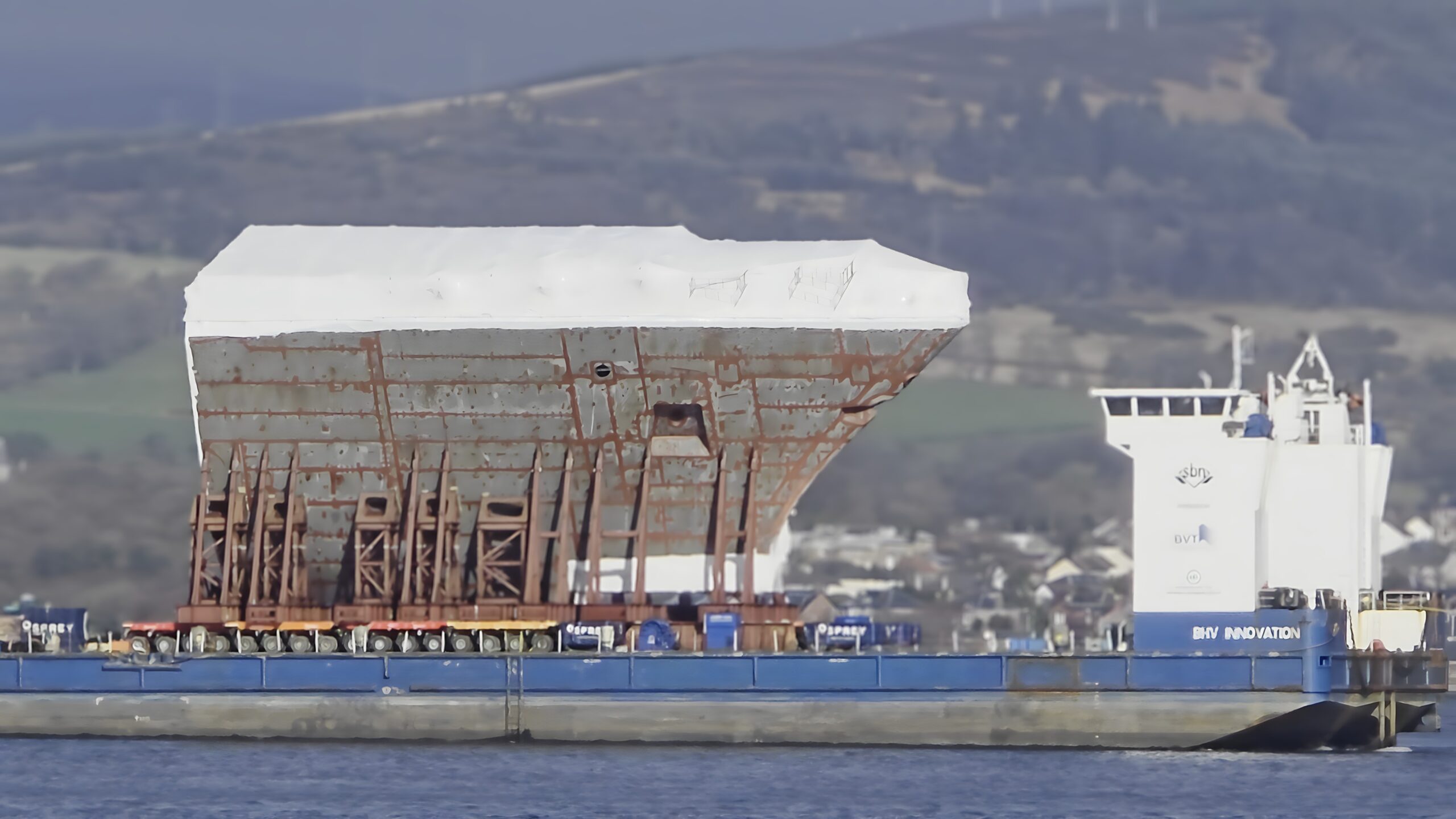
The bow section of future frigate HMS Birmingham has arrived on the River Clyde ahead of final assembly in Glasgow.
The large steel structure, which forms the forward section of the ship’s hull, was transported by sea from Cammell Laird in Birkenhead, one of several UK shipyards manufacturing major blocks for the Type 26 frigate programme.
Under the programme’s modular construction approach, large sections of each ship are built at different facilities around the UK before being transported to BAE Systems’ shipyard on the Clyde for final integration and assembly. Once lifted into position inside the company’s build hall at Govan, the bow block will be joined with the rest of the ship’s growing structure. From there, additional modules will continue to be added as the hull gradually takes shape.
The distributed build model is intended to allow work to continue on several vessels at once, with different shipyards producing major sections in parallel while assembly takes place in Glasgow. HMS Birmingham is the fourth Type 26 frigate under construction for the Royal Navy and follows HMS Glasgow, HMS Cardiff and HMS Belfast in the build sequence.
The Type 26 is being designed primarily for anti-submarine warfare, with a focus on acoustic quieting, endurance and advanced sensors. The ships are intended to escort carrier strike groups and track submarines in the North Atlantic and other operating areas.
While the arrival of a single hull section may appear a routine step in construction, it reflects the wider industrial effort behind the programme, with shipyards, suppliers and engineering teams across the UK contributing to the build of each vessel. Over the coming months at Govan, the structure of HMS Birmingham will continue to grow as further modules are integrated, gradually forming the Royal Navy’s next-generation frigate.






Good to see this, we are much better focusing on one or two assembly facilities with competitive block assembly at yards all around the country.
Costs more to build in bits scattered across the country which is why other countries don’t do it.
Some other countries do it. The original Iver Huitfeldts were built in blocks in the Baltics, then assembled and fitted out in Denmark. Cost comparisons are less relevant if you have no practical choice.
You do have a practical choice with a big yard like H&W or Rosyth.
H&W will have an idealised linear layout – which will be much more efficient than moving blocks around.
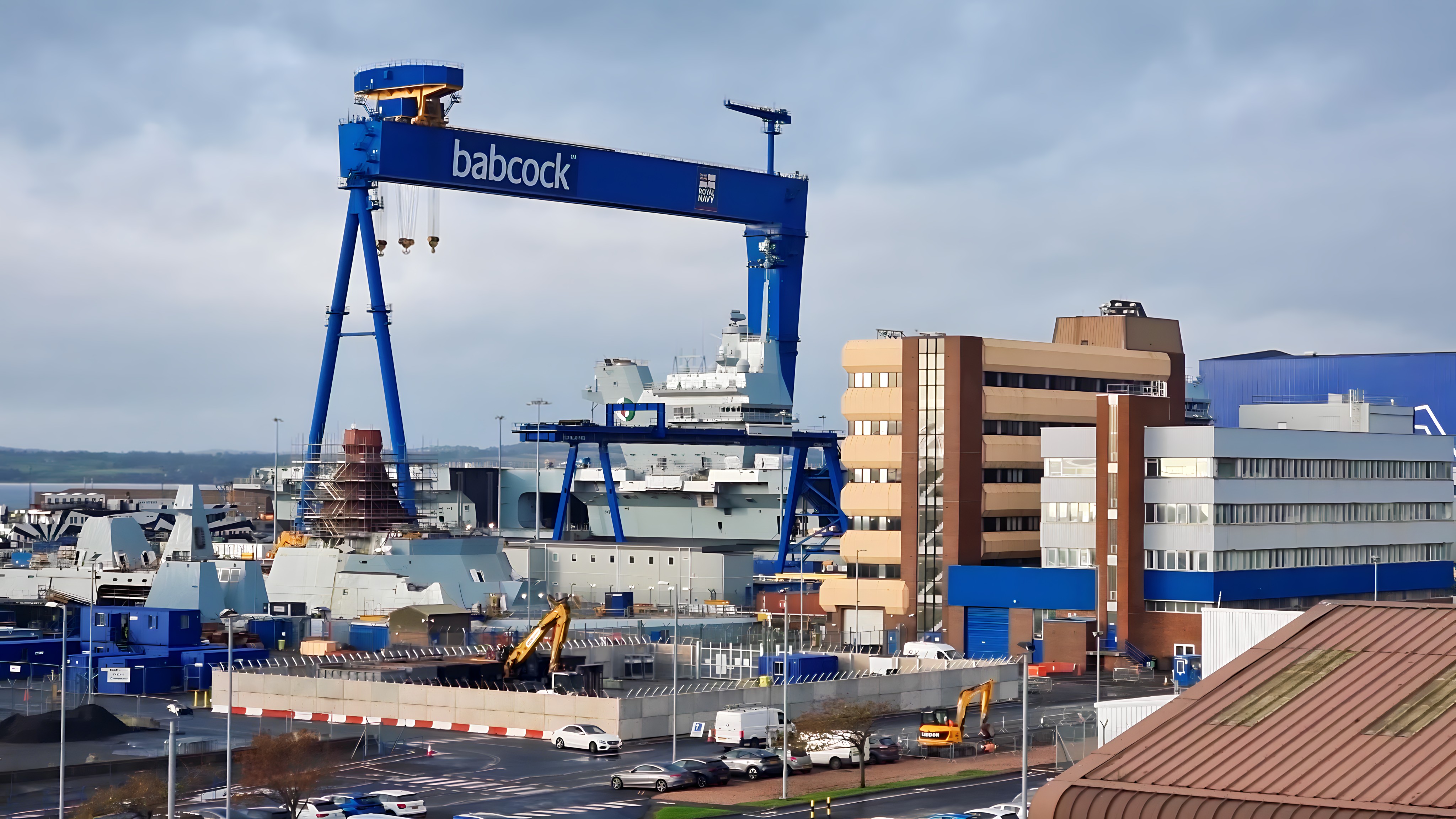
BAES didn’t invest early enough and so have to do things this way.
Building blocks made a lot of sense for QEC as there were plenty of yards that could contribute skilled labour – now those have been shuttered etc – and each block was a corvette’s worth of work.
BAE wanted to build a frigate factory on the Clyde. As usual HMG decided to cheap out and not support it.
BAE is not publicly owned, it’s a PLC worth billions – should it not build its own facility then bid for the work of its cheaper??
That’s how it works in the rest of the economy
BAE sort of got the Hump when their expectation of 13 Type 26’s being ordered was cut to 8,the Frigate Factory was concieved on the basis of 13,so it too was cancelled.As Babcocks joined the Frigate Building Club, and was prepared to Build it’s own New Facilities .this sort of forced BAE’s Hand and they followed suit.The result of which is more Orders.
Still no official announcement as to whether Birmingham will be transferred to Norway.
Given the state of the RN we’d be mad to. Every vessel in build needs to go straight to the RN
The Terms and Conditions of the Deal with Norway will likely dictate this to be the case. No Ships for Norway = no Deal. Extra numbers ordered should improve efficiency for all of the Builds, which is a win win for everyone.
the deal with Norway is contingent on delivery of 2 frigates by 2030. that requirement is high on Norway’s list of demands.
UK needs them more.
Not if the UK wants to remain a credible partner/supplier
UK signed a contract with Norway as well as other bilateral defense agreements.
Of course flushing these down the toilet is an option, but probably not wise in the long run.
I am sure others will be happy to pick up the slack
More than likely she will be one of the Norway builds, leading to a prolonged capability holiday for the RN.
It’s good to see these incremental progress updates. They remind us to keep focussed on the prize, a fleet of brand new frigates. I’m looking forward to seeing news of Glasgow and Venturer sea trials replace the stream of dispiriting T23 retirement news.
Increasing 45 availability and PIP progress is heartening!
Yes. My reading of how agressive the recent series of T23 retirements has been is that the RN are confident Glasgow and Venturer will complete contractor trials and be in RN hands this year. Fitting out for Cardiff and Active should be faster than first in class. If we can eke out the remaining T23s things could look a lot different by the end of the year.
How long between ‘in RN hands’ and operational?
Dunno. Best ask the experts. I think there have been RN crew on board both ships for some time during construction. Good planning by the navy 👍
No chance, I am afraid.
Type 45’s availability pre and post PIP is still poor, only HMS Duncan is yet to have it done.
T45 have never bee good ships compared to the earlier T42’s who could undertake back to back deployments without any major issues. T45’s from day one have had issues and will continue to do so. Overall whilst the fighting system is state of the art, the rest of the platforms is far too unreliable to support it. They need replacing ASAP with something more up to the task.
People in general are now talking about the state of the Royal Navy in such a way as to acknowledge it requires urgent budget improvements. One possible way forward could be a national contract to ensure, by act of parliament, a new capital fighting ship is ordered every two years, regardless of which party is in power. The type of ship could vary depending on RN needs, but built it would be. The guarantee of a 24-month order would allow a constant feed to UK shipyards and maintain a stream of new vessels without large gaps in skills and experience for yard employees and new kit for navy crews.
Exactly what the shipbuilding strategy advised 10 years ago, in the meantime we’ve spent around £100 billion on illegal migrants! Oh what a fleet we could have bought with that!
Don’t care, as this will be going to Norway.
That’s why I feel it needs to be an Act of Parliament. That way the law would hopefully ensure a 24-month cycle, and with a year to eighteen-month overlap in commissions, it would quickly build up ship stock. Mind, more aspects of defence procurement should be covered by an act.
A percentage of social spending (NHS, Welfare, etc).
Only half joking.
Fixed percentage.
Nice to see it arriving but it kind of feels like calling it a huge section means we have forgotten seeing the lower blocks from the QECs being delivered when they were around 8000 tons each, i.e. the displacement of an entire Type-26 and there were multiple ones of them. Now they could genuinely be called huge.
Looking at it from a ‘glass half full’ perspective (unlike some others), it’s good to see other British yards getting work for this programme AND, if it means we ‘take one for the team’ (i.e., NATO) and one of our Type 26s goes to Norway, that’s OK too because, whether it means it’s a Norwegian or a British crew, it still means that a new NATO ship is still going to be available for deployment.
Not sure about that as the new fleet solid support ships are being built in Cádiz, Spain Appledore England, Belfast with final assembly in H&W and that will be for all three with Belfast get more from ship 2 onwards as Navantia UK have modernized their facilities to take on more work.