

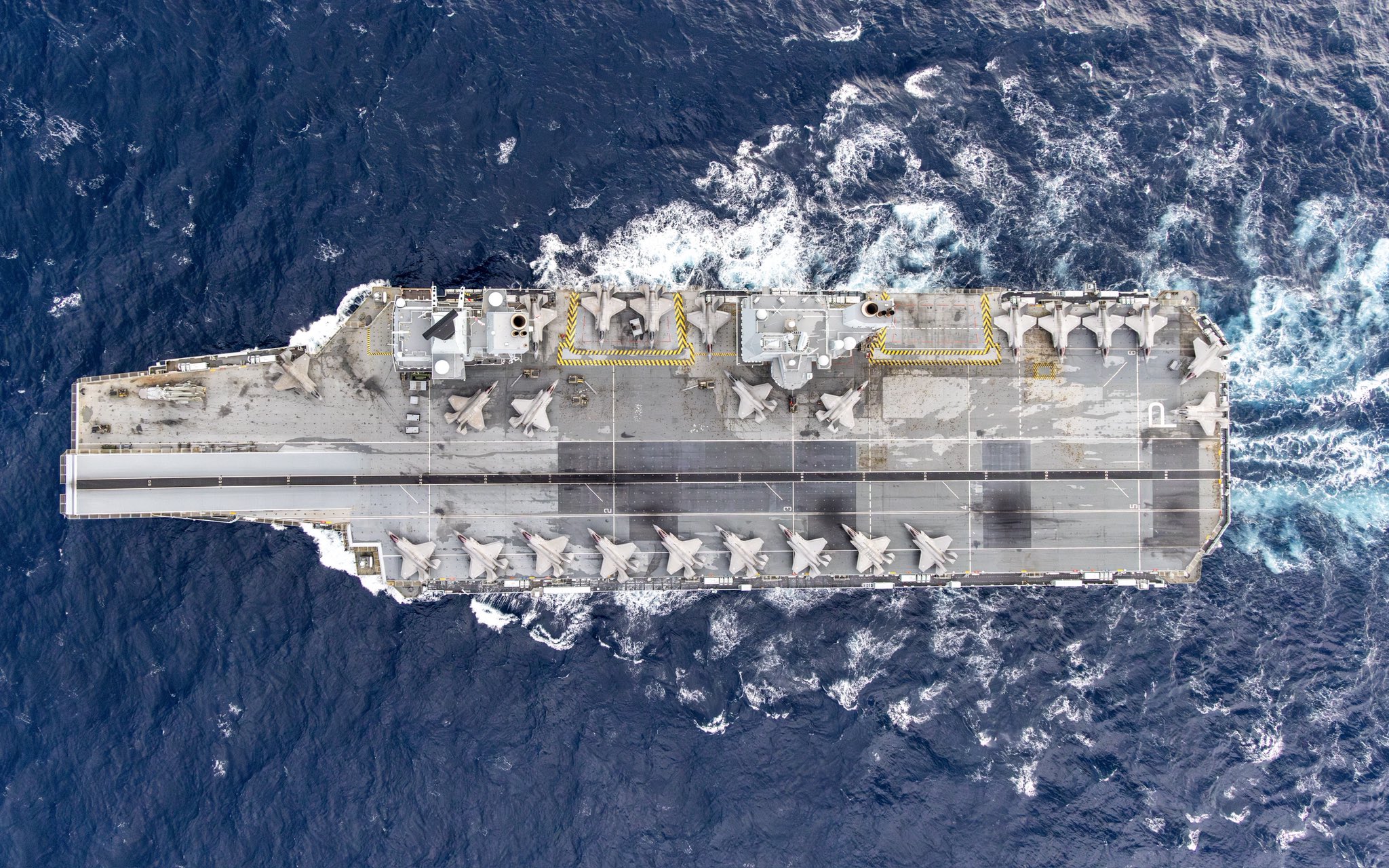
The UK has deployed the largest number of F-35B Lightning jets ever embarked on a British aircraft carrier as HMS Prince of Wales led the UK Carrier Strike Group in the Mediterranean.
According to the Royal Navy, 24 British F-35Bs were aboard this month, the highest number of fifth-generation fighters ever assembled on either of the UK’s Queen Elizabeth-class ships. This was also the largest number of fifth-generation combat jets put to sea anywhere in the world.
The aircraft trained alongside Italian, US and Greek forces in complex day and night missions designed to improve NATO’s combined air and maritime combat capability.

Commodore James Blackmore, Commander of the Carrier Strike Group, said the deployment marked a significant milestone.
“The upcoming exercises with NATO allies will be a real demonstration of the warfighting readiness of the UK Carrier Strike Group,” he said. “This eight-month deployment, covering over 26,000 nautical miles and engaging with 40 nations, reinforces the UK’s position as a leading European power delivering fifth-generation aircraft and carrier capabilities to NATO.”
The strike group’s return to the Mediterranean follows five months of operations in the Indo-Pacific as part of Operation Highmast, a global deployment designed to demonstrate British reach and reinforce alliances across multiple regions. Italian frigate ITS Luigi Rizzo had joined the group for the latest phase, alongside Norwegian and British warships, bringing the combined force to around 4,000 personnel.
The UK Carrier Air Wing is operating in support of @NATO on #NeptuneStrike. The largest 5th generation Carrier Air Wing remains ready to act to defend and protect our Allies and Partners.#CSG25 #StrongerTogether pic.twitter.com/Q8nPmpO1Sw
— UK Carrier Strike Group (@COMUKCSG) November 22, 2025
During a recent stop in Souda Bay, Crete, command of Prince of Wales passed from Captain Will Blackett to Captain Ben Power. Supporting ships include Type 23 frigate HMS Richmond, which has conducted anti-submarine warfare exercises with the Greek Navy, and Type 45 destroyer HMS Dauntless, which held a remembrance service at the Commonwealth Graves site in Crete.





Huzzah!
I noticed that you can’t land on while that port-side sponson is being used as a deck park- the scorch marks indicate the F35 landing area is off to the left of the runway.
That would make it easier to put an angled deck in as there isn’t anything there during flying ops anyway.
Shows you know nothing about STOL type flight procedures on an aircraft carrier F35b do not need a landing strip just a pad like a helicopter. The RN have been using STOL & VSTOL aircraft for over 45 years ( the longest of any navy in the world) and these carriers are the 3rd Generation of RN carriers to use them.So have designed 2 generations of carriers this way. FYI the British invented the angled deck ( oh and also the aircraft carrier itself ) The RN leads others follow for over 400years
Hold your horses there.
I am fully aware of all of the facts in your post. My point is that the 4 F35 landing spots (or ‘pad’ as you put it) are displaced to the port side of the main runway.
Then you must know that a new “combat landing system is now in use so F35s can land without dumping thier armament .and land on the centre line so what the f***k are you going on about
Sir/Ma’am, please be polite.
SRVL has been cancelled, at least for the other ship of this class, and if that decision was based on an operational decision of not being worth the trouble then no, F35Bs won’t be able to do rolling landings on the centreline. IIRC it had only done trials, albeit extensive ones, and wasn’t in squadron use yet.
All 24 of our F35B , the headline is a total farce
We have more than 24 F-35Bs, you know that right?
There are currently 36-38 delivered British aircraft, four of which remain in the US for trials and testing.
Wow, That’s almost a Carrier full. 😁
Just about the same number as the Typhoon T1’s we no longer have.
Can’t wait till we start to replace all the Harriers and Tornado’s.
All for this aircraft but the availability rate is around 45%.
I am well aware how pitifully few we have and the glacial pace we are aquiring the other current 100 soon to be undoubtfully alot less.
So, why did you post that 24 aircraft were the total British fleet? That’s not hyperbole, that’s just misleading and incorrect, especially when combined with your unwarranted criticism of the headline.
Clearly sarcasm is lost on you. We have two carriers and barely enough to put an airwing on one.
I will edit it if it makes you happy
2 carriers were built to ensure 1 is always available, hence it’s an airwing for 1 carrier.
Ah so we don’t need the 138 that we are supposed to be buying , 24 is enough, well that is a relief. I hope the navy keeps it tucked up safely in port in case of an actual war-.
The recently-announced plan is to have a total force of 62 F-35Bs, so a further 23 to come.
That will permit 30 in the frontline, with.the other 30 in maintenance, OEU, OCU etc.
That is enough for the one operational carrier.
Naval grumbles should be a little more appreciative of what they’re getting: the F-35s are all coming entirely from the RAF’s combat air budget – the RN is.not paying a penny towards the mega cost
Because the RAF budget only runs to 6-7 new aircraft a year, it means that there has been NO money to buy additional Typhoons or anything else for about 7 years now, all the money has gone into buying the most expensive, least effective and by far and away most maintenance heavy version of the F-35.
Whether that is strategically wise is another matter: we are miles short of the combat airpower we need to protect the UK and contribute to the NATO-First strategic direction, so sending 34% of our airpower off on the back of a carrier to foreign parts is rather counter-intuitive.
Have any been order NO!
Have we order an RCH 155 to replace the AS 90 we donated to Ukraine NO
MoD big on announcement, short on delivery !!!
Well, the 62 F-35Bs have been announced and the next 8 of these are definitely on order, to take us to 47. I would assume the remaining 15 have been notified to LM. They build in batches, which are shared out between the USMC and the export customers, and we will get some of each batch.
Before anyone tells me, There is a massive difference between announced and ordered.
Currently once the current order for F35 is complete there is no follow up order.
Farce alert, total farce alert !!!!
Whinger detected
Opinion rejected
😂
Agree with you Jim. Fantastic picture ’24 British F35’s on a 65,000 T British aircraft carrier. Excellent to see, I know we all have concerns about different area’s of the UK armed forces, enhancements needed in many areas, but this is something to be impressed with. 👍👏 Great to see. Well done to all involved.
Great to see a RN carrier whose flight deck bears the scars of months of hard flying operations, rather than looking all too pristine. The special aluminium-titanium coating to protect selected parts of the flightdeck from melting due to jet exhausts seems to have stood up well. Note only one Merlin – those have started to fly back to the UK.
👍
I have noticed a terrific opposition to the statistics that show the availability rate for the F35B is under 50%. These figures are produced by US and UK governing bodies. It’s a superb aircraft but why the hostility to these statistics.
I don’t remember asking for your opinion but clearly my point has gone over your head.
You are quite right Richard, the naval circles so predominant on here do seem rather reluctant to address the fairly dismal availability rate of the F-35Bs.
It rather undermines the effectiveness of the small carrier air wing if half the aircraft are in the garage. Not quite what the RN wants to hear.
No doubt the MOD is trying to tackle the problem behind the scenes but the complexity of the B-version, spares issues with LM and the big shortage of trained aircraft engineers in the service is going to take years to rectify.
Any news on the feasability study to retrofit catapults (at least for drones)?
I’d rather we invested properly in getting the F35B flying hours up to the levels that others have achieved by spending the ££££ on that TBH.
What RN urgently doesn’t need is a spattering of poorly resourced projects all over the place.
fair enough.
but launching drones with any meaningful payload or range is going to require some assist to take off and land.
I agree with that too.
It is all an issue of getting something working!
The other alternative is AAR for P8 and E7 combined with 3 ring-fenced units for CSG use.
seriously doubt a fleet of 3x E7 is going to be able to provide a CSG with 24/7 support far away, like in the Pacific or Indian Ocean.
if the answer is to use bases from other nations, then there is no need for a CSG then
It’s scary how well strategic air could actually do that.. because the UK has sovereign basing access all in the correct places it could essentially provide its carrier with strategic air cover in the northern seas and high north, north and south Atlantic, med and western Indian Ocean and eastern Indian Ocean.. the only place the RN could struggle to provide strategic air is in the pacific..
Wedgetails undertake missions between 13-17 hours as normal practice.. the longest ever strategic air mission was 35 hours with an E-4.. in theory with tanker missions you could keep a strategic air mission running for days.
But if you consider a 17-18 hour wedge tail mission that would give you a range of 3900kms and a time on AO of 10 hours.. that means 10 wedge tails could give you permanent cover…. Same with P8.
Essentially if the navy had 3 wedgetails, 3 P8 and 3 strategic tankers it would have the best AEW and ASW air cover money can buy.
The best bit is that these are strategic assets even if the carrier stays at home..
Now 3 P3s would set you back .45 billion, 3 P8s, .45 billion and 3 wedgetails about 2 billion.. so all in for about 3.9 billion of strategic capability that is always on.. vs carrier CATOBAR drones, 2 billion for the catapults a good MQ-25 drone would set you back .2 billion so a squadron of 12 would be 2.4 billion.. for a total of 4.4:billion for a capability that can only be used when the CBG is deployed.
Now do Airlander!
PS are you also Jonathan? I’ve noticed there are two different icons associated with the name Jon, and you and Jonathan have a similar focus and style to your posts.
Yes I am the Jon formerly known as Jonathan.. I will be transitioning to J at which point I will simply be called the letter formally known as Jonathan. 😜🤪
Speaking as the Jon formerly known as Jon, I’m as confused as everyone else.
Speaking as a Halfwit, I am and shall always remain a Halfwit.
I did notice Jon, Jonatha, Jonathan and Jonat this last few weeks but put it down to Pilot Error, or even Error 502 Bad Gateway, which happens here most weeks.
I’m no Cyber expert for anyone who thinks I might be !
Happy Monday.
I like the idea of using Airships for logistics, including for CSG, and if they also carried long range radar that could add to combined battlespace awareness. The costs of an Airlander 10 will be sub-£50m, but as soon as you start fitting it out with a big radar antenna and all the electronics there’s no way to know how high the price will go.
We know that the USMC originally wanted the MUX program to include a large amphib-based UAV capable of AEW. They found that it was too difficult to get the capability with the necessary endurance, and around 2020 they decided to base any AEW capability on land. As I understand it they are testing squadrons of Reapers to find out what a land-based requirement consists of. Whether that includes AEW testing, I don’t know.
Airlander 10, has a large payload and 2-week endurance (when uncrewed). Reapers have faster top speeds and higher service ceilings. Neither are going to be able to function in lieu of a Wedgetail. I think the RN and the USMC are feeling their way forward with this, and I wouldn’t expect too much from the RN in the near future due to budget constraints, but I reckon MQ-9B is the most likely thing we’ll see trialled in a few years, whether STOL from the carrier or land-based full wing.
I find that a little confusing. Back to the early-mid 1900’s we could launch all aircraft from Carriers by just turning into the wind, even some heavier B25’s. Yet the talk is to fit Cat’s to be able to launch light weight Drones (if anything even gets ordered)
Why ?
I believe you are referring to Dolittle raid. Those B25 were stripped to the bone with a symbolic bomb payload to send a message. Furthermore it was a one way mission since they couldnt get back to the carrier for lack of fuel and I doubt the B25 could even land on a carrier (runway length, sturdiness of airframe) that is why they were loaded on carrier via crane
FYI regular B25 max MTOW of 16 tons, not sure what the Doolittle MTOW was off a carrier
as a comparison the F35B has an empty weight of just under 15 tons. then add fuel, weapons …
Yup, I know all that.
So back to my question Why ?
As in Why do we need to spend untold Billions on Emals (or another launch system) for Drones that we don’t have that will be a lot lighter than F35B’s that are the same weight as B25’s from 80 years ago ? 😁
The RN announced they want to operate drones from carriers. The only drone they have tested so far are small and lightweight AFAIK. Hard to know what actual payload these could carry, but i will guess sa fewhundred Kg? so maybe a small radar (like on a fighter) or an optics for surveillance.
that may be what the RN wants, but I get the impression that the RN wants to operate drones with more usefull payloads to do air refuel or carry weapons. This would mean bigger and heavier sized drones like the Boeing MQ-25 Stingray (empty weight +6 tons and MTOW 20 tons) which require EMALS or steam catapults to take off and arrestor wire to land
Well I hope we make the correct decision If we do fit Cats, wouldn’t want to end up limited in what aircraft/drones we could carry !!!!
(Sea Typhoon, Sea Tempest, Sea Vixen, Sea Saw)
hehe, there we are with the eternal cornelian dilemma
UK has 2 carriers that can do some missions all of the time
France has a carrier that can do all missions some of the time.
Interesting to note that Italy and Spain have made recent announcements that they want to have CATOBAR carrier sometime in the mid 2030s. Italy actually talking about nuke powered carrier, which they say they can do in a decade.
Still at discussion stage at this point
Who knows maybe in the 2030s, European nations may be able to field a decent carrier fleet
Ah, so true, I heard the Admiralty are looking at old plans for a super carrier made of Ice and Straw !
you joke , but it was a pretty good idea even if unconventional.
But with climate change I think its relevance is doomed
Ha, by the time this Country ever built one, It would be a new Ice Age.
Anyone got any Pykrete ?
Turkey have already started building a CATOBAR carrier
Well we have a MARRS Bar build too.
So there,
Eat me !
MQ-9B won’t need catapults and arrestor gear, at least according to General Atomics. Following the trials with a General Atomics Mojave last year on HMS Prince of Wales, they are making a STOVL kit for the MQ-9B, promoting it for Carrier use (without catapult launch and arrested landing) and planning, jointly with SAAB, a demo of an AEW&C version next year.
Not sure what this offers in terms of capability
Mojave is superlight with MTOW of around 3 tons, not really a useful load as i said in previous post
MQ9B Sea/SkyGuardian has a payload capacity od 2.5 tons, that is from land. going to be lower from a carrier in STOL
None of these are survivable unless you plan on fighting the Taliban. Their low payload means small radars like on Lynx helicopter with limited detection range. Plus to fire hellfire, etc… they need to get danger close. The only plus is increased loiter time over helicopter (plus it remains to be seen what is actual MTOW in STOL mode and actual endurance). Better than nothing I suppose.
This sounds like a half measure whose performace/survivability in combat is very questionnable, for limted capability
my 2 cents
A half measure and limited capability sounds about right but nothing better exists that can be used off the ships as they are and I suspect the criteria are: ‘better than Crowsnest, achievable soon and building experience’. More positively, I don’t see that an MQ-9B based AEW (and/or ASW) solution would be less survivable than a Merlin with Crowsnest or even a Hawkeye and at least there wouldn’t be any crew on board if one did get shot down.
It’s hard to see the money being found for serious catapults and arrestor gear but I agree the lack of them is going to really limit what combat UAVs can be operated.
FYI Hawkeye E2D has a more powerful radar as well as onboard cooling required allowing it to detect farther and operate from a safer distance than a Crowsnest Merlin or MQ9 radar.
If you want bigger detection range, it also means bigger radar, more cooling, more power consumption, that is a lot to ask from one small propellor that produces 671 kW vs 2 engines on Hawkeye that produce 3,800 kW each
Their survivability depends on how you use them. There are planned equipment sets for MPA and ASW that can be loaded onto the MQ-9B, and having a carrier-based MQ-9B as a spiritual successor to manned fixed-wing ASW aircraft would be a survivable role, partly because the development of submarine-based sub-surface to air missiles is still in its infancy, and partly also because the chances of the drone running into anything more dangerous is pretty slim out in the vastness of the Atlantic.
So, yes, you’re completely right that the MQ-9A is vulnerable in direct combat situations, but that’s not the only useful role these aircraft could play.
Not sure what a MQ9 or similar has to offer in ASW except to drop sonobuoys. Helicopters can do that and more like using a dipping sonar.
Furthermore carriers are escorted with ASW frigates (with heli) and a SSN to prevent any potential enemy sub. from getting within striking range.
Lastlly an aiircraft carrier’s role is not ASW.
Helicopters don’t have 10h on-station time 1500km away from base (that’s very conservative BTW). Even Merlins use sonobuoys, because dipping sonar kills endurance even for helos.
Carriers have been doing ASW since they were invented, the idea of carriers being land strike platforms rather than for naval combat is a post-1990 idea since the USN got rid of their dedicated carrier-based MPAs. MQ9B would allow the RN a capability no other carrier group on earth has- I don’t see that as a problem.
@Torpedo
i did say helicopters can drop sonobuoys in my comment. please re-read
secondly you overlook the fact that underwater drones will play an even greater role in ASW, much much better endurance than 10 hours BTW and once a MQ9 has dropped his sonobuoys what is he really doing in the air? at least helo can use dipping sonar after dropping buoys. and you are not dropping sonobuoys from a MQ9 1500km away fom a carrier, sorry but that is just ridiculous suggestion since the sub hunters need to be able to close in quickly
using carrier for ASW is just ovekill and not best use of that scarce ressource, plenty of more capable and cheaper platforms can do it like Type 32 (or other) supposed to carry variety of drones, Type 26 with towed sonar and helo etc…. and also dont require the few thousand staff of a whole CSG
Underwater drones have very slow reaction times and are also unlikely to be able to localise and destroy a submarine by themselves, so it actually makes a lot of sense to combine the two with the Atlantic Net UUVs and USVs searching for submarines and then MQ9Bs using their extreme range and endurance to hunt and destroy them. Subhunting is a very slow game and having an MQ9B on a carrier 1000km away is a lot faster than getting a P8 crew out of bed and the aircraft ready from 2000km away at Lossie. The drone also carries between a half and two-thirds of a P8s sonobuoy capacity so for plain subhunting it’s a decent substitute considering the cost disparity.
A small CSG (1 frigate, 1 destroyer) acting as the quarterback of the whole Atlantic Net and using MQ9B to prosecute contacts produced by Cabot USVs would actually be an immensely capable force to essentially bottle up the whole Russian Northern Fleet, and the USN used to train for that role a LOT in the Cold War alongside our carriers (when we had them) and the Invincibles.
A lot of the catapult thingy is around AAR and persistent AEW which requires lots of energy and therefore fuel.
The next issue is operating margins in high sea states. This means high power margins for safe takeoff and low return weight for safe landings.
So the one feeds the other the AEW needs to be light and then the AAR allows for the fuelled weight to be increased post takeoff.
Strictly you can build drones that can take off quite heavy over the ramp from a QEC as they have a long run at it.
That’s a good question actually, why is it that we need extreme STOL designs to match what was possible with perfectly normal aircraft from 70 years ago? Surely with modern CFD and engines we could produce something that is simultaneously more capable and safer than what was possible then?
I suspect the answer lies in the fact that safety standards have improved beyond all recognition.
It’s often the case that in our haste to develop future capabilities, we forget the basics.
The first aircraft to fly from sea platforms were small, crude and slow, so just a decent headwind was enough to give lift, the age of Jets required Cats as Jets lacked the take off and landing performance required at the time. (ME262’s were often hit by Allied Aircraft when taking off (and Landing) due to lack of thrust).
This is a bit of a cliché, but a modern startup couldn’t go very wrong in trying to create a modern Fairey Swordfish for AEW, ASW and patrol.
Something with good STOL performance and very rugged but with the fuel and payload capacity to be useful. Obviously an open cockpit taildragger isn’t the way forwards but something like Faradair’s BEHA (if it wasn’t a useless paper company) would do the job nicely. Joined triplane wings means extra lift without extra deck area.
Or a Gannet, you gotta love a double Mamba !
If you want some of the other slightly wacky things British engineers have come up with, have a look at the Shipbucket site and their catalogue of never built designs.
Some of them are really quite beautiful.
Cool, does it have topless women on page 3 ?
Un/Fortunately (delete as appropriate) not, but some of the lumps on the Saro Princess AEW concept are quite suggestive…
If the Aeralis can get off the ground (literally!) why can’t something “AEW” be made from their platform? It must be comparable in size to some of the propeller drones?
Aeralis is a fast jet and a small one at that.
I doubt that even in the long wing ISTAR config it has as much endurance as a Merlin, and then it wouldn’t have the landing performance for our carriers.
Best keep it on land IMO.
because Corsair F4U (MTOW circa 6 tons), etc… that took off from carriers didnt have good range, small weapons payload, slow speed, state of the art avionics, etc… that require lots of energy,.etc… Fighters today are much higher performance but also many times heavier. FYI a storm shadow weighs 1.3 tons, air launched anti ship missiles weigh around 700kg, (unless you think you can sink a frigate with a Sea Venom or even get close enough)
I am aware of how much a Storm Shadow weighs thank you, but my point is that everyone seems to immediately turn to catapults for aircraft categories that would once have been unassisted, like small combat drones.
A 6 tonne aircraft lifting 1000lbs of weapons 600km at 300mph largely without catapults isn’t all that bad once you think about it, and compares reasonably well with the Vanquish RFI that was immediately rubbished for being impossible to fulfil.
Modern technology is heavier if you want the absolute maximum in performance, but it would be nice if the miniaturisation that has occurred in practically every other industry were applied to Defence.
Vanquish RFI deadline for submissions is early 2026 so too early to predict what is feasible in terms of actual combat range and usefull payload/capability for STOL drone.
We will have to wait and see the proposals and what comes of it. Should be interesting
No, they expect to be awarding contracts by April next year.
The deadline for a reply was the 14th of this month, and the final list of questions the respondents asked has been published on the MoD contracts site (go and have a look, it’s really quite informative).
Do you have a link to that please?
Here you go, I think these are what TJ is talking about. Unfortunately, working links are auto-moderated and subsequently removed by the UKDJ platform, so I’ve broken these links to allow the comment to remain posted, with instructions on how to fix them attached.
contractsmoduk/esop/toolkit/opportunity/ns/60349/detail.si?isOnModification=false&_ncp=1763947766918.14736-2 (add full stops/periods after ‘contracts’, ‘mod’ and ‘uk’ to fix the link)
wwwfind-tenderservicegovuk/Notice/066914-2025 (add full stops/periods after ‘www’, ‘tender’, ‘service’ and ‘gov’ to fix the link).
I like the ‘removing full stop’ method of getting links through the system, I’d tried breaking it up for my Shipbucket post but that got caught.
For anyone looking, the list of questions is in an excel file at the bottom somewhere.
Thank you.
The issues that made Vanquish difficult (once you remove any requirement for tanking, which deserves to be ignored) were the speed, the price and the timescale. They seemed to be looking for off-the shelf, when for me at least, a new plane needs to be designed.
I think it could be done, but they need to stop looking to get something on the cheap and be prepared to sink a few bob into the design.
That was a worry, but from the respondent questions the MoD seems to have got lucky and the companies think they have designs available; one of them even thought they could achieve M0.75 with carrier landing performance.
Oh! That’s a pleasant surprise. I’m really looking forward to reading about that.
It’s over 60 years ago that the USN trialled C-130 Hercules off the USS Forrestal.
Mate, I think C130 reaches its 70th year of continued production and operations in 2026? A remarkable achievement.
Well, the 62 F-35Bs have been announced and the next 8 of these are definitely on order, to take us to 47. I would assume the remaining 15 have been notified to LM. They build in batches, which are shared out between the USMC and the export customers, and we will get some of each batch.
Interestingly for shits and giggles the USN once tried landing and then launching a Hercules C130 of the Forrestal CVN ( none catapult and none arrested ).. but although it worked the USN decided it was all to mental and brown trousers to try it more than once.
Now we need the capability to deploy 24 on both carriers with an attrition reserve ashore & all FAA, rather than RAF/RN joint force. Plus all our weapons integrated.
I’m glad UKDJ picked up on this, I saw the photo on Twitter and was impressed.
Just to add balance, though, when we embarked Sea Harrier FA2s, if we ever got to this number ( which I think Robert will confirm we didn’t ) we still had Harrier GR9, Jaguar, Tornado GR1 GR4 to carry out our Close Support, Strike, Interdiction roles for the RAF.
I don’t blame them wanting the A, they need Strike aircraft.
The Close Support role can be said to have been taken by Drones, but our Strike capability is on the carrier apart from
what Typhoons with Storm Shadow are available, and TLAM on SSNs, which give away their position on launch.
Not ideal in a wider sense. We’ve gained Carrier Strike back, with gaps, but lost RAF Strike assets in the process.
We neee both. 98 Typhoons is not enough.
17 Harriers was the max deployed on a Invincible class. (HMS Illustrious Autumn 2001 Ex Saif Sareea 2) 8 GR7 and 9 FA2s. One jet from 899 was robbed to make 9 FA2s. And it was bloody hard work.
Good grief -17 Harriers Robert! No doubt,there were no loose wing assets on that deployment! I imagine the Sea Dart launcher had been removed by then? Useful space to park up an extra Harrier two!
Yep, Sea Dart had gone then to make way foe a couple more aircraft. Even back then the RN was wise enough to not have missiles on the carrier 😆
👌
A great sight. Takes a huge amount of work and planning to deploy that many fast jets. As a side note. 24 Typhoons have never been deployed overseas at the same time from the same operating bases. Not that the Typhoon force can’t do that. But its a testament to the Lightning force to hit this milestone. POW is in Gib now for some R&R before heading home for Christmas. A hugely successful deployment spanning 8 months. A huge amount of aircraft movements and sorties, exercises, and built upon relations with our allies. 🇬🇧
Well I guess having built the two Carriers with a design criteria to be able to carry in excess of 36 F35’s , the 24 shown here is 2 thirds of the way there.
Typhoons should be kept home as much as Possible and especially when virtually all our F35’s are away.
Shame we have so few of both.
Great trip though.
Once a 3rd sqn is set up, then we could deploy 36. Despite what the carrier’s are capable of carrying, you would have to go back to 2003 Op Telic was the last time we deployed a greater number of a single fast jet type. (32 Tornado GR4s) So we shouldn’t take anything away of what been achieved. We certainly couldn’t do this with the Harrier force.
Robert, I merely pointed out that we paid for and built two massive carriers specifically to be able to carry and launch 36 F35’s (more in times of danger) so this 24 (2 thirds of a load) is good but don’t forget It’s taken 8 years to get this far.
Maybe we just should have built small carriers again ?
I just made a coffee, It’s two thirds full but I used the big cup rather than the Expresso one. 😁
Building smaller carriers would have been a very bad move. I understand the feeling and frustration, but carrier aviation is a very complex and expensive business. Hence why so few countries can do it at scale and far from home. 24 F35s is a major capability that should not be underestimated, and even more so, the logistics behind it all.
I’m really not disagreeing nor underestimating any of that Robert, I’m just putting over various points you never do !
It’s not an argument, nor a battle of who’s right or wrong, we both see things from different viewpoints, that’s all.
And I’m fully aware of the challenges carrier strike still faces. And the wider Armed Force’s. I just concentrate on what we have and what we can do, rather then fantasy fleets, and endless moaning about subjects none of us can control.
Morning Mate (from NZ). Its worth noting that the original doctrine was to have one of the 2 carriers deployed as a “Commando carrier” and as a redundant back up. Unsure if the is case now thought, but it seems essential now that Bulwark and Albion are gone.
Talking logistics, if more than 24, there would then be more supplies needed. Question, 24 well armed and lots of resupplies vs more aircraft well armed but less resupplies to go around – is there a point where a good sounding number like 24 if exceeded actually becomes counter productive? To me as a total non-military outsider, if both carriers at a pinch can carry 24 F35Bs plus other craft and there’s a backup of another 24/2 squadrons, 72 sounds a good number plus maybe an additional 10 or so for training, spares. What’s your thoughts on an effective number to have?
Talking logistics, if more than 24, there would then be more supplies needed. Question, 24 well armed and lots of resupplies vs more aircraft well armed but less resupplies to go around – is there a point where a good sounding number like 24 if exceeded actually becomes counter productive? To me as a total non-military outsider, if both carriers at a pinch can carry 24 F35Bs plus other craft and there’s a backup of another 24/2 squadrons, 72 sounds a good number plus maybe an additional 10 or so for training, spares. What’s your thoughts on an effective number to have?
*apologies for the double entry
“Apologies for the double entry”.
Mate, some things, we don’t need to know !😁
Lol…its bloody irritating not being able to post edit like you can on NL and I think we use to be able to do here too.
Morning Mate- how are tricks in Aussie?
Morning Chris, still here in sunny Sydney. The CSG 25 didn’t show you despite us clearing out the harbour for it. Could have done the same as thev recent Chinese navsl visit and circumnavgated Aus. Guess it missed NZ too. See that NZ may be choose Mogami over the AH140/T31. That’ll be a step up. Be interesting if they’ll go for a CAMM/CAMM-MR fot or go same same as Aus. Saw they’ve ordered 5 Seahawks. Good move there.
*here
Cheers Quentin, Unfortunately NZ didn’t make the cut far a CSG25 visit either. There is definitely NZ support for the Mogami frigates. It’s a good opportunity to take up economies of scale by piggy backing on the RAN order. Can’t see more than two being ordered to replace the pair of ANZC frigates.
It’s worth remembering that a squadron of 10 USMC F-35s have already operated from a QE class.
The next step is to be able to deploy 24 fully working UK F-35s from our two front line squadrons (which these 24 are not). These can then be tested properly to try to maximise sortie rates. But after that, inviting the USMC back to increase the airwing to 36 planes is not beyond imagining.
I believe those 24 F35s did all work as advertised. 😄
All sounds really good but in reality the UK purchase of F35b isn’t what the government make it out to be has short on numbers, maintenance issues lack of funds to keep the aircraft flying and updated weapons system’s etc. Theses problems are never going to go away unless the UK government start to fund Equipment properly with manpower for all three of our Armed forces now . Sorry to be a spoiler but our services deserve better . 🍺
The biggest issue is a lack of manning. The aircraft isn’t anymore maintenance heavy then aircraft types of the past. But why it wasn’t addressed years ago is pretty mind boggling. It’s not like we only just decided to purchase F35 and it’s been a rushed job.
Thought it was QT ( I live near Marham ) So they flew a few out to take a pic to give a “good show? Never a fan of these gin palaces or the aircraft. Rather have more Astutes and frigates, a decent number of strike aircraft and a tooled up army.
Fisheads feel free to bite.
Love from Light Infantry 🙂
Thats world class real power .
Just looking at the OH view, I would guess another 6 could fit on deck so that leaves a whole Hanger Space for, what, another 15-20 ? That’s already way above the 36 figure and I’ll guess more space could be found for Wildcat’s or Merlins so that Publicised figure of up to 70 in an emergency could be doable.
Reckon a good Chanel Ferry Loader would manage that ok.
“Bite me” Grinch !!!!😁
This sort of tells you how many f35s an Elizabeth could carry 24 on the deck and 24 in the hanger… that’s 4 squadrons
So if we are actually trying to max our carrier strike then it sort of shows that we need 5-6 f35B squadrons…. Fantasy I know but we spent 6.6 billion pounds on our carriers 10 F35Bs cost about .8-. 9 billion pounds 80 aircraft would just about get you 4 squadrons.. which is 6.4 billion… why ohh why did we spend 6.6 billion then cripple the potential air wings…
You might get a bigger surge power that way, but you won’t increase the sustained strike. Sustained sortie rates would be maximised with 36 and a few spares. As I understand it the carrier can’t support enough engineers and aircrew to turn around more aircraft over extended periods. Of course, that’s all theory. We won’t actually know until we try.
More aircraft, more sorties more fuel and armaments needed, more personnel and more clutter. Wonder if there’s an ideal number for these carriers without under or overdoing it? And there’s helos and drones to add into the mix.
I assumed 36 was the theoretical optimum.
I’m curious as to the difference between 24 and 36. I suspect 24 probably would give a lot higher than two thirds sorties if enough engineers, etc, are available. I’m conscious of the Nimitz surge test back in the 1990s (held over 4 days if my memory is right), where the sortie rate limiter for the CATOBAR carrier, was found to be the number of available engineers, rather than the number of planes or pilots. For sustained use I can only see that being more important. Obviously that was relative to the numbers of each carried for the test. Also the test was biased towards closer targets and shorter sorties than might be consistent with carriers avoiding anti-ship missiles defences today.
The finalised key user requirements for CVF (set in March 2005) included a maximum capacity of 36 F-35’s, these being able to make 108 launches (3 per a/c) in the first 24 hours, reducing to 72 per day (2 per a/c) for ten days and 36 for a further 20 day. This was for a strike tailored air group also including four maritime air surveillance and control (MASC) aircraft/helos.
However the standard (balanced) air group was defined as including 30 F-35 (accepted as likely to be 24 in peacetime), six anti-submarine Merlin’s and four MASC’s.
Thanks RB, need to ask , what’ are the MASC’s? Is that to do with Wildcats?
MASC – Airborne Early Warning Aircraft. Due to budget constraints Merlin CrowsNest was eventually selected for the role in 2016 – in a classic case of penny wise but pound foolish. CrowsNest only formally entered service this June and will have an official service life of 4 years before being retired in December 2029 because it’s proved very unreliable and its outdated technology just can’t cope with modern threats. It cost £420M. Worryingly – allowing for inflation – the £1Bn budget for its replacement is only slightly more in real terms.
Thanks for that. That must mean that any Wildcats have been left out of the count?
I believe back in 2010 it was the plan to have 6 frontline sqns+ OCU & OEU from 138 F35Bs. That was when the expected cost per jet was still in the 50-60M range. The flyaway cost ended up being pretty much double that.
The QE class aircraft carriers that some people like to pretend have no aircraft to fly from them.
Whilst in reality they are operating with a world record number of fifth generation jets aboard.
OK thanks for letting us know but we have Robert to tell us all this !!!!
The reality I describe is consistent with the detail reported in the article above.
Who does “us” refer to in your reply?
Just to re-stir an old pot…if putting increasing numbers of expensive assets abs personnel on these carriers why the h..l can they look at upgrading its defensive armaments? This lovely photo shows how “skinny” it all is. EW, CSG and escorts aside there’s room for those “mythical ” 30m, can evenn source (8?) spares from decommissioned T23s. Or, keep Phalanx’s as is plus a pair of 40mm, port forward sponson and rear starboard sponson? Or, bring the starboard Phalanx up onto the forward deck, replacing thd GPMG station and put some CAMM farm, ExLS and or even mk41s for CAMM-MR in the current Phalanx spot just give these ships some independent and solid defences? Considering all these systems are going onto T26/31/45s can’t they find sone spares and cash to get it done?
*and
* “can” is meant to be “can’t!
I believe there would be concerns about debris on the flight deck, depending on where the VLS would be mounted. I’d also think something like CAMM-MR would be a little beyond the capability of the carrier’s radar setup to effectively use, though CAMM would be fine.
I don’t really buy this FOD argument as it doesn’t seem an issue for other navies and their carriers. Guns, decoys, missile launchers can be screened off or placed out of the way to mitigate this. CAMM would have next to no FOD issue. Only have to look at the French CdG & PA-NG and Italian, US amd Chinese designs.
Having these defencive weapons might just stop any “Debris” from appearing on the Flight deck !!!
(Incoming).
I used to be dead against missiles for the same reasons as you, until WIZ pointed out that when the French test Aster on the CdG, they don’t even bother to clear all of the Rafales off the deck, and Aster certainly isn’t the cleanest-burning of missiles. CAMM is both much cleaner and cold-launch reduces the effect on the deck, it’s pretty much just those triangular seals that would need to be picked up.
That said, it’s a bit harder in terms of silo placement for our carriers. Angled deck carriers have angles on the port quarter and starboard bow where there are almost never aircraft, but the QE landing pattern is all along the port side (starboard is fully clear). Even positioning a CAMM farm up near the ramp would lead to any jets hovering over the sponson to ingest a lungful of exhaust gases.
Just getting 40mms or ideally guided 57mm would be better IMO.
You’d think then that the next Artisan NG could handle CAMM/CAMM-MR as they’re putting on the T91 with all those mk41s?
I do think that CAMM-MR capability should be what BAE aim for with Artisan NG. There’s very little we know about it at the moment beyond its shape and being significantly larger than Artisan 300, so it’s hard to make predictions and assumptions.
*Sorry for the double entry.
She arrived in Gib yesterday (Sunday 23/11) – just 5 F-35Bs, one Merlin and one Wildcat on the flightdeck. Maybe a few more in the hanger but it looks like the majority of the air group disembarked and flew home on Friday or Saturday. NATO may feel short changed!
UKDJ reported thet F-35 will be in service till 2060.
By 2060 maybe British F-35’s will have got Meteor’s, Spear 3, and maybe Spear 4. Even though the UK has handed over millions of £’s, the F-35 Joint Program Office and Lockheed have repeatedly pushed Meteor intergration to the back of the queue. Now in service date is sometime in the 30’s.
When I see an RN carrier with a deck loaded with F-35’s, as with the PoW now off Naples, I can’t help thinking of the “Emperor’s No Clothes.” Maybe the F-35’s are not completely naked but are just wearing vest and underpants.
*Spear 5
Spear 4 is a series of upgrades to Storm Shadow, which is itself being replaced by Spear 5/FCASW/Stratus.