

New images of HMS Glasgow show the Royal Navy’s first Type 26 frigate taking shape on the Clyde as the 8,000-tonne warship moves closer to sea trials.
The photographs, taken today, capture the scale of the City-class frigate, with her towering mast, expansive flight deck and enclosed mission bay now clearly visible as outfitting progresses.
The vessel, the first of eight planned for the Royal Navy, recently reached a key milestone by generating her own power for the first time. In December, BAE Systems confirmed that HMS Glasgow’s diesel generators had been switched on, allowing the ship to self-power as systems integration gathers pace. The generators form a core part of the Type 26’s hybrid propulsion architecture, providing electrical power for onboard systems and enabling quiet propulsion when required.
The Type 26 Global Combat Ship has been designed primarily for anti-submarine warfare, with low acoustic signature central to the platform’s design. Power generation, auxiliary systems and internal routing have been engineered to minimise noise and vibration, reducing detectability during operations.
HMS Glasgow is being built at BAE Systems shipyards on the Clyde, where further ships in the class are at varying stages of construction. The programe also includes five Type 26 frigates for Norway, while variants of the design have been selected by both Canada and Australia.
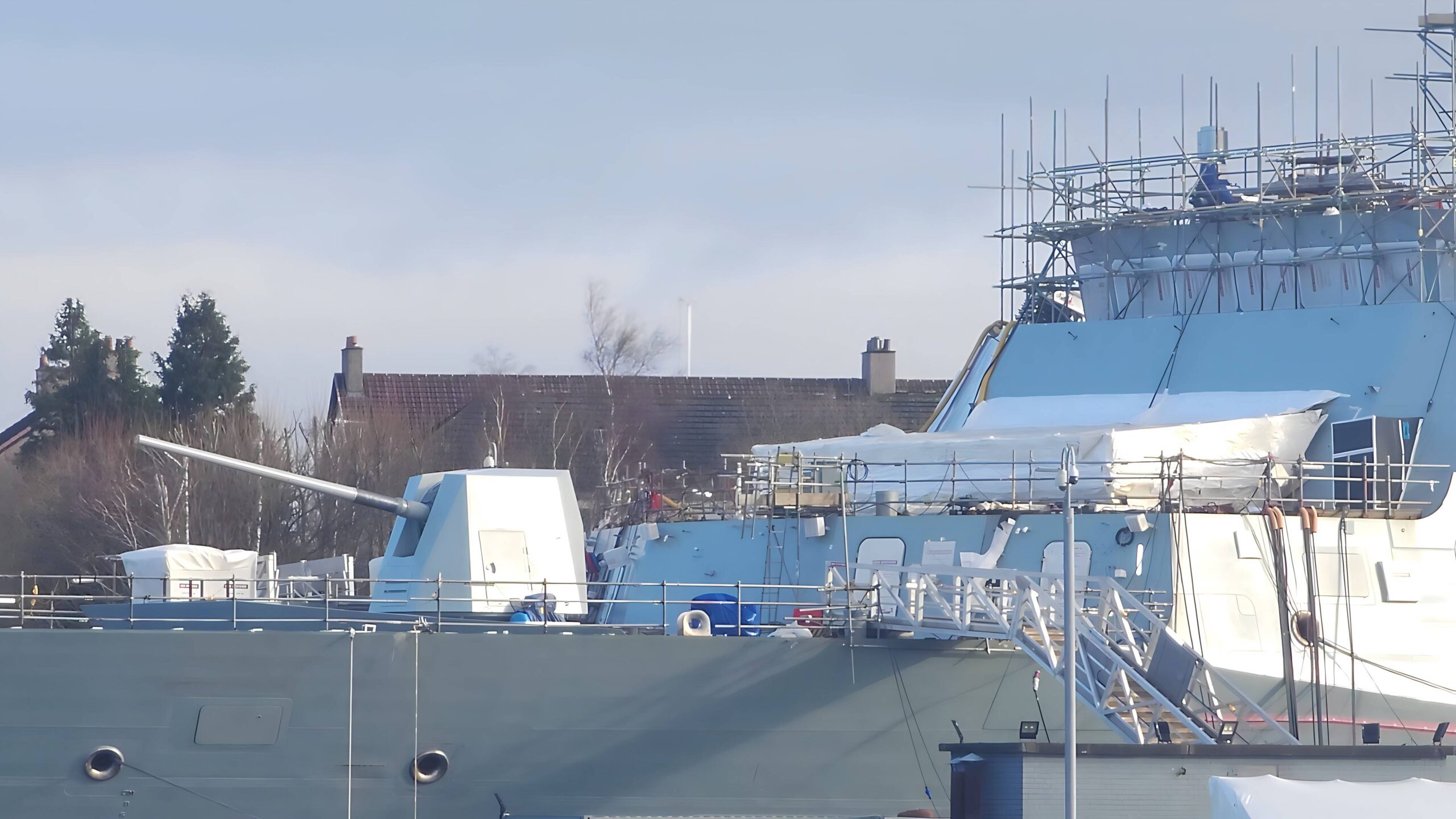
The Type 26 frigate, known in Royal Navy service as the City class, is the United Kingdom’s next generation anti submarine warfare escort. Designed and built by BAE Systems on the Clyde, it is intended to replace the ageing Type 23 fleet and to form the backbone of Britain’s surface escort force into the 2030s and beyond. Eight ships are planned for the Royal Navy, beginning with HMS Glasgow, followed by Cardiff and Belfast, with the remaining vessels due to enter service in the years after 2030. Variants of the same basic design have also been selected by Australia, Canada and Norway.
At around 8,000 tonnes at full load and just under 150 metres in length, the Type 26 is a large frigate by historical standards. It has been shaped first and foremost for anti submarine warfare in the North Atlantic, reflecting a renewed focus on tracking increasingly capable submarines. The hull and internal layout have been engineered to reduce underwater noise, and the propulsion system combines a Rolls Royce MT30 gas turbine with four diesel generators driving electric motors. In quiet electric mode the ship can operate with a far lower acoustic signature, while still being capable of speeds above 26 knots when required. Range is expected to exceed 7,000 nautical miles, giving the class the endurance for sustained global deployments.
The sensor fit mirrors that emphasis on undersea warfare. Royal Navy ships will carry the Type 997 Artisan three dimensional radar for air and surface surveillance, supported by modern navigation radars and satellite communications. Beneath the waterline, the combination of a bow mounted sonar and the Sonar 2087 towed array provides both active and passive detection at considerable range, together with torpedo warning capability. Electronic warfare and decoy systems, including the Ancilia launcher now being introduced across the escort fleet, are intended to improve survivability against contemporary missile threats.
In terms of armament, the class balances anti submarine specialisation with broader combat power. Sea Ceptor surface to air missiles provide local area air defence, housed in a vertical launch system capable of carrying up to 48 weapons. A separate 24 cell Mark 41 strike length launcher offers flexibility for future systems, including the Anglo French Italian Future Cruise or Anti Ship Weapon. The main gun is a 127 millimetre Mark 45, replacing the Royal Navy’s long serving 4.5 inch weapon, and is backed up by 30 millimetre guns, Phalanx close in weapon systems and machine guns. The flight deck is large enough to operate a Chinook helicopter, with an enclosed hangar for a Merlin or Wildcat, and there is a substantial mission bay designed to take boats, containers or specialist equipment depending on the tasking.
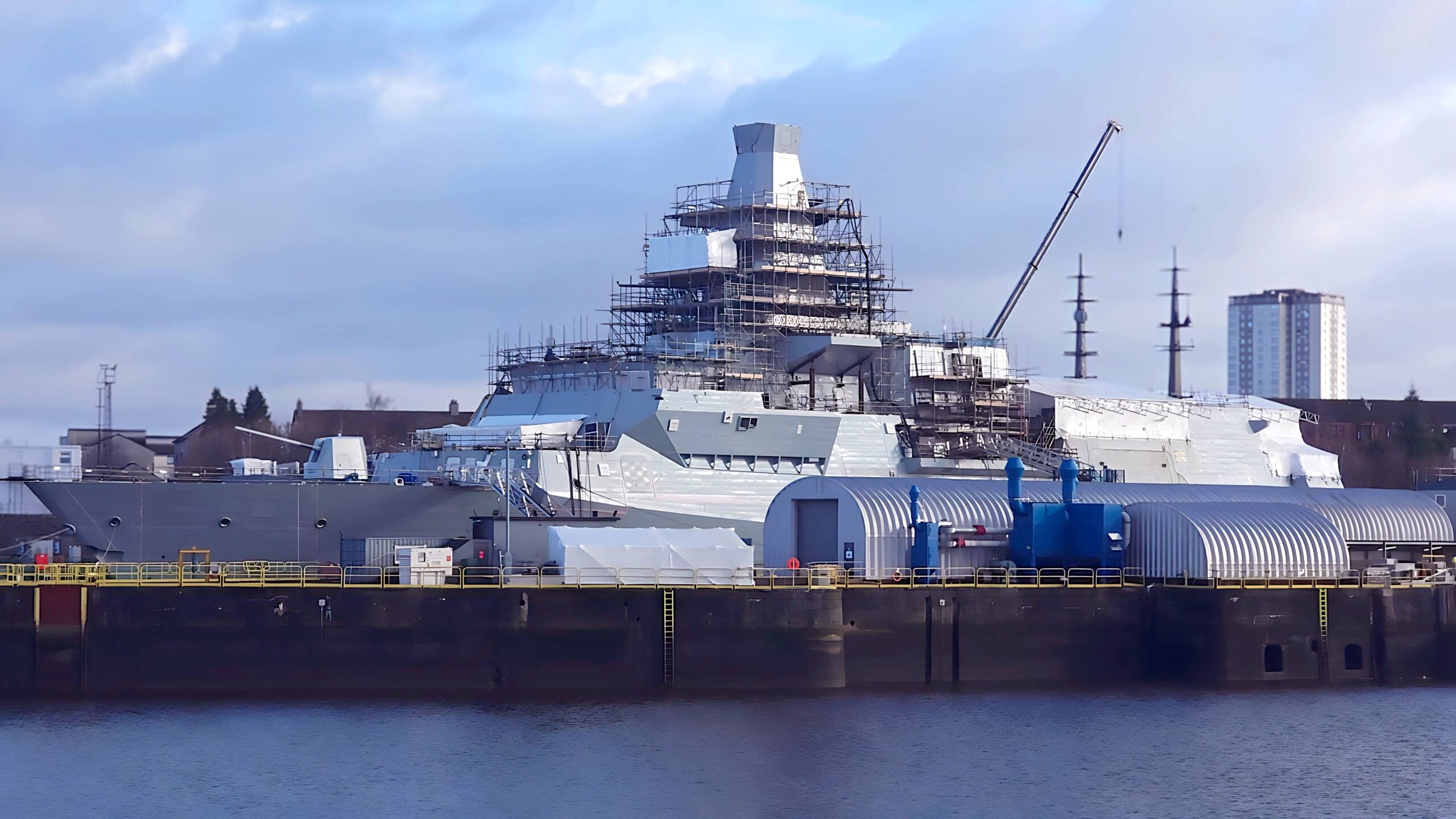
With propulsion systems energised and major equipment now installed, the ship is progressing towards eventual sea trials later this year before formal acceptance into Royal Navy service.








That old line “Come and look at my huge warship”
“Worlds most powerful Frigate”.
There, that sounds better.
Maybe. The Gorshkovs are arguably more capable in every domain save ASW, as are the two in-construction Constellations.
Theoretically, the Type 26 will have more missile capacity
24 VLS cells for offensive missiles
48 cells for SeaCeptor
Not sure what offensive missile load-out she will have,
but I assume some of the VLS will have some type of Anti-sub weapon (Asroc?)
Gorshkov
16 VLS cells for Kalibr, Oniks, Zircon anti-ship cruise missiles or Otvet anti-submarine missiles.
32 VLS cells for 9M96, 9M96M, 9M96D/9M96DM(M2), and/or quad-packed 9M100 surface-to-air missiles
The Gorshkov does have torpedo tubes which the RN seems reluctant to fit to any new vessel.
More capacity, but less capability. The SeaCeptor is a fine system for its niche, but it isn’t comparable with the longer-ranged Russian systems carried on the Gorshkov. Of course, quad-packing the 9M100 pushes the capacity out significantly.
Then, the later upgraded variants of the Gorshkov will double that 3S14 complex in size, offering 32 cells dedicated to ASuW, and 32 for AAW.
The actual offensive missiles carried are different, but the Kalibr is likely significantly longer-ranged than STRATUS LO, but a less survivable missile. Oniks would lose out to a STRATUS RS as we currently understand both missiles. Of course, the RN currently has nothing comparable to either the Zircon, or the Otvet.
The significant differences that we’ve not mentioned are the presence of anti-torpedo torpedoes on the Russian frigates, as well as a more capable CIWS (though it lacks an equivalent to the 30mm), and a more developed, multi-system radar suite. It does have a full sonar suite, but is obviously not comparable to the Type 26 in that regard.
In terms of their performance – the Gorshkov supposedly trumps the Type 26 in raw speed, but loses out significantly in range, with the disparity being almost 3000nm.
But yeah, as TorpedoJ says below, it’s quite hard to make a definite assessment when the ships are displaced from an operational scenario. That said, dismissing the Gorshkov out of hand, as some have done here, is not an action borne out by reason.
Russian AAW systems have not really proven themselves..
Also worth noting that the AG’s are half the displacement of a Type 26. You’d hope that they have better AW systems than Moskva but with the standards of the Russian Navy who knows, but I wonder if you scratch the surface what you find? Russian ships have historically prioritised offensive power over things like Damage control and survivability.
(Also I don’t think the AG’s trump the T-26’s in terms of Top Speed. The City’s are listed as being “in excess of 26” which means all we know is they are faster than 26 knots. Given that the QE’s can hit 32 knots, given an official speed of “in excess of 25 knots” and that the T-26’s are supposed to sprint ahead of them for ASW operations… yeah.)
I’m going of disclosed statistics, mostly because embracing rumour for the British ships would necessitate an exploration of the wacky reporting done by the Russians, who seemingly under- and over-report their performance statistics at random.
I didn’t embrace rumour. I pointed out that the official top speed of the Type 26 is “over 26knots” not “26knots” and that the QE’s official top speed is “Over 25knots” and that it has been measured going 32knots.
So you simply can’t say the AG’s are faster.
I apologise, it was a poor choice of words.
so far russian ciws and air defences have been totally rubbish in ukraine.
The Paket anti-torpedo torpedo is not rated very high by the Russian’s themselves…given the issues that others have had with target discrimination and the technical characteristics of Russian Sonar I suspect that may be true.
The Gordhkovs….hmmeee….well….right….
Not sure what you’d disagree on there – the Gorshkovs are plenty capable ships, with a far better AAW and ASuW fit than the Type 26.
This is a fairly common opinion amongst those who don’t immediately discard a ship due to its nationality.
I gave yet to see any evidence for the S300 family of weapons being any use.
Just because you only hear about their failures in Ukraine, doesn’t mean that they’re not also achieving plenty of interceptions…
Anyway, the missile used onboard the Gorshkov are only loosely related to the S-300. They’re far more closely connected to the S-400 system, and the South Korean system currently in use over on the peninsula.
Probably similar to most previous Russian designs, a floating death trap for its crew.
Western intelligence has had a golden opportunity to get first hand access to Russian technology ( aircraft avionics, Sam systems electronics and MBT optronics and gun aiming systems etc, because of the War in Ukraine, its mostly proven to be sub standard and behind the West (and China for that matter), I would imagine the Gorshkovs are similar, look good on paper, but probably found wanting, with poor systems integration and doubtful crew survivability.
I’ve seen the photos of the guts of a number of the systems that have been widely shared and they do not impress.
The performance of any Russian naval assets has been consistently poor.
Apart from those we get first hand experience of, which you are right rarely live up to the Russian hype, we can only go by what the Russians claim to be the capabilities of their newer weaponry. As Leh says it’s always wise not to dismiss capabilities out of hand. However there are two examples we have information about that again question claims. Firstly the Kalibr has been shown to be far less capable than was claimed. Secondly Zircon much hyped by Russia has raised questions based on upon the footage of its test launches released by Russia. Some experts have claimed that the footage either wasn’t a Zircon at all or that if it was, then it was remarkably similar to a previous Soviet design and contained little to none of the characteristics of a true modern conception of a hypersonic missile. So it’s very difficult to make true judgements between competing capabilities. In the West capabilities like range and speed are generally under stated whereas historically the Soviets and their successors have very much tended to exaggerate their capabilities, or at best highlighted an individual superficially impressive spec while ignoring the (often related) weak or limiting aspects in their capabilities. That said the MoD are hardly renowned for over spec-ing their warships in the name of cost savings or debatable assumptions.
There is the whole issue around Russia recycling Cold War tech. Things like Zircon sound impressive on paper but turn out to be very fallible IRL.
The other things that is well known to be very poor is the integration of Russian systems into a full CMS. It is one of those things that sounds really easy until you start to actually do it and then get the thing to run fast enough and robustly enough to be remotely useful.
Not to mention that, even if they behaved to spec NEW, Russia straight up just doesn’t maintain it’s stuff.
At BEST it doesn’t maintain stuff too.
Usually it gets nicked and sold.
One contributing factor to Moskva sinking is all the fire fighting gear being under lock and key to prevent theft. With no access to the key. It wasn’t even on the ship.
Same with their subs, described as dangerously silent. When new.
That’s the RuZZian wunderwaffe missiles with a 50% fail to fire or go tonto rate?
With GPS targetting systems that can miss a point target by an entire city block.
Those RuZZian missiles?
As for the CIWS system – a navalised Pantsir, and Pantsir has proven so vulnerable to the very systems it’s defending against, it’s become an internet meme
As close as an entire block….they have improved at hitting static targets….now for a moving target…..
Pantsir is well pants…..
Ha, It was more a little sarcasm aimed at previous labels given to US Ships but as always, I intended more depth !
Good to see you are still here, I fancy a lot of regulars are missing lately. I had a look on that other site but could still not find any !!!!
Haha, I understand. Mine was a poorly worded attempt to make fun of the global appreciation for pseudo-destroyers, given both these are pushing the boundaries of traditionally-understand labels.
What are the traditionally understood labels for destroyers or frigates for that matter mind, they seem to change every couple decades or so. Different Countries seem to have definitions that vary from current UK thinking.
Traditionally in the UK Frigate is a small(er) ASW Focused Escort, a Destroyer is a larg(er) Surface and Air Focused escort. But that is the only in the UK and is strictly was only true in WW2. After that it’s basically a Frigate is a ship that was built to replace in service Frigates.
Germany has historically tended to say that regardless of size a Frigate is a ship that is meant to specialise in one field, while a Destroyer is a ship that is intended to be able to do everything, but that’s gone by the wayside. France doesn’t have Destroyers, just ASW Frigates, AAW Frigates, GP Frigates etc, America; “If it’s smaller than an Arleigh Burke and we can’t invent a TLA for it it’s a Frigate.”
And thankfully we’re more building them big n roomy because we realised steel is cheap where upgrading small ships is overly expensive.
These frigates will hopefully spend their entire lives steaming next to a carrier or hunting smugglers. No need for multi billion pounds fit outs.
But if we ever need to we can bolt a whole BUNCH of boom on these.
Fitting T26 with NSM and STRATUS together would balance the books a lot, but it would all be top trumps anyway.
Remarkably the main Russian shipborne helicopter is still the Helix series, which first flew in 1969… It’s apparently one of the most successful Russian aerospace exports (even used in Canada and Portugal) as the coaxial rotor gives it good hovering characteristics in confined spaces. The more you know!
I was unaware, very interesting. Russian export, or Soviet export? I imagine the former, right?
The Euro-certified version first flew in 1997 according to Wiki so Russian.
Coaxial rotors are interesting because they’re less fuel efficient than traditional helicopters but much more space efficient. Perhaps for unmanned aircraft that’s a useful combination to have?
Yes. NSM should be fittable atop as shown on the Norwegian models and RAN and RCN T26s. Be wasteful not uitilise this. Which then means that more thsn 11 sets should be ordered. Is FCASW going to be available as cannister launched?
They are not mutually exclusive.
Personally I say we should go for Cannister ASM and VLS AShM. The Stratus can hit naval targets and outperforms the NSM massively but currently is only VLS. Meanwhile the Italian MILAS outranges all heavyweight torpedoes, seems to be comparable to the Type 07 and red shark VLS ASM but is about half the price, plus according to MBDA is already capable of fitting the stingray torpedo thereby making it the best choice for an ASM missile.
STRATUS RS at least will have a canister launch option as that’s the only way it will fit on the French FREMMs. So if we want that on our ships it will have both VLS, air and canister options.
LO will likely only be VLS and air launch.
In every domain …. Except for the specific domain that the T26 is actually being built for ……. Keep spinning and try not to get too dizzy.
Are you blind, or just illiterate?
No, I was taking the micky out of your comment.
Whereby you contrasted the power of one ship vs the other but included the whole purpose of the other as though it were an afterthought and almost hardly worth mentioning.
So, you’re angry because I acknowledged that the Type 26’s ASW capability was so advantaged as to be incomparable to that of the Gorshkov, and then based a comparison around areas that were comparable. Of course, capability is not localised to a single domain.
I think some people genuinely don’t reread their posts.
Oh, you’re back.
You posted farewell the other week.
Nice boat… How many are the RN getting… 4? Are Norway’s being built before the RN’s other ships?
8 – maybe read the article before commenting? 🤷🏻♂️
5….
8.
5, 6, 7, 8, my boot scootin’ baby is driving me crazy 💃🕺
🙂
🤦🏻♂️
Oh? You know as a fact that the RN will get 8? Whatever dude…
What authority do you have to suggest there’ll be four?
Merely a guess, considering how governments in the past have broken their promises.
😂
8 have been ordered, idiot.
You arrogant mediocrity… if you cannot at least attempt to be civil, do not insult me again.
So 8 have been ordered. An order from HMG is meaningless without the funding, and true intention to buy that many.
What’s “meaningless” is your opinions as they are clearly based on rank ignorance.
You don’t seem to comprehend that “ordering” is a legally binding contract to buy. 🤷🏻♂️🤦🏻♂️
Maybe the Teletubbies website would suit you better?
Well given that 8 have been ordered and the long lead items started, and that 6 have already been laid down… yeah pretty sure the RN is getting 8.
I agree that at least 8 will be built in the UK, but the Norwegian interest may disrupt the delivery time-scales for the RN and possibly how many the RN gets.
I’ve not heard any clarity or of additional orders of long lead items.
Delivery scales, yes, as ship 3 or 4 will go to norway. Total? No.
The ships where ordered in two Batches, 3 ships and 5 ships. The long lead items would have all been ordered together when the second batch was ordered.
Up to 304.
Have you considered a job as a government PR rep, Mr Wit?
Yup, but I’m running for POTUS next time.
Reckon I’m well qualified given the Clown there at the moment.
Certainly half a wit improvement on the incumbent,
Loving his latest Tarriffs Tantrums !!! 😅😅😅😅😅
Shaping up to be a lovely lady, and hopefully a savage Ivan hunting femme fatale.
It’s a hooog, bigly hooog warship.
A good indicator that she is almost ready for sea trials will be when the navigation radars and satcom domes are visible on the mast.
I assume the type 997 main radar will be fitted last?
.
Preparing for sea trials was mentioned 5 months ago. Got to hope they are very close now.
It would be good if BAE listed the progress made since then, because externally she mostly looks the same.
Slightly Off Topic but It looks like Argus is being “Tugged Off” at Pompey.
Not a lot of room left “up the creek” now.
Bye bye old friend.
not a bad innings though -28 years or so?
1982 she was aquired so 44 years In total.
Just shy of what life our carriers are designed for.
cheers for that Mate- my maths was really off ! 😂
Hello Klonkie. Hows things in NZ my friend?
Hiya Geoff – I’m well thx, chugging along here down under. Hope Durbs is treating you well.
Now just replace the fungus farm with more Mk41 cells and a more powerful radar, then we have a real winner
As a comparison the County class (rated as Destroyers/Cruisers) were ~6200 tons
Frigates – ASW
Destroyers – AAW
Correct 👍. Also I’m pretty certain that we will see NSM fitted because the Norwegians will certainly want them.on theirs and we arse supposed to be identical on every way. Both the Aussie and Canadian T26 graphics all show canister launched SSM above the hanger aft.
That’s at odds with current RN doctrine, given the Type 31 is anything but an ASW platform.
Globally, it’s even less accurate.
It’s a historical classification not an official policy. The most accurate measure in the RN tends to be “A Frigate is a ship that is built to replace a Frigate.”
Yeah, that’s probably fair :).
According to the mailonline they are all battleships :):)
Eh if you look at the Defiant Class “Battleships” the US is planning, a British Frigate probably has as much to do with an actual Battleship as those (and before anyone mentions displacement, HMS Ajax (1883-1901) was a Battleship that displaced 8,500t)
Except the T31 has little ASW capability.
Interesting way of saying no ASW capability
If a Merlin is the embarked heli, then that can hunt & kill, I presume. If a Wildcat, then IF another nearby vessel can detect the sub, then the Wildcat could drop DC or a homing ASW topredo, I’m presuming again. A frigate(“escort”) without ASW sonar is a bit of a contradiction though.
It will have the Ultra SSTD which is pretty good I believe. But it does beg the question though of how you respond if you do dodge the torpedo.
Run away at 30kts and get the Merlin to drop a barrier of sonobuoys behind you in case the sub chases, I imagine!
Indeed Simon. Typical displacements have varied considerably over the years. WW2 destroyers above and below 2000 tonnes as opposed to the Type 45s at plus minus 8000 tonnes with the Type 26 Frigate of similar displacement. Cruisers varied in size with some as low as 5000 tonnes. Multi role designs have also blurred the lines in Naval ships and aircraft. When I was a youngster we had Bomber Command and Fighter Command!
We have, pretty arbitrarily decided to use WW2 displacements as some sort of yard stick across the internet. If you accept that WW2 isn’t a necessarily the yardstick by which everything should be measured you can find Cruisers with Displacements as low as 1,800t and Destroyers at the 500t mark.
Indeed Dern, there are no hard and fast rules in terms of size
In real news – FCAS at risk of getting canned. Germany and France at odds.
In other words, it’s the average week in on the continent. 😉
Being serious for a minute, I expect that the fallout will be more impactful on Germany than on the French. Neither will come out looking good from this, though.
Its been declared dead by the Belgians, but it could be a load of waffle on their part
The French have always been difficult partners in aviation consortiums always wanting to prioritise their own interests and seldom compromising. One might think that this strengthens Tempests chances-I suppose in theory Germany would be a good add on to the Italy UK Japan group and let France get on and build their own next generation. Obviously there are different requirements in each camp but how far apart could they be? Surely there cannot be insurmountable obstacles. It would certainly spread the costs and bring the run numbers to a much more viable place?
Cant believe no one from Germany has approached the UK about joining up or even buying the platform
Hopefully might happen Andrew
They definitely have, according to German sources. The issue is, no-one particularly wants to give up their workshare to Germany, nor do they want to slow down the programme.
Germany would be very welcome as a Customer for GCAP,not so much as an Industrial Partner though.
It’s a bloody good job we got a translation there George !!! Some of us from “Dan Saff” would struggle understanding most of what you said 🤔😁😁😁😂
(Still think you should market your Tank Top with a UKDJ Logo !!!)
You haven’t got a UKDJ T shirt then? 😉
I also have a Ukraine Snake Island themed “Go **** ********” T shirt as well.
George should definitely do a line in UKDJ T-shirts. BAE sell merch to gullible cadets, why shouldn’t the team set up shop at DSEI and make a few quid?
(I mentioned it a while back, not sure If It went down well though)
Heck no, I do have lots of TVR and Bike ones, plus a whole bunch of Motorhome ones, some are specially chosen to suit the occasion.
“I sleep around” gets washed the most as I always live in hope !!!
Today I have a Honda CBR1100 XXX Super Blackbird one on, It goes under the Wind proof jacket and I’m just warming up after a little hours “Hooning”.
Dry roads and being home allows such antics.
..let alone news from your Harland and Woolf Belfast correspondent-he might give George a run for his money:):)
Loving the drama above. Leh is trying to have a grown up debate objectively (using publicly available data, comparing measurable capabilities, and not letting emotion or bias interfere), while others start flying in with emotion.
Now, if we are going to debate the ‘world’s most powerful frigate’, surely we should be talking about operational frigates, not ones covered in scaffolding still in outfitting. So let’s start again: our offering is the T23…
Most people here will be aware of most of this, but I think it sums up the issues well.
The United Kingdom’s Royal Navy (RN) is at a low ebb. Years of deferred modernisation are coming are beginning to negatively impact the RN’s operations. Ballistic missile submarines are performing ever-longer deterrence patrols. Attack submarines deployments are rare, with the RN often going months at a time without their principle conventional deterrent systems at sea. Destroyer deployments are recovering, but corrective maintenance programmes continue to limit flexibility. Mine countermeasure systems, previously an area in which the RN might have been considered the global leader, have fallen behind the curve, with dedicated mine-countermeasures vessel (MCMV) HMS Stirling Castle frequently in port, and smaller MCMVs continuing to be extended in service with no ready replacements. The Royal Fleet Auxiliary (RFA) lacks a deployable fleet solid support ship (FSSS), and will continue to take industrial action following a failure to secure improved compensation. The carriers HMS Queen Elizabeth and Prince of Wales have proved themselves through two global deployments, but still lack properly-equipped aircraft, as integration challenges continue to delay the deployment of the Spear-3 stand-off cruise missile. Programmes to replace vital survey vessels such as the retired Echo-class ships have now been cancelled, whilst amphibious capability now sits entirely with the three Bay-class auxiliaries, following the sale of HMS Bulwark, and decommissioning of Albion and RFA Argus.
The most frequently discussed area of atrophy in the RN is the looming frigate gap. Currently, the RN operates six frigates, of the aging Type 23 or Duke-class. These were built in the 1990s and 2000s, as a class of 16. Three were promptly sold to Chile in the 2000s, whilst the remaining 13 were due to have been retired and subsequently replaced after a lifespan of 25 years by the Type 26 or City-class. Now, in 2026, those 13 frigates have been stripped back to just seven, with the fleet set to drop further to just six this year as HMS Richmond, a veteran of two Pacific voyages, decommissions. Ideally, the final ships of the class will remain in service till 2035. However, following the failure of Northumberland to emerge from her planned refit, questions have been raised over the condition of the remaining seven frigates of the class, and whether the planned service time of those ships is realistic.
What are the effects of this decline? Arguably, the single most important role of the RN’s frigates is in detecting, tracking, deterring and (if required) prosecuting hostile submarines. This is generally considered with reference to the Russian Northern Fleet, though when deployed alongside the RN’s carriers, British frigates have been tested against the submarines of the PLAN. In a domestic context, this is of particular important with regards to the sanitisation of the area surrounding an SSBN deployment, especially given the lack of deployable SSNs to assist in this role. Other roles have been entirely disregarded as numbers decline. The Fleet Ready Escort Ship (FRES) has frequently been a patrol ship, or at worst, an unarmed auxiliary equipped with an ASW helicopter.
There is a solution, though this solution is limited in a major way. The UK is currently constructing seven new frigates in two locations in Scotland. Six more are on order. These are the Type 26 City-class frigates, numbering eight, and the Type 31 Inspiration-class frigates, numbering five, with the former built by BAE in Glasgow and the latter by Babcock in Rosyth. Whilst the previous Type 23 frigates had been separated into two sub-groups, identified by the extent of the sonar fit (five ‘general-purpose’ [GP] frigates had no towed-array sonar [TAS]), this new generation of British frigates entails two entirely different classes of vessel.
The Type 31 ships are dedicated GP or patrol frigates. They carry a single sonar system, as part of their torpedo defence system, but lack any dedicated hull-mounted array, or a TAS, for anti-submarine warfare (ASW). Additionally, they will commission with just 12 defensive missile systems, the Sea Ceptor, guided by a significantly improved radar system, the Thales NS110. These ships will be ideal for the FRES role, and other presence operations in low-intensity areas.
More interesting in relation to this post are the Type 26 frigates. These are dedicated ASW combatants, and perhaps will be the most capable warships deployed globally in that niche. Their hullform is designed to radiate as little noise as possible. They integrate a new electric propulsion system, again to reduce noise. They’ll carry a full sonar fit, with both a HMS and a TAS, as well as a large mission bay for various useful modules. However, they lack a comparable radar system, or an extended-range defensive missile, to those found in other frigates (Constellation, FREMM, Gorshkov). These ships will both defend the UK’s northern coastline from Russian submarine threats, acting as a control node in the Atlantic Bastion programme, and deploy alongside the carriers.
So, everything’s rosy, then? Not particularly. The first Type 26 frigate will begin sea trials later this year, and will likely commission in late 2027/early 2028. In comparison, the first Type 31 frigate has seen its commissioning date slip to a nebulous ‘by the end of the decade’. Questions then arise as to the planned numbers of frigates, and the lengths of the ‘frigate gap’.
The RN and MoD have provided little support to the Type 32 frigate programme, which theoretically would replace the decommissioned Type 22 frigates, and the sold Type 23 frigates, with five new warships.
On a similar note, agreements to sell five Type 26 frigates to Norway, with the initial warships being diverted from RN builds, furthers fears of an extended frigate gap.
The Type 31 frigates will be fitted with the Mk41 VLS, but timings are uncertain. Sources like Navy Lookout report that the final three ships of the class will have these fitted during construction, but failed to respond to questions about the sourcing of that information. Certainly, no VLS have been ordered directly for the Type 31, and with a two year lead time, the prospect of an extensive Capability Insertion Period post-commissioning for each patrol frigate is possible. Of course, that further reduces deployable frigates in the period.
As such, the RN is a force facing an uncertain frigate future, with the prospect of both very capable, and more middling warships entering service over the next decade. However, timings are nebulous, and transparency is declining. Hopefully, the absent Defence Investment Plan, now delayed by more than two months, will provide more clarity.
Worse things happen at sea.
What’s this from? I assume you didn’t write it unless you want to compete with Jonathan for essay length?
It’s a good summary.
Essay lengths are often to be found here and that other place. Pete the Irate Magenta bloke likes to write these epics, so I notice !
Essay’s are fine, just don’t copy Pete’s “let me use ALL the formatting options in my essay” style XD
I literally fall asleep at times reading his “epics” !
Not to rag too much on someone who isn’t here, you have to be either good at writing or have something interesting to say if you’re going to routinely type that much text, and he rarely is either.
It’s mine 🙂 .
I posted it as an accompaniment to the Reddit post I made over on the r/Warshipporn (not freaky, just pictures of boats). That has all the attached citations and references for various claims I make.
A nice copy-paste if somebody is being willfully ignorant, I suppose.
At least there’s a pipeline to give T26 Aster and they could even be given rooftop canister Stratus-RS, then they will be truly formidable .
Yeah, feel free to use it if you want. Might want to check my spelling though 🙁
thought the T31 had their missiles increased from the basic fit out?
The Type 31 frigates will be fitted with the Mk41 VLS, but timings are uncertain. Sources like Navy Lookout report that the final three ships of the class will have these fitted during construction, but failed to respond to questions about the sourcing of that information. Certainly, no VLS have been ordered directly for the Type 31, and with a two year lead time, the prospect of an extensive Capability Insertion Period post-commissioning for each patrol frigate is possible. Of course, that further reduces deployable frigates in the period.
One BBW if I’ve ever seen one.
Can’t wait to see her with her radar on – the finishing touch as it were.
Related news.
RIP Cmdr Tony Moreton.
Captain of HMS Yarmouth (Leander) FI’s 1982, former Buccaneer Pilot and long serving RN hero.
Hi halfwit-now there was a skill-flying a Buccaneer at very low level-was apparently something that required concentration and great piloting skills. The SAAF had a squadron delivered overland and sea to South Africa-lost one on the way! an route rout!!
Yes, I have such respect for those pilots doing those speeds at such low levels, 200mph on a bike is pretty scary but these guys were often at 3 times that !
“Root” is probably another that your computor might struggle to allow ? 😁
..wouldnt let me say ** route??
Both Glasgow and Venturer to complete contractor trials in 2026. Cardiff trials to be underway. The frigate famine is ending.
Fingers and toes crossed. Can’t come soon enough.
Not a Naval type myself, but can any frigate be described as “huge”? Its just “big for a frigate” isn’t it?
It depends on how close you are.
And compared to a typical Caribbean cruse ship?