

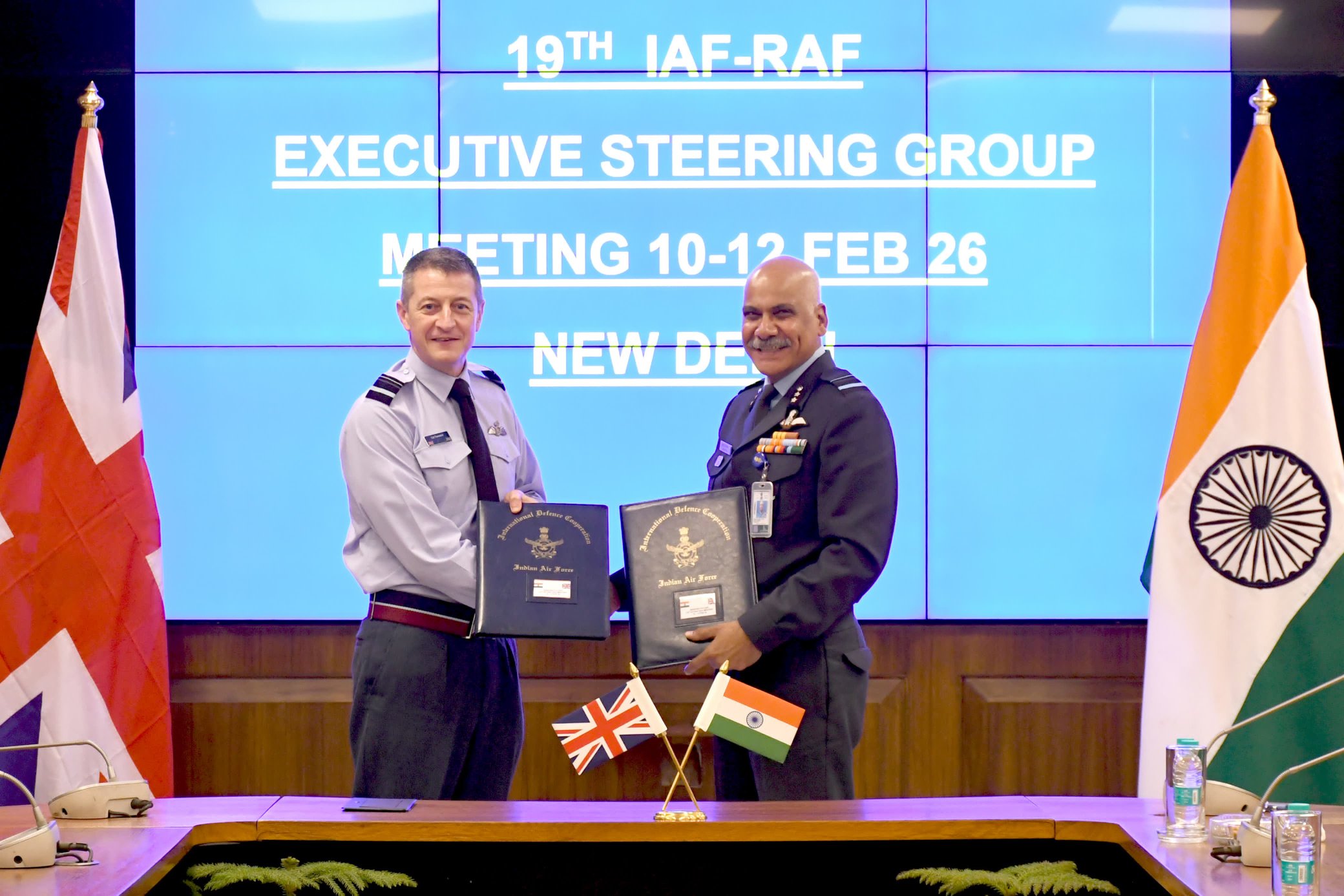
Indian Air Force instructors are set to begin training Royal Air Force fast jet pilots at RAF Valley under a new agreement that may also help ease long-running pressure on Britain’s military flying training pipeline.
The British High Commission in New Delhi confirmed that three Indian Qualified Flying Instructors (QFIs) will deploy to RAF Valley for an initial two-year period, marking the first time Indian instructors will directly support fast jet training for RAF pilots at the base.
RAF Valley, located in Anglesey, is central to the UK’s fast jet training system, hosting training aircraft such as the Hawk T2 and Texan T1. The announcement comes after repeated concerns raised in defence circles about bottlenecks across the wider UK Military Flying Training System.
The High Commission said the move was agreed following the 19th UK–India Air Staff Talks in New Delhi, describing it as part of a broader effort to expand military training engagement between the two air forces.
Air Vice Marshal Ian Townsend, Assistant Chief of the Air Staff, said the agreement was “a significant step” in strengthening ties between the two services. “Bringing Indian QFIs into UK Military Flying Training Systems deepens our cooperation, enhances interoperability and reinforces our shared commitment to excellence in aircrew training,” he said.
“Together, we are investing in the foundation of a long-term collaboration and shaping a partnership that is both enduring and strategic in its outlook.”
The British Defence Adviser in New Delhi, Commodore Chris Saunders, also emphasised the wider strategic framing of the initiative, linking it to the long-term UK–India defence agenda. “The forthcoming deployment of Indian Qualified Flying Instructors to the UK represents another significant milestone in our expanding defence relationship,” he said.
“It reinforces the mutual trust and shared experience that underpins our training cooperation and exemplifies the increasingly sophisticated levels of interoperability we are building together across our services.”
The agreement follows a separate development earlier this year, when an Indian Air Force officer was deployed as an instructor to RAF College Cranwell, the UK’s air officer training academy. UK officials said this meant all three of Britain’s military academies now host Indian instructors from their respective services, including at Britannia Royal Naval College Dartmouth and the Royal Military Academy Sandhurst.
The High Commission added that the Indian instructors will remain under Indian Air Force command while carrying out instructional duties under RAF commanders at Valley.





After losing several jets to Pakistan recently, I really think these are not the people who should be teaching us anything….
Maybe they need the money for their space program, while ignoring their chronic poverty situation 🤦♂️
This is so short-sighted.
The Indians did lose jets. Those jets were European-designed, fourth-generation jets equipped with European-design modern BVRAAMs. You know, the same types of aircraft and missiles that the RAF will be flying into combat with. So, you don’t think that knowledge of where a combat doctrine based around a fourth-gen delta-canard equipped with advanced BVRAAMs fails would be useful to the RAF?
Beyond this, the Indians then carried out a successful strike against >10 airbases concurrently, using again, European planes, equipped with the same BVRAAMs and the same cruise missiles, the Storm Shadow, that the RAF uses. Do you not think that training from the people who have used your weapons, used very similar jets to your own, against a target similarly defended to, for example, Russian targets, would be at all useful?
How would their experience help us against russian targets?
Pakistan’s air force is made up of Chinese, American and old French jets and same goes for their ground AA systems, mostly Chinese
But I get what you mean, we learn from their failures
The Chinese HQ-9B (the system purchased by Pakistan to defend their airspace) is derived at its core from the Russian S-300, albeit with major performance upgrades. To understand how the Indians were able to defeat that system, using the same British/French cruise missiles, would be incredibly valuable, because it provides applicable information on how the Russian S-300 would perform against those systems. It’s similar to what we’ve been getting from Ukraine, but more useful, because the Indians are using the Rafale, comparable to the Typhoon, to launch those cruise missiles, compared to the UkAF, using an aging stock of Soviet Su-24s.
Similarly, the Indians also operate the S-400, and undoubtably have experience in how their own Rafales perform against the system – experience that will translate through into training with the RAF. That’s obviously very useful, when considering that the S-400 remains the premier Russian GBAD (the S-500 is limited).
And yeah, we learn from their failures. At the end of the day, the Chinese missile arsenal function much akin to the Russian one, just better. The R-77, for example, can be compared to a poor man’s PL-15. But understanding why the Indians failed to use their Meteors, and why they couldn’t evade, is incredibly useful to the RAF.
The Indians and the Pakistanis are the only nations around today with experience in a peer-level air conflict. To get training from either would be useful, but particularly from the Indians, because their systems and doctrine are far and away the more comparable to the RAF’s.
I suspect the Indian losses were down to poor tactics and lack of preparation.
Both S300 systems and Bavar-373 (derived from S300) proved no threat to Israel’s attack on Iran in June 2025.
Equally, Venezuela’s S300s proved ineffective during the Raid to capture Maduro.
From what I’ve read it was more down to the fact china does not over claim on its missiles.. it has a tendency to undersell, the Indians are very use to Russian overselling capabilities and they simply did not believe or understand the engagement envelope of the PL15… this is core learning for anyone planning to take on the PLA..because China has a clear export vs core Chinese policy… it means Chinese export aircraft and BVRMs are peers vs very good western 4.5 generation fighters..
The second part of that story is Pakistan’s use of its Erieye AEW aircraft. The J10s/J15s carrying the PL15Es, from what I understand were operating passively guided by the Erieye. The Erieye tracked the Indian aircraft, the JF15 launched blind, with the PL15E controlled by the Erieye. To all intents and purposes, the radar warming receiver (RWR) operating on the Indian jets, would have shown the Erieye operating in search mode. The aircraft’s RWR would not have shown this as a threat. The PL15Es would be operating passively for most of the journey, only going active either on command or around 10km away from the target.
If Indian Rafales were shot down with the PL15, it’s probably because they didn’t detect the threat until it was too late. The PL15E uses an active electronically scanned array (AESA) radar, as it active radar seeker. Rafale has the SPECTRA defensive aid system, that incorporates an active RF jammer as well as expendable decoys like chaff and flares. The system has in the past shown that it very good at deceiving ground based radars used by SAMs. However, it seems that at least one Rafale was shot down by the PL15E. This may be due to the missile’s AESA seeker being less suspectable to jamming and decoys, or has a mode allowing it to home-in on to the jammer. Unlike the Typhoon it doesn’t use an expendable jammer like Leonardo’s Britecloud.
I’m pretty certain India nor Dassault, will be very forthcoming on releasing the information publicly, of really happened.
That was some of the most impressive spin I’ve ever seen though – yes the Pakistani Airforce shot down some of the attacking jets. They however failled to protect any of the targets from being hit.
Indian flight training may have a lot to offer I thought it might have been in India, imagine flying over the Himalayas. So they have experience of Pakistan and china , Russian and French kit. Loads to learn from.
Indian flight training may have a lot to offer I thought it might have been in India, imagine flying over the Himalayas. So they have experience of tensions with Pakistan and china , Russian and French kit. Loads to learn from.
Good news. I’m up for any solution that will ease the bottleneck of students awaiting training to become fast jet pilots.
I’m not going to criticise. I’m going to give my support.
Yes, but isn’t it shameful that Great Britain is in this position in the first place?
The RAF FTS worked fine until politicians messed with it like everything else.
Not really? Not sure why we shouldn’t want training from one of only two nations to have modern peer-level experience in both air-to-air, and air-to-ground operations, most of which were undertaken with the same systems used by the RAF.
Hi Leh.
Are we clear what type of training this is?
You’re going straight to complex combat scenarios and 4FTS does basic through to learning to fly a fast jet.
We surely have QFIs for that. Indeed, the CFS trained the trainers until politicians wrecked that as well.
Are you wanting Indian QFIs then in our OCUs and actual front line Sqns that also practice for complex air operations?
All training is good, but again, with the RAFs experience it’s tragic it’s even necessary.
If this were an instructor exchange, it would be great news. India must have some excellent instructors, for the reasons Leh points out and because of the sheer size of their Air Force. For me, closer ties are a good thing in general, especially as India is an emerging global power. But of course, this isn’t an instructor exchange — it’s to fill in the gaps that the RAF have.
Exactly, which shouldn’t exist given the stature of the Royal Air Force.
It’s only 3 guys mate.
Yep, absolutely this. Papering over the cracks again.
My mistake, I was under the impression that the training provided would be more…targeted and niche, compared to the basics.
I’m not sure I agree, firstly different systems – IAF was based on the UK system but that was 60 years ago, different standards, pharseology – they’re not even a NATO country.
Secondly security risks, IAF has shown it’s more than happy to cozy up to the Russians and again a non-NATO country.
All in all it’s a huge refletion on how poorly thought out the 2010 SDR was and the consequences of the conservative governments screwing up defence for a decade.
I would hardly call a few bombs dropped peer to peer warfare my god that so called peer to peer went on for about 9 hours and enfolded very few aircraft the RAF have been dodging s300/400 missiles for years in the various wars in the Middle East
Poor blokes, 2yrs at Valley. Show some compassion
Anglesey (Ynys Môn).. a glorious island with fabulous beaches, Yr Eryri for mountains, an hour or so to Liverpool, Ireland a couple of hours on the ferry. And a drier climate than much of western UK (it always rains in Wales, I know, but a bit less here!). And the longest place name in the UK, which, I can pronounce… 🙂 What’s not to like!
How pathetic can we get. Three Indian instructors, which is fine in itself, but are we so badly off.
Exactly.
It’s often said the RAF is one of the few western air forces able to join the US in first night of war complex air operations, carried out by professional air forces.
We aren’t nobodies. The training pipeline has been cut, cut again, and squeezed by politicians making cuts, then part privatised, using the very civilian instructors who were once themselves RAF pilots. ( Elementary, 6FTS, Basic and multi crewed, 3 FTS, fast air, 4FTS, with RAF Linton on Ouses 1 FTS old role of streaming through to fast jets thrown in as they cut that as well.
Didn’t the RAF have a very aggressive DEI policy years back where they were refusing to hire white pilots and then had a crisis that they couldn’t find enough qualified people? Are they still suffering from that policy?
It was one year 20-21 and it was found to be illegal and stopped. Are you suggesting that only white pilots can fly? There was no suggestion we had less pilots, just fewer white ones. Could we have done with the white ones as well? Certainly. But we need to make sure we don’t shift the argument here.
Yes it lowered the standard to get more black and brown people into the RAF
No, you are wrong.
The reports said “Unlawful Action, Not Lowered Standards: An independent report found that the RAF discriminated against white male applicants by fast-tracking female and ethnic minority candidates for training places in 2020 and 2021.”
Illegal, quite counter productive, but it was a policy of not taking white candidates of equal qualification. That is not lowering standards, just a very silly way to shoot oneself in the foot. You are on dodgy ground suggesting that those who were accepted were of lower standards, and even more so when you use that phrase in the same sentence where you reference ethnic groups. And you are potentially libelling the RAF! They got it badly wrong, but not by lowering standards. Those are the facts as we have them. If you have alternative facts let them be put in the pubic domain. Because if they did lower standards that would be worrying.
Or to put it another way… why do you think “black and brown people” need lower standards?
When u have a group of people and there is a minimum stand and let’s say you have 1 group that scores far higher than the minimum standard but there passed over because of stupid DEI rubbish u are lowering the overall standard u can pretend it doesn’t but it does
No, you are not, you are simply reducing the number of successful applicants. Unless you are biased towards thinking that those who were rejected were better qualified than those who were accepted. There is no evidence for that. In fact, for all we know, this raised the quality! But the truth is the information we have doesn’t allow us to make connections that aren’t there.
They did. But I think that applied to all recruits?
Not just pilots.
“I don’t want this white trash” was the quote oft repeated for a certain Group Captain.
Assume it takes much longer anyway to progress to QFI status so don’t know if that would be applicable here?
As Wyn says, colour isn’t relevant here. My issue is that we need to outsource this in the first place given the history and stature of the RAF.
Change for change sake, always to supposedly to save money,and that nearly always costs us dear. There must surely be someone who could sit in a dark room and work out what we need, or at least what the priorities are. I’m not talking about numbers and budgets, just the basics eg “we are short of combat pilots so we need more instructors” The conclusions are not difficult really.
Not surprised.
India now has a larger nominal GDP than the UK.
India’s economy is growing ata fast pace (around 6%–7%)
compared to the relatively stagnant or slow growth of the UK economy.
What has that got to do with this farce? Serious what possible correlation does that have to our inability for the RAF to train its own fighter pilots. I’ll tell you – Absolutely none.
Simple.
India can afford to maintain and crew a bigger airforce.
One of the main reasons that our armed forces have atrophied so much is that basically we are broke,
and the economy has been poor since the 2008 meltdown.
It has 2 billion people and its economy is only slightly larger than the uk this is nothing to shout about and yeah your economy tends to grow at 6% when in at such a small level
Very good. Curry on.
It’ll be Interesting to see what they take away from this experience.
Yes but it’s a shame with have naan of our own to do this.
Might seem a strange question,but i wonder if they will bring their own Hawk Trainers over with them ?.
Just Jags and Harriers.
Hopefully they’ll bring the F‑35B back! #Day245
(I know ! ) 🤗
Great Britain can’t train it’s fast jet pilots… What a fucking headline.
Oh my God what on earth has it come two, and this no April fool’s joke? And Indian Air Force accident rate is 😦
Geostrategically India is one of the future pivot points.. it may not have the capability to form one of the next geostrategic poles, but it’s going to be probably the single biggest independent/neutral power and it will dominate the eastern Indian Ocean.. it’s going to be the 3rd highest GPD nation by 2030 at around 7-7.5 trillion dollars.. with the UK in fifth spot at 4-4.5 trillion dollars.
If the UK wants to stay out of the EU it’s going to need good relations with other pivot point independent nations.
True, I suspect this has more to do with that than anything else.
It’s still a sad indictment of the RAF and the past decades of management of by the MOD and respective ministers.
7 trillion with 2 billion people lol
GDP per capita is not a measure of power.. total GDP and size of population are.. because the total amount you have to spend can be converted to hard power as can be population.. just having a few rich spoilt people who live long happy lives does not equal hard power…
Thats just not true at all india has to share out any tax take within billions of people thats quite relevent
Sorry you are profoundly wrong
China has a GDP per capita of £13,000 .. tiawan has a GDP per capita of £40,000 which is the nation waiting to be crushed like a bug..
The US has a GDP per capita of £90,000 yet China with its GDP per capita of £13,000 is eying up the USN like a turkey for Christmas
If GDP per capita had any meaning whatsoever in regards to hard power Luxembourg, Ireland, Switzerland, and microstates like Monaco or Liechtenstein would be the military powerhouse of Europe.. all that matters is Population, total GDP, military industrial output and political will … how wealthy the individuals are in a nation has zero fucks to do with hard power.
Economic power does matter and so does gdp per capita China ain’t going to squash anyone the USA won’t let it India is hard pressed to give its citizens indoor plumbing let alone being some global superpower it has to keep most of its military defending its border from both China and Pakistan there is hardly any money left for anything else plus India runs a deficit about the same as the U.K.
Economic power is important but that dues not come from GDP per capita.. China has the most industrial power on the planet it has huge economic power and if you think the USN is not profoundly worried about China I suggest you do as I have done and read every single journal article and publication from the US naval college, China Maritime Studies Institute.. that will tell you just how seriously the USN is taking what is likely to hit it in a decade ( a navy about twice its size and half its age)…
Economic power is based on how well a country can leverage its tax and national dept which to be blunt has little to do with its GDP per capita
Let us take the fictional nation of Muskrat this has a population of 1 and its GDP per capita was 120 billion pounds in 2025 and collected 11billon in tax.. so about 9% tax rate… normy is a nation with a population of 38700 with a gdp per capita of just over 31,000.. with a total GDP of 120 billion.. same as the micro nation of muskrat but its tax take is 45billion.. just over 37% tax take.. which government ( not individual citizens) has more economic power ? Along with a greater population base to create individual output and actually turn into an army and which nation would win a war…
Very large nations full of poor people have overcome very small but wealthy nations throughout history… personal wealth of your population means very little..
hahahahahahahahahahahahahahahahahahahahahahahahahahahahaha. How the mighty have fallen. This speaks volumes.
What goes around comes around?
At least the Ryan Air Farce will now be assured of very top hole curry nights
I wonder what the Diversity quota for the Indian Airforce is ?