

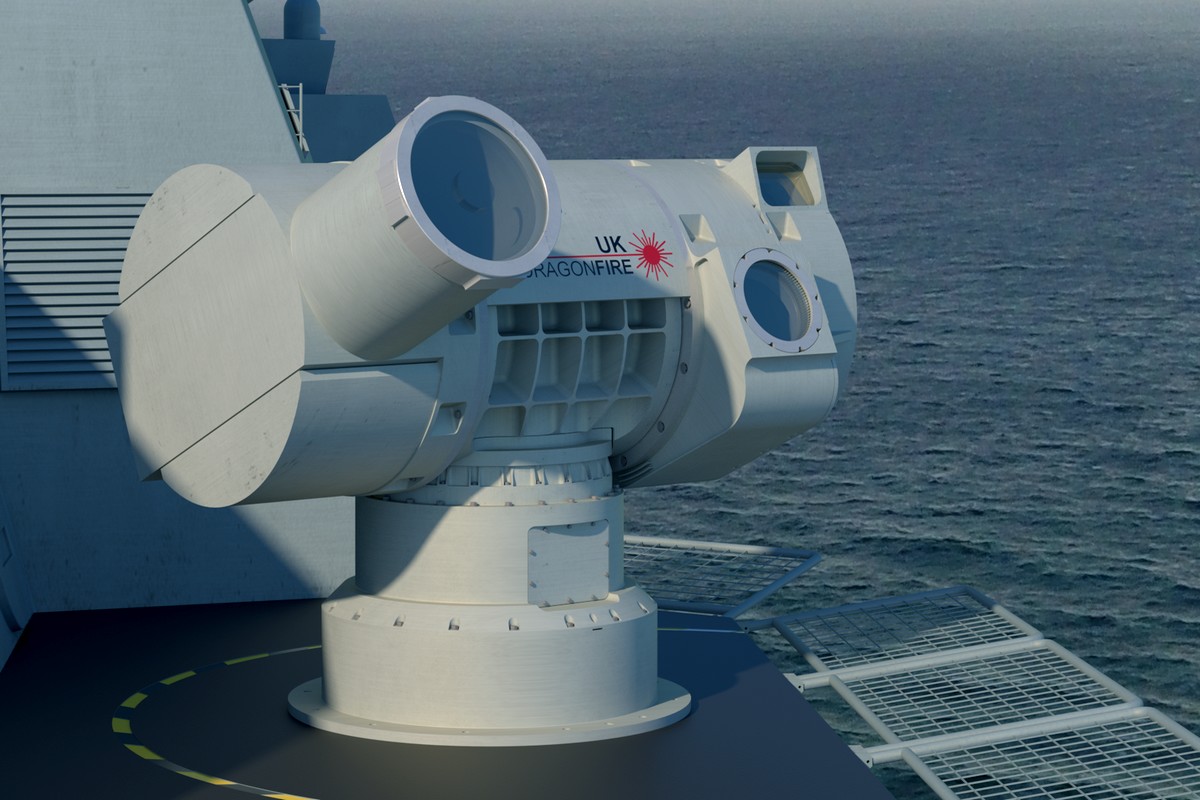
The UK DragonFire laser weapon remains on course for Royal Navy deployment by 2027, with ministers reiterating existing plans rather than announcing further acceleration.
Responding to a written question from Lord Spellar, Defence Minister Lord Coaker said the government is committed to advancing development, testing and integration of the system.
“The UK Government is committed to accelerating the development, testing, production, and installation of the DragonFire high energy laser system,” he said.
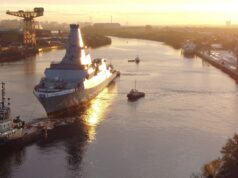
However, the timeline referenced reflects progress already in motion. A contract for the first two systems was awarded to MBDA in November 2025, with the first due to be installed on a Type 45 destroyer in 2027, five years earlier than originally planned.
Two major firing trials completed in 2025 have supported the system’s move towards operational capability, with the UK aiming to become the first European NATO nation to field a laser-directed energy weapon.
DragonFire is a British-developed laser directed-energy weapon being built by a consortium including MBDA UK, Leonardo UK, QinetiQ and the Defence Science and Technology Laboratory. First revealed publicly in 2017, the system has undergone a series of trials in the UK, including testing at the Hebrides range where it has tracked and engaged aerial targets. The weapon is designed to counter threats such as drones and mortar rounds, using a high-energy laser in the 50 kilowatt class, according to previously released information.
The system combines multiple glass-fibre lasers into a single beam and is mounted in a turret alongside tracking sensors, including an electro-optical camera. Trials have demonstrated a high degree of accuracy, with the Ministry of Defence previously stating the precision is comparable to hitting a small coin at a distance of one kilometre. Its range remains classified, though it is understood to operate as a line-of-sight system.
One of the key features highlighted by the Ministry of Defence is the comparatively low cost per shot, which has been described as around £10, significantly lower than conventional missile interceptors. As an electrically powered system, DragonFire also reduces reliance on stored munitions, which may have implications for sustained operations where resupply is constrained.
The programme has been brought forward from an earlier in-service date later in the decade, following successful trials and additional funding. Beyond its initial deployment at sea, the technology is also being explored for use on land platforms and potentially in the air domain.



Nice to see some positive news out of UK defence. Dragonfire could be a major win from both a defence and industrial aspect, if we can market it to our allies over potential US rivals
Let’s face it – there are a few war zones at the moment. If it shot down everything that came within range in one of those war zones firstly they would have proved their worth, secondly we could commit to installing them on every ship in the RN plus British bases world wide not to mention an excellent export market. We could be building and exporting them in their thousands.
Slightly off topic but Pete Hegseth just referred to the Royal Navy as “a big bad navy who can do this stuff as well” when referencing a naval operation to re open the straits of Hormuz.
Sounds like a TACO is coming with a declaration of victory from the Trump administration, apparently if countries don’t want to get their fuel from the gulf they can buy it from the USA so it’s a big “American victory” 😀
The UK is probably the only other country in the world capable of stitching together a coalition of countries to deploy a force in the region(which I guess is what Hegseth is referring to). A single UK T45 and the MCM drones is probably enough for us to get by on. Countries like South Korea, Japan, Australia, France and Germany can and should all contribute vessels.
It would be very useful to have separate Chinese and Indian naval operations in the straits as well. This is very similar to the operations the UK lead of the Somalia where China and India also made their own separate contributions.
I’m guessing we will need to lift what ever sanctions remain on Iranian oil from the UK and EU however the USA already seem to have defacto removed its sanctions.
Iranian hard liners will no doubt feel in boldened but just like with the Taliban they may rapidly find themselves in a civil war once the outside threat disappears. Their command structure survived by splitting the IRGC into 31 separate independent commands. After so many leaders were killed they may not all agree on who the new leader is.
With the ability to easily incorporate lasers and the addition of sea Ceptor, a limited land attack and first rate anti ship capability with NSM, the T45 is slowly becoming the fully capable destroyer we need.
Even the two onboard wildcats are now becoming important anti drone air warfare assets, maybe the best in the world. As long as it can be done without minimal impact on the warship production, I do think delaying the T83 as long as possible makes sense. Unlike the T42 which were largely useless on the day they were launched, the T45 still has a lot of capability. If more missiles and land attack capability is required this can easily be provided by something like a T91 sloop with 16 mk41.
We need to role out the Aster30 NT missile as soon as possible but once that’s done the T45 would seem to be the ideal platform for most air ware fare threats and with 80 missiles onboard (48 Aster, 24 CAMM, 8 NSM) that’s only 16 less than the Flight III Arleigh Burke.
It’s certainly nice to see.
On a side note the Type 42s were certainly very useful. A slightly larger platform with a short range/low altitude defence (e.g. the T43 design with sea wolf) would have been more flexible, but they were crucial in the Falklands with keeping enemy aircraft at low altitudes, especially as the RN in the 70s-80s was really poor on air defence for any other vessels.
My point on the T42 is it should never have gone to sea without sea wolf and phalanx. The Type 22 and Type 42 were being built at the same time. T42 was a dated design when being built, by the time it left service it was close to useless in its primary role.
Type 45 is very different. Lots of room for growth and a very capable radar arrangement with lots of electrical power for future growth.
👍
I just came across this amazing way to earn $6,000-$8,000 a week online! No selling, no struggle—just a simple system that anyone can follow. Mia Westbrook did it, and so can you! Don’t miss out on this life-changing opportunity.
Follow Here ………………… http://www.giftpay7.vip