

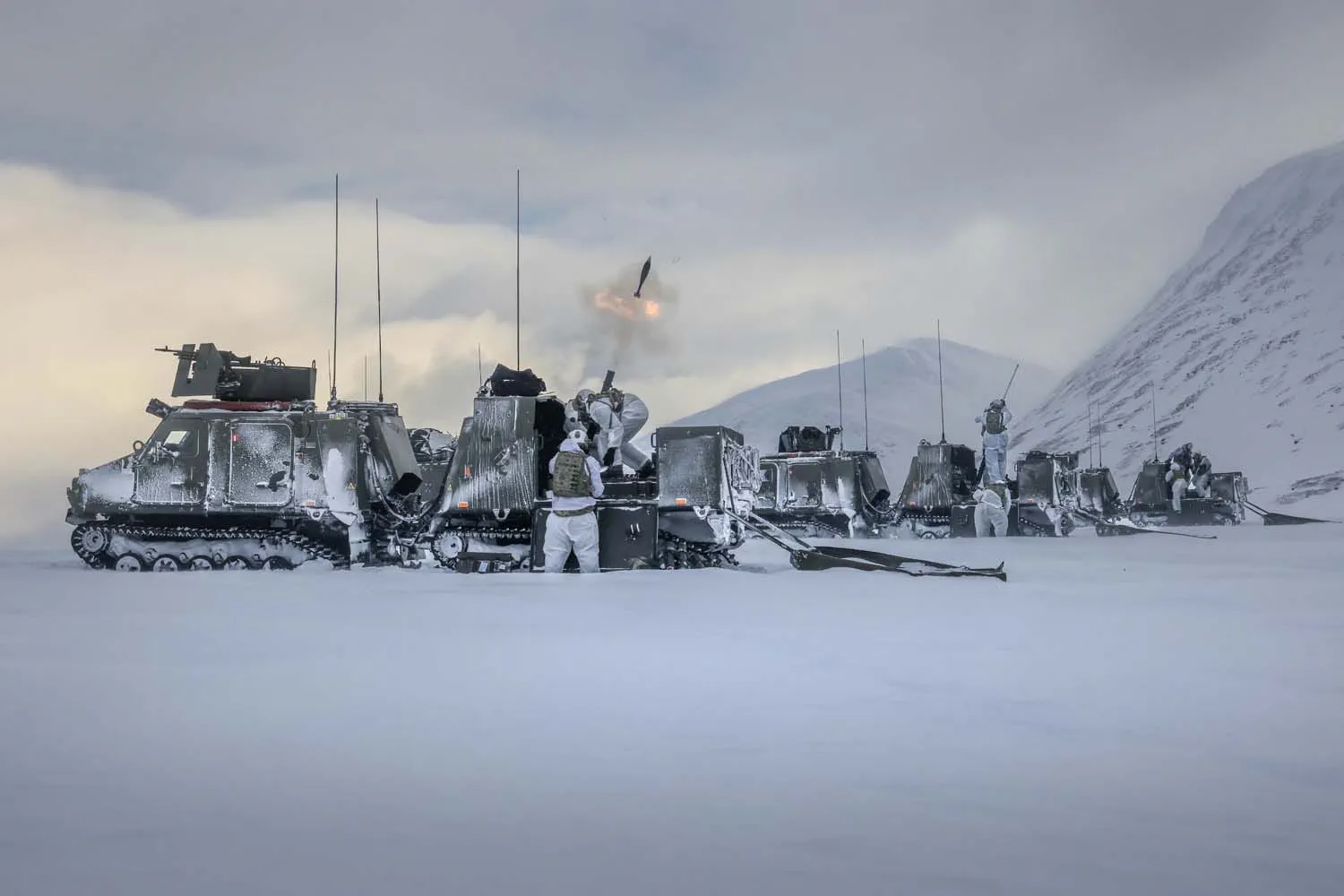
The UK and its European allies should move towards a more forward-leaning military posture, including stronger defence in the Baltics and High North, as part of efforts to shift Russian risk calculus, according to a parliamentary report.
The Joint Committee on the National Security Strategy highlights criticism from experts that the current approach to managing Russia-related risks has been too incremental, contributing to a more attritional form of conflict in Ukraine rather than enabling decisive outcomes. In response, witnesses argued that European readiness should focus on forward defence in areas most exposed to Russian pressure.
The report also points to the need for deeper integration between the UK and European allies across defence industry, procurement and supporting infrastructure such as transport networks. A more “flexible and scalable” defence-industrial base is seen as essential, particularly if Europe is to reduce reliance on US support over time.
There are also calls for new mechanisms to support this shift, including closer cooperation through NATO or a “coalition of the willing” focused on funding and developing strategic capabilities. Integrating Ukraine into Europe’s defence-industrial base is highlighted as a priority, both to sustain its economy and to leverage the experience it has gained in combat.
On deterrence, the report notes concerns that Russia lowered its nuclear threshold in 2024, prompting suggestions that the UK should consider sub-strategic capabilities more closely. While recent steps to deepen nuclear cooperation with France and participate in NATO’s dual-capable aircraft arrangements are welcomed, experts stress that credible conventional forces remain central to deterrence.
Beyond continental Europe, the report flags the Arctic as an area where the UK risks falling behind. Despite longstanding strengths in polar science, some witnesses argue that Britain is not giving sufficient strategic attention to the region, particularly as tensions increase and areas such as the Greenland-Iceland-UK gap and Svalbard become more contested.
The report also warns against assuming a fundamental shift in Russia’s long-term trajectory. Experts describe “Putinism” as entrenched, centralised and likely to persist beyond any individual leader, urging caution about expectations of a post-Putin reset.
Alongside these strategic concerns, MPs and peers identify broader weaknesses in how national security policy is developed and delivered. They say industry and civil society were not sufficiently engaged in shaping the National Security Strategy, and warn that a lack of transparency, particularly on issues such as China, risks undermining public trust.
The committee calls for clearer accountability across government, including identifying which ministers are responsible for delivering specific elements of the strategy. It also recommends regular reporting to Parliament and annual progress updates to track implementation.





For goodness sake, we are repainting Bulldogs as fast as we can. What else do they expect?
We are going to fill the gap with what ?, with only 45Cdo group who train in the Artic (Norway) so is the Army going to commit 2 or 3 Para (as in the 70’s and 80s) to work along side 45Cdo.
Norway and Denmark now have Finland and Sweden to help out in the Artic but if we want a say in what happens in the Artic area then we must commit more troops and equipment if we are to be taken seriously. But that is a big ask at the moment when our Political elite are happy with the UK military being the but of European and US jokes.
🤥
I see you are still on your 5 year mission to boldly go where no Proctologist has gone before, up your own backside.
If you have nothing constructive to contribute to a conversation go back picking the peanuts out of your phoo.
And you think your lies are “contributing to the conversation”…?!?
ATM Scandinavian ground forces is basically 45 Cdo Group, 3 Ranger and I think 3 SCOTS.
But it is only 45Cdo group who keep their Arctic training up to speed ie they go each year and bring all the new bods up to Arctic trained readyness, the Army have not had an infantry unit regaly train in Norway for quite some time so within a year or 2 the majority of the Arctic trained bods in the unit would have left.
3 Ranger is permanently deployed to Scandinavia and the Baltic, and keep their Arctic training up to date as far as I can see given their persistant presenced there.
With all due respect the Baltic dose get a bit nippy but it is not in the Arctic with average temp well below -20. 3 Rangers are doing a good job in Estonia and have been sending guys to Norway to work with 45, but as a unite they have not deployed and worked in the Arctic. It was the 1st time in quite a number of years that we saw 40Cdo’s support coy working with 45’s support coy but that experiance will be lost in short order as the guys will not be going back to Norway unless the government change their minds and reinforce our commitment to the high North then it would be worth having 1 unite from the Army deploy alongside 45, 3 Rangers might be a good idea or one one the Para,s along with their support units
Well I can’t help it if I write a single sentence and you choose not to pay attention to it. 3 Rangers are persistently deployed to *SCANDINAVIA* and the Baltics.
3 Ranger doesn’t deploy “as a unit” btw, deploying as a unit is not in their ConOps, same as every other Ranger Battalion. They deploy SOTU’s and SOTG’s, persitantly.
Britain will never be able to defend itself, let alone lead in NATO while pursuing the unevidenced madness of net zero.
‘Since 2019, there have been many attempts to put a cost on achieving net zero by 2050, with wildly different results…The cost of net zero is highly likely to be above the 2020 estimate of roughly £3 trillion from the National Electricity System Operator (NESO), and could even be above this year’s attempt, which calculated gross cash costs of £7.6 trillion or over £9 trillion including the carbon costs of emissions.
If we are to have a serious debate about net zero, the various public bodies need to be more transparent and frankly more honest, both about the upfront costs and their assumptions about the operational savings that net zero will bring.’
‘The Cost of Net Zero’ IEA Report Jan 2026
🤡
‘The North Sea Transition Authority’s most recent reserves report, published in late 2025, estimates proven and probable (2P) reserves on the UK Continental Shelf (UKCS) at 2.9 billion barrels of oil equivalent as at end-2024. Contingent resources – discovered but not yet commercially developed – add a further 6.2 billion barrels. Prospective resources (unmapped and unmapped leads) add 4.6 billion barrels on top. In total, the UKCS holds an estimated 13.7 billion barrels of recoverable resource across all classifications.’
‘UK Continental Shelf (UKCS): recoverable gas reserves amount to 456 billion cubic metres (bcm), more than six times the UK’s annual requirement and more than double the NSTA’s production projection of 226 bcm between 2025-2050.’
All sounds good and had we invested in a Sovereign Investment Fund like the now super wealthy Norwegians I might have agreed to some of that. But truth is we haven’t been self sufficient in gas since the turn of the Century, our sector of the a North Sea has never been a great reserve of gas despite your figures and due to ridiculous historical outdated entrenchment when it was cheap, gas is now not only the most expensive method of producing electricity but is used to cost our energy bills to the consumer, unlike some of our competitors like Spain. Of course the rush to get rid of coal (rightly however) and the short sighted under investment in nuclear to replace old stations meant the genius decision to commit to being massively reliant upon that (once cheap) gas fired power stations which one might have thought would have led to further exploitation of the stuff back in the day. Fact is that another statistic I read only last week (those damn contradictory ‘expert’ statistics eh), argues that our sector of the North Sea is now over 90% depleted and argued that while new reserves do exist the cost of extraction is barely profitable even at prices prior to this recent upturn. The pro extraction lobby argue to make it worth while we should reduce taxes on the whole North Sea oil production, but this would not guarantee supplies to Britain (without Govt policy change which would hardly encourage oil producers and it’s too late for a SWF) while reducing the overall benefit to Britain financially as tax is effectively our only wealth creation from it. So rather Catch 22. It should also be noted most of the Norwegian investment now is going into the arctic regions that we do not have access to. I don’t have any great problem selectively extracting more oil and gas from the North Sea if we can profit from it but anyone who thinks it’s going to be anything but is a distraction from the real need to invest in freeing ourselves from fossil fuels is living in Cloud Cuckoo land while dreaming of being on Cloud Nine, which accounts for why Trump is so invested in the idea.
California the hub of western World and indeed US growth and investment which uses immense amounts of energy is on occasions 100% renewables and nuclear, which rather ‘statistically’ argues against the idea that renewables equals high energy costs and lack of competitiveness. Equally India in little more than a year introduced more renewable energy generation than Britain has in all its history of the transformation. They know reliance on oil and gas may be a present necessity, but ultimately is no answer to longer term economic growth. Little we do now in the North Sea is going to noticeably influence our generation costs, it’s all far too late to imagine that outside of opportunistic politicians trying to pull oil soaked wool over our eyes. Don’t let’s fall for something that will keep us tied to dodgy parts of the World and deluded Presidents dictating our energy prices (because Brent Crude is insignificant in that) just so, like the Trump family and hangers on themselves they can make millions out of the process and insider trading. It’s a con.
This is not complicated.
We still have gas and oil in the North Sea. We could very easily have more energy from fracking. We hsve nuclear. We have coal which is a great deal cleaner now. We cannot remove gas from the equation because we need back up for intermittent renewables.
All we lack is a competent energy minister with a sensible plan.
We know net zero is not that plan:
‘The cost of net zero is highly likely to be above the 2020 estimate of roughly £3 trillion from the National Electricity System Operator (NESO), and could even be above this year’s attempt, which calculated gross cash costs of £7.6 trillion or over £9 trillion including the carbon costs of emissions.”
The plan should be nuclear + renewables + fossil until such time as battery technology permits environmentally sensitive and feasible storage capacity.
Net zero simply leaves the country defenceless and broke…last man out no need to turn off the lights…
California?
‘Two Northern California cities just learned – again – that local “electrify everything” mandates run into both federal law and energy affordability. California cities Petaluma and Morgan Hill…have repealed or removed their rules banning natural gas appliances in new construction after facing…the reality that forcing electrification could drive sky-high state energy costs even higher.
In January, the DOJ sued Petaluma and Morgan Hill:
“In pursuit of “electrification,” these bans deny consumers reliable, resilient, and affordable energy, as well as the use of commonplace gas appliances for cooking, heating, and other household needs. But natural gas is often the lowest cost and most efficient energy source for uses like these—outperforming electric on both expense and lifecycle emissions’
Defenceless and broke…