

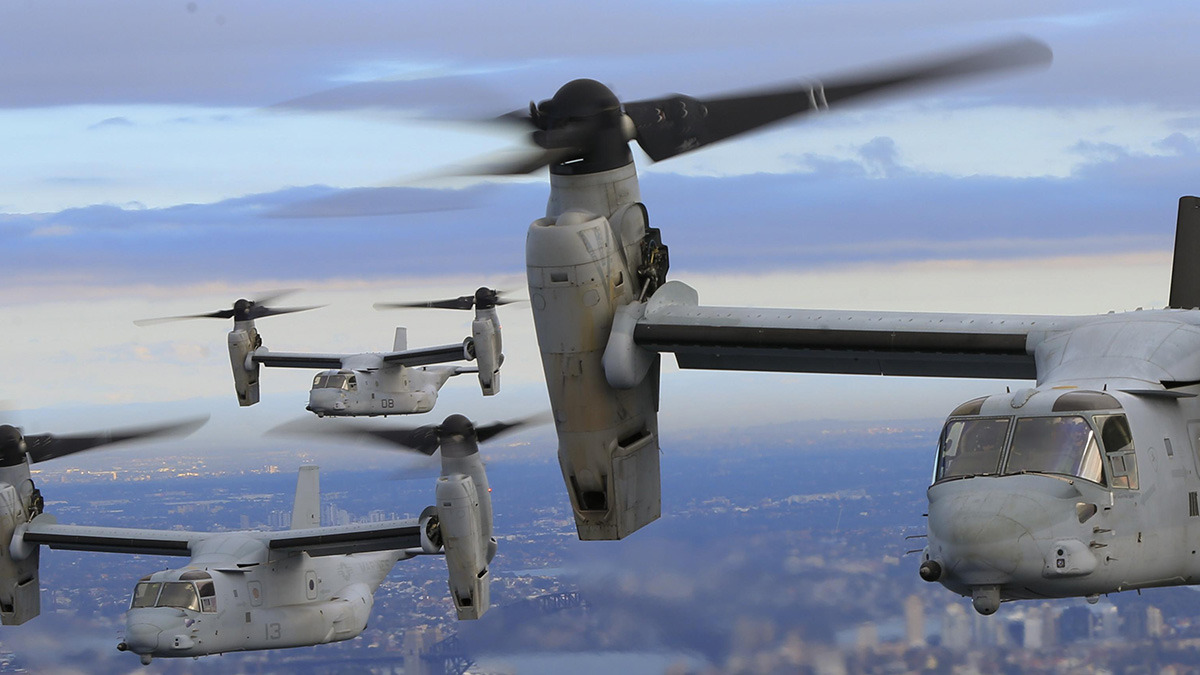
Bell and Boeing have completed the MV-22 Program of Record for the United States Marine Corps, closing out deliveries of the tiltrotor to the service after 359 aircraft, the companies stated.
The milestone was marked with a ceremony at the Bell Amarillo Assembly Center in Texas on 28 July. The Marine Corps operates the largest Osprey fleet of any service, and attention now shifts to sustainment and upgrade work, with the companies saying the Corps expects to keep the type flying until 2055.
Eldon Metzger, V-22 programme director at Bell, said in the release that for the Marine Corps the milestone “isn’t an end, it’s a transition to the next chapter”, and that the company is committed to delivering sustainment, readiness and modernisation.
Colonel Robert Hurst, programme manager at the V-22 Joint Program Office, described the completion as significant, saying delivery of the MV-22 has “extended the reach and lethality of the United States Marine Air-Ground Task Force for 20 years”. He said efforts remain focused on fleet readiness, capability and modernisation.
Danielle Hoelzer, V-22 programme director at Boeing, credited engineers, technicians and suppliers with delivering a capability that lets the Corps operate with speed, range and flexibility, adding that the companies remain “committed to keeping the fleet mission-ready well into the future”.
The release points to several operations the type has flown. Marine Ospreys have been supporting United States and partner nation search and rescue teams following the Venezuela earthquake since 24 June, and the aircraft were used through Operation Inherent Resolve in Iraq and Syria for troop movement, resupply and casualty evacuation.
During the 2022 Haiti earthquake response, the companies state MV-22s flew 5,300 nautical miles, moved more than 230,000 pounds of food and carried 320 aid workers. The type also supported the 2009 operation to recover Captain Richard Phillips after the hijacking of the Maersk Alabama.
Bell and Boeing say Team Osprey draws on more than 500 US-based suppliers across 44 states and some 27,000 employees. Production continues on the CMV-22 for the US Navy, which uses the variant for carrier onboard delivery in place of the retired C-2 Greyhound, and the partnership is running the Nacelle Improvement programme intended to address maintenance burden on the Air Force CV-22 fleet.
The Osprey was the first tiltrotor to enter military service, reaching initial operational capability with the Marine Corps in 2007 after a development history stretching back to the 1980s that included fatal crashes and repeated attempts at cancellation. The aircraft takes off and lands like a helicopter but cruises like a turboprop, roughly doubling the speed and radius available from the CH-46 Sea Knight it replaced.







Feels like tilt rotor still waiting to be fully embraced.
I think the smaller, newer MV-75 Cheyenne II/M-280 Valor will certainly see a much bigger production run than the Osprey and should normalize acceptance of tiltrotors more than the Osprey has. If it’s successful in US Army service in supplementing and replacing the Black Hawk, it will likely have a greater export potential than the bigger Osprey has.
That said, the US Marines have certainly embraced the tiltrotor, and the USN, USAF and Japanese Self Defense Force have to a lesser extent.
The AW609 is also an interesting tiltrotor program.
Paul,
Certainly agree, MV-75 is an impressive development w/ improved mechanical design v. V-22, including inherent increased safety w/ single RR Allison engine capable of powering both rotors, if necessary. Presumed increased maintainability, reliability, (oh hell, all the “ilities”). Other than the reduction in troop-carrying capability vs. Osprey (14 v.24), not certain there is any additional downside. AW609 is intriguing, but will certainly lag in developmental timeline for military role (despite Italian Navy shipborne trial) and has a reduced troop-carrying capability. Anticipate eventual lucrative FMS market; US MIC still occasionally produces a successful product. 🤔😊👍
Well it is costly, takes much more space while landing, disk loading of 150kg vs 50kg in comparison to an UH60 makes it impossible to land in some situations and it is much more mechanically complex than an helicopter. That makes it heavier and also with a big logistic footprint. Piloting an issue too.
Unless some technological breakthrough happen, tilt rotors will remain a niche.
Spoken like a true Brit- provincial to the core. The Osprey is a direct replacement for the Ch-46 not the Blackhawk. It has greater speed and twice the range of the Chinook. Unlike the UK, the US is a global power, and its main adversary China operates in the Pacific where range and speed make all the difference. Of course, the US Marines have no experience fighting in the Pacific and they are stupid not to listen to some Brit sitting on a dinky little island off the northern coast of Continental Europe who knows so much more.
Who says i am Brit? Ch46 was niche.
Tiltrotors have their place, they can do things that no conventional helicopter could ever do.
I don´t disagree, they might be better than helicopters in some missions.
Osprey is not an optimised tiltrotor for disk loading. The MV-75 has no requirement for folding and so has much larger rotors, while the abandoned V-247 UAV had a slimmer fuselage for better disk loading while still folding for naval storage.
A solution in need of a problem.
Needed simplicity in it’s life and a less ferocious ground wash that buckles deck plates.
Not much use without airwolf