

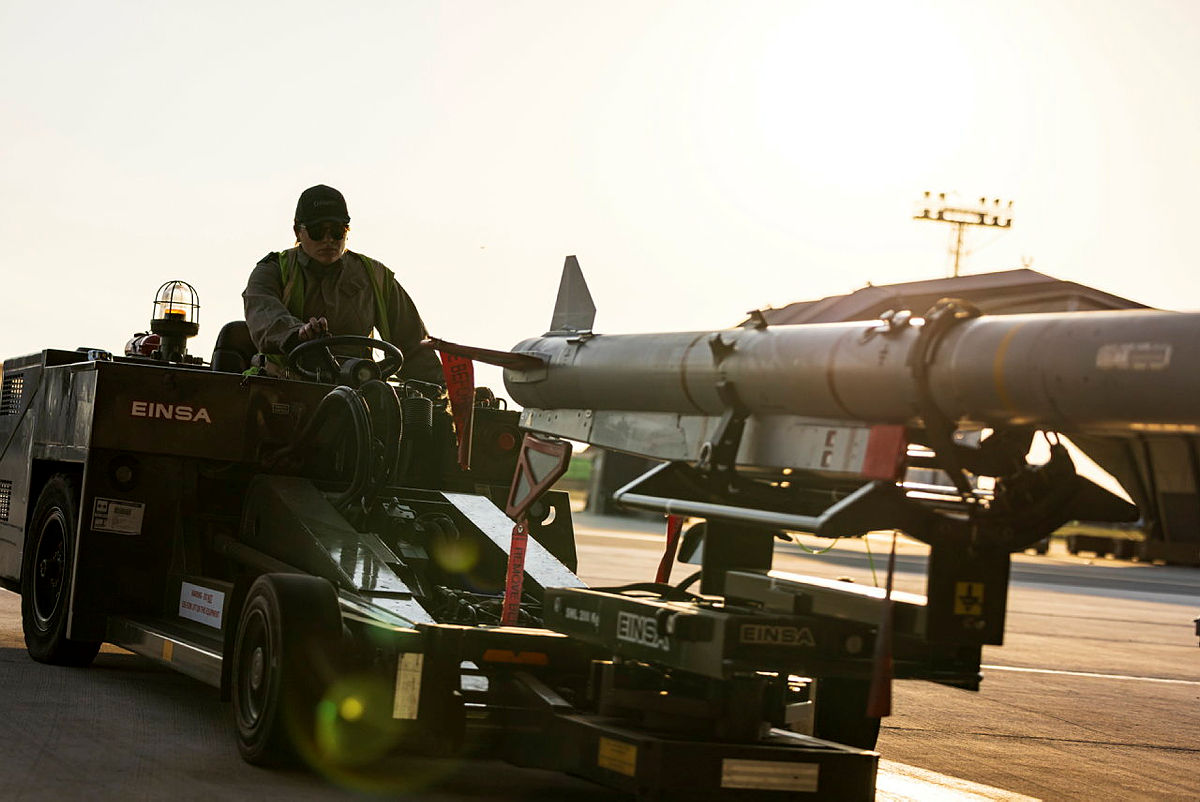
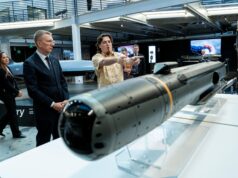
The government has confirmed that integration of the MBDA Meteor air-to-air missile with the F-35B remains on an early 2030s timeline, with Minister Luke Pollard telling parliament on 20 April that “integration testing continues and the estimated timeline for in-service capability remains the early 2030s”, adding that the work is driven by the US-led Lightning II Joint Programme Office.
The answer offers nothing new, which is itself the story, given that the weapon has been in development for integration onto the F-35 since 2019, has slipped from a mid-decade target to 2027 and then again to the early 2030s across multiple administrations, and the latest parliamentary answer contains no indication that the pace is about to change or that anyone in the programme is treating the delay as a problem that requires urgent resolution.
The structural reason for that is the F-35’s Block 4 software upgrade, which is a prerequisite for integrating any new weapons including both Meteor and SPEAR 3 and which has itself run significantly late and over budget, having risen from an original cost estimate of $10.6 billion to around $16.5 billion with completion now anticipated around 2029, and because any weapon integration on the F-35 requires approval and coordination through the US-led Joint Programme Office the UK has limited ability to accelerate things unilaterally, with partner nations having little recourse when the programme misses its own targets.
That structural dependency matters beyond just the Meteor timeline, because it means the UK’s ability to equip its most capable combat aircraft with the weapons it actually wants is contingent on a US-led programme that has consistently underdelivered, and the same constraint applies to SPEAR 3, to any future weapons the UK might want to integrate, and potentially to GCAP if lessons from the F-35 experience are not applied to how that programme is structured from the outset.
Some progress has been made, with the RAF confirming in February 2025 that the first test flights of an inert Meteor on an F-35B had been conducted by the US Marine Corps at Naval Air Station Patuxent River, and ground vibration testing and fit checks on the F-35A were completed at Edwards Air Force Base in December 2025, though the fact that those milestones are still being described as significant progress illustrates how much of the journey remains ahead before the weapon is anywhere near operational service.
In the meantime the F-35B carries the AIM-120 AMRAAM as its primary beyond-visual-range missile, which is a capable weapon but has a considerably shorter effective range than Meteor, whose ramjet propulsion gives it a no-escape zone regarded as significantly larger than any comparable missile currently in service and which is already operational on the RAF’s Typhoon fleet, meaning the UK is flying two front-line combat aircraft types where one has a materially superior air-to-air capability to the other, and that gap is not going to close for the better part of a decade at the current pace.







Meteor on F35 is not that big a deal, AMRAAM D is highly capable and given its half the price of Meteor both missile have a long term role to play on F35B for the UK.
SPEAR is much more important
I’d strongly argue against the line in the article stating that Typhoon has superior air to air capability. Even with the shorter range AMRAAM the F35Bs all aspect stealth and APG-81 radar will make quick work of a Typhoon at BVR ranges. The gap will close when Typhoon receives ECRS MK2, but the stealth makes a huge difference for F35. He who sees first, shoots first. Kill.
Yes however since the chance of an F35 and a Typhoon coming to blows are unlikely it’s probably not the best metric to compare.
With the ECRS mk2 typhoon will probably have a significant detection advantage over APG 81 by possibly as much as 40km, typhoon also has significantly better kinetic and altitude performance.
In an BVR engagement with Meteor against Russian aircraft Typhoon has a significant advantage in BVR over F35 however F35 is able to get in significantly closer and does not rely as much in expensive long range missiles as typhoon.
In air policing Typhoon is superior to F35, in almost all other scenarios F35 is superior.
Together they are a formidable paring
The F35 also has APG-85 coming, and is already being delivered to new build F35s. You are right about the kinetic performance advantage of Typhoon, but F35s overall advantages of sensor fusion, stealth and ISTAR capabilities gives it a considerable advantage. The RAFs experience with F35B with Typhoon has proven its 5th gen advantages. Like you say though, paired together, they are a very formidable team.
APG-85 is not being delivered, still a couple of years out.
I agree Meteor has distinct advantages over AMRAAM in its kill radius so against anything other than a stealth target gives Typhoon potential advantage. More interesting is Gripen’s (in E/F version) performance with Meteor with probably the most advanced IR sensor installation available (we saw Iran managed an IR ‘hit’) and a level of digital stealth too, while being able to share data seamlessly with other Gripens. Technically it might be able to detect an F-35 at distance passively and attack using Meteor but if this has been physically tested in an authentic scenario no one is giving out the results. But in this regard it is arguably the most capable air to air 4th Gen combatant out there against stealth opposition, certainly the most likely to catch an F-35 pilot unawares till Typhoon gets its new radar anyway. Meanwhile it’s eating F-16s et al for dinner.
The issue here would be the data-link. If say Gripen could detect a target at 50km with its IR sensor. Meteor will still need a mid course update, as its active radar won’t have the range to see the target. As soon as the data-link is activated, your opponent might detect it, if they have the right ESM. This gets worse over the distances that Meteor can go, as the launch aircraft will have to do more updates through the engagement. This remains true even if a 3rd party is guiding the weapon and the F35 is purely acting as the launch platform. However a lot of the 4th gen aircraft don’t have the necessary ESM, so are unlikely to detect the data-link transmission.
Gripen’s IRST is a smaller, less capable version of the Typhoon’s PIRATE….
Just like its original radar was a smaller, less capable version of CAPTOR-M
The new ES-05 radar, again from Leonardo, is massively less capable than the ECRS series of radars…its far smaller with less power available and far fewer TRM modules…
“But in this regard it is arguably the most capable air to air 4th Gen combatant out there against stealth opposition..”
Good luck arguing that 😀
Having had a conversation with a Typhoon pilot on a front line squadron who spoke quite openly. I asked the F35B question. Clean at distance the 35 has a clear advantage. Typhoon with a sentry help that reduces reduces. Up close the F35B is dead every time. I also asked him the question why the wingspan of the F35B is the size is. Straight away he came back “so it fits in the US amphibious ships hangars”
The F35B was designed for one customer the USMC.
It broadly speaking is doing what they want it to do, ground attack. Their is never going to be and never was a priority for the US to clear any non US weapons.
If the the 35 appears over the North Sea carrying external stores which is almost never that is a game changer.
Typhoon pilots if they get in close have the added advantage of the gun.
Taking a knife to gun fight means you are the one that ends up dead
Yep, why on earth would the F-35 get close to a Typhoon. Mugs game.
They do just that several times a week over the North Sea. Along with F16,F15 F35A also routinely with the aggressor force from Teeside airport.
Yep that’s a real war going on there (eyes roll)
As real as it gets for us. Unless we take part in the US form in the their desert training areas.
I am sure all the NATO countries that take part believe it has value. Along with countries like Qatar and Switzerland that join in.
No doubt they will take note of your derision.
I can assure you that following these training sorties our Typhoon pilots get great value out of it. They are debriefed using information from all sides and platforms.
You can sometimes track the aggressors, tankers and sentries on ADSB the odd typhoon or F15.
So the RAF labels the practices as warlike exercises? I think not.
The F-35B was designed to fit the UK’s Illustrious class hangars. Maybe hard to believe but true.
No they were not. The specifications were laid by the USMC. In particular the size was limited by aircraft lifts on the LHDs and LHA that the USMC. We had no input at all.
Yes they were as documented by the project team. As a tier 1 partner, the UK had significant input to the specifications.
Sorry but we had no input whatsoever. As Is demonstrated by the whole topic of this article. We are twenty years down the road and still trying to get our weapons cleared. Now that is kicked down the road. By contrast the IDF has had permission and has done alterations to their Adirs. By placing unknown technology into a vacant space in the wing.
Tier one only gave us an opportunity to be a supplier to the project. We had no say whatsoever on specification.
You are arguing against facts. A losing proposition.
They were influenced by the lift size on the Invincible class.
Okay one last time we had no say and nobody from the US even considered the dimensions of the invincible class or any other UK vessel.
Let’s assume you are right.
The lift on an invincible class is
16.66 M x 9.65
The F35B is
15.6 M x 10.7 M
Even you can do the maths. If someone from LM measured the lifts on our ships they must took a SWAG.
If memory serves me well Harrier wingspan came in at just under 8 M
Which gave little clearance on either side.
I was onboard HMS Illustrious when they did trials with a mock up. It fit on the lifts. Just.
The maths does not lie. F35B is a much bigger aircraft. If you were lusty you would know a harrier with ferry tips only made it withe a foot to spare at the most. The F35B has no chance of fitting on illustrious at over 10 and a half metres. So your mock up story does not stack up.
@ken Scott. The mock up went on the lift at a slighy diagonal angle to fit. It 100% fit on the lift.
Yeah it’s literally that simple ,no jet has ever evaded or survived 🤣🤣
Tosh.
AIM-120D-3 is more expensive than Meteor….
No idea where you’ve got the daft idea that it is ‘half the price’…
Nope, not half the price but substantially cheaper: approx 1.5 mill against approx 2 mill depending on size of order etc. Dollars.
The cheapest AIM-120D-3 contract in recent years was Finland’s at $2.7m per missile….
Germany, Netherlands and Poland all paid over $3m per missile….
The UK’s FMS case was also over $3m per AIM-120D-3
Germany paid under $2.2m per Meteor in 2025….
And that Meteor per missile cost tracks with other operators.
Grateful if you can find a recent AIM-120D-3 order for 1.5m…..
The fly-away cost for the USA is 1.0 to 1.3M per missile.
DSCR data shows recent sales to Germany of 400 AIM-120D-3 missiles at an estimated cost of 3.07M / missile. Belgium and Norway sales came out to 2.4 to 2.8 M per missile. Total Program Cost is missile + training + spares + software. The “Export” numbers are Total Program Cost, which is what a foreign nations actually pays to add the weapon to their inventory.
Exactly my point….’fly away’ numbers are utterly artificial and have no bearing on reality….
There is an actual, real, cost per missile.
We too could play the game with ‘fly away’ costs for Meteor….but it serves zero point.
The actual costs, in real money, consistently show that Meteor is around 20% cheaper….which for a missile that has higher performance and with a significant amount spent in the UK (c40%) and all monies spent in Europe is a dramatically better choice for most operators…
“We too could play the game with ‘fly away’ costs for Meteor….but it serves zero point”
If you are comparing cost of missiles like we are here, it’s very much to the point.
Dividing FMS estimate’s by number is a a very unreliable way of determining unit cost. However US acquisition reports are rather reliable.
The UK used to report projects in similar levels of details but in a push for open and honest government, they were cancelled /sarcasm off.
Its half the price while America says its half the price.. also its American so a non-sovereign dependancy
And yet Japan and Norway will get their JSM missiles integrated on the F-35 this year. Funny that.
Probably because those nations have actually committed to the JSF programme.
No it’s because JSM is a US weapon from Raytheon. It has multiple customers demanding it so it gets more priority than SPEAR.
Indeed Jim it was significant that a couple years ago military types and even Congress were going crazy over the lack of weapons, especially offensive weapons available to the F-35 in light of reports of considerable Chinese advances in Air Defence making F-35 and refuelling assets deeply vulnerable. Sadly for us they need those missiles urgently, while delaying Meteor gives them little negative effect while actually offering the benefit of keeping a rival off of those aircraft they export while they truly produce a full on competitor and tie in customers. If anything the delay in UK weapons probably only endangers and delays Uk commitment to the overall programme if anything.
Kongsberg in Norway who make the JSM & NSM will be very surprised to hear that.
NSM is Kongsberg only…
JSM is Kongsberg/Raytheon joint venture
JSM is a NSM that can be launched from an aircraft. Raytheon adapted the Norweguan missile for US production and use.
JSM is a joint Norwegian/Raytheon programme….Raytheon did not do all of the adaptation….
Adapting NSM for US use is the joint project. Not developing the missile.
It’s a Norwegian missile. Stop trying to make out its American.
Kongsberg played by the US rules, they set up a factory in collaboration with Raytheon to manufacture both JSM and NSM in the US. This got round the problem of “not made in the USA”. Which then allowed it to be put on the “US products” F35 integration list, hence why its being integrated. If Kongsberg had not set up the collaboration and factory in the US, they would be in the same boat as us with Meteor and Spear-3, not to mention the cancelled Storm Shadow integration, i.e. going nowhere fast.
And the fact that the US placed orders with Kongsberg for both NSM and JSM missiles puts to bed any notion that the missile is American.
It probably also helps that JSM is for external carriage on F35B so the physical integration isn’t as hard. Also, it’s less likely to be launched in strange aerodynamic scenarios.
F-35B external carriage is not believed to be part of the integration effort. All the effort is on F-35A internal carriage.
Not true. Italy is paying to integrate JSM on F-35B’s.
They have it in a plan…but its not contracted yet.
You just contradicted yourself dude.
An unfunded plan/ambition is not the same as a contracted piece of work….
Until Italy actually contracts the JPO and LM to integrate JSM to F-35B it will not happen….
They have not contracted yet, and may never do so…
The money is committed in the Italian budget and has been for some time. I’m not sure if such contracts with LM are publicized as you seem to think.
If it gets integrated for external carry on F35A, then it’s also ok for external carry on F35B. If it gets internal carry on the A, then the missile is integrated into the software. From there to external carry is relatively easy.
US & LM had to get JSM integrated asap as it is the big missing piece of the puzzle. They need to have at least one good heavyweight AShM / land attack missile available. The fact that JSM fits internally in the A & C puts it ahead of alternative options.
It might be easier…but it still needs a contract.
LRASM is also on the integration pathway….
In block 4 which is some way aways.
“If it gets integrated for external carry on F35A, then it’s also ok for external carry on F35B”
Soooo not true.
Japan and Norway are integrating JSM on the F-35A. Italy is integrating on the F-35B.
To be honest I think they will probably need to bit the bullet and buy the JSM for the UK f35s.. it would give the carrier battle group significant strike capacity.
We always should have committed to get JSM for both Typhoon and F-35B.
We’re an island nation, with a focus for defence in the GIUK gap and an expeditionary stance towards security alliances worldwide.
To not be able to strike at surface targets with neither our land based QRA aircraft, NOR our principal carrier strike aircraft is madness.
We’ve got nothing in or planned for inventory that is equivalent to JSM, so it’s a no-brainer to get it. Plus, I believe seeker and warhead are the same as NSM, so there are maintenance economies.
Completely agree
The UK is paying for the development of Stratus which will be a direct competitor to JSM. Why on earth should the UK buy JSM?
Because Stratus does not yet exist. JSM does exist. JSM is getting integrated on F35 right now. They can’t integrate a weapon that doesn’t exist & the F35 weapons queue is way too long already. Right now, UK has 2 carriers but its embarked fighters have no heavy AShM or long range strike missiles & won’t have any for at least 10 years (or more) unless they buy JSM. NSM was bought for the frigates for much the same reason. As JSM fits internally on the F35A, the missiles could be used on them when Stratus eventually becomes available on the F35B.
Yep completely agree it’s going to be 6 years to get stratus on typhoon and there is not even yet a published 10 year timeframe to get stratus on the F35b.. I would say the next 2 major wars will be done and gone before there is even a timeline for stratus on the f35B …
Not wanting to assume, so apologies if this is stuff you’re already aware of.
Stratus LO is a stealthy, long range, subsonic cruise missile- 1,000 km range, big warhead. It’s a Storm Shadow replacement that can be surface launched from Mk41 and target moving ships as well as fixed land targets- so presumably a similar sized warhead to Storm Shadow too. It’s a great capability (Like a stealthy TLAM BkV), but not even sure it’ll fit on a F-35B, let alone in one- integration timescales will also be an issue. Earliest date for fielding I’ve seen is 2028, on the T26- but we’ll see what happens to that when we finally get a defence review.
Stratus RS is a hypersonic missile with (presumably) shorter range, intended to hit high value targets of opportunity on land and in the air, support SEAD/DEAD, and also kill ships. It’s going to be very expensive, like the air-launched SM-6 that the US has come up with, and also probably will not fit inside an F-35B- but is also unstealthy. Earliest in service date for this that I’ve seen is 2032, but it’s being led by France, so that may not be the date it’s available on either a Typhoon or an F-35B.
From what’s available on both Stratus missiles (at least the stuff I’ve seen), neither are a direct replacement for NSM, so I don’t think an NSM buy would be wasted.
I know that JSM doesn’t fit inside the F-35B’s bays, but it is being integrated onto the external hardpoints, onto the P-8A, and could easily be integrated onto the Typhoon. It is available now, rather than in 8+ years, and could serve as a respectable low part of a high/low mix even after the delivery of the Stratus missiles.
Excellent argumeOK.
I suspect if JSM were to be acquired, STRATUS would be cancelled and SPEAR would be on shakey ground. Maybe that’s ok.
*argument
You highlight a very real risk- one that could only come from UK MOD…
I’d hope that it would be treated like NSM- an interrim solution that can be extended into service alongside the (same) planned future weapon. But whether we’re allowed two sensible decisions in the same 10-year period is an open question…
As far as STRATUS and Spear are concerned, I think Spear will be in greater danger- as it’s already behind, has no crossover with Navy use, and is arguably being overtaken in functionality with drones.
But I really hope it will continue, mostly for it’s future potential rather than the capability it offers now. It’s better than what is currently available (Storm Breaker, JDAM-ER), but it’s no longer the step-change it was 5-10 years ago when it was supposed to come into service. But, with a longer-ranged rocket motor, EW payload, development of the loitering capability for more sensitive missions, warheads with different effects, it could become a really useful tool.
Agree 100%
Stratus LO or RS definitely won’t be able to fit in the F35A let alone a B, due to their physical sizes. JSM is more of a lightweight compared to these. Storm Shadow is a 1300kg class weapon, whilst JSM is just over 400kg. Stratus-LO is supposed to have twice the range of Storm Shadow. Which would logically mean, it needs to hold more fuel if its travelling at the same speeds, so will be bigger and heavier.
I’d say if Stratus-LO is going to be carried by both Typhoon and F35B, then it will only be a pair of weapons under the wings. GCAP, perhaps twice that, i.e. carrying four.
The Stratus-RS is an interesting one, as I have a feeling it will be in real life similar in size to the ASMP, including a similar range. But like the ASMP it will be much lighter than the Stratus-LO, so perhaps aircraft like the Typhoon, Rafale and F35 could carry four, with GCAP carrying eight.
I’d agree with the above.
I don’t mind that JSM is lighter weight than Storm Shadow- it fills a niche and is plenty big enough to at minimum mission kill pretty much anything in the Russian (or Chinese) fleet. It’ll also handle smaller land targets that would be a waste of Storm Shadow/ Stratus LO. The fact that it can launch from Typhoon, F-35B and P-8A (has anyone looked at putting it along the centreline of an MQ-9B..?) makes it a no-brainer purchase for me, especially as we at least partially refocus to the High North.
I’m interested also that you’re seeing GCAP as a larger aircraft than both- more of a ‘fighter-bomber’ than a strike fighter? Bit of a mash-up of WW2 and more modern terms, but you seem to be viewing this as more of a Beaufighter/Mosquito than a Typhoon/P-47 if that analogy works better?
I do feel there’s a place for NSM/JSM, even when we have Stratus-LO and RS. The MQ-9B, should be able to carry at least 2 JSMs as they weigh around 420kg each. The MQ-9B has an external payload of 1400kg.
There have been a number of clues about the size of GCAP. The first is derived from the aircraft’s requirements. Being very long range, the RAF CAS mentioned in an interview that they were looking for an unrefuelled range significantly greater than Typhoon’s, 3 to 4 times was mentioned. But it also going to be “uber” stealthy. Meaning it will be using weapons bays, as anything under the wings will increase the radar cross section. Especially when you require an all-round low observability. For a plane to have very long range, it will require a large internal volume to house the necessary amount of fuel. But added to that is the volume needed for the weapons bays. To meet both requirements, the aircraft will need to be much larger.
The second, I’ve heard that the EJ200 even when modified is not powerful enough, so RR are developing a much more powerful engine. Which normally means it will be a wider diameter, so it can use more air. As a comparison the F35’s F135 engine is about 1.17m in diameter, whilst the Typhoon’s EJ200 is 0.78m. The F135 is nearly 40cm wider, which accounts for why it is much more powerful than the EJ200. I am expecting GCAP to have an engine of a similar size and rating as the F135, but using two of them. As this will be needed to give the aircraft the performance it needs to overcome the aircraft’s size and weight.
My thoughts are the aircraft will be operated more along the lines of the Tornado F3 in air to air combat, i.e. a very good interdictor/interceptor platform, but not a knife fighter. Whilst it will be predominantly a stand-off missile carrier for air to surface. Size wise, more in keeping with the F111 rather than the F22.
I heard that RR might be reviewing use of adaptive cycle (I think that’s the name for it) on this new engine, from some of the stuff they were requested to support the F-35 engine competition. If I understand the tech, because it needs a larger bypass than traditional straight fighter jet engines, it would again be larger- another compounding factor.
Yes, the adaptive or variable cycle engine is the likely the answer. In essence it is like two engines in one, a turbojet and a turbofan. But its actually something more in the middle. Traditionally fighter aircraft have used either a turbojet, where all the air enters the engine’s core. Which is great for max power (plus higher top speed and higher altitude), but not very good for fuel efficiency at cruise speeds, eg The Phantom’s J79. Or they have used a low by-pass turbofan, eg the Typhoon’s EJ200, where a portion of the air coming down the intake by-passes the core of the engine and goes done the outside of the engine. Which is better for fuel efficiency and will develop more power in military and reheat regimes.
A more exotic design is the combined cycle engine, eg similar in principle to the SR-71’s J58 turbojet engine. Which in this case, turns the turbofan into a ramjet. Where the air can be made to bypass the core completely and the reheat system becomes the main combustion area for the engine. As it is a ramjet it will be limited to a theoretical Mach 6, as the ramjet works by slowing the air down to subsonic speeds before it is ignited with the fuel. The engine’s fan would inhibit the engine air being run at supersonic speeds ie a scramjet.
The first publicly seen and used variable cycle engine was General Electric’s YF120 used in the YF22 and YF23 prototype aircraft. Where part of it was later used in the joint RR & GE F136 engine proposed for the F35 that lost out to the F135 engine. The proposed new engine for the F35 was to be an adaptive engine. But I believe they have now settled on an improved F135 engine.
Adaptive cycle engines, use some of the by-pass and feed it in to the engine’s core (more air = more thrust). The bypass air can also be used to help further cool the engine’s core, thereby helping the engine to run hotter, which again helps to make more power. A lot of them are being called 3 stream engines. Where one stream goes into the core. The second stream can either by-pass the core or get fed into it. Whilst the third stream bypasses the core and is used to cool the aircraft’s avionics systems, exhaust temperature etc.
Adaptive/variable cycle engines generally have a slightly bigger fan section (the bit that sits in front of the engine’s core). This is so they can draw in more air. However, the downside, is they can’t be too big. As the mass makes them slower to accelerate (spin up). A lot of science has gone into making the fan section bigger but lighter, by using exotic materials like ceramic matric composites (CMCs). Which are generally used for combustion chambers and power turbines. But as they are significantly lighter than nickel based alloys, could be used in compressor or fan sections. However, they do cost a lot more due to how they are fabricated.
The F47 NGAD’s engine is supposed to be in the 45,000lbs (200kN) class. Which is about 10,000lbs more than the F22’s F119 engine. But it supposed to be a lot more fuel efficient as well. They have pretty much admitted that the engine will be based on the adaptive cycle design. This is pretty much where I see the GCAP’s engine power being. Which is double what the EJ200 can produce. A RR based GCAP Adaptive/Variable cycle engine will give you that power.
no rush, got all the time in the world, like every thing else its will be fine in a few more years. MOD/Government as useless as every
Its pretty clear that Meteor and SPEAR will never be cleared on the F-35. It is not in the interests of the White House, Pentagon or American MIC to clear competitor weapons. The structure of the programme means we have no meaningful recourse.
Time to stop throwing good money after bad and cease F-35 acquisitions, at least until we gain the ability to integrate weapons and generate mission information independently. Which will be never, so it will essentially mean the end of the UKs participation in the programme.
🤡
Hits the nail on the head that.
Great bit of realism Ed.
Xenophobic bullshit.
As I pointed out earlier: Lockheed is integrating a Norwegian missile on the F-35A’s and B’s at the behest of Norway, Italy, and Japan.
Also one of the earliest missiles integrated was ASRAAM, a direct competitor to US missiles.
Negotiate access to the F35B source code and write the software to integrate the Meteor system. Sitting waiting for things to happen is not a great option. Another medium term option is to a purchase a squadron of Typhoons rather than the F35’s and push forward with the Tempest aircraft development.
It’s worth noting that the US also doesn’t have such access to code. They too are stuck in the LM queue. Israel has an over lay that allows it to plug in its own weapons however it comes at the cost of giving up on much of the NATO+ Eco system that makes the F35 so capable.
Maybe someone from UK MOD should call the US, pretending to be an Israeli Defence Minister. Not only will the work be done in the blink of an eye but the US taxpayer will pick up the tab.
Never saw a photo of a F35 with an Israeli weapon.
Israel is integrating its own battle management systems…lots of talk over the years of weapons, but nothing ever seen….plus repeated Israeli orders for US weapons specifically for F-35 (AIM-9X, Amraam, SDB1 and JDAM series).
When you look at the available Israeli weapons it becomes clear why….
– Israeli air to air weapons are inferior to AIM-9X and AIM-120
– SDB1 and JDAM are far cheaper than Israeli equivalents (if there are equivalents).
– Other Israeli weapons like Rampage, Delilah are external carriage only (or in Delilah’s case requires a non-stealthy external guidance pod) so are best left to the F-16 and F-15 fleet.
– Larger munitions like ALBM are too big for F-35 hardpoints so will remain on F-15 only. Or like LORA, F-15 and 16.
– The only Israeli weapon that has ever made sense to integrate, and even then only marginal, are the SPICE series of bombs. Either in the larger EO guided versions or the small SPICE 250 munition….but….SDB1 is far cheaper and SDBII will be available soon.
– There is no real export market for Israeli munitions on F-35….none of the current F-35 customers would be interested (maybe Greece might for limited numbers) so there is little incentive for munitions integration.
Tempest? Good luck with that
The UK, Italian and Japanese aerospace industries thank you 👍👍👍
“…and potentially to GCAP if lessons from the F-35 experience are not applied to how that programme is structured from the outset.”
It’s long been known about the limitations of what is now an archaic software approach in the F-35, it’s very sophisticated yes for when it originated but its methodology and underlying principles limit its upgradability and has become inherent to the limitations of the overall system design and the major source of its now limitations. It’s long been known therefore that a modular approach is vital to any new aircraft software design platform that separates flight control, sensor operation and weapon control because previously in a non modular set up like the F-35 code alteration to one means all code has to be re re checked thoroughly to detect unforeseen interactions between distinct functions. The more modern approach is to sandbox these so changes to one at least in theory does not effect the others (or at worst limits it) thus much reducing wider implications and the testing required given any upgrades and weapon integration in particular should be far more straightforward. That’s the promise anyway, fact is anyway more generally we are generations on from the environment in which the F-35 software was first devised and written and it’s that legacy that has so restricted the F-35’s troubled development so hopefully lessons will have been learned and the underlying structure more easily upgradable.
You have clearly never done safety critical software.
I’ve gained $17,240 only within four weeks by comfortably working part-time from home. Immediately when I had lost my last business, I was very troubled and thankfully I’ve located this project now in this way I’m in a position to receive thousand USD directly from home. Each individual certainly can do this easy work & make more greenbacks online by visiting
following website—.,.,.,.,.—>>> JobatHome1.Com
Four and a half grand a week? I wouldn’t get out of bed for less than £6k a week, maybe £5.9k if the fringe benefits were good, but nobody here will slum it for under £5k.
Looks like the US have done what hey wanted. They have kept the best BVRAAM in the world off their aircraft, well done to everyone, you could not make this up. Typhoon will benefit from having more available.
So which will we see first, Meteor on F-35 or on GCAP?
This is why you don’t buy jets from abroad, you build them yourself.
Exactly so. “I must make a system for myself or be slave to another mans.’ – William Blake
This is really not the big issue, or surprising issue, that many people think it is…..
Because even if Meteor and Spear were integrated onto F-35 tomorrow…..there isn’t a single F-35 in UK service that could use it…to understand why….read below….
And this is the same for all users….including the US.
Even if JSM gets integrated onto F-35 this year…its doubtful if any (perhaps a couple) of Norwegian or Japanese F-35 could actually fire it….
I’ve posted this elsewhere…but everyone needs to read it and understand it…
There are NO powered air to ground munitions integrated and operational on any F-35 variant….10 years and 9 months past its IOC with a user (USMC). And there won’t be until late 2026 at the earliest (but would anyone sane bet on that?).
JSM may have been delivered to Norway as operational weapons….in their storage containers….but it is not integrated, cleared and operational on F-35A yet…if anyone thinks that it is….please forward video of a live weapon being dropped from an F-35 and transitioning to powered flight….because I can guarantee that if Kongsberg had actually managed that they would publish it immediately…
I believe this is the list of currently cleared stores for F-35….if anyone thinks anything is missing let me know…
Gun
GAU-22 – Internal Gun – A variant only
GAU-22 – Optional External Gun Pod (Terma) – B and C variants
Air to Air missiles
AIM-9X – All variants
AIM-120C/D – All variants
AIM-132 Asraam – B variant only
Nuclear Freefall Munition
B-61/12 – A variant only
Freefall Munitions
Paveway IV – 500lb – B variant only
GBU-12 Paveway II – 500lb – All variants
GBU-31 JDAM – 2,000lb – A and C variants (I need to do some digging on this…might be on the B as well, but never seen any photos of it).
GBU-32 JDAM – 1,000lb – All variants
GBU-49 Enhanced Paveway II – 500lb – A and B variants
Gliding Munitions
SDBI – A variant only (not used by USN or USMC on the B or C)
JSOW – C variant only (this might have been cleared on A variant as well for international users, but I’ve not established it 100%).
Other Stores
Baggage Pod (internal only) – A variant only (made by Kihomac, no idea why this hasn’t been cleared for B and C though)
To Note:
Paveway IV, GBU-12 and GBU-49 are all 500lb Paveway series laser guided bombs, and are in the main, functionally the same…PWIV and GBU-49 have GPS/INS guidance on top of the laser guidance, GBU-12 is laser only. Paveway IV is the more advanced of the 3, and is made in the UK with insensitive warhead from Rheinmetall Italia. It is also more expensive than the other 2. You could make an argument that in terms of their general capability they are a single munition type, 500lb LGB….. The UK does use Paveway II and Enhanced Paveway II (and the 2,000lb EPW III, but is retiring both) but it is only in the GBU-16/EGBU-16 1,000lb version that is not cleared for F-35.
So….that’s all folks….clearance on one variant does not mean that it is available on all (although clearly easier to integrate as a result)…and just because a munition has been test fired does not mean its actually operational….
There are obviously munitions on the way. SDBII will probably be next, but won’t be fully operational until TR-3 is combat capable, which is currently planned to be September 2026 (that may slip though). 500lb Laser JDAM and the Norwegian/US Joint Strike Missile (JSM), which will be the first powered air to surface munition integrated and operational, are the likely next candidates for going operational beyond that….however…JSM and Laser JDAM will be A variant only, SDBII should be across all 3 variants.
As above you could argue, accurately in my view, that Laser JDAM (GBU-54/B) is just another 500lb class LGB and joins Paveway IV, GBU-12 and GBU-49 in that category…if you wanted to be really harsh (or accurate depending on your view) you could say that there are in fact only 4 ‘types’ of conventional air to ground munitions integrated; 500lb LGB (inc. enhanced), small gliding munition (SDB1), large gliding munition (JSOW) and satellite guided freefall bomb (JDAM, both sizes). And that in reality only 3 ‘types’ of air to ground munitions are available, at most, to each individual F-35 variant…..19 years after first flight….and over 10 years since IOC.
Worth also noting (and often ignored) is that if an integrated weapon requires the TR-3 processor upgrades, or Block IV enhancements, then the vast majority of users will not be able to use the weapon until they either receive new F-35 with TR-3 built in, upgrade their existing fleets from TR-2 to TR-3 processors or undertake Block IV enhancements (which have not been contracted or released for retrofitting yet)…in Norway’s case with JSM it might mean that only a handful of their total fleet will be able to actually carry and fire JSM even when TR-3 is cleared for combat (cSeptember 2026 in current planning). Norway received its final 2 of 52 F-35A in April 2025 so will have at least 2 aircraft that can use JSM….until the rest are upgraded which will take years….and upgrades of the existing fleet are not even on contract yet with anyone…
UK commentators often think the fact that Spear and Meteor have been waiting for an age, and now won’t arrive until 2032 (originally it was 2024, so a dismal 8 year minimum delay), is due to the US deliberately holding back on their integration to favour US munitions….there might be a very small sliver of truth in that….but….its also clear as day that the US, and everyone else, is also waiting on munitions to arrive….I suspect with as much frustration as the UK.
The list of weapons/stores that we know of that are planned to be integrated in the future is:
SDBII
JSM
Laser JDAM – (GBU-54 500lb variant)
Spear – (possibly including Spear variants like Spear-EW and SpearGlide)
Meteor
ASRAAM Blk VI
AARGM-ER
SiAW
JASSM-ER
LRASM
JAGM
Beyond that there is the possibility of…
MACE – Affordable missile for USN (has been mentioned for F-35A as well)
ERAM – Affordable missile for USAF and Allied countries (the Rusty Dagger appears to be the frontrunner)
AIM-260A JATM
Stratus LO
Quicksink JDAM variants
Israeli weapons have been mentioned before, specifically the Spice 1000 and Spice 250ER, but it remains to be seen if these actually are real on F-35
External tanks (660Gal mentioned before, inner wing pylon only)
Re-use of the Terma external gun pod shape for other roles like EW and Recon
Gliding variants of existing weapons like JDAM and Paveway series with wing kits
Powered JDAM – If ERAM and MACE don’t steal its lunch…
SOM-J – Could we see the return of the US/Turkish SOM-J cruise missile? All dependent on Turkey getting F-35…
Upgrades of existing munitions, Meteor MLU for example. Potential for some upgrades to arrive before initial integration.
Very nicely done, how long did that take to type ? 🙂
Good post. I was under the impression that the standard 500lb JDAM was already integrated as well (not just the 1000 & 2000)?
According to Boeing, all aircraft cleared for JDAM can use JDAM-ER (not so sure of the JDAM-LR powered version recently tested on Super Hornet).
Quicksink should be an easy integration once general testing is completed as its just another JDAM variant & probably should move up on your list.
GBU-38 – The 500lb standard JDAM has been drop tested from F-35A and F-35C, but weirdly, despite it being fairly simple to integrate has not really progressed much over the last few years…not sure why.
JDAM-ER – I’d take Boeing’s assertion with a big pinch of salt….a full integration and test campaign will be required for F-35. It will need software integration to account for increased range, launch parameters as well as aerodynamic behaviour when carried and dropped from internal and external carriage. The 500 and 1,000lb JDAM-ER should fit internally, not sure about the 2,000lber though, could be a tight squeeze.
JDAM-LR (previously called PJDAM) – Current consensus appears to be that it will not fit internally in any F-35 variant. Also JDAM-LR is in competition with other missiles like ERAM and MACE for F-35, so might not see the light of day. I think a lot will depend on the cost…
Quickstrike (naval mine) – Same story as JDAM-ER…if winged…otherwise should be a fairly easy integration (but only if the fuze setting is done n the ground prior to launch, which should be the case)
Quicksink (cheap anti ship) – Same story as JDAM-ER if winged and if in 500lb size, even with the larger seeker, it should fit in the internal bays of all variants
The internal effect of JDAM-ER on aerodynamics is next to nothing. The wing kit is very lightweight. The external carry effect is greater but was designed to be minimal (it’s not the overnight design seen on Russian planes in Ukraine).
I think Boeings claims are based on that the information passed to the munition is identical, regardless if it is JDAM or JDAM-ER. If you ignore the advice of the avionics you can override & drop it anyway. The JDAM-ER will take it from there. Ukraine is using it via tossing the munition which is unlikely to be a normal calculation on most planes. But a smart phone is enough to calculate the answer either for tossing or range difference between the two. If you really want to, you can calculate the answer before you take off. Reach point A at B speed & C height & JDAM-ER will hit D within 5 meters or so. Obviously it is better if the plane is aware of the difference, but possibly not essential.
“This is really not the big issue, or surprising issue, that many people think it is….”
Your big reveal is that new munition types will need new software and in some cases new processors?
Pretty sure that’s widely known (eyes roll).
Given how consistently, and provably, wrong you are with your comments I suggest winding your neck in…
Because you missed the obvious point…..the UK’s fleet of 47 F-35 will not all be capable of firing Meteor until at least 2032/33 even if it was available today….because even if we could order the upgrades today (TR-3, Block IV upgrades to existing aircraft to Lot 19 standard, DAS, uprated power and cooling and changed F135 core) they could not be completed across more than a small portion of the fleet prior to 2032/33…
IF we order Tranche 2 at Lot 19 standard then they will only start arriving after 2030 anyway, and given in year spend limits and the normal delivery pace to keep up with training, they won’t be all delivered until 2033…
So Meteor integration not being completed until 2033 is neither here nor there….
In respect to Spear-3 I’d agree, but question the reason for Meteor. Especially as F35 has been cleared for the AMRAAM AIM120D variant. Both The D variant and Meteor are about the same age and likely to have the same or similar processing power. Both are data linked controlled, with Meteor said to have the better active radar sensor. So the integration of Meteor needing to wait for the full TR3 update or the Block 4 update, doesn’t sit right with me. Is this the same for the AIM-260 JATM? Or like the AIM-120D it can be used with TR2 software/hardware? The issue I do have is that the US has managed to leapfrog AIM-260 into the integration schedule, because the US see the 120-D being overmatched by the Chinese PL15. Which if the assumptions are based on the performance of the PL15 in the latest Pakistan/India spat may well be true. Meteor would have been the obvious answer to PL15, but it’s not made in the US, so has to wait.
Or that the US is willing to have to pay more: qualifying for pre TR3 and then again for blk IV. While the UK will only pay for one qualification.
Hopefully tempest will have all the desired improvements on the f35 program. If Europe Japan wants are aero space industry it has to work.
Whom are we fighting exactly? Russia is a dead duck. A nuisance but nothing more.
Money spent on protecting U.K. defence infrastructure from green haired saboteurs might be a wiser use of funds. I think that R.A.F. cadet had better grasp of what is what.
Can the Meteor also be loaded to fire underwing on the F35Bs? Or, even off the ASRAAM racks? I know its not stealthy to do but at a decent range its an extra load of fire-power.
I asked this before but re-asking. If the RAF is getting the F35A would they then consider getting the gun pods for the F35Bs? Same ammo isn’t it? Do any F35B user nations actually use the gun pods?
No powered stores of any type are currently integrated for inner or mid wing pylon carriage. Thats unlikely to change any time soon for air to air missiles, regardless of LM ‘Beast Mode’ CGI…
The outer wing pylons are not rated to take the weight of anything heavier than an Asraam or 9X.