

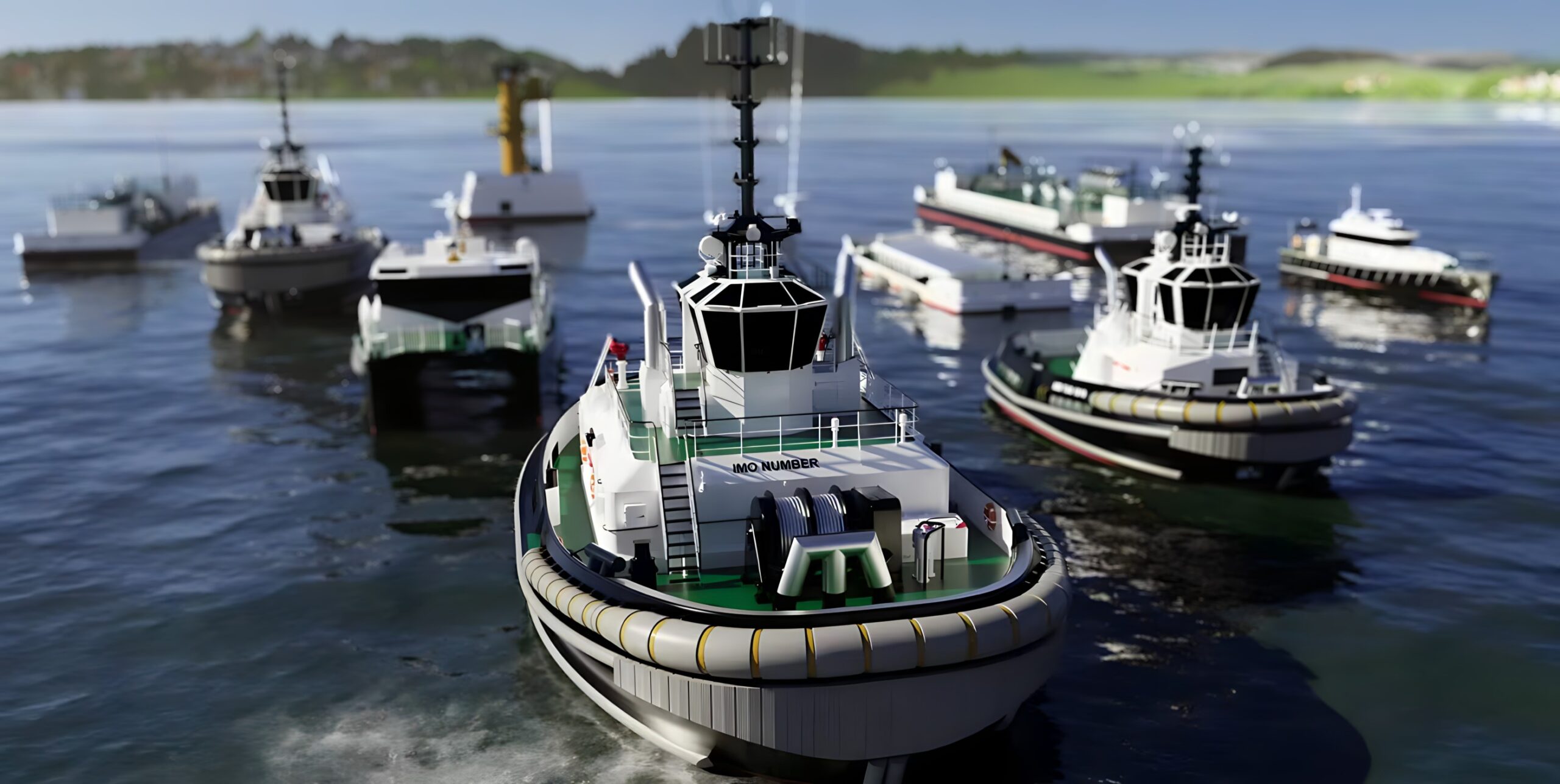
Concerns about the decision to place the Defence Maritime Services replacement fleet with Damen have now been sharpened by new ministerial answers confirming that British shipyards were not even invited to bid for the work.
The issue surfaced at industry discussions at Holyrood and also in written responses at Westminster, and together they paint a picture of a procurement system that allows major small vessel orders to pass offshore with limited scrutiny and little strategic intent.
At the Scottish Parliament’s Cross Party Group on Maritime and Shipbuilding, participants questioned how a 24 vessel programme ended up in the hands of a Dutch yard currently under investigation for alleged sanctions breaches involving Russia. Those present argued that the boats are central to daily operations at Clyde, Devonport and Portsmouth and fall squarely within the capabilities of several UK builders. They also warned that outsourcing through private service providers has become a route through which industrial opportunities quietly disappear.
Paul Sweeney MSP, convenor of the Cross Party Group, said ministers had been taken by surprise by the outcome of the process. “I think it’s fair to say that UK Government ministers were blindsided by the decision by Serco to award the 24 vessel contract for workboats to Damen,” he said, referring to the Defence Maritime Services Next Generation vessel replacement programme covering the three main naval bases at Clyde, Devonport and Portsmouth.
Sweeney argued that the decision ran directly counter to the National Shipbuilding Strategy. “It’s clear that the goal of the National Shipbuilding Strategy is to maximise the cross government shipbuilding pipeline over the next 30 years and convert that into a UK demand signal for shipbuilding. This militates against it,” he said. He added that the vessels involved, including tugs, crane barges and pilot boats, were exactly the type of ships that UK yards are well placed to deliver. “These are vessels that would be well suited to UK yards,” he said.
He also raised concerns about the ongoing criminal investigations involving Damen. “The other consideration is the ongoing investigation into the directors of Damen and alleged breaches of sanctions against Russia, particularly through their yards in Romania, and the potential risk there,” Sweeney said. He described the situation as serious and damaging. “With the trial underway and further investigations relating to bribery, forgery and money laundering, it’s really reputationally problematic for this contract to continue,” he added.
While acknowledging that ministers are now engaging with Serco, Sweeney argued that more decisive action was required. “I would like to see this work brought into the UK under a subcontract, or the contract essentially pulled and re awarded to a UK shipbuilder,” he said.
Sweeney pointed to the immediate pressures facing Ferguson Marine as an example of why intervention matters. “There is an imminent risk to Ferguson Marine,” he said, warning that even if a direct award for a new ferry is made later this year, the yard still faces a significant gap in workload once Glen Rosa is delivered. “There are huge risks with people leaving the shipyard due to lack of orders and uncertainty. People are already leaving as we speak,” he said. He noted that mobilisation on a further ferry would not begin in earnest until late next year, leaving a prolonged period of underutilisation.
He argued that construction of workboats for the DMS programme could provide timely infill work. “I think it could be perfect infill work to do these Damen tugs under subcontract at Ferguson Marine in Port Glasgow,” he said, pointing to existing precedents for workshare arrangements involving Damen on other UK projects. “We should really press hard on a deal for workshare for Ferguson’s. Getting tug boats constructed there would be a perfect short term solution,” he added.
The written answers from defence minister Lord Coaker set out the official position. He explained that “the Defence Marine Services Next Generation programme did not seek tenders directly for the Vessel Replacement Programme” because the shipbuilding element was embedded within a wider In Port Services contract. Bidders were therefore free to select their own suppliers. Coaker confirmed that “there was no policy requirement to engage for this procurement” and that the Ministry of Defence has no record of discussions with the Confederation of Shipbuilding and Engineering Unions. Only one compliant bid was received for the overall services contract, leaving Serco to select Damen without direct government involvement.
Coaker also addressed the legal and financial issues. He said the MoD is aware of the Dutch proceedings and “will take appropriate action should a conviction occur.” He stated that Serco had assessed Damen and found “no immediate risk to delivery of the Vessel Replacement Programme,” while confirming that monitoring will continue. The minister emphasised that the MoD holds no direct contract with Damen. The subcontract is valued at around two hundred million pounds, roughly twenty two percent of the overall In Port Services package. Coaker argued that British yards would still benefit from around two hundred million pounds of maintenance work, though this has done little to reassure those concerned about the loss of higher value newbuild activity.
The discussion at Holyrood stressed that a fleet of this size could have provided several years of steady output for UK yards and helped sustain skills between major naval programmes. Comparisons were drawn with countries that deliberately use small vessel orders to stabilise their shipbuilding sectors. The procurement structure, rather than an explicit political decision, created the conditions for the work to go overseas. Once shipbuilding is embedded inside service contracts, ministers lose the ability to apply industrial priorities even when these align with stated policy objectives.









DMS is a managed service. SERCO is a private company buying tugs to meet its requirements. It is not a contract that comex under the procurement act. Minster have no power to decide how a private company procures vessels from another private company.
Agreed, private companies do what they do, which is to work in the interest of share holders and not nations. So maybe it is time to bring back the RNAS.
Actually it’s taxpayers money via a government contract the government has every right to say it should be UK built vessels serving the contract.. that is 200million pound of government money.. it’s essentially the typical UK government Neo liberal approach that has left our sovereign industrial capacity on its knees. They should have specified in the contract a requirement for uk industrial stimulus… I have been involved in many contracts in which we require and assess value to the local economy and workforce as we procure a service.
But only if the contract says that.
The problem is that HMT will want the ‘best value’ contract which HMT sees as the cheapest contract…..because there is no money.
Yep but that is the historical short sighted contract.. because in the end it would not have cost that much more if negotiated in the commissioning of the contract.. you have multiple providers trying for the contract.. trying to get changes iin later will cost you a fortune.
Then you pay the extra taxes for the pension liabilities then
No because there is no pension liability that is why you use contractors.. but you can ensure your contractors develop and deliver on your strategic requirements.. I created large complex contracts all the time for contracted out government services and within those contracts there was the responsibility to build long term strategic goals such as workforce and capital investment.. essentially the contractors got profits to run it but at the same time they were paid to be custodians of the system capabilities.. they were essentially if they lost the contract they were excepted to hand the capabilities off to the next contractor as part of the whole contract life.. if they did not they went on the naughty list an may have lost their license to bid for contracts..
Mate the reason why the contract was outsourced was its cheaper. One of the reasons why it is cheaper is that the pension liabilities are no longer the responsibility of the taxpayers. So once again for the hard of thinking how much extra tax are you going to psy to have the things the way you want. There is no magic money tree.
Ron we have paid for those tugs in the contract.. essentially we gave the contractor 200million for capital expenditure.. so there was no issue with putting a clause in the contract about how that capital expenditure is spent.. I did it all the time..
The contractors are hired to provide a service. You dont care what tools the builders use as long as they are capable of doing the job
A minister “blindsided” Astonishing !!
This smacks of corruption, but then again it could align with the current “prioritise foreign government interests over that of Britain, even if they’re linked to Britain’s enemies” that has become endemic in recent years.
Very true sadly.
Clueless more like.
You’re not saying our political masters are clueless surely Jack. Look at all the money, all the orders, all the preperation…. Oh, yeah, I see what you mean!
The above group of “fellacious” ruskibots seem to be enjoying blowing each other off.
Doing everything they can to constantly undermine British cohesion.
Yawn, deluded lefty spotted.
If you understand colour theory; the name and the political perspective is on the tin.
Stop yawning, wake yourself up, eat tofu, it is a highly nutritious, low-calorie, and cholesterol-free alternative with unique plant-based benefits like fibre, healthy fats, isoflavones, that make it a healthier choice for heart health and weight management for many people – without the being pumped full of antibiotics, hormones, pesticides, and various processing chemicals and environmental contaminants like nitrates and nitrites and the ever present disinfectants and decontamination agents, all the various chemicals, including chlorine-based compounds, organic acids; lactic, citric, and peroxyacetic acid, used during meat processing to wash carcasses and reduce microbial loads.
🥰.
As is pointed out above Serco is a private company but it now runs the Blue ensign fleet as well as taking over from Capita so will soon be responcible for the recruitment for the military also Serco runs 90% of refuse collection in the UK so has quite a massive imprint on the day to day life in the military as well as civilian life in the UK so why do a good parentage of the profit gained by Serco go directly to the USA who’s companies own most of the Serco’s shears the same companies who own Landmark who run the military training establishments around the UK.
As a good percentage of the companies who own Serco and Landmark are America they have little to no interest in the Defence of the UK and are only interested in the Profit gained out of the Defence budget, they have no interest in the National ship building programme and no interest giving good value for money for the MoD. A good example of this is when Landmark was asked to build a series of trenches for the training of Ukrainian troops, the cheapest and probably the most productive way would have been to get the Royal Engineers along with their Ukrainian counterparts to construct and maintain them but no they did not go for that option they had a number of civilian contractors construct the trenching system over the coarse of 6 months costing well over £1 million .
Take a look at Mite facilities management and Black Rock as well as Vanguard also look at the portfolio of the Bank of America to see were a good proportion of the UK’s defence expenditure ends up.
As reported in these pages, BAE just got a 1,7 billion contract for the US Navy. Careful what you wish for when you go down the buy British road.
👍
Indeed but the USA is the single largest shareholder of BAE at around 42%, with significant US investors like Capital Research and BlackRock holding large stakes. So the leakage to the US of our money exists there as well.
As pointed out by WS BAE is no longer a UK company and the same companies still profit from defence expediter. The civilization of the MoD under varies governments has created and MoD not fit or unable to defend the UK as there are to many civilians with their fingers in the pie who have little to no regard for the defence of the UK (or America for that matter) with their only thourght being “how much can I get out of this deal”
BAE Systems Inc. is a wholly owned subsidiary of BAE plc. Inc.’s revenues, profits, and losses are fully integrated into Plc’s group-level financial statements. BAE Inc. contributes a significant portion of the parent company’s global revenues, almost half at times.
The profits are reported as part of the total Group earnings, the actual movement of cash e.g. in the form of dividends from the U.S. subsidiary to the U.K. parent company faces specific restrictions due to the Special Security Arrangement with the U.S. Department of Defense. This designed to protect sensitive U.S. national security information and programs.
Sadly the key component of this arrangement is that most profits and intellectual property must stay within the U.S. entity and cannot be freely transferred to the U.K. parent company. BAE Inc. is run by an American board of directors and operates as a firewalled U.S. company for many operational and financial matters. This is the price of entry that all foriegn players into the US defence market must adhere to.
A large portion of Inc.’s earnings are reinvested into the U.S. business for operations, growth, and research and development. BAE Plc generates sufficient cash flow across its entire global enterprise to maintain an ongoing dividend policy and share buyback programmes for its public shareholders on the London Stock Exchange. The company consistently pays dividends from its OVERALL Group earnings. … OVERALL.
Investors value the scale and its access to contracts over the repatriation of cash, as shareholders of BAE Plc. invest in a company that is globally significant, largely because of its access to U.S. programs.
The “cash” remains within the Group’s balance sheet. It is reported as profit, it increases the whole group’s net worth, and is reinvested in crucial r n’d and capital expenditure within the U.S., driving future growth for the entire business.
Without the special security arrangement BAE Systems would not be allowed to access the highly restricted defence market and the lucrative U.S. contracts e.g. F-35, naval shipbuilding, advanced electronics, APKWS … a seemingly endless list of big boys toys.
Should a merger between BAE Inc. and one of the major US defence companies happen, I imagine a lot of people here will lose their collective shit.
Having said that, The UK government has a “golden share” that can veto / block any hostile takeover or acquisition of BAE Systems by another company. It gives the relevant Secretary of State the right to restrict individual foreign shareholdings to a specific limit, historically 15%, preventing any single non-UK entity from building up a dominant stake in the company, the UK Gov, can also hold veto over any major asset disposals, this affects BAE Inc. indirectly, primarily by facilitating the necessary conditions for BAE Systems to operate in the sensitive U.S. defence market while also preventing the U.S. subsidiary from falling under the control of an undesirable third party, at the same instance, it reinforces the entire ownership structure, assuring the U.S. government that their critical defence supplier is nice and secure.
No BAE inc got the contract and BAE systems inc is owned by BAE systems PLC .. and the US has very specific protectionist legislation in place to ensure that money stays pretty much in the US all the tax will be paid to the US and almost all profits are required to be reinvested in the US.. essentially it’s an enclosed system.. that is why only BAE systems inc operates in the US not BAE systems PLC.. because the main UK BAE systems could not legally win the contracts and comply with US protectionist legislation.. so yes I would love the UK to go down the US road..
You are wasting your time explaining it . I pointed this out last year and was told the next CEO would be American , guess what that hasn’t happened
What needs looking at is Serco gives a contract to Damen which they have been doing since Serco took over the Blue Ensign fleet but the same companies like Black Rock, Mite, Vanguard and the Bank of America have an interest in both companies, Damen it must be said dose make exceedingly good tugs (not cakes) but if companies closer to home had been given the contract from day one then maybe we also would be making exceedingly good Tugs.
As a matter of agreed international process, ‘gross profits’ generated in a country are subject to taxation in that country. Serco will have to pay tax to the UK HMRC before transferring ‘net of tax profits’ to a parent company/owner that is resident abroad. The parent/owner will claim a tax ‘voucher’ or ‘credit’ in their tax jurisdiction for the tax already paid in the UK.
FTSE 100 companies also make profits around the world through their susidiaries. They pay tax in those jurisdictions before finalising their profits (including foreign tax credits) before submitting their accounts to HMRC.
BAE North America operations are worth 14 billion dollars. They are only possible because of a memorandum of understanding signed by the President. How long do you think the memorandum will exist the second you exclude American contractors
Blindly outsourcing has downsides and this is one of them. Suck it up.
Both elected representatives and senior officials, at National and Local level, have over the years been responsible for the massive outsourcing of “public” services in a bid to apparently make said services cheaper or better. Rarely does it turn out for the better. Labour and Conservative governments have hollowed out the public services and we now find ourselves in the mess we are in.
I am not advocating a mad rush to “nationalisation”, but we do need to look at what is considered critical infrastructure and services, and decide that if it is critical, it needs to be either owned by the country or a UK company.
As the article and others have said, we need to onshore our services and industry and support UK owned businesses.
Hollowing out? Really? The latest figures available show the public sector work force at over 6 million. U.K. manufacturing employment is around 2.5 million.
The claim that Ferguson’s will have no work is rather hollow. They are perfectly capable of building sections for T26 which BAE now have to source parts to build five more. Ferguson’s could easily be used to produce both parts they have produced for existing under construction T26 and other similar parts to fully utilise their capacity and help speed up T26 construction.
Oh dear, how sad, never mind.
One day we’re going to get a story where the needs of Britain were put before the needs of foreign powers.
One of these days.
Oh yes the extreme emergency when we need the ability to build 5 tugs
Trough. Snout.
This is where lack of joined-up thinking, and lack of a strategic National industrial strategy, winds up.
All the dosh, steel production, and profits going outside the UK – again. Maybe Trump has a point.
Surely they could have written something into the contract..? It might have put the cost of the contract up, but if the Government / HMT properly discounted for the tax returns (corporate and income) from building in the UK then in all likelihood making sure these tugs were built in the UK would actual work out cheaper. Especially if you also count the likely reduction in benefit claims as well…
Or am I being too sensible?
Cheers CR
One day we’re going to get a story where the needs of Britain were put before the needs of foreign powers.
One of these days.
Serco have been buy the majority of there new boats from Damen ever since they took over from RMAS . It is hardly new news. Probably.One of the reason they got the contract was it saved embarrass for the government of the day having to purchase abroad them selves as a majority of the RMAS fleet needed to be replaced
Ferguson are no match for the quality, scale and experience of the Damen Group. It seems that no other UK biz was interested in the deal, who could / is available to service the contract to the competance required.
As much as I dislike Serco, their previous contracts with Damen have been succesful. They had “Future Provision of Maritime Services” in 2007 for 29 vessels for the RN.
Damen designed and constructed the Australian Antarctic division’s research and supply vessel RSV Nuyina – too “Big” for the the Tasman Bridge bridge, this was AAD fault, but I feel that Serco should have shepherd AAD as a responsibile entity, but sadly, I don’t think they had the chops – RSV Nuyina is operated by Serco Defence, also not forgetting that Serco and Damen were a consortium – Serco/Damen – for the Fleet Solid Support (FSS) programme and were awarded a “Competitive Procurement Phase” contract to mature designs for the RN’s support ships.
So their are a few tie ups here, besides, Damen build quality ships/boats at good market rates.