

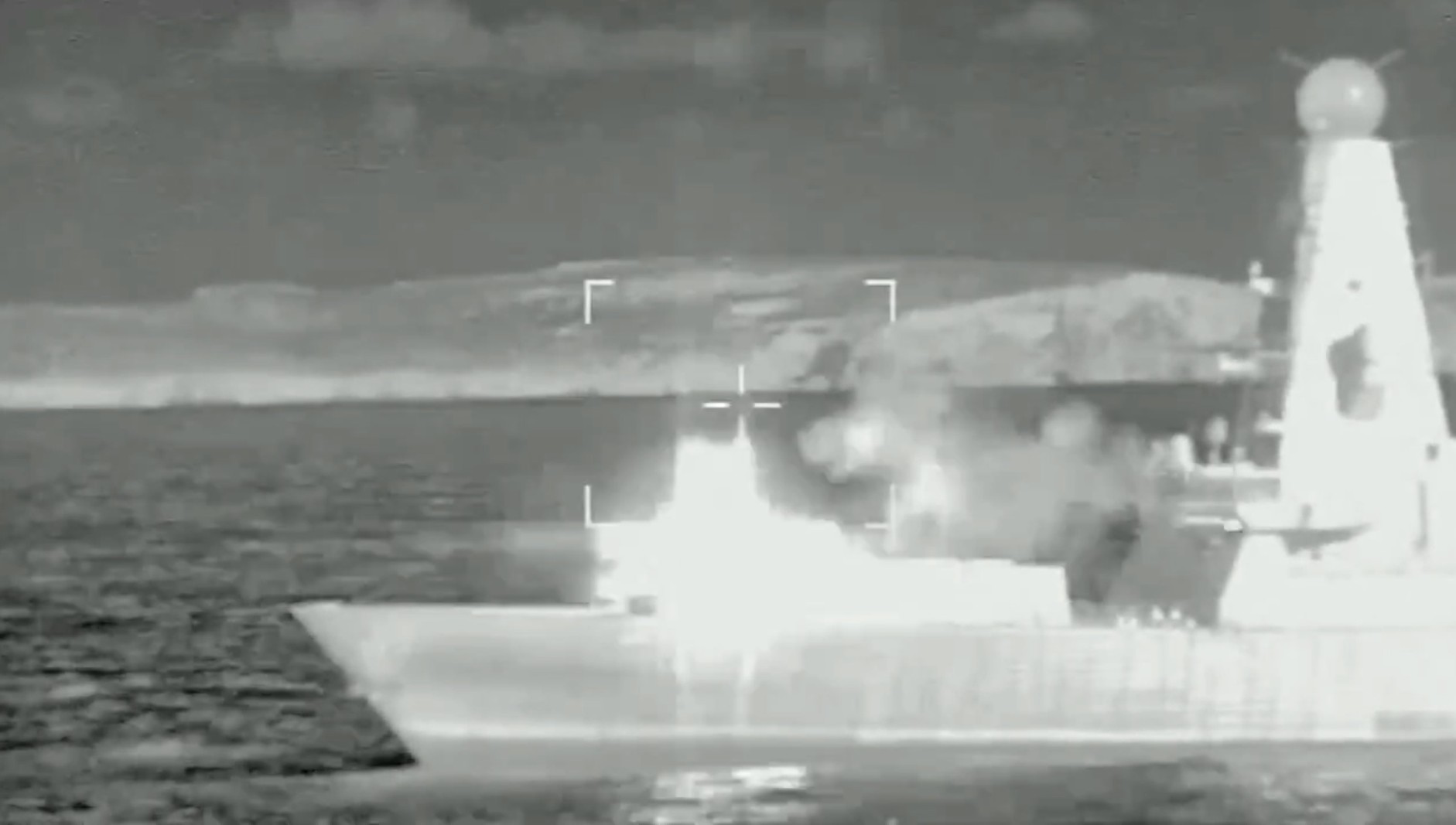
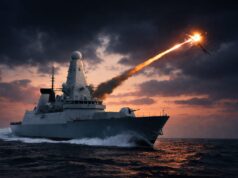
The Royal Navy did not make a formal offer earlier this year to deploy a Type 45 destroyer before HMS Dragon was eventually sent to the eastern Mediterranean, the Ministry of Defence has claimed.
Responding to a written parliamentary question from Conservative MP James Cartlidge, Defence Minister Al Carns said no formal proposal had been made between 1 January and 2 February 2026 to pre-position a destroyer.
“We constantly review deployments of Royal Navy assets in line with securing the interests of the UK and our allies,” Carns said. “No formal offer was made by the Royal Navy to deploy a Type 45 Destroyer ahead of HMS Dragon’s deployment at the first available moment on 10 March 2026.”
Further answers from the Ministry of Defence also set out the timeline behind the decision to send HMS Dragon to the region. Carns said the proposal to deploy the destroyer to the eastern Mediterranean was reviewed by the Chief of the Defence Staff on 3 March 2026 and approved by the Defence Secretary the same day.
“The Chief of the Defence Staff reviewed the proposal to deploy HMS Dragon to the Eastern Mediterranean on the 3 March 2026 and the Secretary of State signed it off the same day,” Carns said.
HMS Dragon departed Portsmouth on 10 March following the approval.
The Ministry of Defence declined to disclose how long the ship will remain deployed.
“For operational security reasons, we will not comment on the duration of her deployment to the Eastern Mediterranean,” Carns added.






The RN did not offer is a smoke screen. What was the PJHQ position and the advice of CJO to MOD. That is the question to ask please.
Sounds like a statement the MOD has been forced to make to protect the PM.
I read it the opposite way. As the MOD protecting itself against the political row.
This sounds like the minister is hanging out the RN to dry.
Why would the RN randomly offer an asset up, surely tasking is decided in advanced based on threat assessments and commitments and the RN is told to do something (whether it can or not is another thing)
Governments have been quick to accept capability gaps and force reductions over the last 35 yrs, this is the logical outcome of that sequence.
Really poor statement – the defence secretary should get a daily briefing and should be insisting on measures being taken.
He will be getting briefed. The whole notion of the RN or army or RAF offering their services is absolute nonsense.
I’m not sure who the Royal Navy would be making a “formal offer” of a warships too. Itself perhaps 🤣
Maybe to the king 🧐🇬🇧
😂
problem here is that the general public are not as well informed as those of us on sites like this and will probably believe this crap.
given this minister is ex RN (RMC) and an active reservist he knows that he is deliberately misleading the public
time for this type of thing to become an offence whilst in office.
MPs really should be held to far higher standards than they are currently and if found in breach should lose their seat and be banned from standing again.
Notice the careful use of the word formal here.
I would like a formal offer of a warships, sounds very impressive 😂
On a serious note BFBS are reporting that air defences were in Cyprus before that attack (possibly a sky Sabre unit and certainly stormer) and there is a wide range of highly advanced ABM batteries in Jordan and Israel in the path of any ballistic missiles.
It was probably deemed quite rightly at the time that a T45 wasn’t adding much especially when the US was clearly signalling action was not imminent.
I heard about Stormer too, although haven’t seen any confirmation or denial of sky sabre still (may have missed it though). Id argue with the knowledge Iran and its proxies posses ballistic missiles there should 100% have been a T45 at the absolute very least at high readiness. They are hooting about getting HMS Dragon ready in 6 days, if they could do that now then they could have done it prior to giving the okay on March 3rd. L
Just my 2p worth though.
And if things go off they could be needing some back up Aster stock closeby…not in Gibraltar or the UK.
Worth reading or listening to the Sky Politics at Sam and Annes podcasts. One of these suggests that No 10 proposed sending the navy to support Akrotiri early on, but that the Chief of Defence staff said there was no need we have an aircraft carrier already – Cyprus.
He was right about the carrier just not the ability to deal with ABM and other high end threats or have floating radar up threat.
What he has missed is the maintenance facilities on the carriers which is odd for an engineer.
I stepped the issue was the usual RAF ‘if we deploy people in carriers they don’t like it and leave’.
He also ignored the fact that you can’t move Akrotiri, that Akrotiri doesn’t have CIWS to deal with drones that do get close or that the carrier is the perfect platform to have Crowsnest and Wildcats operating from and increasing their time on station with them being in a target deconflicted area. It’s almost as though he has no combat operations experience at all…Oh, right. Seems he doesn’t. He’s head of the armed forces and has never been in a combat zone, ever.
The thing is that Akritori will remain a target as it is a manifestation of The Little Satan.
In an ideal world a couple of T45 working with T23/31 would be ideal as T45 can detect the threats and maybe hand off to guns or Sea Ceptor to prosecute the inbound.
I do also wonder how good the very high up ARTISAN set on QEC is for detecting skimmers if anyone dared to use it in active mode….it is even higher than T45….
The higher the radar the further your radar horizon moves further out from the ship. Artisan uses active electronic scanning so can do dwell/revisit, beam steering etc. All techniques that help reduce contacts being missed.
To be fair, how many SF experienced CDS and CGS have we had the last 20 years who did sod all?
It’s a political post, combat experience isn’t necessarily needed for it.
”Oh, right. Seems he doesn’t. He’s head of the armed forces and has never been in a combat zone, ever”
The same logic should be applied to Defence Ministers not that Ben Wallace was any good but at least he would of understood what he was being briefed on a Battlespace level.
No T45 would have been offered at an early stage because none were available, as we have seen.
Meanwhile whatever limited GBAD is available is rapidly being exhausted in defence of Erbil. The one Crowsnest deployed to Cyprus can only deploy for a few hours each day, has, in any case, limited airframe hours available.
What on earth is that strange cacophony…maybe chickens returning to their roost…?
Get rid of the unevidenced and profoundly stupid spending on net zero immediately so that defence, the first duty of government, the lives of servicemen overseas at risk, can be properly resourced!
I suspect T45 will deploy with another bagger.
Saves the self deployment issue.
The Fleet Air Arm is and has always been an exceptional organisation. They will, as ever, do a magnificent job.
But, like every other service, they have simply not been adequately resourced:
‘To keep a Merlin in the air 24/7 will not be attempted as this would require at least 4 or 5 aircraft and a large number of engineers and aircrew. Instead, flying time will have to be balanced with threat levels and availability of Protector and other ISR assets. However, even a sortie per day for a few weeks would quickly rack up precious airframe hours, a significant consideration for the RN’s small fleet of 30 Merlin Mk2s, which has been extended in service until 2040.
The RN has 10 Crowsnest kits that can be fitted to different airframes as required. Installation and removal are not simple and around 6 cabs are fitted at any given time. The deployment to Cyprus may also impact ASaC Merlin availability to embark on HMS Prince of Wales if the carrier strike group were to be deployed.’
Meanwhile Britain squanders funds required for its defence on the quixotic and unevidenced pursuit of net zero. Sensibly, few other countries are following this moronic example. Nuclear power soaks up further funding as a consequence of draconian overregulation.
Systemic reform is required.
I never understood why there were so many CrowsNest systems for so few cabs.
But I do fully agree that reform in the shape of ££££ is required.
“Unevidenced and profoundly stupid spending on net zero”
I’m curious as to what you think is unevidenced? Global warming is pretty undeniable, and we’re feeling it’s effects.
Furthermore, moving away from fossil fuels reduces the leverage other countries have over us, particularly in Russia and the Middle East. It’s predicted that the cost of net zero is less than that of a single oil price crisis. Not using up fossil fuels in our own territory also means that they will be available in the future, should there be dire need (WWIII, for instance).
It’s no mistake that China has strategically targeted green technologies (solar panels, batteries, EVs etc.) to dominate. They can read the writing on the wall. It is clear that these technologies will be of massive global importance, and it should be a matter of national importance to not be left behind.
I completely agree that the armed forces need more funding. The world is getting more dangerous and we’re not keeping up. But killing net zero would be a blow to our sovereign energy security, to emerging industries, and the wider environment.
‘the Sensitivity of the West Antarctic Ice Sheet to 2° Celsius of Warming (SWAIS2C) project drilled through 1,716 feet of ice to extract a 748-foot-long sediment core below it. SWAIS2C holds records of time periods when Earth’s global average temperatures were significantly higher than 2 degrees Celsius above pre-industrial.’ 20 Feb 2026.
Global warming is happening….from, historically, a fairly low base. Climate change has always happened since the beginning of time. Are man made emissions affecting the climate? It would be strange if they did not. Are they affecting it in any major or even measurable way? The (latest) evidence is against that:
‘The University of Alabama in Huntsville (UAH) Version 6.1 global lower troposphere dataset shows a long-term warming trend of +0.16°C per decade from January 1979 through February 2026. That trend has remained essentially stable for years. There is no visible post-2015 inflection point in the long-term slope.
The chart shows the strong 2015–2016 El Niño spike rising above +0.7°C relative to the 1991–2020 mean. After that peak, temperatures declined. The most recent value — +0.39°C in February 2026 — remains well below that earlier El Niño high-water mark in 2016.
If warming had truly “doubled” in rate beginning in 2015, today’s anomalies should sit well above the 2016 peak. They do not.
It is also important to understand what caused some of the more recent spikes in the record. The unusually warm values in 2024 stand out in the UAH time series. But those occurred in the wake of the 2022 Hunga Tonga–Hunga Ha’apai volcanic eruption, which injected an unprecedented amount of water vapor into the stratosphere. That injection temporarily enhanced radiative forcing, aka the greenhouse effect, because water vapor is in fact the strongest greenhouse gas. It was a short-term perturbation — not evidence of a structural acceleration in the underlying greenhouse-driven trend.
The UAH report itself describes 2024 as “anomalously warm,” and the data show a return toward the longer-term trend through 2025 and into early 2026. That behavior — spike and partial retreat — is characteristic of natural variability superimposed on gradual warming.’
Net zero is a flawed idea based on simplistic and inaccurate modelling, modelling that cannot accurately recreate even the observed climate of the last few years.
A mass of detailed evidence is available within: ‘The Frontiers of Climate Science’, Nicola Scafetta
‘The Frontier of Climate Science explores climate dynamics through physics, complex systems, and astronomy, synthesizing several decades of peer-reviewed research. The book critically reviews the scientific foundations of modern climate theory, the evolution of IPCC assessments, and the limits of global climate models (GCMs) when confronted with observations. It investigates natural variability across multiple timescales, including oceanic oscillations, solar variability, and astronomical cycles driving both solar and climate variability, integrating satellite data, paleoclimate reconstructions, and empirical modeling approaches.’ 10 March 2026
‘Solar variability and its role in climate change remain among the most profound and unresolved issues in contemporary climate science. Scafetta makes a compelling argument that it is time to bring the Sun back to the centre of climate discourse.’
WRT previous global temperatures:
Firstly, that global temperatures were once significantly higher (and lower) than today is not disputed. However, the rate of previous climate change was vastly lower, giving time for life to evolve to match the changing environment. Currently, we quite enjoy the life on the planet as it is, and changing the environment rapidly will cause much of it to die off. However, as evolution is a slow process, new species will not fill the extinct one’s places.
WRT the UAH atmospheric data:
Firstly, the dataset is of the lower atmosphere, but not the surface. Atmospheric flows are very complex are will not neccesarily be directly applicable to surface temperatures over a relatively low temperature range.
Secondly, the data is gathered by satellites. Measuring air temperature via satellite is very challenging, inferring temperature from emissions in various spectra, and then attempting to decouple the effects of multiple “layers” of atmosphere. Due to this, atmospheric temperature measurement via satellite is subject to considerable uncertainty. For reference, another group analysed the same dataset, but came to the conclusion of a warming rate of 0.208°C per decade from 1979 to 2012.
Thirdly, simply looking at the plotted UAH data, it is pretty clear to the naked eye that the average is curved and not linear. Inspecting the (much more reliable) data for surface temperature which can be found here: [https :// science.nasa.gov/earth/explore/earth-indicators/global-temperature/] shows an obvious accelerating trend, with an average rate of temperature change of about 0.25°C per decade between 2000 and 2020. I defy you to look at this data and not see a “…structural acceleration in the underlying greenhouse-driven trend”.
Finally, even if it is closer to 0.13°C per decade (it isn’t), that is still a significant number! Just that it implies relatively little change on the timescale of a human lifespan, doesn’t make a good case for continuing business-as-usual. Under this hypothetical, when I retire global temperatures would be ~1.65°C above the 1950-1980 baseline (at current actual rates it will be closer to 2.25°C). The effects of this on the environment cannot be fully known, however as a keen scuba diver, I am extremely concerned about the future of the world’s coral reefs (not just for looking pretty – these are a vital part of the marine ecosystem).
It is our duty, and to our benefit, to clean up our mess before it becomes an unstoppable problem.
Thank you for your reasoned response.
Coral reefs come and go, but, somehow, no-one knows that…’In the last 36 years the Great Barrier Reef has never had more coral. AIMS have been conducting detailed underwater surveys since 1986, and the most recent study showed the reef is in excellent health. Despite that, when 1,004 Australians were surveyed last year by the Australian Environment Foundation, remarkably, less than 3% of them knew the coral cover was “at a record high”.’ 2024
‘the rate of previous climate change was vastly lower’:
‘Observational satellite data disagree with that claim, showing short-term variability driven by natural, short-lived, events, with current temperatures now below the 2015–2016 El Niño peak. In addition, proxy data from the past also show many periods over which temperatures shifted much more rapidly and steeply, both upwards and downwards, than during the recent period of modest warming.’
‘atmospheric temperature measurement via satellite is subject to considerable uncertainty’:
Satellite temperature measurements are more useful than surface measurements in climate studies for several reasons:
The data used is all collected the same way and with similar instruments.
More atmospheric mass is included.
The temperature measured is mostly above the chaotic boundary layer of the atmosphere and is more stable.
Radiosonde data is available as an independent check on the calculations. the UAH temperature calculations correlate best with the radiosonde data, suggesting that it is the best satellite temperature record…radiosonde data is not perfect, it has erroneous data as well, but it is independent of the satellite records and provides a neutral, unbiased check on the various methods of processing the satellite data. There is no such check for the various surface temperature datasets, they all share the same data and mostly use the same methods to process it
One of the reasons that UAH has a lower warming trend than the other datasets is UAH has corrected clearly spurious data in the older NOAA-11 to NOAA-14 satellite instruments and the other datasets have not.’
‘shows an obvious accelerating trend’
‘The claim rests on statistical adjustments that “filter out” natural variability such as El Niño and volcanic effects. That filtering is central to that narrative. The acceleration appears after removing natural influences from the temperature record, that are clearly displayed in the raw data…If warming had truly “doubled” in rate beginning in 2015, today’s anomalies should sit well above the 2016 peak. They do not.’
‘that is still a significant number…doesn’t make a good case for continuing business-as-usual.’
It doesn’t make any case at all. The case that still has to be made is that mankind is causing the increase and can do something to stop that increase. The evidence simply does not bear that out.
‘…the claim that the planet is heating “faster than ever before” since 2015 is not supported by the observational data.Nor is it supported by paleo-climate proxy data.’ ‘Ice-core records show that climate changes in the past have been large, rapid, and synchronous over broad areas extending into low latitudes, with less variability over historical times. These ice-core records come from high mountain glaciers and the polar regions, including small ice caps and the large ice sheets of Greenland and Antarctica. Climate shifts up to half as large as the entire difference between ice age and modern conditions occurred over hemispheric or broader regions in mere years to decades. Such abrupt changes have been absent during the few key millennia when agriculture and industry have arisen. The speed, size, and extent of these abrupt changes require a reappraisal of climate stability.’
We cannot achieve energy security through renewables since they require back up fossil fuel generators. We import a great deal of the components of renewable generation from countries that use fossil fuels including coal to power their production. The back up power generators that we use source most of their gas from Norway which gets that gas from the North Sea. ‘Green’ jobs are a mirage. We prefer to export those jobs in order to meet our own crazy net zero emissions targets.
The key to energy security is nuclear but we have regulated it to the point where it is frighteningly uneconomic. The latest estimates from the North Sea indicate that available reserves can sustain a large proportion of Britain’s energy requirements while we transition to modular nuclear. At the moment, we import nuclear generated electricity from France, 10-16% of our total electricity demand…not very secure.
“We cannot achieve energy security through renewables since they require back up fossil fuel generators.”
This statement is overly reductionist. I’d much prefer to go without backup generators than to loose all primary generation. Furthermore, construction of pumped hydro stations, EV smart-chargers, and (for absolutely worst-case scenarios) hydrogen backup storage can, if deployed at sufficient scale, replace fossil-fuel backup generators.
“We import a great deal of the components of renewable generation from countries that use fossil fuels including coal to power their production”
Even considering the embedded CO2 emissions from manufacturing renewable generators using high CO2 intensity energy, these still come out way ahead of fossil fuel generation. This also holds true for electric cars.
I completely agree that nuclear energy is overregulated to a silly degree, and that nuclear power should be a crucial element of our energy generation.
Unfortunately, the general public is woefully misinformed about nuclear (pushed by the greens and greenpeace, which I think is ridiculous and betrays their commitment to the environment over ideological grounds of “wooo! Nuclear scary and unnatural!”)
However, I think that using up North Sea reserves while promising a transition to modular nuclear would be catastrophic. We know how the government works when spending cash is on the table. The modular reactors would go 10x overbudget, the plans would be walked back and back and then get cancelled, and then we’d start importing oil and gas again, without anything left in reserve.
The technology needs to be developed, proven, and deployed before we commit to it. In the meantime, offshore wind is proven, costs less than gas and constantly getting cheaper, and is entirely independent of oil oligarchs.
”We cannot achieve energy security through renewables since they require back up fossil fuel generators.’This statement is overly reductionist.”:
This is not complicated. Renewables, in the present, require back up fossil fuel generators. You know it. I know it. Everyone knows it. That could change in the future…but would that necessarily be a good thing? Batteries have serious ecological drawbacks, particularly in terms of recycling/disposal, hydro stations cause habitat destruction, alteration of water flows, and water quality degradation during construction and operation. Wind farms themselves are ‘intermittent, inefficient, labor-and resource-intensive, and require a tremendous footprint on land or water..wind turbines strike eagles, hawks, birds, and bats out of the sky, once you erect them, many species abandon the area, never to return.’
‘Even considering the embedded CO2 emissions from manufacturing renewable generators using high CO2 intensity energy, these still come out way ahead of fossil fuel generation.’
That undercounts the whole costs of renewables: ‘the physical bottlenecks of the energy system…underinvested energy infrastructure, in new mining and minerals capacity and in the firming assets required to maintain system reliability…an economy-wide investment into an industrial economy involving mining, electricity transmission infrastructure, storage, and the various aspects of energy systems required to deliver reliable, affordable, and clean energy services to a growing global population. This will inevitably generate substantial volumes of wastes, which in turn requires major investment in environmental remediation…’
We are already using up North Sea reserves of oil and gas…from Norway. The idea that Britain could switch to North Sea reserves in a time of crisis seems optimistic at best. But there is certainly a case for contingency planning and infrastructure preparation for fracking utilisation in support of national security.
‘offshore wind is proven, costs less than gas and constantly getting cheaper’
‘…at current costs, such a program is likely to require investment of £200-£250 billion. Adjusting for probable cost inflation, actual costs are likely to be £300-£350 billion. Huge investments are required in both transmission and distribution…National Grid has announced that it needs to spend £50-60 billion over five years in England and Wales to enhance its transmission network to meet decarbonisation targets. Scaling that up to cover the rest of the UK and allowing again for cost inflation yields an estimate of investment in transmission at least £150 billion by 2030. Roughly the same amount will be required to expand the distribution network.
Financing such investments will only be possible with strong government guarantees which means that, setting aside accounting fictions, real public debt will increase by 20-25 per cent of GDP for the decarbonisation programme. The cost of servicing that debt under current arrangements plus operating and maintaining the assets will about £40 billion per year for generation and about £25 billion per year for transmission and distribution.
In broad terms, electricity bills would have to double by 2030…
Detailed modelling of the electricity system using many years of weather data suggests that some gas generation would be required for 50 per cent to 60 per cent of hours in the year even after the heavy investments outlined above and allowing for potential imports from other countries. The options for preventing power blackouts in the early 2030s are either storage – mostly batteries – or carbon capture and storage (CCS). The first option is extremely expensive. It is only economic for load shifting from the middle of the day to the evening, so that gas generation would still be required for 40 per cent to 50 per cent of hours in the year. CCS is an experimental technology which up to now has failed everywhere it has been deployed on a commercial scale.’
Good luck to any political party that hopes to be elected on that prospectus.
By the way, many thanks for your reasoned response. This subject attracts a great deal more emotion, for some reason, than it should.
I am all for a cleaner environment but successive governments would have had a great deal more credibility in that regard if they had not permitted our rivers and coastal seas to become as dangerously toxic as they now are.
The strong suspicion is that the concept of net zero has been ideologically captured, used as a tool to pursue political objectives that may not necessarily be in the country’s best interests.
The dates are weird too. Nothing during January, but what about during February?
Several thoughts on all this business.
Firstly, typical passing of the buck from HMG, never our fault, yet we have zero strategic nous or vision, despite the intelligence available.
It is up to ministers to think ahead, given that it was obvious for weeks what was likely to happen and that the US would attack.
Advice is then given by the CJO and Ops at MoD as to options available.
It is not the RNs fault so little assets are available, but YOURS.
And the current abuse sent the CDS way is shameful.
He was correct that there was no need to send a Carrier, as the UK has Akrotiri available.
But, a T45 was needed as contingency against possible BM and wider missile attacks and land GBAD needed as the SBAs have nothing.
That we only bought 6 T45, rather than the 12 wanted, is down to YOU, Labour.
That these ships now have engine issues is down to YOUR minister who ignored advice, sitting pretty now with his pension no doubt.
That Dragon has taken a week to deploy is the result of her coming out of maintenance and needing to be worked up you cannot just magically deploy a vessel until it is ready.
That there were no other options is YOUR responsibility, not the RNs.
That GBAD barely exists is YOUR fault, nobody else. You cut most of it in 2004 and it was never rebuilt. Even at it’s peak, apart from SHORAD assets, we had nothing beyond Bloodhound and 2 Regiments of Rapier.
Having said that, what was available should gave been already pre positioned, you do it as standard in the South Atlantic and the threat here was far greater.
You’re now looking like INCOMPETENT IDIOTS, HMG, as we take a week to send a T45, and our MCM capabilty has collapsed as the mother vessels needed to support the autonomous boats STILL have not been ordered.
That the straights are now in peril due to mines, just as you withdraw the last Hunt MCMV to the UK, with the most of the rest of them sold, used as spares, or as a training vessel, is YOUR responsibility.
You cannot now GRANDSTAND, Mr Healey, as you’re doing, that the RN has autonomous MCM assets deployed to the Gulf.
Whoopy dooos.
What defends them? And how do they deploy with no mother vessels beyond close to shore?
If wider action is now taken by the international community to secure those straights I hope you sit on the sidelines looking stupid and impotent, as what assets are there to send?
Meanwhile, I assume you’ll continue to close down our own sources of oil and gas in the North Sea, while expecting the LNG to be imported?
UTTER, SCUM. The lot of you…..
Here here.
For once Daniele, I have nothing to add, except you are one hundred per cent right.
Bloody well said sar!
The 🇬🇧 deserves so much better!
Regards from 🇦🇺
Exactly that.
Ah so its not the Governments fault, or the MOD’s or the CDS, its the Navys fault for not offering, ah will that clears that up. Pass the blame, it was not us it was some one else, the CDS is weak and lacks leadership and Government and MOD are bare faced liars who are sad enough to blame others to hide thier own massive failings and disgusting run down state of our military.
We have been totally embarassed around the world, again, because nothing works, nothing is ever ready and what we have is last minute and normally scrapped togeather.
Context is key here: and in this case its what as the question that was asked? A quick check on the questions-statements section of the UK parliament website shows that James Cartlidge MP asked :
“To ask the Secretary of State for Defence, whether the Royal Navy made a formal offer for the preposition of a Type 45 Destroyer between 1 January 2026 and 2 February 2026?”
Answered on 12th March by Al Carns MP (Armed Forces Minister on behalf of Secretary of State for Defence) as :
“We constantly review deployments of Royal Navy assets in line with securing the interests of the UK and our allies. No formal offer was made by the Royal Navy to deploy a Type 45 Destroyer ahead of HMS Dragon’s deployment at the first available moment on 10 March 2026.”
note the 10th March date: that really does mean that no vessels were available before this and, regrettably, this is where we are. Contrary to popular belief the MOD, Navy and indeed the Govt. all know this so they wouldn’t deploy a ship that doesn’t exist or cant deploy.
Carns is a boot licker who’ll say whatever his master voice requires
I’d not want to that far, he is ex SBS, that gives him due respect from me right away.
Ex SBS, so never did any proper high level Staff work and is just a grunt with attitude.
Yes, but calling him a “boot licker” given his experience and current commitment as a reservist as well, wasn’t justified for me.
That’s all. 👍
Just Me, I have never known anyone who served as a Major, then Lt Col, then Col and did not have a posting as a Staff Officer.
On a more serious note…and correct me if I’m wrong…but
didn’t …HMS Dragon…use to have a Red 🐉 (definitely green!) on both port and starboard bow? Now its just the port bow? What’s happened, been painted over!?
*definitely [not] green!
Saving on paint.
One side had deteriorated, so been removed pending enough time and money to replace it.
I might be late to this thread but wasn’t Hms Duncan already at sea conducting an anti Drone exercise of the coast of Wales ,could she not have been retasked for Cyprus ,rather than what turned into a right can of worms with availability, working practices and politics .I take it with the dwindling size of the fleet there is no longer an FCS on stand by .The Dockyard no longer seems too have the spirit of 82 .
I wondered about Duncan too. I have read statements that it needed to get back to base for necessary work, and that the crew would have been deployed for too long. Navy Lookout mentioned some defects that need addressing, but what ship doesn’t have a few defects that need addressing? I have some problems believing that was the reason. I suppose I’ve been lied to a lot and these days have trouble believing much of what I hear.
Thanks Jon at least I’m not the only one thinking that ,and the excuse of the crew had would have been deployed for to long is rather Lame, we deployed for OP Corporate and didn’t touch dryland for months until we returned in the Sept of 82 ..The whole situation seemed politically motivated ,and after Dragon sailed she was still in the Channel 3 days later an oared galley could go faster .
CDS could have sent one out anyway, but CDS is a never deployed Ryan Air Force one man clown show
Notes:
There are a lot of not deployed Phalanx systems in RN sheds that could be bolted to a truck and sent somewhere useful.
I get the impression that the MOD is under the thumb of the Treasury and the Treasury is making operational decisions skewed towards their narrow interests. I would suggest a more dynamic approach from MOD leadership. The MOD should regularly be looking at force levels and emerging risks and looking to remediate them. If a significant risk is identified they should be actively asking the Treasury for extra money through urgent operational requirements funding.
An identification of a significant risk might look like a determination that surface ship avaialbility levels are going to fall below a certain level. The remediation to that might be to fund earlier, faster maintenance to bring addtional ships back earlier. Another example might be a growing threat to an overseas air base in a dangerous region full of missiles and drones. Remediation might look like an urgent off the shelf GBAD purchase for the RAF Regiment.
The point is to push and to do that you have to ask. If you’re lucky you may even get. If you don’t get then secondary objective is embaress the Treasury or the political class into saying NO and to leave them vulnerable to events if things go awry. Then when things do go wrong use the story of their poor judgement and the ashes of their careers to act as a morality tale to improve future decisions.
Is my local NHS hospital going to make a ‘formal offer’ to the Health Ministry to treat patients? What is this nonsense?
I expected ex-RM Al Carns to know that MoD or another senior HQ (such as PJHQ) orders units to deploy – they don’t wait sitting on their hands for a bright idea to bubble up through the CofC from the CO of a destroyer.
It wasn’t so long ago that C-in-C Fleet(s) would order the deployment of ships in penny packets to trouble spots, without troubling the PM and SofS, except to clarify ROE etc.
Carns is just an ex trigger puller, not a Staff officer, a user, not a planner,
So politics is the obvious place to go.
True. I’m assuming though that Dragon was having work done and that has been stopped (adding additional cost) in order to deploy. The issue here is really that we have no additional ships to deploy or even any land based missile systems available.
The damage to the global economy from Iranian attacks on tankers, means Britain needs to join efforts to keep the straits of Hormuz open. The RN may not have ships available, but it does have helicopters. Even 2 pairs shows willing. A pair of Wildcat armed with Martlet is good against Shahid drones & armed speedboats. A pair of Merlin ASW is a useful deterrent against Iranian mini subs. RAF A400M & C-17 can fly them out to the Gulf.
Never mind Merlins or Wildcats. What about Apache?
DM if you want to add Apache then that is fine by me.
I’m getting the sense today that parties including Iran and Israel are increasingly looking to fudge some sort of compromise.
There is no way to keep Hormuz even vaguely safe. With the attack on military infrastructure on Kharg island maybe plan B is coming? Open the Straits or 6 B52s will visit Kharg Island and that will be the end of that? Even the crazies in Tehran and Washington must see the end of days that would bring.
I’ve just read on the BBC website that Trump is asking the UK and other nations to send ships to ‘help secure’ the Strait of Hormuz….and this from a leader who has always maintained that the US doesn’t need anyone else to help in their military adventures!
Anyway what Task Force shall we send?!
UK and everyone else who is being asked to contribute vessels should ask the US how many ships the Israeli’s have been asked to contibute. They are amongst the arch-architects of the conflict so they can risk ships and lives first.
We do have two old T23’s we could send to the Strait of Hormuz and risk in a mission to keep it open, Hms Richmond and possible Argyll, if they get damaged, No great loss, as they are due for the scrap yard anyway!
Yet’s call it the old banger warship mission!