

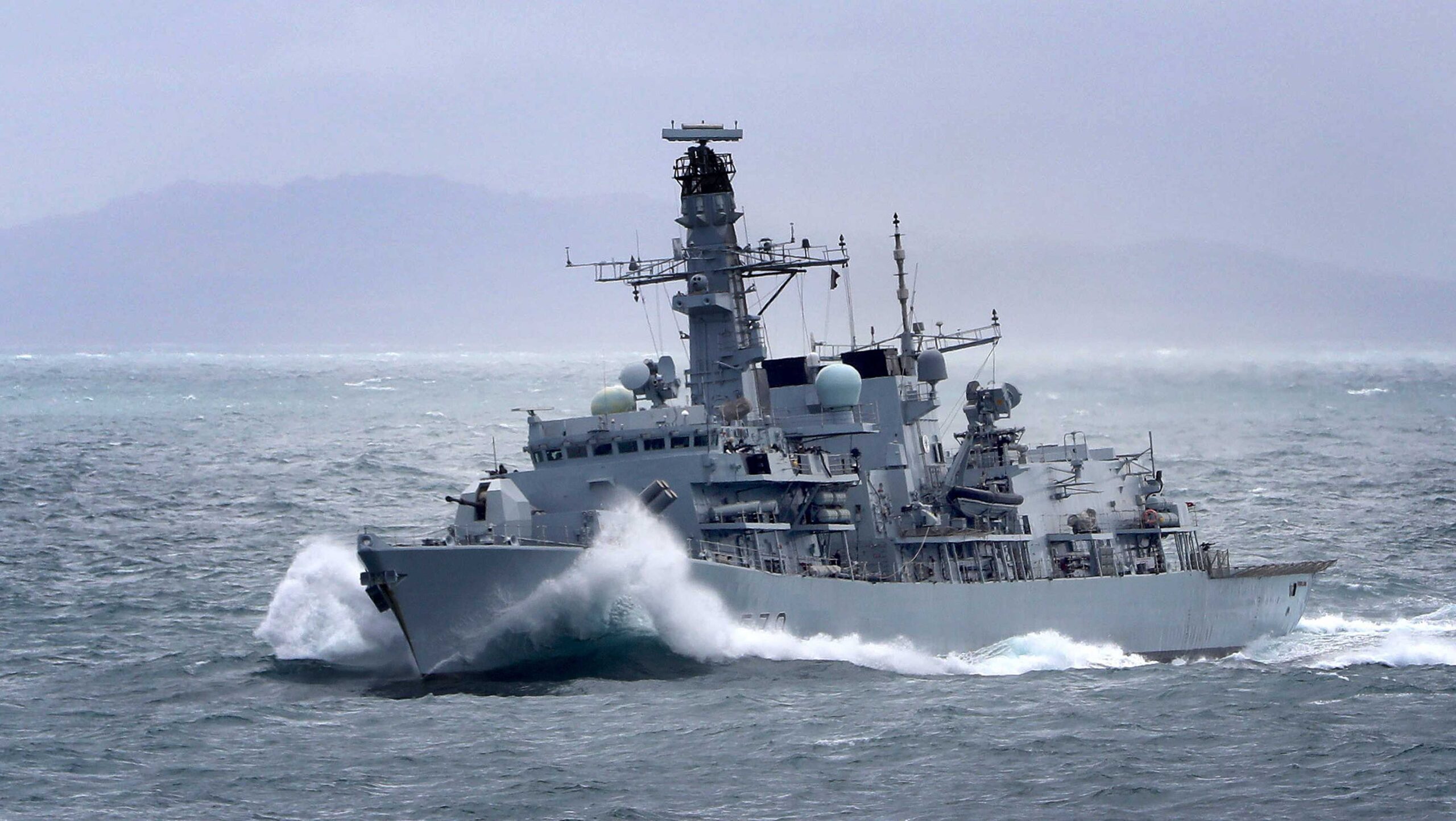
A Conservative MP has questioned the use of Royal Navy assets to support security arrangements around an informal meeting of European defence ministers in Ireland, arguing that restrictions associated with Irish neutrality could limit the usefulness of any British deployment, the UK Defence Journal understands.
John Cooper, MP for Dumfries and Galloway, raised the issue in a letter dated 28 August to Defence Secretary Wes Streeting, after reports that Dublin had requested Royal Navy support for the meeting in Wicklow.
Cooper wrote: “I am aghast at media reports from Dublin that their Government has requested support from the Royal Navy for security, but that any vessel involved must stay outside their 12-mile territorial-waters limit.”
In a social media post accompanying the letter, he said: “Neutral Ireland portrays their gunboat George Bernard Shaw protecting an EU defence event there next week… but they’ve asked for help from the Royal Navy… who must get close enough to be much use! I’ve asked the Defence Secretary why we’re paying for this idiocy.”
The meeting is due to take place in Wicklow as Ireland holds the rotating presidency of the European Union. Cooper’s letter asks whether the Defence Secretary will attend and whether the UK will reconsider the deployment of British forces in support of the event.
He linked his concerns to a reported incident near Dublin Airport in December, when uncrewed aerial vehicles were detected close to the airport as Ukrainian President Volodymyr Zelenskyy arrived.
Cooper wrote: “While the Irish Defence Forces spotted the UAVs, they had no ability to interdict, lacking any meaningful air-to-air or surface-to-air capability.”
He acknowledged that Ireland possesses a small number of RBS Bolide short-range air-defence missiles, but argued that these would provide only limited coverage against fast-moving or higher-altitude threats.
The MP also questioned the value of positioning foreign warships outside Irish territorial waters. He wrote: “This insistence that foreign warships remain outside Irish limits hampers their effectiveness. The Royal Navy is being asked to do a bad job. To add insult to injury, British taxpayers are footing the bill for this bodge.”
Cooper went on to argue that Ireland’s long-standing policy of military neutrality has not been matched by sufficient investment in its own defence capabilities, despite recent moves to increase spending.
He said: “The Republic makes great play of its neutrality but has for too long not funded this in the way that, for example, Switzerland does.”
The letter also refers to expected French involvement in security arrangements around the Wicklow meeting. Cooper said the French frigate Aquitaine was expected to remain 12 miles from the Irish coast and questioned how useful its air-defence missile system would be from that position against small or fast uncrewed aircraft.
He wrote: “Her Aster surface-to-air missiles will have the range to cover Carlow, but against low and fast UAVs may be a sledgehammer when a scalpel is required.”
Cooper suggested that smaller-calibre naval weapons might be more suitable against some uncrewed aerial threats, adding that foreign ships would still have to be positioned sufficiently close to be effective.
The MP also raised the broader question of military cooperation between Britain and Ireland, asking the Defence Secretary whether the UK should reconsider the current relationship.
He wrote: “Will you look again at the deployment of any British forces for this ‘informal’ chit-chat next week? It is both an affront to Britain and unaffordable expense, especially when our involvement is subject to damaging caveats?”
Cooper then asked: “More substantially, will you bring to the House details of a reset of our military relations with Ireland?”
The letter ends with a broader criticism of Ireland’s defence posture and the degree to which British forces might be expected to assist during an emergency.
Cooper wrote: “We can no longer afford to let the Irish walk on our cane. Will the Marine Nationale bear the cost of protecting those cables and pipelines? Do you agree that rather than RAF Typhoons and F-35 Lightning IIs scrambling – at gulping expense – to intercept anything airborne in the Republic’s airspace, it should be over to the Armée de l’air et de l’espace to cover IDF blushes?”
He concluded: “Ireland must accept neutrality without funding is simply freeloading.”





If an area defence destroyer can’t guard a target 12 miles away it would not be much of an area defence asset.
Ahem.
He wrote: “Her Aster surface-to-air missiles will have the range to cover Carlow, but against low and fast UAVs may be a sledgehammer when a scalpel is required.”
12 miles is a long way to be providing air defence against UAS against a cluttered shoreline.
Haha, i bet there lots of no go sectors and altitudes for the Aster. These venues must be defended in situ or at very close distance.
But if it wasn’t guarding an area over 12 miles away it wouldn’t have to be an air defence destroyer and wouldn’t have to use the most expensive and limited missiles.
While I am happy we provide security to less capable nations that does come with the expectation that they don’t put expensive hurdles in our way.
Think it’s about time Ireland either pays for it’s own defence or join NATO instead of freeloading on the UK.
Funny that, we now have an asset available for an Irish request however when Cyprus was seeking similar they got?
Difference being the RN knew this tasking was coming rather than an emergency situation.
Is the RN not supposed to respond to emergency situations?
Sure, but by definition it can’t be planned for, so the RN had what it had when the Cyprus tasking came up. This meeting has been pencilled in for at least 6 months (hence why its in Wicklow due to the then position of Simon Harris), and discussions between Ireland, France and the UK had been happening for at least this long.
Very different situation, Cyprus was an urgent unexpected deployment caused by trumps actions when we were at a very bad point for it in the pip upgrade schedule and was an expeditionary deployment which is vastly different. This is planned, and ostensibly a home deployment just outside our home waters where most of our fleet is currently situated anyway, you are comparing a slight detour around home territory in a safe area unlikely to experience any issues when we have available ships to an unexpected emergency expeditionary deployment to an active threat zone when we had nothing on hand due to successive failures in government planning.
Also Cyprus didn’t ask us for help we deployed to defend our own sovereign base areas, and by extension the surrounding areas
Where has the French angle come into it, or is the MP getting confused with the last tasking?
I think it sounds like the MP has beef with the republic.
Maybe wonders why we’re spending money defending a country whose populace mostly despises the UK and who belongs to a rich multinational bloc which again mostly despises us for having the temerity to leave and has consistently worked to undermine us by throwing us out of collaborations with them. Ireland meanwhile hosts huge multi national companies on paper to steal the tax receipts from the rest of Europe while freeloading their defence under the pretence of being neutral.
Much as any sensible Brit is irritated by this, however, us covering the defence is better than having a French or Spanish ship in the area doing it.
Therefore we need to hold our nose and what needs done.
You do realise that your cover as a Russian propagandist and troll has been well and truly found out here years ago.
The French are also sending a frigate.
Are they, no mention of that in any of the coverage outside of here, and if so why the duplication? Aquitaine handled the main events without any RN presence at all last time. So if they are sending another ship, why is the RN involved?
Hadn’t realised the pretty much do freeload. Not just from us but everyone. Must me cool just not have anything. It’s taking the piss surely. Then on top of that “May enter when needed.”
Bad attitude. Especially literally contributing nothing. Didn’t we just literally hand them 3.25Bn or something not that long ago when they crashed. They take the piss out of the EU too.
Why do we need to send a ship if the French are doing that!
We should not be involved and we should not be using our money to defend the EU and the Irish republic.
For context, Danish and Dutch taxpayers paid for their warships to accompany RN carrier groups to the far east. Twice. A T45 could easily do this job from 20km off Wicklow Head. Or further. It’s the Sampson radar providing an air picture that is the main asset here. Getting antsy over another country’s constitution is a compete non sequitur , would he prefer to see an advanced AAW destroyer bumping rubber boats back across the channel? When idiots like him start jumping up and down with stupid, MAGA like reasoning it’s clear the Putin bots have polluted political discourse.
It’s called supporting allies, friends and neighbours. He should try it sometime if he has any.
Irish have been EU and NATO Freeloaders for some time.. Ask the multi Nationals companies…!
From a country that voted for Brexit, to “take back control “, it doesn’t really sit well to criticise the taxation policy of another sovereign nation . Taxation, foreign and domestic policy are , I’m sure you will agree, entirely within the gift of national parliaments.
On the question of defence capability , yes, there has been a large degree of naivety and/or complacency within the defence department. That is changing however, there is an increasing acceptance that defence spending and capability must increase. But equipment and capacity doesn’t arrive overnight, it takes years to generate or regenerate a capability. We know that, look at how long it takes to generate carrier aviation after it was gapped., and this from a country that virtually invented carrier aviation.
It is what it is, throwing toys out of the pram because of something you don’t like or can’t change won’t change facts. Nor is it a reason to refuse to help.
There are plenty of contributing factors towards the state of Irish defence policy, with department stances from 1922 till today, through to inter-service issues.
In this case, think its more that the DOD/DF ran out of time trying to get the sign offs, if the refits are as planned, the 60’s would have been able to offer creditable capabilities, but that’s not happening till next year.
Irelands tax policy is to lever their small size to reduce their corporation tax levels and attract multi national companies to base themselves on paper in Ireland and then steal the tax from the countries where the tax was generated and should rightly go. Luxembourg is another country that has benefited from this scam.
Why shouldn’t he comment about a country that profits from stealing from us.
I never stated that he couldn’t comment, and Ireland isn’t stealing anything. All countries are free to to set their own tax policies. It’s called competition, I’m sure the city of London undercuts other financial centres to gain business. Nothing to stop HMT setting an even lower corporation tax rate if they wished. They haven’t though….
But Denmark and the Netherlands both are part of an alliance that wants to show commitment in the Pacific. Their ships accompanied the carriers as much for their own countries defence diplomacy and standing commitments as much as for Britain’s benefit.
Fair point. Though what I was really meaning was that if we were to get into the weeds of what taxpayers are funding then we’re going to start dancing on heads of pins. In reality, having a T35 sailing in the Irish Sea, in what is virtually home waters is nof no great cost to anyone. It could probably do the job from Cardigan Bay. It helps to build alliances and goodwill, essential in these times.
I agree, no harm in goodwill to our neighbours.
It’s about protecting European personnel… not just Irish. So of course we step up and pay for it. The interesting thing is that’s it’s happening in Ireland at all. The Irish seem very hard to move when it comes to neutrality… which is, of course meaningless… they live on a strategically important island covering the western approaches to Europe. Sweden and Finland have honestly admitted that the time for neutrality has long gone.. It’s time Switzerland stepped up too. They would not be immune to the fall out from any land war.
I just don’t understand the angst over the Irish Constitution. Last I checked, under international maritime law, the right of innocent passage (or freedom of navigation) allows any foreign ship to navigate through another country’s territorial waters as long as the journey is peaceful and within the purpose of the ship’s mission.
In this instance, the RN ship could just sail in circles periodically entering Irish territorial waters. So long as the ships moves continuously, there shouldn’t be a problem. And, of course, the ship could stop to render aid as required.
You don’t see the conflict of “the journey is peaceful” and “the ship is tasked with shooting down drones if needed”? RN ships and British Army personnel visit or train in Ireland plenty of times without issue, the position of the AG however is that as they would be operational for the duration of the event, they would be an active foreign military force.
To allay all those concerned, simply put an Irish officer, Naval Service or otherwise, in the chain of command to approve the RN ship to engage an airborne target threatening Carlow while within Irish territorial waters.
Being on a peaceful mission, the RN ship would have the right to self-defense, where ever it sails.
There is going to be an Irish officer on board, just as there was when the French did this last time (can’t remember if the site got so worked up about the limit then?), doesn’t change the AG’s position on a foreign warship actively operational in Irish waters.
Freeloaders.
While Ireland steal billions from their EU partners they expect the EU and also the UK, provided they stay outside their territorial limits, to protect them.
And it is not me accusing the Irish of theft. That comes from the EU Parliament itself.
Source. EU Parliament. Report on financial crimes, tax evasion and tax avoidance. 26-March-19. Items 327 thru 330.
One of the benefits of the EU becoming more centralised and potentially one day having it’s own supernational military structure is that Ireland will be dragged along and forced to actually contribute to defence. It’ll stick in their craw since the RoI usually only feels comfortable with military action if it involves murdering women and children in shopping centres.
There is not another nation on Earth that would have ignored the persistent murder of their own men, women and children as the British establishment accepted.
And not only did this same Establishment accept this, now they collaborate with the Labour subversives to hound down soldiers who were defending the British people.
It all sinks.
Oh wow. Sudden far right propaganda out of left field.
Do bore off with your conspiracy shit, and give Elon his money back.
Just a statement of facts.
Not my problem if you do not like hearing them and are unable to rebut them without resorting to tedious cliches and abuse then I do not think it is worth trying to have reasoned discussion you. Goodbye.
There is no reasoned discussion with people who are detrimined to spout propaganda so good luck to you little fascist.
And there we have it. Unable to deal with the FACTS presented, namely that the UK acted with excessive restraint and now Labour are engaged in a vindictive persecution against veterans, and so resorts to asinine abuse. I bet you now feel proud to have put a “little fascist” in his place. Well done.
You didn’t present facts you went on a MAGA style non-sequitur rant and then had a hissy fit when it was pointed out.
I didn’t insult you, I called you a fascist because that is what you are. Don’t want to be called one, don’t act like one.
Are you incapable of comprehension ?
In my post and reply I suggested Britain acted with excessive restraint and secondly that Labour is engaged in lawfare against veterans. This is in stark contrast to their approach to known terrorists who received Comfort (OTR) letters from Blair.
All you have done is call it ” conspiracy shit ” , “little fascist” is that really all you can do ?
You seem to be demonstrating a rather retarded intellectual capability ?
If the Republic cannot provide adequate protection it should not host the meeting. It is its own failt it has no military. It is not a poor country….
Why should a non-EU country have to cover a meeting we are not even attending. They should get a EU country to do the job. The Republic is just freeloading…
The UK is attending at least some of it, Miliband will be at the FM meeting, not sure if the UK is sending anyone to the Defence side.
I do not think that justifies an air defence destroyer!
Meanwhile if Britain wants to join the EU procurement fund it has to pay a rather large entry fee.
Time we had leaders who respectfully stood up for us.
NLAWS into Ukraine, first country to pledge tanks, extensive pilot training scheme – all things massively beneficial to the EU and not a word of thanks.
History shows us the futility of this. Look at how the Irish behaved during WWII, a haven for German spies and with many Irish working for the Germans under cover and then tell everyone they are neutral. I’d put a limit to how far from the Irish border we intercept any UAS, it would be 20km and let them protect anything inside that distance.
And look how many irish men gave their lives in both world wars for the allies. I am a proud brit, but a ‘ot of these comments sound more like Trump than my fellow citizens.
Some individuals went against their government’s wishes, and served in the British Forces, but they where villanised in Ireland. I respect them a hell of a lot more than the Irish state.
No mention of the uprising during the war either I see?
None of that is even remotely true. Ireland was actively pro Allies, from intelligence sharing, to joint defence planning, to code breaking, to facilitating lost/downed aircraft.
100% Ireland likes to act like it was pro allies, but it just happily sat behind the RN, fed info to the Germans and basically said “Screw little countries we’d rather see actual Nazi’s run europe than work with the UK.”
Again, none of that is true.
Oh? Show me the Irish declaration of war on Germany in support of Belgium, or Denmark, or Poland, or the Netherlands.
Show me “feeding info to the Germans”?
Okay so you can’t show me a declaration of war. So want to retract that “none of that is true?”
Allied pilots and crew were ‘repatriated’ to Northern Ireland very quickly.
Ze Germans… not so much.
Is that a declaration of war?
I would say all the Irish who fought in both WWs (members of my family) and the Irish in North America and their descendants to be a ‘declaration of war.’
Then I’d suggest you learn what a declaration of war is, because that’s not what that is. Some Irish mercenaries signing on with the British Army is admirable for those individuals that had the humanity and empathy to understand what was at stake, but the actual ROI did not declare war, and sat on it’s hands, too scared and too obsessed with it’s own victim complex to stand on the side of humanity.
And trying to lump in the Americans? Don’t make me laugh. So Italy declared war in 1941 on the Axis too because there where a shitload of Italian Americans? No. Nobody would argue that.
Learn what a declaration of war is, then come back.
Oh and in the 1st WW the Irish took military action against the UK in 1916, actively joining the central powers, so if anything Ireland declared war on the UK in WW1.
We can support this, but when we needed air cover in Cyprus we were left wanting. The optics of this look bad, freeloading Irish who want to be neutral but don’t want to pay for it. Both Sweden and Finland held there own when there were neutral, don’t see why the Irish can’t. The question raised is right and the government must answer why we can provide this but could not, when our own armed forces were left short in Cyprus.
i dunno y i bothered get 6 sirloins butchers 18 quid like perfume yesterday a french women boots i sear swooped in end 1 locals 125 small bottle not even that nice ok not ralph lauren green gold or aramis or ronaldo leg i c
butchers is generally cheaper for meat not as big true get tomahawks 15 like then finding things do it do
sausages pasties chicking 1s stuffing rolled up good range not a rage like nicest sauces city centre net veg shop good pair ing
anyway you laugh irish better sited diplomacy however boils down spending you cant trust them no skin of the nose irish is concern so shit
well thats how it francise whats my name helpless vunrable dont care other ways u know me soo there u go
lmfbo
o aye still qharter pounders evenly matched. step side my dear. aramis cheap bit of aquired taste legacy so strong ive had a bottle near decade i litterly dab it on toilet paper