

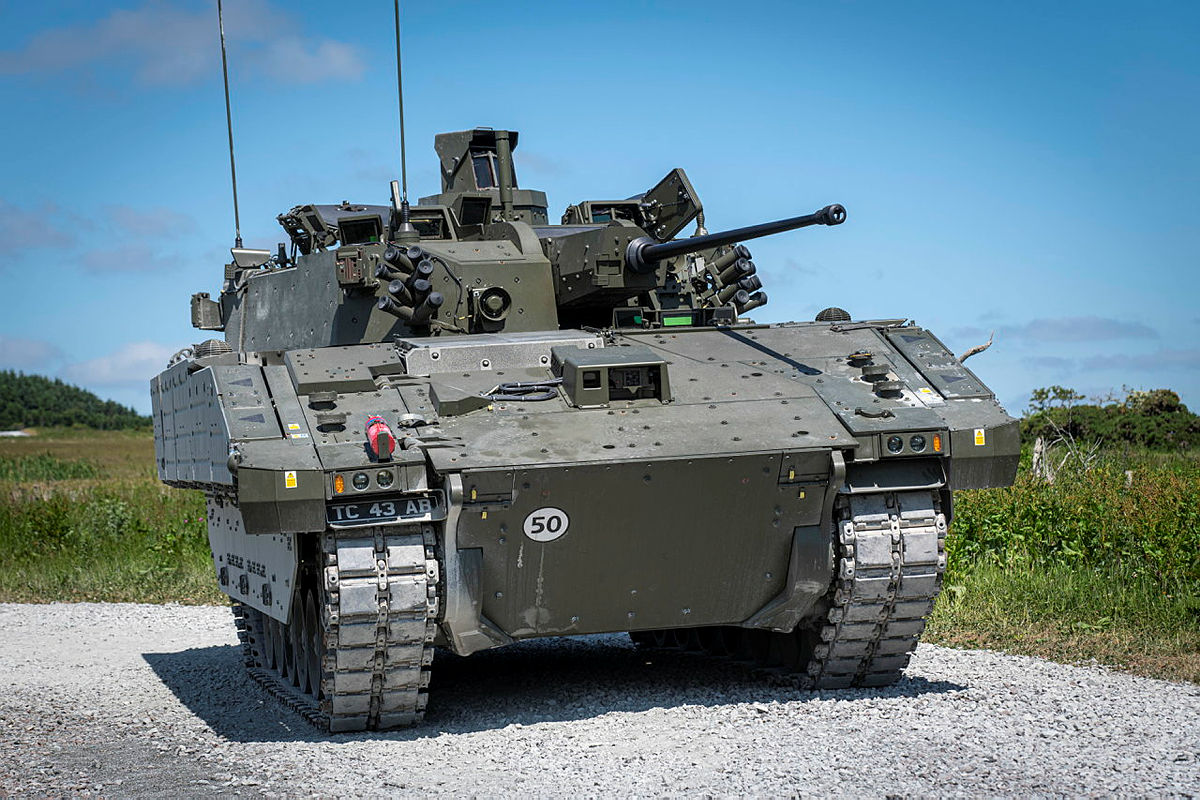
Ben Obese-Jecty MP used a Westminster Hall debate to challenge the Ministry of Defence over the decision to declare Initial Operating Capability (IOC) for Ajax in November 2025, after the programme was paused again following reports of noise and vibration related injuries during training.
Obese-Jecty said the programme’s problems have been known for years, but argued that the latest pause has put the credibility of the IOC decision, and wider armoured capability, under renewed scrutiny. “Since then, the Ajax programme has gone from on track to throwing a track, and the outlook for the programme and our armoured capability…are now all very much under the microscope,” he told MPs.
He pointed to the scale of requirement changes as a driver of complexity, saying Ajax began as a platform based on an existing General Dynamics design but became “bespoke technology” after the Army pursued extensive additions. “We are talking about a staggering 1,200 capability requirements for each of the six vehicle types under the Ajax umbrella,” he said.
Obese-Jecty repeatedly returned to the contradiction at the centre of the latest controversy: senior military sign-off that the vehicle was safe, followed by a fresh training pause within weeks of the public IOC declaration. “How did we reach a point where four-star senior officers and equivalents had the confidence to sign off the vehicle’s initial operating capability…only for it to blow up in everybody’s face weeks later?” he asked.
He said the Department had confirmed to him that IOC criteria were met on 23 July 2025, the Army declared IOC on 15 September 2025, and the Government announced IOC on 5 November 2025 after a review period. He also cited ministerial claims that written assurances were provided from senior leaders ahead of IOC.
“Before declaring Initial Operating Capability…I received written assurances…that the vehicle was safe to operate…described as ‘demonstrably safe to operate’,” he quoted from a ministerial response. The MP questioned whether long-standing programme pressures remain, referencing the National Audit Office’s findings about incentives to prioritise milestones. “The contract incentivised GDLS-UK to prioritise production milestones over the quality and performance of the capability,” he said, quoting the NAO, and asked whether the same dynamic still applies.
He also raised concerns about continuing production and the implications for the workforce at General Dynamics’ Merthyr Tydfil facility if the fleet is completed on current timelines. He warned that, absent additional orders or exports, the factory could face a cliff-edge. “There could potentially be an idle factory in Wales,” he said, asking ministers to set out what comes next for the site and whether staff can be assured about jobs once production ends.
A further line of attack focused on the renewed training pause and reported injuries. Obese-Jecty said ministers had confirmed that during a late-2025 exercise, a number of soldiers reported being affected, and that vehicles were linked to personnel suffering injury symptoms. “For 30 soldiers to be affected…with identical symptoms, as a result of a known issue supposedly resolved…is simply unacceptable,” he said.
He asked ministers to clarify whether there had been any comparable incidents during exercises between late July 2025, when IOC criteria were said to have been achieved, and the later exercise where the pause was triggered. He also questioned what measurement approach is being used in current investigations, arguing past assessment methods had drawn criticism.
He pressed ministers on transparency around the internal discussions that took place between the July milestone and the November IOC announcement, and asked for clarity on compensation claims linked to noise and vibration issues, and on how many personnel may be undergoing treatment or have been diagnosed with hearing loss after operating Ajax variants. Beyond the immediate pause, Obese-Jecty argued the debate goes to the heart of the Army’s armoured doctrine and the coherence of its force structure, warning of capability gaps and mixed-fleet complications as Ajax, Boxer and Challenger 3 are brought into service. He questioned ministerial statements suggesting the Ares variant could fill infantry troop-carrying roles, arguing that its armament and original purpose do not align with an infantry fighting vehicle requirement.
“In my opinion, the Ares variant is not designed for mounted close combat,” he said.
Other MPs intervened to urge ministers to address prior concerns raised by the Defence Committee about IOC deliverability. Stuart Anderson MP said the Minister should explain what checks were made against the committee’s earlier conclusions.
“In 2022…I and colleagues on the Defence Committee went to Merthyr Tydfil…[and] clearly stated that IOC was nowhere near deliverable in the timeframes proposed,” he said.








Talking about “Transparancy” may I suggest the fitting of the Invisability cloak being developed for these types of vehicles ? Nobody would know they were there or not.
I know, It’s genius thinking again, even If you can’t see it ! 😎
They’d hear it surely?
Nope, the crew wear Ear Defenders 😉
See, I told you It was Genius !
Will everybody near it have to wear Ear Defenders as well?
Not for a few years yet !
Hope they’re not 3M ear defenders or we’ll have another round of ambulance chasers on the make!
… and see the crew running away from it too no doubt… unless we fiendishly supply them with the personnel issue Harry Potter invisibility cloak Mk 4. Though I hear it’s delayed in committee as some members have claimed they can’t see the benefits.
There are 9 3/4 benefits
Good one!
It already has a cloak; you can’t see something that has made itto the battlefield.
Not made it to the battlefield. Bloody messed that up.
He he, Humour can be quite taxing at times !
Was an excellent debate / presentation and Ben O-J had certainly done his research and also brought his military experience as an Infantry Officer in regards to Orbats etc.
We’ll work a watch.
Mark, Is this debate with Ben O-J available to watch on BBC Parliament or another channnel/platform? BTW, I can’t find CDSs recent session with HCDC.
Select/ Google Parliamentary TV, then Select All Committees, and add “AJAX” into the search field
My watches never work… bit like Ajax I guess.
Want a laugh ? I have no watch, no iphone and no Sat Nav, judging by what I see on here, they just make people nasty 😉
So far this conversation has been totaly amusing, a refreshing change! The conversation below is encouraging discussion as well, there is hope.
From an engineering perspective i wiuld be really interested to know what the issues are. I suspect they are suffering are varability and tolerance issues in the builds, hence how test units pass acceptance but production units can show issues – but who knows considering the vagueness of statements.
The thing is , I do not trust the Army or the MOD . When the A2 SA80 was deployed there was all the same moaning , HK were sent out and debunked the lot of it. Not a moan since.
Wollaston, I also do not trust GDUK. What was its parent GD US doing? Did they intervene?
I had similar thoughts.
Is it a case of only some hulls got fixed and some slipped through the process?I
30 solders injured I assuming that is about 6 to 10 vehicles( happy to be corrected)
out of how many in service at that time?
Does this just effect the turreted recon version or all variants?
Think the army has 100 plus now!
So it’s not an entire fleet issue….
I want to know what if it’s mainly batch 1 cause if it is then we know the new stuff is fine!
There is so much noise and we need to know what vehicles.
The current plan is to build them all and then upgrade the older ones ones
They HK did upgrade various issues with the rifle certain parts were simply too weak to remain reliable over time and with the sort of heavy usage you get in use but may not be picked up under ‘ideal’ test conditions. Think there were two series of upgrades made overtime. Sadly once issues have set in and a bad reputation established it’s very difficult to shake criticisms off in the mind isn’t it, no matter how perfect the weapon system is thereafter. Can’t see Ajax like SA80 ever shaking off its reputation or troops being confident in it, hardly the sort of extra pressure and distraction one wants for our warriors in a conflict.
Defence Equipment & Support needs to be taken out of the MOD and operate as a department independent of the MOD (who would effectively be a client) with a clear mandate to ensure that projects ran on time and to budget.
What incentive do they have for that other than exhorbarent fees
This heap of crap should have been scrapped years ago we need the south Korean to give us there platform stop all this now and buy from another country Australia have bought the south Korean Redback
Colin, so how good specifically is the Redback recce variant?
If Ajax is canned at this incredibly late stage, there will be little or no money coming back to MoD. There is no money for a replacement buy.
This is the key point really Graham, whether it needs to be reworked or replaced there simply won’t be the funds for it regardless of alternatives and what people want, even if KF41/Redback/CV90 were perfect for Recce unless something else major is cut or pushed back a decade it’s not feasible and would still be a big concern considering how much is needed for modernising the Army.
Money also isn’t the only issue, time is a major factor; even an off the shelf a vehicle would need adapting to U.K. requirements and equipment. A competition followed by development/testing and delivery will be a large undertaking across a time frame the army potentially does not have.
Best case scenario is AJAX can work and the BA get an IFV if they win the lottery and find some funds, rather than buying an Ajax replacement as no one will see the AJAX funds again.
Spent too much to scrap it, do not have the money to buy a replacement. Like most things in the Army lately its shut up and put up and hope no one notices when things don’t work . Stuck with an over spec vehicle thats simply not very well built. Quality control clearly sucks at GD.
And will o ly get worse with use, no vehicle gets quieter as it ages…. unless it is entirely rebuilt with superior parts. Not sure that sounds like an option to add to this creeping and creaking disaster.
Crap or no quality control is the problem and officers not showing back bone and leadership because they want to please some one up the food chain, we have all seen that before. The MOD people running this disasater have never been held to account why?
That is why it is an endless money pit… they beed yo scrap it and do it now. What ever we do it will cost more money so spend it on something that actually works…
Be interesting to see who is footing the bill to fix Ajax? if its GD then fine but not ideal. If its MOD then at some point they have decide keep and fix or write it off, although I doubt there is £6 plus Billion spare to buy working off the shelf kit. Is the GD IFV varaint doom to same problems if not then would make sense if it works to buy that. Same gun, near same parts, etc.
I’m Welsh and I don’t give a toss about the Welsh jobs. I want the British army to have the best possible vehicles and equipment.
Well said Jack 👍 Welsh too and you couldn’t have been clearer.
One day, we will get some good news regarding the Ajax.
Even if that means getting news of its scrapping and buying something off the shelf from Europe, South Korea or the USA I will count that as good news
It still wouldn’t be good news, you’d hear that they were buying a replacement but cutting several other key programs to fund it with how scarce defence funds are now.
Can they at least take the Ajax turrets off and put them on any spare Boxers ir even best Warrior chassis’? Or, build new or regineer upgrade the exisring Ajax chassis’? Good on Mr Ben O-J taking up the fight to box someone’s ears!
AFAIK LM Designed and Manufactures (d) the Turrets for both Ajax and Warrior (WCSP) but they are not interchangable due to different Turret Ring Diameters.
Total shambles whoever was responsible for the purchase of this vehicle needs the sack or have they retired? Cancel the order and buy off the shelf with a proven vehicle and get the money reimbursed. Cannot believe in today’s Hi Tech world they cannot resolve the problem in days not years. One as to wonder if the people making these decisions are working for foreign governments.
Mikey, Clunker, Colin, if Ajax is canned, MoD will get little to no money back. There is no new money to buy 589 recce (and variants) vehicles from somewhere else.
Unless we reduce the order for Dreadnoughts by one hull or cancel 4 or 5 Type 26 frigates (don’t roast me….not a serious comment).
If it’s anything like E-7 they will cut the numbers but still pay the same, so no money even if they did do that, we would still get told 3 Dreadnaughts for the price of 4 is a good deal.
One can hope that CASD comes back out of the defence budget though, so its uncontrollable budget stops hamstringing the rest of the armed forces.
More importantly it leaves a fatal gap at the heart of the armys fighting force. Jobs are great but they aren’t the overriding priority of defence, something these clowns need to get their heads around.
New Me, several capability gaps.
It scares me to think of the possibility of 3 Div being deployed on ops in the very near future; I don’t think it would last very long.
No armoured recce vehicles (unless the fudge of adapting some Warriors continues and/or Ajax is deployed regardless of safety).
Tanks that are up to 30 years old and have never been modernised and are maintained by only minimal spare parts holdings – supported by CRARRVs that are up to 40 years old, unmodernised and built without Chobham Armour.
Armoured Infantry in Warriors that have never been properly modernised that are up to 40 years old (and no Warriors at all in the next year or so). No modern MIVs (Boxer) yet fielded to the the rifle sections of the Mech Inf, but armoured, tracked vehicles for other purposes being met by Bulldogs (a 2006/7 upgrade based on FV432s that were built in the mid-60s).
A maximum of just 14 Self-Propelled artillery guns.
A shortage of M.A.N trucks as they are having drivelines rectified.
A very small number of SkySabre AD weapons.
Troops still using 20-year old Bowman tactical voice and data communications system that should have been replaced by now by Morpheus.
Other weaknesses include very old or ageing Small Arms and Light Weapons including 81mm mortars…and possibly/probably only small stocks of Atrrition Reserve Equipment, spare parts, missiles and other ammunition natures.
Graham is right. There is not £6bn down the back of the sofa and no spare money tlin the budget to buy a MOTS alternative from Hanwha, Europe or USA.
The obvious answer is that we need to fix the problems. Essentially, it is only an armoured box on tracks. There sound to be two engineering issues.
A fundamental problem with the drive train and/or suspension system.
Poor quality, variable build standards.
It may be that the 38 tonne weight is just too heavy for the original chassis. The noise from the comms kit is another specialist issue.
We need to break down a sample of these and bring in a specialist automotive engineering team, some outfit like Riccardo, to diagnose the issues and come up with solutions. Then shift the re-manufacture to a company that can actually build armoured vehicles, like BAE Reinmetall or possibly Babcock.
In the meantime, army will just have to use Warrior in the recon role, for which it will be fine without the weight of ISTAR kit and 4 tonne CTA gun weighing down Ajax.
The project should really be led by a senior REME officer and team, not passed over to DE&S or assorted civil servants, who have got us to this hopeless mess. DE&S and the MOD civvies can spend their time setting out how they have managed to give GD 80%+ of the £6bn budget to construct 20% of the vehicles. I see that the head of DE&S has swiftly moved on but there have to be some heads that roll and bonuses that need clawed back for this shambles.
“I see that the head of DE&S has swiftly moved on”
That shouldn’t matter in the slightest, drag them back by theyr ankles and give them the chop. If its good enough for soldiers years later…
CT40 weighs 350kg all up, not 4 tonnes
Does anyone know the proportion spent on an armoured vehicle between initial purchase and long term maintenance? I work in IT where typically the long term costs of ownership dwarf the intitial purchase costs. If we get Ajax wrong, might pushing ahead with a duff product cost the Army significantly more in the long term, or doesn’t it work that way with armoured vehicles?
Jon, it is certainly the case that the long term maintenance costs together with upgrade costs and other running costs such as fuel for AFVs dwarf the initial acquisition cost. I have never seen figures but I would take a rough guess that over ten years you might have spent as much on ownership costs as a vehicles original acquisition cost.
The BA keep their AFVs for many years – CVR(T) – well over 50 years; Warrior – over 40 years; FV432 – over 60 years.
MP’s worried about jobs and votes but not the Army having crap or no kit, no one has ever been held to account for all the failed kit being over cost, delayed, not up to spec, not working, ever not a single member of the military of civil member of MOD or even a company or contractor its just disaster after disaster year after year. That is the real problem no leadership or at least lack of it. Soldiers risking lives over missing kit or kit that does not work and nothing is ever done about it. Just MP’s worried about votes, is disgusting. Its never ending.
And the MIC. It’s all they are interested in, the rest is all flannel and flowers for the gullible.
There are always exceptions.
The cannon can’t operate without a turret, which contains the sensors, bustle, fire control and armour. Sure, the gun itself weighs 340 kg, but last I read, the crewed turret on Ajax weighed 3.8 tonnes (and cost £306m). LM may have amended the weight in their final iteration, they don’t say on their website.
All the attention so far is on the Ajax vehicle. One of the problem areas throughout has been with the CT40 gun. It had a massive recoil which caused vibrations and affected the fire control system, screwing up the accuracy of a second round being fired in quick succession. It sounds like this is still a problem.
As the previous government spent big money buying several hundred of them for Ajax and WCSP, the general assumption was that the gun must be fixed. I wonder if it really has been, or whether the MOD is keeping the problem quiet and hoping nobody will notice?It needs a question in the House to Healey or Carns – In the light of reports that Ajax cannot fire accurately on the move, which has been a recurring problem with the CT40 cannon during its development, can the Minister confirm whether or not the cannon and manned turret are part of the problem and, if so, (a) what remedial action is being taken with Lockheed Martin and (b) what are the cost implications of rectifying the X00 CT40 turrets purchased previously?
And yet the French who use the same gun in their vehicles have none of these problems.
Some reports that the French are considering a Cockerill 105mm for the Jaguar instead of the 40mm