

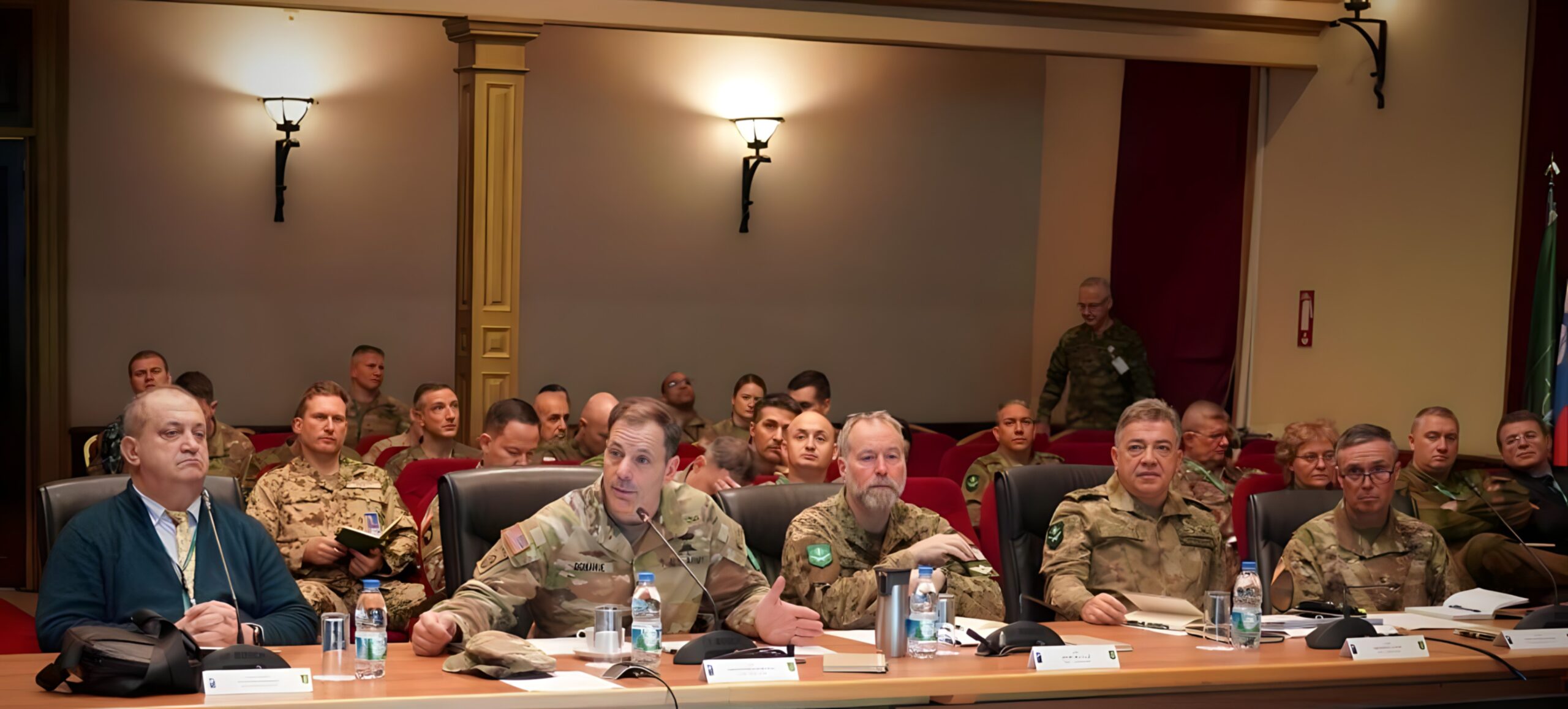
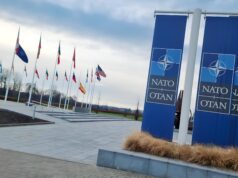
Senior army corps commanders from across NATO met in Izmir, Turkey, in late January to align planning and training priorities for 2026 as the Alliance moves to operationalise its regional defence plans.
NATO Allied Land Command (LANDCOM) said the 29 to 30 January meeting brought together corps-level leaders to discuss how land forces will contribute to executing NATO’s integrated defence plans through coordinated training, investment and innovation. The event included remarks from U.S. Air Force General Alexus G. Grynkewich, NATO’s Supreme Allied Commander Europe, and U.S. Army General Christopher T. Donahue, Commander of LANDCOM.
Donahue said the Alliance had made progress during 2025 in developing a shared approach around LANDCOM’s Eastern Flank Deterrence Line (EFDL) concept. “The goal year one was to increase the land domain’s contribution to deterrence, and we achieved it,” he said. “In year two, we will resource the plans through the EFDL.”
NATO describes the Eastern Flank Deterrence Line as a distributed warfighting concept designed to improve the ability of land forces to execute regional plans, combining conventional formations with uncrewed and minimally crewed systems supported by integrated mission command networks and live data feeds to accelerate decision-making.
LANDCOM said the concept complements national and multinational efforts such as Poland’s East Shield and the Baltic Defence Line, and is intended as an operational framework rather than a single unit or fixed geographic line.
Donahue told leaders that 2026 would be focused on implementing the concept.
“2026 is the year of execution for land forces,” he said. “Increasing Corps involvement in how we train and build ground deterrence lethality is essential to continuing the transformation and readiness of land forces.”
During the second day of discussions, Grynkewich emphasised the importance of ensuring land forces can deliver on the commitments underpinning NATO’s deterrence posture.
“Here at LANDCOM, ground deterrence relies on you, and I need you to be able to do what you say can do,” he said. “This is LANDCOM’s year of execution. A year to operationalize transformation, rehearse plans, and to set the conditions to rapidly implement them.”
NATO said the meeting produced actionable steps to strengthen integration between Alliance regional plans and host-nation forces. LANDCOM, based in Izmir, coordinates NATO’s land component and is responsible for developing and synchronising land capabilities across the Alliance.





Starmer’s hopefully