

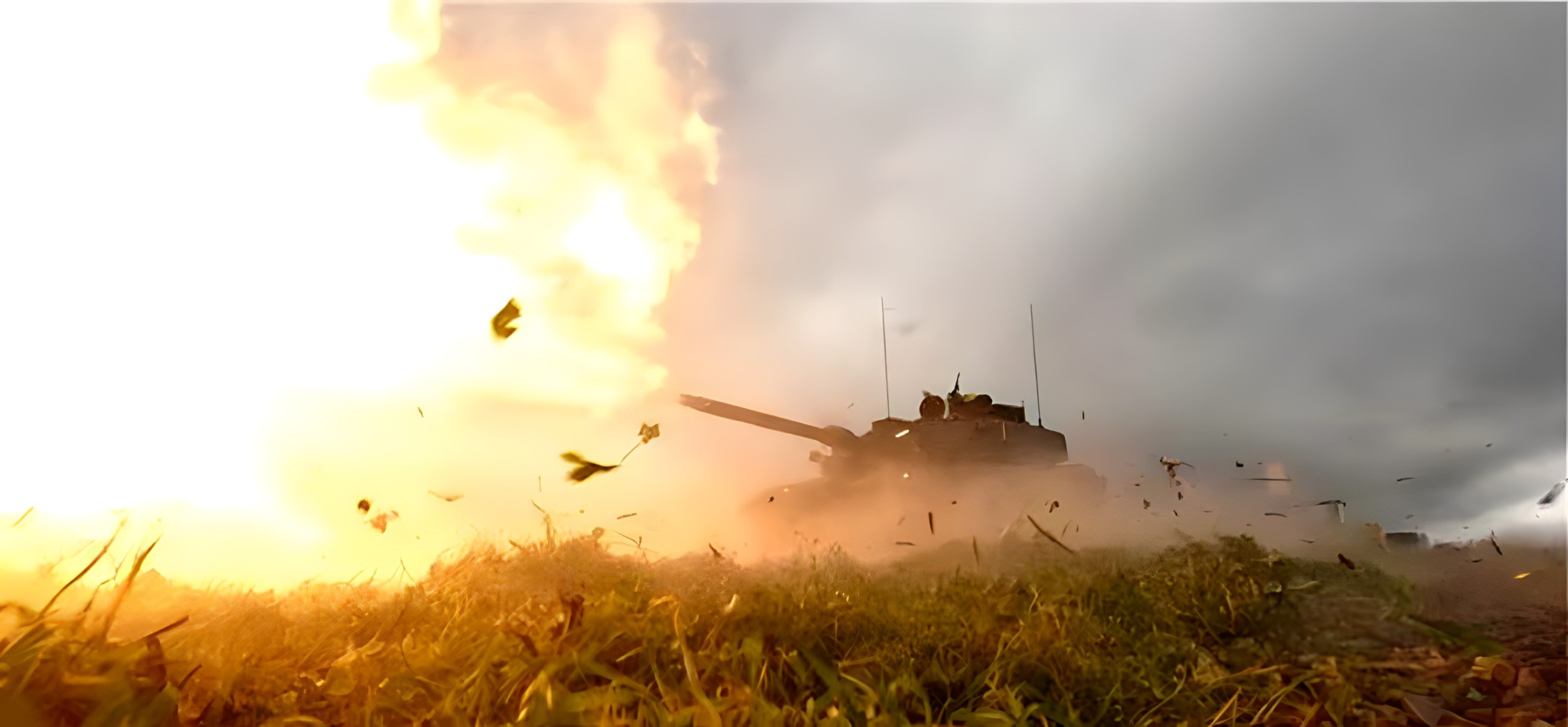
The British Army’s Challenger 3 main battle tank has completed its first-ever crewed live firing trials, marking a major milestone in the programme to modernise the UK’s armoured forces, according to RBSL.
Rheinmetall BAE Systems Land said the trials, conducted in the UK, represent the first time in more than 30 years that a newly developed British main battle tank has fired its main armament on UK soil.
The live-fire activity forms part of a phased assurance programme intended to validate the vehicle’s safety and performance ahead of entry into service. According to RBSL, testing initially began with remote firing before progressing to crewed operation once key safety and system checks had been completed. Challenger 3 is fitted with the 120mm smoothbore L55A1 cannon manufactured by Rheinmetall Waffe Munition. The company said the gun is capable of firing modern kinetic energy anti-tank rounds as well as programmable multi-purpose ammunition.
Rebecca Richards, Managing Director of Rheinmetall BAE Systems Land, said: “This is a hugely significant achievement for the Challenger 3 programme and a testament to the skill and dedication of the teams delivering it.”
She added: “Firing the vehicle first remotely and then with a crew in the turret reflects the enormous amount of work that has gone into ensuring the design is safe, robust and ready.”
Richards said the trials demonstrated the progress made by the programme and marked an important moment for UK armoured vehicle development.
The Army’s Senior Responsible Owner for the programme, Mark Colley, said the milestone reflected close cooperation between the Ministry of Defence and industry.
“The successful crewed firing of Challenger 3 demonstrates tangible progress in delivering the modernised, Main Battle Tank the British Army needs,” he said.
Following completion of this phase, the tank will now enter further trials as it moves towards operational service. Challenger 3 is expected to form the core of the British Army’s future armoured capability. The vehicles are being designed and produced by Rheinmetall BAE Systems Land at its factory in Telford. According to the company, the programme draws on collaboration between UK industry, allied partners and European vehicle systems suppliers.








Congrats to the team. I wonder how the new barrel compares to the old one.
Jon, I was wondering that. Whether the Rheinmetall gun and projectile delivers better accuracy at range and penetration compared to the CR2 with a DU proj.
In general a rifled aerodynamic projectile will have better accuracy, whilst one fired from a smoothbore can travel further (the projectiles design and mass will determine this). For a tank gun, this is due to the projectile with the fins becoming unstable quicker that a spinning projectile, due interference from more drag. As soon as the round drops into the transonic zone, the fins on a smooth bore round become less effective at stopping it from diverging from the desired path. The spinning round keeps it straight for longer, as there are no fins causing drag to keep it straight. I’m trying to remember the percentage difference, 10% seems to be ringing bells. As in a rifled round is 10% more accurate than a smooth bore round (with fins).
However, for the L55A1 vs the legacy L30. This doesn’t quite match up. As the L55 uses a lot more propellent compared to the bagged charge used in the L30 to fire Fin rounds. Additionally the L55’s Fin round is nearly double the length of the L30’s. Meaning that due to the fineness ratio (length vs diameter), the longer round is more aerodynamically efficient, so will go further at a faster rate of knots. Additionally it will slow down slower than the shorter/stumpier L30 Fin round.
In essence this means that engaging a typical target at 1500m, the L55’s round will hit the target with a lot more energy than the L30’s. If the Fin round was made of the same materiel, the L55’s would be able to penetrate better and further. I’d say over the typical battle ranges a tank engages at, say 1500 to 2000m the L55 should match the accuracy of the L30. At the distances the Ukrainians have been using HESH against the Russians around 5km. The Ukrainians are saying its still effectively accurate, will the L55 be able to match that firing the multi-programmable HE shells? Firing something like the M830A1 shell, which is fin stabilized. I’m not sure how accurate it will be at those distances, as its fired with a higher muzzle velocity than HESH.
I’m pretty sure one of the Army’s conditions, was that the L55 had to be capable of match the legacy L55 for accuracy over normal engagement ranges. If it can do that past these ranges billy bonus!
Longer distances are the new normal.
Especially when Russians cover their tanks in fake ERA.
Sorry being a pedant here….don’t you mean…..
‘I’m pretty sure one of the Army’s conditions, was that the L55 had to be capable of match the legacy L30 for accuracy over normal engagement ranges.’ ??
Bugger, yep just spotted the typo.
DaveyB, could there be a requirement to retain some CH2s (following a refurb) within the tank regiments for snipper purposes? The Ukrainians have demonstrated CH2’s ability to be an excellent sniper gun, due in part to the rifled barrel. CH2 rounds could still be manufactured to cater for the CH2S, as I’m suggesting for its designation.
That’s a pretty unlikely scenario tbh. It’s pretty hard to build your force structure around sniper armoured vehicles. More likely CR2 (CH2 is Chieftain mark II) held would be used for called up reserves.
Dern, can’t see it being a problem, the hulls are the same (almost) and the Ukrainians swear by the sniper ability of CH2. I’m talking about two per regiment.
It is a problem though.
You have two tanks. Where do they sit? Armoured Regiments aren’t like Infantry Battalions, they don’t have support Coys with platoons of capabilities like Assault Pioneers. Does OC Recce have to take these two tanks? He now has his Recce force on Ajax and two tanks that are going to sit in a competely different battlespace? Do they go to the HQ Sqn and now OC HQ has a combat role instead of just a supporting one? What’s the ConEmp? Where do they physically sit to support the Sqns? What happens when the three Sqns get detached to make Battlegroups?
And along with all this is a competely different ammunition (not to mention a lot of other components that aren’t the same) chain that potentially has to be pushed down to Sqn or Company Group level, for a single tank.
It’s not a problem that anyone is considering worth the organisational and logistical squeeze
Here mate, the Ukrainians used a mixed fleet of MBT, admittedly through necessity, and CH2S would be available to the tank regiments if and when the infantry required them in support. To place these vehicles under any other units would require MBT training, which would be a waste of time and money.
The Ukranians have a mixed fleet but they still have an entire squadron of CR2’s that operate together as a squadron, not two orphaned vehicles retained for a very niche role. Your response does not answer a single question I posed, and I suspect you didn’t quite grasp what I was saying as I didn’t suggest putting them into a non-armoured regiment.
As others have said, I believe it is in the Nations best interest to convert as many Challenger 2s to 3. Primarily because in a perr vs per fight that includes MBTs and everything else you find on today’s battlefield, we are bound to suffer losses. Therefore we must have sufficient reserves to maintain our formations strength.
For the sniper role, perhaps it could be filled with surface launched Brimstone, fired from either a Boxer or Supacat chassis?
DaveyB, the government is not interested, 148 if we are lucky and that’s it.
Sadly too true, until the panic takes over.
The loss of rifling is a loss for accuracy, however the have pushed the fact that the new smooth bore is fired at a greater pressure.
The rifling did reduce the life of the barrels but the higher pressure in the breach has to be contained for the sake of the crew. I just hope that the Obturatiors have a long life.
What I find most interesting is the reversal of military history: rifled barrels dramatically improved accuracy compared to smoothbore muskets, but on a macro-scale, smoothbore tank guns are normally preferable to rifled.
Programmable multi purpose munitions… will it tidy your room or cut the grass if you ask it….
Don’t be silly, I’m getting rather tired of all this silliness on here, this Is a serious site I’ll have you know.
😁
What range was used?when Rhienmettal done their firing trails they had to go to Germany because ours were not up to standard for that ammo!
Castlemartin I would have thought
Ours weren’t “not up to the standard.” It was just that it needed to be signed off still at the time.
Let’s hope this testing regime incentives defect reporting as opposed to ‘that’ll do the job’…..
Really that is the AJAX issue – sweeping things under the carpet with a massive broom!
I think the current program position of not setting a date on this ones is sensible, fact is despite all the s**t people talk about challenger 2, it is still up to the job as experience in Ukraine has shown. C3 was in part a response to the T14 and the T14 appears to no longer exist as a weapons program. This means we have time to get C3 right and we should also consider retaining C2’s not upgraded because it’s clearly an effective weapon system as long as the ammunition lasts.
A small orphaned fleet with obsolete parts…..
I’d upgrade the lot TBH for the extra change it will cost. Every single serviceable hull must be upgraded.
The ammunition is a real issue as having a process to make ammunition for a tiny number of tanks is something that MOD would cut in heartbeat when under pressure and it isn’t NATO standard so no interoperability.
Aren’t we upgrading all the Challengers we can? Are there any further C2 hulls available for upgrade? I wonder if the headline numbers might be misleading us into believing in phantom tanks that don’t really exist.
There are more hulls at Ashchurch for sure.
Whether they are complete operational tanks or not is quite another matter.
We are upgrading all the challengers we can for the price point RBSL is offering. More hulls could be upgraded, or even manufactured, but the price would go up because they need more work.
I disagree with retaining C2, Last thing we need is two tanks with two different ammunition types. I would like to see another 50 converted even if they are stored as a potential surge/replacement back-up but…money. We should have picked the German gun back in the 90s. Should have picked Leopard 2 TBH but we are where we are. And yes I know it’s not perfect and C2 probably has better armour (not sure about the Leo 2 A7V) but logistics wins wars and having the same kit as most of the rest of Europe would make support easier as well as upgrades.
I suggesting retaining them in reserve and not active.
My preference would be to see them all upgraded to C3 but failing that we should retain any C2 we can.
Jim, while I agree keeping CR2’s for RWxY should at least be considered, do remember that ammunition has a shelf life. Even if you want to keep CR2 in reserve, the fact that it uses different munitions from CR3, Leopard, M1, Ariete, Leclerc etc means that you need to keep ammunition production running just to replace the stocks that go OOD.
Interesting fact for you. Back when they were designing and testing the L30 gun. Royal Ordinance were also testing it against a smoothbore version.
However at the time the Army still really wanted HESH and believed the CHARM series of Fin rounds would be sufficient to knock out any rank at normal combat ranges. The rifled gun won obviously, as the HESH capability was a deciding factor. The company in a Belgium that currently makes the HESH the Chally uses. Designed a HESH shell that could be fired from a smoothbore gun. I believe this was done by angling the rear fins, much like on an arrow causing the shell to spin after leaving the barrel.
There is also the single Challenger 2 CLIP which has a Rheinmetall 120mm smoothbore gun. Unsure about how the ammunition worked for it since it was only a demonstrator and didn’t have to worry too much about the single piece ammunition, but still.
Is there a world where we upgrade the set number of CR2 to CR3, then (for a lower unit cost) just add the gun and standard sighting system to the remaining CR2 hulls and put them in storage?
That removes the ammunition issue, provides some level of ready reserve, without blowing the budget on the new armour, ISTAR system, etc.
Personally, I don’t think the cost would be worth the benefit, and we should just up our CR3 order- potentially as a follow-on trickle flow in the next budget or two. But our forces lack so much depth in terms of armour and other key systems that I don’t think we can do nothing…
Except the ammunition storage would continue to be an issue.
Sorry mate, I’m missing something: If we just fit the CR3 gun and bare minimum fire control changes to the remaining CR2s, so they’re a back-up storage (not at all my first choice, but just talking hypotheticals), where would the different ammunition storage come from?
CR2 uses a two (really three) piece ammunition system. Aka the shell or rod goes in first, then you load a separate bag with the powder, then the primer, then fire it. The ammunition that the Rh120 on CR3 uses is single piece, so the shell, primer and powder are all contained in one package that gets loaded at once. Because the smoothbore 120mm ammunition is much longer than either of the two piece 120mm smooth bore pieces the ammunition stowage is an issue.
That’s one of the main reasons CR3 needed a completely new turret, not a refurbished one, because the ammunition storage on CR2 CLIP, when reconfigured, only had space for about 6 shots of the larger ammunition.
Ah, gotcha- thanks. 6 rounds is hardly a useful operational load…
I still think we should trickle feed additional CR3s once the main order is done- if we can’t afford a second larger one. Even if we don’t expand the active tank force (which might be preferred, but still), we’ve got no reserve whatsoever, which makes us far too brittle. And that’s not just tanks, to be fair.
You also have to remember how difficult it would be for the loader, to bring up the one piece ammo from the hull in the Chally 2. Being nearly 1m long, there’s going to be a lot of swearing. Plus it won’t be quick, as the tank’s ergonomics are not designed for the longer rounds!
The new turret houses the ready rounds in the rear bustle (as per the Leo and Abrams). Meaning the loader has a much easier and faster means of loading the gun. The hull has also been modified, to incorporate a new armoured bin for additional ammo, which I believe has been designed, so that the loader can reach and collect the rounds easier.
There’s videos of crews operating inside Leo turrets, that show the gun being loaded in around two seconds, then fired. I’ve seen one where they banged off five rounds in under 10 seconds. Compare that to using the multipiece ammo used in a Chally 2. Which on the best of days would never be able to match that. The Leos have also demonstrated that they can get a second shot down range much faster than an a T series with an autoloader can do. Our Chally 3s will be able to match the load and fire speed of the Leo.
Real life combat in Ukraine and the gulf/ Afghanistan has shown that Ch2 is a superior platform to Lep2 in every metric except speed so why would we give British tank crews a system we know isn’t as good and strategically tie ourselves to a foreign power?
Our reliance on the F35 and it’s issues should surely prove that if you can produce weapon systems domestically you should.
Definitely should not go with Leo of any type. Compared to a Challenger they are a bugger to repair. Leos use torsion bar suspension, which are solid stell bars that go through the hull. Whereas Chally uses a derivative of the Horstman system. Where all the components are bolted to the outside of the hull. Which after suffering damage is much easier to repair or replace. Meaning the tank can get back in the fight much sooner than a Leo.
In fariness Leo is far from unique in using Torsion bars, M1, Ariete, T-90… tons of vehicles use it, and it seems a pretty decent system.
In fairness compared to everything except the Ariete, everybody has a lot more tanks than we do. So we have a greater need to maintain ours, turn them around and get them back in the fight, Gulf War 2 was a good example of this. The Yanks would haul theirs back to Saudi and leave them in the park to be shipped home for repair. Whilst we, out of necessity did the repairs in country. From memory none of the damaged Challys had to come back to the UK for repair (Graham may know more?). I would also say the Leo has yet to face a realistic threat. Yes the Turks used them against the Syrian regime and various “militias”. But the ones that were damaged and not destroyed, I would like to see how they recovered them.
My reason with being biased against torsion bar suspension, is based on the Canadians using them for force protection in Afghan. Where in a convoy, the lead Leo had an IED detonated underneath it. Which the EOD later determined was three 152mm shells wired together. My Team and I were in a Foxhound about three vehicles back. We witnessed the tank leaping about a foot in the air, track and wheels flying off, then landing with a huge thump, that we felt in the Foxhound. The convoy came under contact as the Leo landed. Which didn’t end well for the Taliban.
A Yank low loader came to recover the Leo, as the engineers couldn’t fix it. Even though it had additional belly armour. The force of the blast had buckled the hull’s bottom. On one side about three suspension arms were missing along with their road wheels. But the torsion bars sticking out of the hull, you could see were buckled as well. The tank sat in Kandahar for 4 months, before it was airlifted back to Germany for repairs. If a Chally had the same attack on it, would the tank needed to be recovered back to the UK? I suspect not!
Um… I would consider the Russian Army to be a realistic threat to be honest.
I too would like to know which range, all experimental firings were carried out in Kirkcudbright. Also what was fired Fin, HE, water shot?
18 ready and IOC in 2027, according the the keynote speech at the IAV conference.
Full squadron+, could there be optimism here? I wonder what the production rate is after IOC.
This is bit off subject but does anyone on here know if the turret off the AJAX would be able to be mounted on the challenger? I’m not an expert just a keen follower, and was genuinely just wondering if the challenger would make a good replacement for Ajax? With the view to buying the new Leopard as our MBT instead of updating the very limited number of challengers we have. Also if there are issues with the chassis and frames of challenger that the recoil from the AJAX turret would be significantly less damaging and keep the fleet going abit longer? Also due to challys size would be able to accommodate future upgrades. Might then be able to go back to GD and get them to build the other variants of Ajax then if they’re not experiencing the overweight rattling issues? As I said I’m not an expert so apologise if it’s a no goer.
I’m less concerned with the gun swap as I am in the active protection system, the gun is a proven working system that really just needs integration into ch2.
What I’m concerned about is has the MOD taken the lessons from Ukraine and designed a tank that can cope with the current threats in a modern environment.
The risk to modern armour seems less about tank on tank engagement than mines, drones and dedicated manpads today.
The tank was designed pre-Ukraine. It’s APS is mostly designed to deal with ATGM’s. The next upgrade package down the line will probably focus on lessons from the Ukraine War, and probably digest the actual lessons rather than Twitter video reels. Also while I’m not sure why anyone would be worried about MANPADs (Man Portable *Air Defence*) being a risk to tanks though it is worth noting that using Tanks to defend against Tanks hasn’t been doctrine really anywhere since about 1942.
Yes, the L55 can fit in the Chally 2’s turret, but like they found in earlier trials, you would only be able to store about 6 rounds. The Chally two was designed to house the bags of propellent and rounds in multiple but separated locations around the tank (hull and turret). The L55 gun uses one piece ammunition that is nearly a metre long. BAES/Rheinmetall have had to completely modify the interior of the hull to store extra ammo, where they built an armour protected magazine in the hull much like the one the Leo uses. Plus the ready rounds are kept in the new turret’s bustle, that incorporates roof blow out panels..
Cost per mile of using a tank hull with AJAX turret is not economical. An engineer at Bovington said the old 432 APC costs 1/4 of running a Warrior per mile.