

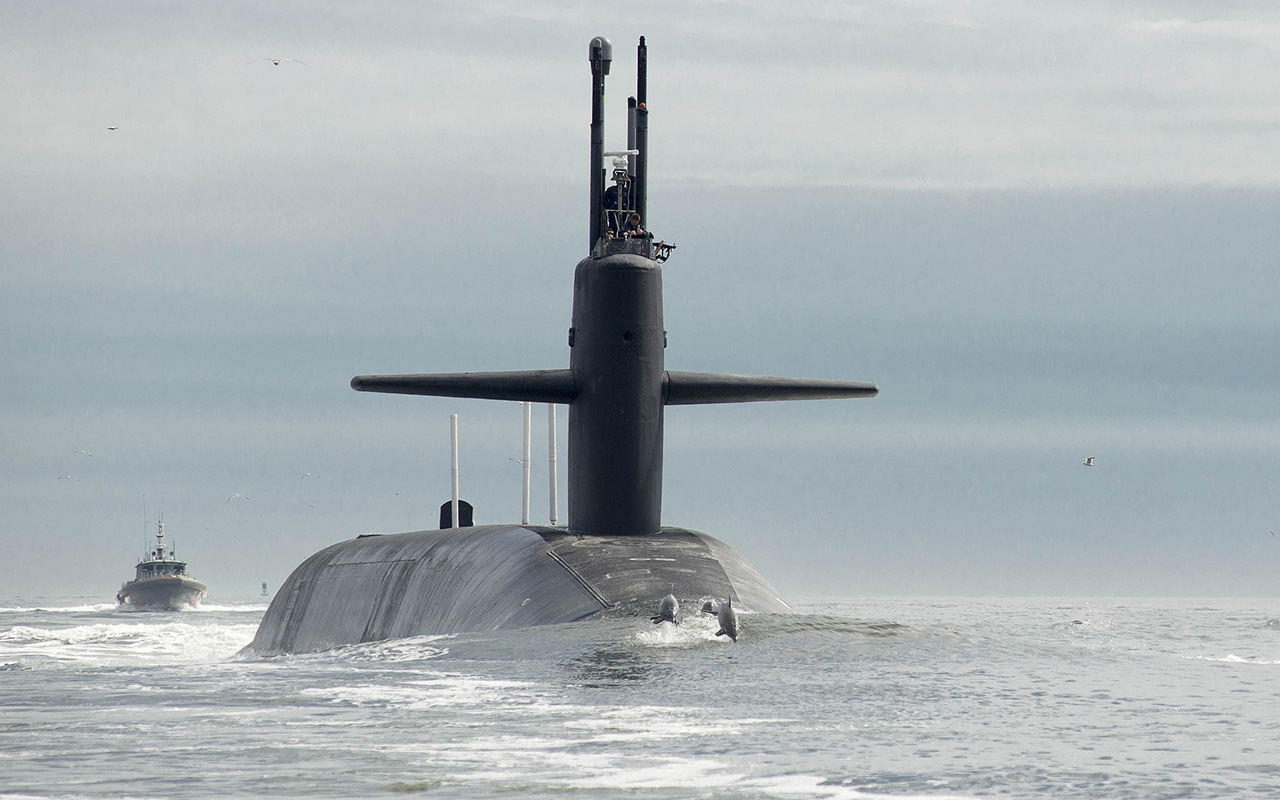
A new advanced manufacturing facility aimed at increasing production of U.S. Navy submarines has opened in Cherokee, Alabama, supported by a mix of government and private investment, the US Navy stated.
The 2.2 million square foot site, developed by Hadrian, will house a highly automated “factory of the future” known as F4, designed to mass produce components for Virginia-class attack submarines and Columbia-class ballistic missile submarines. The project combines $900 million in Navy funding with $1.5 billion in private capital, totalling more than $2.4 billion, and is expected to create up to 1,000 manufacturing jobs.
The facility is intended to address capacity constraints within the U.S. submarine industrial base by shifting component production away from traditional shipyards. This allows shipyards in Rhode Island, Connecticut and Virginia to focus on assembling submarine modules, with the aim of increasing overall build rates, according to the US Navy.
Secretary of the Navy John C. Phelan said: “Both chambers of Congress delivered the generational investment required to rebuild our shipbuilding capacity, bring those jobs back to Alabama and put American skilled laborers back at the center of American strength. I look forward to building on this progress together in the months ahead, because we are just getting started. This factory is the first of three facilities designed to address the most critical bottlenecks in the maritime industrial base.”
Jason Potter, performing the duties of Assistant Secretary of the Navy for Research, Development and Acquisition, added: “We call this distributed shipbuilding, and it’s a key tenet of our plan to achieve required shipbuilding production rates. These factories of the future might be several states away from the yards where the ships are ultimately built, but by taking on this work they reduce bottlenecks, having a profound effect on the speed of delivery.”
The project is expected to take between 18 and 24 months to reach full-rate production, including facility commissioning, component qualification and compliance processes such as SUBSAFE. By its third year, the site is expected to operate at sustained production levels supporting submarine construction programmes.










Well in principle this is a great idea: let the shipyards focus on putting ships together from really accurately made parts. Simplifying that is made at the shipyard.
There is a but coming along here. How do the decades of experince get moved to this new facility with out hamstringing the shipyards?
SB,
Concur this is a potentially high risk/payoff submarine production measure/plan. Not certain whether the Dept. of the Navy has many viable alternatives available in an attempt to increase production to a projected requirement for 2.33 SSNs/yr. by the early 2030s. Possible that this workforce will be seeded w/ some journeymen level talent, recruited from the principal yards. Unfortunately, time is of the essence, and USN is forced to take big swings at bat. If called out, AUKUS Pillar I will be in serious jeopardy, and require significant revision. At the very least, USN should be given credit for a serious attempt at recovery from a post-CWI implosion in SSN availability.
I am really impressed with what Hadrian are doing and already achieving – we need a couple of these factories in the UK as they are a game changer – not just for defence but auto parts.
Their manufacturing tolerances are incredible once they get going and super efficient, so not sure where the 1k jobs are going to come from (I guess delivery and management of materials)
This seems like a really smart move on the part of US imo
The thing with this sort of low volume defence manufacturing is that automation is viable up to a certain point.
A lot of the lifting and shifting that could be automated isn’t worth it due to the low volumes and low frequencies of moving some of the larger parts.
That said with smaller high frequency parts automate as much as possible.
Agreed, but I think Hadrian have a really good process model that enables high quality micro manufacturing. I have to say I am really impressed with what they are doing and their ability to do it.
Of course everything is relative but the fact that they can turn one of their manufacturing lines over to any given product with the correct scheduling and produce a run of that product before switching to the next has to be a positive.
It’s not for super small batches really (although it will do them) it comes into its own once you are producing 100+ of an item at which point the scale kicks in. Having said that it wouldn’t surprise me if they have 1 or 2 lines solely focused on low volume / high value items which can meet any demand.
they do seem to have a very good handle on this and are making a difference in the markets they have already entered. Will be interesting to watch them grow further.
btw. I think they make parts for Space X – so the ability to deliver complex parts to quality is already there
Hi SB, The thing is that with CAD, automated CNC machines and Laser printing, basic old fashioned engineering skills just ain’t what they used to be. Here we are in the UK we are about to start building RR SMR in factories in areas with no attachment to the existing related manufacturing base (though that’s intentional). The Sheffield AMRC is a microcosm of what can be done with advanced techniques and equipment to produce bespoke items.
The most important resource is people with the right basic skill sets and enough of them. This US initiative is IMHO a very logical solution to a moribund problem, the US shipbuilding industry needs a shake up as just throwing cash at it just isn’t working.
To be completely honest I do wonder what would happen if we thought about something similar to help us with the issue of spares parts. Get rid of Robbing one ship to fix another because there are no spares, these days we don’t actually need the OEM to still be in business if the part can be produced in a high tech small volume manufacturing plant.
“ To be completely honest I do wonder what would happen if we thought about something similar to help us with the issue of spares parts. Get rid of Robbing one ship to fix another because there are no spares, these days we don’t actually need the OEM to still be in business if the part can be produced in a high tech small volume manufacturing plant.”
Three issue spring to mind; subcontinents, testing/calibration and security.
The big issue with fixing or making a log things is the bewildering rate at which many components are NLA. Things that were catalogue buys 20 years ago are now specials.
Testing and calibration can demand highly specialist kit and knowledge that are super hard to replicate.
Diffuse manufacturing aids security – no over concentration of knowledge.
Hopefully this will allow the US to meet its commitments to Australia under AUKUS, I really can’t think of how bad things will get if the Trump administration follows through on its recent idea of just saying to Australia “thanks for the cash and don’t worry about the boats, we totally have your back”.
Slightly off topic but has anyone heard anything further about the mysterious failures in the USS Fords plumbing and the fire. Seems sailors have been actively sabotaging the ship by flushing ropes down the vacuum toilets and may have deliberately started a fire to go home as ford is on its 10 month at sea on deployment in near continuous war time conditions.
I’m not sure how America being such a super power needs to work one carrier so hard that its crew start flushing ropes down the toilet to go home. This seems to have been the second nightmare carrier deployment for US navy crews after everything that happened last year with the USS Truman deployment.
If these were British ships and this was happening it would be front page news and the daily mail would be decrying the death of the British empire but with US ships it barley seems to register past the price of gas.
A French aircraft carrier was actively broadcasting its location on social media yesterday in a war zone and barely a mention in the news.
Prince of Wales gets a blocked toilet and people start loosing their minds.
Double standards
Good news as long as it does not shift people from the ship yards..
I’m the end this does not solve the basic issue that the US only has 5 construction bays to lay down nuclear submarines.. China has 24 with possible another 8-12 being built.. with large factories for both large and small components next to the bays..
The present construction rate will be down to 43 boats by around 2035 that’s if they can move from the 1.2- 1.5 boats a year to two boats a year and at that point the first 2 sea wolfs will be 38 years old and retiring and the last seawolf will be 31 and first Virginia 32.. they should have 66 boats so they are heading to a 24 short fall … that’s an extra 3.2 boats a year needed…so all this work is just to really secure them 43 boats for 2035… not replace the massive losses ( they are at about 51-53 boats now).. the 2 sea wolfs aging out will mean they will not see an increase until 2037.. they will increase by 2 two maybe the mid 40s for 2038.. then 2 more boats will age out probably in 2039.. from 2040 they will increase by 1 boat a year ( losing 1 gaining 2).. until they hit there 66 in around 2055-2060…
China the communist smart arses that they are will have serial produced 16 Type 093Bs for about 2028 ( launched not commissioned) then start serial producing Type 095 from about 2030 at maybe 5-6 launches a year.. they will probably ditch their earlier Type 093s to be honest ( bit shite) so by 2035 they may have 16 T093bs and maybe 20+ T095s launched ( not commissioned).. if they kept popping them out at capacity they could have 40-50+ T095s launched by 2040 as well as the T093s..( the T093 is though to be mid flight 2 LA comparable)…as well as the Chinese AIP programme which will have them having 40+ AIP subs on top
That’s scary set of trajectories for the USN.. they are really going to want the UK to have 12 SSNs and Australia 6 as well as the French 6.. because the balance will be with those nations..in the 2040s… but im not sure what anyone can do if china just keeps pumping out 5-6 SSNs a year beyond 2040.. better hope they run out of money…it will have the largest fleet of SSNs ever seen.. but I’m not sure anyone can afford to keep that level of production, my fear is they start selling them.. because China would.
Probably need to bring Japan and South Korea in as well.