Category: Sea

  • UK and South Korea to conduct joint sea patrols

    The United Kingdom and the Republic of Korea have signed a new Accord to jointly enforce sanctions against North Korea, focusing on halting its illegal weapons programme.

    This agreement, part of the Downing Street Accord, is set to be formalised by UK Prime Minister Rishi Sunak and ROK President Yoon Suk Yeol during President Yoon’s state visit to the UK.

    Marking the 140th anniversary of diplomatic relations between the UK and the ROK, this Accord includes a defence agreement, a first of its kind, enabling both nations to enforce United Nations Security Council sanctions on North Korea.

    UK Defence Secretary Grant Shapps stated, “The UK is leading the way in supporting our Korean friends in countering North Korea’s aggressive posturing and ensuring the safety and security of the Indo-Pacific. Deepening the ties between the Royal Navy and Republic of Korea Navy, our bilateral defence relationship has never been stronger.”

    Foreign Secretary David Cameron emphasised the enduring trust and respect between the two nations, underscoring the UK’s dedication to democracy in the region. He remarked, “This agreement – signed 70 years after the Korean War Armistice – is a truly unique step in the strengthening of our work to secure the security of the Korean Peninsula and the region. We are proud, as a permanent member of the UN Security Council, to be at the forefront of international sanctions enforcement activity.”

    The Accord encompasses plans for expanded security and defence cooperation, a Strategic Cyber Partnership to combat cyber threats, and a joint Ministerial Statement Of Intent for a new Defence Partnership for Industrial and Capability Cooperation.

    You can read more about this by clicking here.

  • British frigate returns home

    British frigate returns home

    HMS Portland, a Type 23 frigate, received a warm welcome upon returning to its home port in Devonport, after months of operations in the North Atlantic and surrounding UK waters.

    Embarking from Devonport in early August, HMS Portland’s mission included the shadowing of Russian naval vessels and visits to ports from Belfast to Nova Scotia.

    According to the Royal Navy press release, “HMS Portland has had a busy schedule since leaving Plymouth.” This included a brief collaboration with HMS Queen Elizabeth and the UK Carrier Strike Group for NATO training and exercises.

    A pivotal aspect of HMS Portland’s deployment was tracking Russian warships and submarines. This task was undertaken in coordination with the offshore patrol vessel HMS Tyne and the RAF’s P8 Poseidon aircraft. The frigate monitored several Russian vessels, such as corvettes Boikiy and Grad, cruiser Marshal Ustinov, and the Udaloy-class destroyer Severomorsk.

    During a visit to Belfast, Northern Ireland, HMS Portland then embarked on a transatlantic journey to Canada to participate in the Royal Canadian Navy’s inaugural International Fleet Week in Halifax, Nova Scotia. The frigate opened its gangway to the public, including participants from Techsploration, which encourages young women to pursue careers in science, engineering, trade, and technology.

    HMS Portland also took part in exchanges with sailors from various international navies in Halifax, culminating in a salute to the Commander of the Canadian Navy, Vice Admiral Angus Topshee.

    Upon its return to the North Atlantic, HMS Portland rejoined the UK Carrier Strike Group, escorting HMS Queen Elizabeth alongside the Type 45 destroyer HMS Diamond. The frigate played a critical role in the launch of a Training Variant Torpedo from Merlin Mk2 helicopters aboard the aircraft carrier.

    With its return to Devonport, HMS Portland concludes a series of strategic operations, underscoring its vital role in maintaining security in the North Atlantic and surrounding UK waters.

    You can read more about this by clicking here.

  • Sweden selects British CAMM missiles

    Sweden selects British CAMM missiles

    MBDA has signed a contract with Sweden for the delivery of Common Anti-air Modular Missiles (CAMMs).

    This agreement, brokered between MBDA and the Swedish Defence Materiel Administration FMV, involves equipping the Royal Swedish Navy’s Visby Class Corvettes with CAMMs, to be deployed via MBDA’s Sea Ceptor naval air defence system.

    Sea Ceptor, a state-of-the-art naval air defence system, is well known for its ability to provide comprehensive self- and local area air defence.

    It can counter a wide array of threats, including supersonic anti-ship missiles, attack helicopters, and un-crewed air vehicles. Notably, the system is adept at handling simultaneous attacks, including saturation attacks, from any direction.

    Eric Beranger, CEO of MBDA, emphasised the significance of this contract. “CAMM will provide Sweden and the Royal Swedish Navy with a formidable air defence capability that gives the country a strong new contribution to NATO together with other allied Sea Ceptor users like the Royal Navy from the United Kingdom. We’re proud also to be continuing our long history of partnership with Sweden and Swedish industry, including Saab.”

    Sweden now joins a growing list of countries, such as Poland, the UK, Italy, Canada, and Brazil, that have selected the CAMM family for their latest generation naval and ground-based air defence needs.

    You can read more about this by clicking here.

  • Drone video shows status of ferries at Port Glasgow

    Drone video shows status of ferries at Port Glasgow

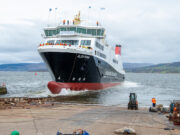
    A recent drone video provides an overview of the ongoing construction of two vital ferries at the Ferguson Marine shipyard in Port Glasgow.

    The Glen Sannox and Glen Rosa were originally due to be in service in 2018 at a total price of £97m. The cost for completing the Glen Sannox has risen to £130m and for the Glen Rosa it has increased to £110m.

    But today, we’re just looking at their material state. They seem to be looking the part now, at least externally.

    MV Glen Sannox

    The MV Glen Sannox, moored upon the Clyde, bears the semblance of readiness, with her exterior suggesting near completion. However, her outward readiness belies the extensive internal work that remains, particularly in the wake of a failed safety audit by the Maritime and Coastguard Agency (MCA) in September 2023.

    The MCA’s insistence on additional staircases for safety certification precipitated a delay, pushing the sea trials of Glen Sannox to the first quarter of 2024 and casting doubt on her readiness for the forthcoming summer season.

    Cabinet Secretary Neil Gray has articulated the MCA’s integral role in the early phases of vessel delivery, particularly for those of pioneering design. The process of certification has been one of partnership and refinement, with the MCA’s input leading to vital design modifications that, whilst introducing delays and additional costs, are essential for the vessel’s safety and compliance.

    The result of these modifications has been a reduction in passenger capacity from the initial 1,000 to 852, a necessary concession to meet the MCA’s stringent safety standards. In March 2023, it was reported that further delays have pushed the vessel’s entry into service to Autumn of 2023; in August 2023, a further delay to the first quarter of 2024 was announced.

    MV Glen Rosa

    The sister ship, MV Glen Rosa, shares a similar story. It will also undergo design modifications following the Glen Sannox template to meet MCA standards. Her exterior, while looking close to completion with the main hull and superstructure in place, is yet to be finalised, as indicated by the extensive scaffolding that envelopes her.

    The ferry’s external aspects, from the paintwork to the installation of safety equipment, are in the midst of being completed, but her readiness for service is still some way off.

    Internally, there remains a substantial amount of fit-out and systems installation to be done before she can be deemed ready for operational duties. This includes the intricate fitting of dual Wärtsilä 34DF diesel engines, controllable pitch propellers, and the trio of bow thrusters that will eventually enable her to reach service speeds of 14.5 knots.

    The Glen Rosa, her name chosen by public vote and embroiled in what’s been dubbed the “ferry fiasco,” reflects the complexities and heightened scrutiny of modern shipbuilding.

    With her finished tonnage at 1,273 DWT and a length of over 100 meters, she’s set to be a significant vessel within the CalMac fleet, intended to carry 1,000 passengers and 127 cars or 16 HGVs, though currently licensed for 852 passengers.

    The vessel’s recent milestones includes the completion of design issues involving below-deck escape trunks and the announcement of a slipway launch and naming ceremony set for March 12, 2024. The expected delivery date for Glen Rosa is May 31, 2025, with an estimated cost of £100 million.

    Looking Ahead

    The future of Ferguson Marine (Port Glasgow) Ltd is under careful consideration, with plans to refine investment proposals while adhering to subsidy control rules and demonstrating value for money. The Scottish Government say it is committed to a sustainable future for the shipyard, balancing the interests of the workforce, local communities, and the broader Scottish economy.

    David Tydeman, CEO of Ferguson Marine in Port Glasgow, expressed his hope to secure substantial work from the Royal Navy’s Type 26 Frigate programme, potentially utilising over half the yard’s capacity. Despite the uncertainties surrounding the future of the shipyard, Tydeman was confident about Royal Navy work supporting the yard during a recent Public Audit Committee meeting.

    “We have been planning for some time,” he said, “and I am delighted that we were able to sign a framework agreement with BAE Systems.”

    According to Tydeman, the agreement with BAE Systems would help address the workforce surplus at the Ferguson Marine yard as work on two ferries progressively winds down over the next 12 to 18 months. He further added, “Both those yards (BAE and Babcock) have more work than they can do on their sites—as I said, this is a buoyant time in the shipbuilding market—and they need supporting contractors.”

    Ferguson Marine started work on the first sections for a Type 26 Frigate earlier this year.

    In terms of scale, Tydeman compared the additional, potential future work from the Type 26 programme to ongoing projects at Ferguson. “Hull 802 will be about 3,000 tonnes of weight when she launches down the slipway later this year, and a bow block unit for type 26 ship 4—which we hope to do with BAE—will be about 900 tonnes,” he stated. Elaborating on this, he said “A programme of work with BAE can use more than half the capacity of the yard, and I hope that we can complement that with the CMAL small ferry programme.”

    Additionally, he mentioned that the company is actively tracking opportunities in the market. “We have a small commercial team that is tracking the market and we have been putting in proposals to the patrol craft market,” Tydeman disclosed.

    There are also ongoing discussions with operators in the wind farm market, providing potential long-term work. “The first of those ships could be built in 2027. That does not fill the immediate gap, but…that is a very significant opportunity for us in the future.”

  • Irish activists shout at British naval vessel in Dublin

    Irish activists shout at British naval vessel in Dublin

    HMS Penzance, a minehunter, was the scene of multiple arrests whilst docked in Dublin after a small group of activists appeared at the vessel to protest non-existent British arms supply flights to Israel.

    As a Sandown Class minehunter, HMS Penzance is specially designed to neutralise underwater threats and clear shipping lanes, often working alongside Irish vessels to enhance the security of waters around the UK and Ireland.

    The activists, part of a self-described Socialist Republican Organisation, claim they are “campaigning against Brit, EU and US Imperialism in Ireland”. Video footage shared by the group shows the incident.

    It is unclear what flights the group are referring to, as it has been confirmed that UK flights into Israel are part of efforts to assist with the departure of British nationals.

    UK explains nature of military flights into Israel

    “The RAF has operated 17 flights into Tel Aviv in order to support the UK’s diplomatic engagement in country as well as to assist with the departure of British nationals. None of these flights transported any lethal aid for foreign nations.

    The group reported that a number of them were arrested and charged with trespass.

    “This protest was directed at the British government and its armed forces who are actively involved in the genocide in Palestine, supplying weapons and munitions directly to the Zionists as well as hundreds of millions in funding. The protest was also against Britain’s ongoing occupation of 6 counties of Ireland. Activists entered through an open gate to the Port and made their way onto the gangplank where they were blocked by a British soldier armed with an assault rifle. Several more armed British soldiers made their appearance on deck. Protesters chanted “Free Palestine”, “No Weapons to ‘Israel’” and “From Ireland to Palestine – Occupation is a Crime!”

    After a time, Gardaí arrived and threatened the activists with arrests. In response, activists sat down and refused to move, asserting that it was a legitimate protest. Gardaí then physically dragged activists off the gangplank and arrested them, coordinating with the British warship personnel before and after. Activists were held for 24 hours in custody and charged with trespass, brought before the courts and released on draconian bail conditions limiting their right to protest.”


    Disclaimer: The image used in this article is included under the principles of ‘fair dealing’ as defined by UK copyright law, specifically for the purpose of reporting a current news story. We believe that the use of this image is necessary to provide a comprehensive and factual report of the event in question. It is intended solely for informational use. Please note that copyright of the image remains with its original owner.

    The use of this image is believed to be in compliance with UK fair dealing guidelines. If you are the copyright owner of this image and believe that its use does not fall within the scope of fair dealing, please contact us for immediate review and action if necessary.

  • Clyde naval base to get two new floating docks

    The Ministry of Defence (MoD) has announced plans to procure two new floating docks along with associated infrastructure for Faslane, the primary hub for the UK’s nuclear deterrent and the home of the Vanguard-class ballistic missile submarines.

    This development comes as part of the Ministry’s Additional Fleet Time Docking Capability (AFTDC) programme, aimed at enhancing the maintenance capabilities of the Royal Navy’s submarine fleet.

    The early engagement notice, released on 7 November, marks the beginning of a procurement process that has evolved from a thorough market engagement with various industry stakeholders.

    The AFTDC Programme, as outlined in the MoD’s Prior Information Notice (PIN) published on 7 November 2023, details a strategic initiative to enhance the docking capabilities at HM Naval Base Clyde. The purpose of the notice is to invite industry participation in market engagement events, as part of the AFTDC Joint Project Team’s (JPT) efforts to procure two floating docks and associated infrastructure.

    “The United Kingdom Ministry of Defence (‘the Authority’) has initiated the Additional Fleet Time Docking Capability (AFTDC) Programme to procure two floating docks and associated infrastructure to be located at HM Naval Base Clyde. As the single integrated operating base for UK Royal Navy Submarines, HM Naval Base Clyde is the home of fleet time docking capability to support submarine availability. Following completion of a period of market engagement with industry, the Authority intends to formally commence a procurement for AFTDC.”

    John Healey, the Shadow Secretary of State for Defence, queried about the Ministry’s plans in relation to the National Audit Office (NAO) report titled “The Equipment Plan 2022 to 2032,” asking:

    “To ask the Secretary of State for Defence, with reference to the report published by the NAO entitled The Equipment Plan 2022 to 2032, HC 907, published 29 November 2022, whether his Department plans to procure a submarine floating dock.”

    In response, James Cartlidge, the Minister of State for the Ministry of Defence, highlighted the department’s proactive approach in assessing its needs, stating:

    “The Ministry of Defence has conducted an assessment on its docking needs. This assessment has identified that two floating docks are required to enhance the out of water maintenance capability and meet future demand for submarine maintenance at His Majesty’s Naval Base Clyde.”

    He further added:

    “Market engagement has recently commenced to better understand the delivery strategy required to procure floating docks and the associated infrastructure necessary to create an additional out of water maintenance capability.”

  • Disaster averted onboard British nuclear submarine

    Disaster averted onboard British nuclear submarine

    In an exclusive report for The Sun by Jerome Starkey, it has been revealed that a major disaster was narrowly averted involving a Royal Navy nuclear submarine.

    This Vanguard class submarine, part of the fleet that carries the UK’s Trident nuclear missiles, suffered a critical malfunction while preparing for patrol over a year ago.

    The heart of the incident lay in the failure of the main depth gauge during the submarine’s dive. This malfunction misleadingly indicated that the vessel was at a safer, shallower depth, whilst in reality, it continued to descend.

    The seriousness of this situation was underscored by the fact that the submarine was nearing its “crush depth.” This term refers to a depth at which the water pressure is so immense that it can cause catastrophic structural failure to the vessel.

    Remarkably, it was the engineers on board, whose primary role doesn’t include depth monitoring, who noticed the anomaly on a secondary gauge. This observant action averted what could have been the worst Royal Navy disaster since World War Two.

    It highlighted the importance of the submarine’s redundant systems, designed to mitigate the risks inherent in such complex and critical military equipment.

    Following this incident, which was initially reported by The Sun, the Royal Navy conducted a thorough investigation, the details of which have remained confidential.

    However, the Ministry of Defence typically refrains from commenting on the specifics of submarine operations due to their sensitive nature.

    While the Navy has reassured that its submarines continue to fulfil their operational duties effectively, this is a stark reminder of the perils faced by those who operate these strategic deterrents.

  • Huge drop in ‘Militarily Useful’ British vessels

    Drastic Drop in ‘Militarily Useful’ British Vessels from 841 in 2009 to 495 in 2023

    The UK has seen a dramatic decline in its ‘militarily useful’ vessel count, plunging from 841 in 2009 to 495 in 2023, signaling a significant shift in national maritime resources.

    The fall in the number of ‘militarily useful’ British vessels from 841 in 2009 to 495 in 2023 represents a 41.14% decrease.

    • 2009: The count of ‘militarily useful’ British vessels stands at 841. This year serves as a benchmark for observing future trends in the UK’s maritime capabilities.
    • 2016: A report on UK armed forces equipment and formations notes a continued decrease in the number of such vessels. The count has dropped to 701 by the start of this year, indicating a significant reduction from the 2009 figures.
    • 2021: The number of ‘militarily useful’ British vessels, including passenger, tanker, and dry cargo merchant ships, is recorded at 532, continuing the downward trend.
    • 2022: The count further decreases to 495, with a notable decline in product and chemical tankers and container ships. This marks a continuation of the trend observed over the previous years.
    • 2023: Current statistics highlight a stark drop to 495 vessels from the 841 recorded in 2009, culminating in a 41.14% decrease over this 14-year period.

    According to report published by the UK Government regrading equipment numbers in and available to the British Armed Forces, there has been a substantial reduction in the United Kingdom’s fleet of ‘militarily useful’ British-registered vessels.

    Defined as civilian ships that can be requisitioned under the STUFT (ship taken up from trade) protocol to support the UK Armed Forces, these vessels are vital for national defense and emergency response operations.

    The 2023 statistics present a concerning trend: the count of these vessels, which includes passenger, tanker, and dry cargo merchant ships, has decreased to 495. This number represents a stark drop from the 841 ‘militarily useful’ vessels recorded in 2009.

    The trend was earlier noted in the 2016 ‘UK armed forces equipment and formations’ report, highlighting a continual decline from the 2009 figures.

    The historical significance of such vessels was demonstrated during the Falklands War of 1982, when a variety of civilian ships were requisitioned for military logistics. The current downward trend, particularly noticeable in product and chemical tankers, and container ships, points to a significant shift in the composition and readiness of the UK’s maritime fleet. Something, realistically, out with Government control.

    The reasons behind this decline are likely to include a decrease in vessels registered under the British flag and the scrapping of older ships.

  • Update on the progress of the Ferguson ferries

    This statement was made by Neil Gray, the Cabinet Secretary for Wellbeing Economy, Fair Work and Energy, in the Scottish Parliament.

    It represents an official communication from a member of the Scottish Government to the Parliament, providing an update on the project involving the construction of two ferries at the Ferguson Marine shipyard.

    “Today’s statement maintains, once again, this Government’s commitment to update Parliament on the progress in the building of two new ferries, the MV Glen Sannox and MV Glen Rosa—vessels 801 and 802—at the Ferguson Marine shipyard in Port Glasgow. It also gives me an opportunity to reassure Parliament that we remain committed to doing all that we can to ensure a sustainable future for the yard, and are working with it to find a way forward that will maintain shipbuilding and all the benefits that that provides to the community in and around Inverclyde.

    MV Glen Sannox and MV Glen Rosa will provide lifeline connectivity for the community on Arran, ensuring access to healthcare and education services, supporting day-to-day commercial activity and providing a boost to the tourism industry, which contributes so much to the island’s economy.”

    Gray acknowledged the importance of delivering the MV Glen Sannox and MV Glen Rosa ferries. He also mentioned that the Public Audit Committee had recently requested more information, assuring that responses would be provided in a timely manner where appropriate. Gray then transitioned to discussing the current status of the ferries’ delivery.

    “The delivery of the ferries matters, and I welcome the scrutiny provided by this Parliament and, in particular, by the Net Zero, Energy and Transport Committee and Public Audit Committee. This scrutiny is right and proper, and I want to take this opportunity to reiterate my commitment to being as open and transparent as possible as their work progresses and concludes. In that regard, I note that the Public Audit Committee wrote to me recently requesting further information on a number of matters. I can give an assurance that that will be provided in a timely manner, wherever it is commercially appropriate to do so.

    First, I will provide an update on the delivery of the two vessels. In doing so, I will address issues that have been raised in relation to the certification of the vessels and provide an update on the pathway to their handover to CalMac Ferries. In his update to the Net Zero, Energy and Transport Committee at the end of September, the chief executive officer of Ferguson Marine indicated that the delivery of the vessels had been complicated by issues related to certification by the Maritime and Coastguard Agency and that, as a result, the estimated costs to deliver both vessels had increased.”

    In the next part of the statement, Gray described the role of the Maritime and Coastguard Agency as a regulatory body, responsible for certifying ships and seafarers. He noted that the MCA was involved early in the delivery of new vessels. Gray then detailed the timeline of engagement between the MCA and Ferguson Marine Engineering Ltd regarding the Glen Sannox and Glen Rosa.

    Several modifications were made to the original designs in recent months to gain final MCA approval, including adding additional stairways from the upper decks of the ships. These changes, while resulting in delays and increased costs, were deemed necessary. Gray affirmed that these modifications made to the Glen Sannox would also be adopted for the Glen Rosa.

    “The Maritime and Coastguard Agency is a United Kingdom-wide regulator that plays a vitally important role in providing certification to ships and seafarers. It is engaged very early in the delivery of new vessels, particularly those of a first-in-class design, such as the MV Glen Sannox. That is consistent with shipbuilding practice across the world and allows for both refinement and development of designs in response to certifier input. The MCA engagement involves both its Scotland office in Glasgow and its UK office in Southampton.

    We understand that the process of engagement between the MCA and Ferguson Marine Engineering Ltd around Glen Sannox and Glen Rosa began back in 2015, with the formal approval process commencing in 2016. I understand from talking to the management at Ferguson Marine that they enjoy good relationships with the organisation as a whole and have worked well together in addressing concerns about the original designs. As reported by the chief executive of Ferguson Marine, a number of modifications have been made to the original design in the past few months in order to secure final MCA approval, including the provision of additional stairways from the upper decks of the ships. Those changes have been made successfully. Although there have been delays and increases to the chief executive’s original cost estimates as a result, it was the right thing to do to make those changes on Glen Sannox, and the modified designs will be adopted for Glen Rosa.

    More recent design issues involving below-deck escape trunks were being considered by the MCA. I am pleased to note that the chief executive officer has informed me and the Net Zero, Energy and Transport Committee that that process has been completed, with approval of those design modifications. That means that the vessel will move to phase 1 of the dockside trials before her move to dry dock for the next phase of work on 18 December. Final outfitting will continue when she returns to quayside and before the sea trials that are planned for January. There is further positive news on MV Glen Rosa from the chief executive, who recently announced that the planned slipway launch and naming ceremony has been set for 12 March 2024. I look forward to being kept appraised of that planned milestone.

    However, as I said earlier, those changes have consequences. It was with much regret and incredible disappointment that I noted the most recent update from the chief executive, which set out delays to his projections of the delivery dates and an increase of estimated costs around the build of both vessels. His letter puts the total cost of delivering Glen Sannox at £130 million since the point of public ownership and at £100 million for Glen Rosa. That represents an increase of £32 million for Glen Sannox and £4.8 million for Glen Rosa from the cost estimates that were provided in September 2022. Of that, he reported that uncommitted spend at the end of September was £10 million for Glen Sannox and £45 million for Glen Rosa. He made provision of up to an additional £30 million to cover contingency issues that may arise, particularly during the sea trials that need to take place before the final handover to CalMac. He projected the delivery dates as being 31 March 2024 for Glen Sannox and 31 May 2025 for Glen Rosa.

    We are currently working with the yard and our external advisers to scrutinise those costs and to do all that we can to assist Ferguson Marine in minimising contingency costs and delays. I will update the Public Audit Committee on the timeline for that work as soon as possible. However, it is worth saying that, on the basis of the information that we have from the chief executive, we remain committed to the delivery of both vessels by Ferguson Marine, and the conclusions that I reached in issuing a written authority earlier this year to continue building Glen Rosa at the yard, with all the benefits that that will bring to the workforce and the community, remain valid.

    We will, of course, continue to monitor and scrutinise the costs and progress associated with the delivery of Glen Sannox and Glen Rosa as part of our due diligence exercise. There is no doubt in my mind that considering a re-procurement would be highly detrimental to the island communities that we serve, because it would likely push the delivery date for Glen Rosa back to 2028. I do not believe that anyone in this Parliament would want me to do that, and I am not prepared to let our communities down in that way.

    I am conscious that the Public Audit Committee has asked me to consider what, if any, information from the previous due diligence reports carried out on the forecast costs that were provided in September 2022 could now be made available. I am looking at whether the passage of time has reduced the commercial sensitivity of those reports and will respond to the committee formally by the required date, but some of the content of those reports remains the intellectual property of the commercial advisers. In reaching a decision, I must always be guided by the need to ensure that we do not harm the ability of the shipyard to compete for and secure future work.”

    I will move on to the future of the yard. In considering the next steps for Ferguson Marine (Port Glasgow) Ltd after delivery of Glen Rosa, we have been very clear that our priorities are to preserve skilled jobs and secure a sustainable future for the shipyard. Earlier this year, we received a business plan and accompanying request for investment from the yard, and we are currently working with it to refine those plans and put together a proposal that will provide the kind of future that we all want to see. Any such request must meet subsidy control rules, as I have set out previously, and needs to demonstrate value for money and be open to parliamentary scrutiny. Our independent due diligence on the initial capital investment request concluded that the initial business case would not meet the commercial market operator test, which is a key legal requirement if we are to demonstrate compliance with the subsidy control regime, and therefore, we continue to examine options that would be compliant.

    At the same time, the markets in which Ferguson Marine operates continue to change, and a key component of the initial case for investment was contingent on winning a specific pipeline of work that the FMPG board and management recently concluded should not be pursued at this time. We and the yard recognise that it is vital that any investment supports a business plan that reflects evolving circumstances, is genuinely deliverable and meets our legal requirements on subsidy control. We will leave no stone unturned in finding a way forward, and we will consider all options for securing a future based on a promising order book. That will be done at pace, and I expect to report back on progress as soon as possible.

    I understand that this may be unsettling for the workforce, but it is important that we get this right, and I hope that I leave no one in any doubt about this Government’s commitment to retaining shipbuilding on the Clyde and providing future opportunities for the new and the future workforce in the local community. I am committed to ensuring that these vessels are delivered as soon as possible to our island communities. I am also committed to doing all that we can to support the shipyard to secure a route to a sustainable future, and to do so we have committed to provide assistance to the chief executive in the development of a revised business case for investment.

    The two ferries, one of which is nearing completion at over 84 per cent cost to complete, will support the Clyde coast communities for future generations. They will increase capacity and provide a boost for the island economy, which will have benefits in ensuring a vibrant future for businesses located there. The yard remains of vital significance to the local, regional and national economy of Scotland. The progress that I have outlined today delivers on those commitments.”

  • Project Ark Royal – Plans for angled decks and drones

    Project Ark Royal – Plans for angled decks and drones

    At the ‘Combined Naval Event 2023’ conference held in Farnborough in May, Colonel Phil Kelly, the Head of Carrier Strike and Maritime Aviation within the Royal Navy’s Develop Directorate, presented an ambitious vision for the Royal Navy’s future in maritime aviation.

    This vision, part of the broader Future Maritime Aviation Force (FMAF) initiative, includes ‘Project Ark Royal’.

    Colonel Kelly’s presentation highlighted several pivotal challenges and objectives:

    1. F-35 Deployment Limitations: The colonel pointed out the current constraints, stating, “Lack of Mass – F35 mass will not reach level required to resource both QEC with full Combat Air potential.
    2. Urgency for Uncrewed Platforms: Emphasising the inevitability of adopting these platforms, he noted, “The question is not ‘if’ the Naval force will prioritise and leverage un-crewed platforms and systems, but how quickly and efficiently, in resource constrained environments.
    3. Automation for Increased Capacity: Colonel Kelly underscored the importance of automation, “We must free up warfighter capabilities for critical operations, by automating routine/repetitive tasks.
    4. Operational Complexities: The focus is on “operating in complex and contested areas all the while reducing the risk to life, force, and mission.
    5. Enhancing Operational Reach: The presentation highlighted the need to “increase our range, endurance, and persistence in order to build advantage.

    Retrofitting

    As part of the FMAF vision, the Royal Navy aims to retrofit arrestor gear and assisted launch equipment to the Queen Elizabeth class.

    We’ve known about this part for some time, back in 2021 the Ministry of Defence confirmed that the Queen Elizabeth class carriers might be fitted with catapults ‘in the coming years’ in order to launch certain types of aircraft.

    MoD confirm aircraft carriers may be fitted with catapults

    The goal is “Demonstrating the potential to INCREASE MASS AND ENHANCE LETHALITY with complimentary uncrewed capabilities and enablers.

    Programmes

    Several initiatives underpin this vision:

    • MUAS Concept Demonstrator: This is central to understanding the potential of MUAS, with an aim to “Setup required enablers, Understand full Potential.”
    • Capability Study and Development Coherence: The Royal Navy is focused on “Study Capabilities, Gather Evidence, Coherence with DEV and FGEN” to maximise operational effectiveness.
    • Uncrewed Systems in Development: Systems such as VIXEN, VAMPIRE, PROTEUS, PANTHER, and FTUAS are highlighted.
    • Project Ark Royal: This project involves retrofitting arrestor gear and launch equipment, pivotal for “operation of high performance Uncrewed strike and support systems.

    Project Ark Royal

    ‘Project Ark Royal’, as part of the Royal Navy’s Future Maritime Aviation Force (FMAF) initiative, is a crucial step towards enhancing the Navy’s operational capabilities.

    As part of Ark Royal, significant upgrades to the Queen Elizabeth-class (QEC) carriers would be undertaken. A key enhancement is the addition of an angled flight deck alongside arrestor gear.

    Here’s a look at its key requirements, with direct quotes from the original presentation.

    Key Requirements

    1. High-Performance Uncrewed and Crewed Aircraft Operations: The project “Enables operation of high performance Uncrewed strike and support systems” and holds the “Potential to enable operation of FW crewed aircraft (e.g. F/A-18E, F-35C, Rafale).”
    2. Initial Demonstrations and Assessments: It’s planned that “Ramp launch to be demonstrated initially, with subsequent assessment once recovery systems are in place to enable full integration can be evidenced.
    3. Launch and Recovery Equipment: The ARK ROYAL – QEC Aircraft Launch & Recovery Equipment is a critical component, designed to “Enables rapid deployment of FW assets held at Alert in order to conduct a range of missions.
    4. Minimising Weight and Cost Implications: A significant focus is on how the “Weight and cost implications of MUAS minimised, reducing through-life capability cost.
    5. Wider Aircraft Range Operation: This equipment is “Necessary for the operation of a wider range of crewed and uncrewed aircraft,” enhancing the Navy’s versatility in air operations.
    6. Enhanced Cooperation with Allies: An integral part of this project is “Enables closer operation with allies and partners including alignment with the UK/US SOI on carrier cooperation.” Specifically, “VIXEN will depend on this for recovery to QEC.
    7. Launch Recovery Requirements: Project Ark Royal is tailored to meet the rigorous “Launch Recovery” needs of modern naval aviation.

    Timeline

    The plan shown below outlines a series of sequential developmental and testing phases.

    Click to enlarge

    The plan commences with the introduction of small-scale Uncrewed Air Systems (UAS) to establish a foundational capability for Carrier Strike. Following the initial integration, the focus shifts to developing the more complex Maritime Uncrewed Air Systems (MUAS).

    Large ‘Mojave’ drone flies from British aircraft carrier

    Down the road, key equipment such as aircraft arrestor gear is slated for deployment. Subsequent phases involve rigorous Joint Warrior operations, which serve as field-testing environments for emerging technologies like the VAMPIRE system. Alongside, there is an effort on enhancing data and digital frameworks.

    Moving through the timeline, Crewed-Uncrewed Teaming (CUC-T) becomes a focal point, crucial for testing the interoperability and efficiency of combined human and uncrewed systems. The plan further includes a series of demonstrations, notably for systems such as VIXEN, a multirole uncrewed jet aircraft.

    The effort culminates in a demonstration of the Queen Elizabeth-class (QEC) carriers’ enhanced capabilities due to the Ark Royal project.

    The Point

    The project is focused on gathering crucial evidence to inform the defence choices available at IR25, ensuring that decisions are based on comprehensive and current data. A key aspect of this programme is to present options for the early introduction of advanced air systems and Aircraft Launch/Recovery Equipment into service.

    Furthermore, a significant milestone for the project is the planned delivery of a concept demonstration in 2024, which aims to ‘open up’ the Queen Elizabeth-class (QEC) deck. This demonstration is expected to showcase the potential and readiness of these systems for integration into the Navy’s operational framework as it prepares for IR25.