

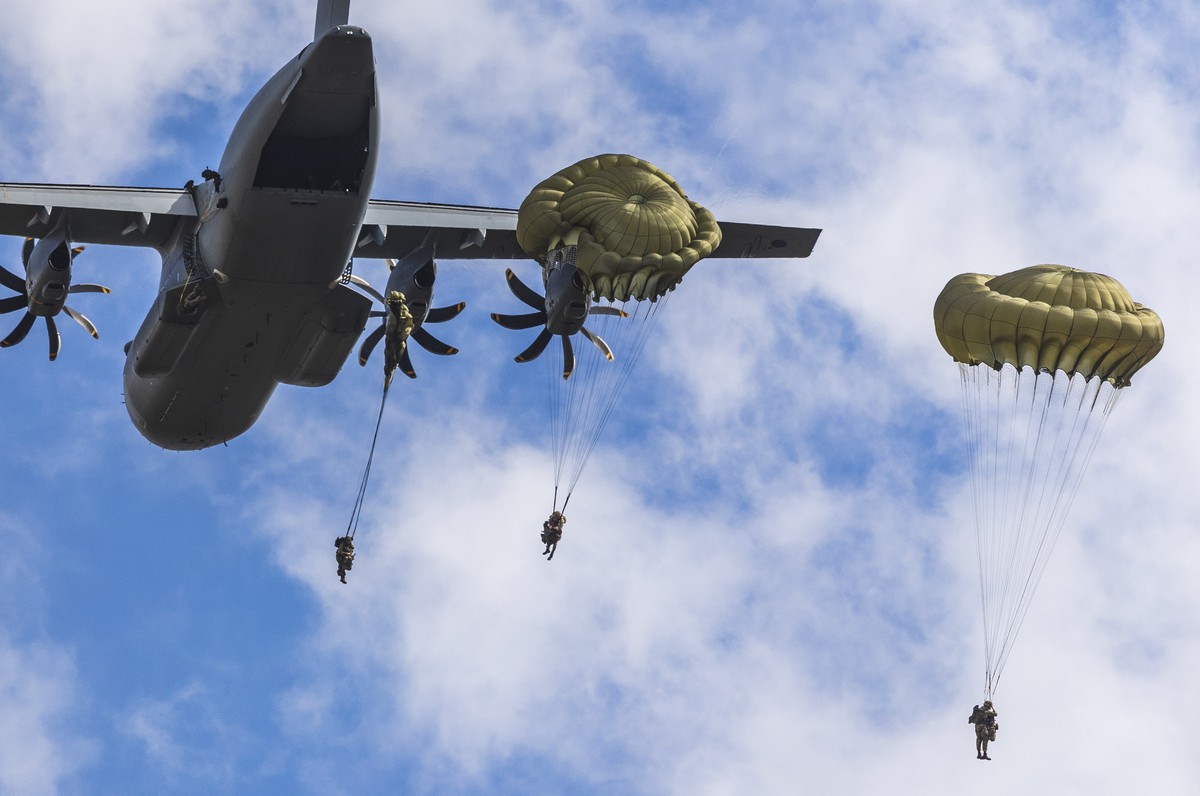
The Ministry of Defence has confirmed that there will be no change to the number of British military parachute training courses as a result of the Strategic Defence Review’s position on airborne capabilities.
In a written answer to Ben Obese-Jecty MP, Defence Minister Al Carns addressed questions concerning the potential impact of a focus on a single battalion group on the availability of parachute training. The questions covered both the Basic Parachute Course and the All Arms Pre-Parachute Selection course, which are central to maintaining airborne capability within the British Army.
Carns said: “The Strategic Defence Review position on military parachuting capabilities represents no change to the current Defence parachuting provision.” He added that “there is no anticipated change to the number of All Arms Pre-Parachute Selection courses or the Basic Parachute Course.”
The Basic Parachute Course provides the qualification required for soldiers to earn their parachute wings and serve in airborne roles. The All Arms Pre-Parachute Selection course acts as the assessment stage for personnel from across the Armed Forces who wish to attempt parachute training. Together, the two courses underpin the UK’s military parachuting capability.
The minister’s response makes clear that the overall volume of these courses will remain consistent with existing provision. No adjustment to course numbers is anticipated as a result of the Strategic Defence Review’s conclusions on parachuting capabilities.
Military parachuting remains a specialist skill set within Defence, requiring structured selection, training and ongoing proficiency. No further detail was provided in the written response regarding course scheduling, capacity or throughput beyond the confirmation that there is no expected change in numbers.
Previously, we reported that there were to be cuts to this capability after the department stated in a previous Parliamentary Question response that the Government had “accepted the recommendations of the Strategic Defence Review in full” and would publish a Defence Investment Plan setting out the plan for “its implementation.”
Our interpretation centred on that reference to implementation. The term is forward looking and denotes putting a recommendation into effect. If the airborne construct described by the SDR already reflected the existing position, there would be no substantive change to implement. The wording therefore suggested that alignment with the review would require adjustment, otherwise the reference to implementation would have little practical meaning.
That said, as we noted at the time, this was an interpretation of policy language rather than confirmation of a specific structural decision. In this case, it appears that our reading was not correct.








Good to get this one done and dusted.
Now can the RAF get its heavy pallets back please for airdropping heavy kit?
Ah guess not actually interested in a conversation, just wanted to name call and run.
? I’m sorry, Dern? What does that mean related to my comment above??
Ah no, it was meant as a reply to my thread below.
Thought so, after I commented I scrolled down and saw it kicking off.
No worries.
On the subject matter, I myself am happy we retain the capability for at least some of our conventional forces, but fully agree for SOF, SF, and some elements of the RM it’s a skill set we mustn’t lose.
Yeah, sorry about that. Frankly should have killed that conversation at the word go. Louis is just needing to get his feels out, and strawman rather than have a decent conversation.
As you said on the subject matter, obviously if funding is unlimited sure, but then I’d make the same argument for a mountain warfare capability with mules and ponies. If we are cutting then a capability we just don’t use in a conventional setting and reserving it for small sub-unit operations with SF makes sense.
Because I didn’t reply within an hour and a half?
If youre going to come in with this sort of bad faith and insult crap then yes. I am going to assume it’s a drive by if you don’t reply promptly.
Ah well, the Para’s will be happy then until someone finally pulls the trigger on cutting what really is a sunset capability.
I’m going to have to scratch the tipex back off my colleague’s para reg mug now…. Looked good without the little parachute.
I just find it interesting how much people online will bitch about “Cap Badge Politics” until the cuts affect a Cap Badge they like, and then it’s screaming murder.
Yet just the other day you were advocating for the rangers to get their wings…
The Paras counterparts in the US and France have conducted recent operational jumps, as has 1 Para. Your counterparts in the US haven’t conducted a recent operational static line jump, and the only recent operational jump at all I could find is a single HALO jump in Iraq in 2007 of 11 men.
You can pretend that you’re interested in modernising the British army, but it is quite obviously professional jealousy. Isn’t the rangers whole schtick that they’re smarter than paras, and therefore above childish beef? If that is the case why do they have (presumably) SNCOs whinging online?
Glad to see I’m living rent free in your head if I ever struggle with the Mortgage.
But if are going to try and quote me I’d suggest you quote me correctly, I said “If I was commander ASOB I’d be lobbying for.”
Wonder who my counterparts in the US are, but given your childish insult throwing in your last paragraph I’m assuming you are trying to refer to the GB’s. Gotta say that I wouldn’t put any stock in what you can find in open source about any SOF organisation though, so I’m not going to take that seriously. I might also suggest that you don’t cite SFSG jumping when your trying to argue that Conventional Parachute ops are relevant but SF and SOF aren’t? Because you are kind of undermining yourself there.
If you want to have an adult conversation about why I don’t think there is much call for conventional forces using Parachutes but that Unconventional and Special Operations still has a space for it, I’m happy to have it. But if you just want to cry and and throw insults then I’m just going to laugh at you.
Not all SOF units are the same, not all parachuting is the same. SFSG and the 75th Rangers are not comparable to GBs and the ranger regiment. (Hence why the former have conducted operational static line jumps, and GBs haven’t). Completely disingenuous to even compare the rangers to UKSF anyway. And calling GBs your counterparts was also extremely generous, so no clue why you’ve taken it as an insult.
Static line jumping is not comparable to freefall. The rangers are never going to get the latter so there isn’t even any point in discussing the merits of it.
You are welcome to look at the source. The US isn’t the UK, they literally have a “Special Warfare” Journal/magazine.
Conventional French airborne units conducted their most recent operational jump in 2023, conducting multiple more in the preceding decade in Mali and Niger. The 82nd jumped into Afghanistan, the 173rd into Iraq, and the 75th Rangers jumped into both. 3 Para nearly jumped into both Iraq and Sudan. If there was no need for conventional airborne units, not only would none of that have happened, but other NATO countries would be shrinking their airborne forces (they’re not). Cutting one of the parachute regiment battalions would put our airborne forces on the same size as the Netherlands, whose army is less than a quarter the size as the British army. The only reason the government would make that decision would be to save a little money, not because they are some forward thinking geniuses.
“And calling the GB’s yur counterparts is extremely generous so no clue why you’ve taken it as an insult.” Well, this kind of proves that you aren’t really acting in good faith doesn’t it? I didn’t say comparing Rangers to GB’s was an insult. So let me break this down into some very simple statements for you;
You didn’t name a unit as “my counterpart.” But you did write some rather butt hurt insults at the end of your diatribe. Going by the insults where you assume I’m a Ranger, I’m going to assume that what you mean by “my counterparts” are the GBs. Because like it or not, the GB’s are the Rangers american counterparts. And that’s not a generous comparison, it’s a simple doctrinal statement.
So are we done with you deliberately misrepresenting me and happy to have a good faith discussion? I somehow doubt it but we’ll give it a shot.
America does indeed have a Special Warfare Journal. But if you believe that everything that USSOCOM does goes into it I have a bridge to sell you. I know the difference between static line and free fall, I happen to have done a few jumps (and hate jumping btw, something I’ve mentioned a few times on this site), so I’m well aware.
Conventional French Airborne units have done some very small scale jumps into asymetric ops that realisitcally would have been better carried out with Helicopter lift, if the French had Chinnoks. Again someone doesn’t know the difference between SOF and conventional forces because they’re citing the Rangers. 3 Para “nearly jumped” but, cruicially didn’t, and hasn’t since 1953. But yes the Americans did a small number of jumps 20 years ago, really the last parachute operation at scale was that 2003 jump by the 82nd, better than 70 years ago, but given the Americans have been at war for most of those 23 years; not a glowing rebuttal.
NATO forces are drawing down their airborne capabilities. The 101st ages ago went from Parachute deployable to Helicopter Air Assault. The Italian Folgore Brigade has a Battalion of Centauro’s which are not air-droppable and are mounted on Lynche, Germany is equipping it’s Fallschirmjaeger with Boxer. Across Europe Airborne forces are primarily becoming elite light mechanised units with a niche Parachute Capability, so yes, the trend is away from Airborne Units.
Also “Cutting one of the Parachute Regiment Battalions” where did I suggest cutting the Para Regiment? Again with this bad faith argumentation. I. never. suggested. cutting. the. Regiment. I said that conventional Parachute deployments are on the way out, that the UK hasn’t done a Parachute drop in 70 years. If you actually bother to read what’s being said instead of projecting what you want me to be saying or what you want me to be into my posts you’d see I’m in favour of cutting back on Jumps to SFSG and SF. That’s not the same thing as cutting battalions.
How is it not generous to compare the two units? Comparing a unit that is over 70 years old with an extremely high level of combat experience, and a much longer and more arduous training pipeline, to a unit that is 4 years old with no combat experience and a significantly shorter training pipeline, is being generous. I am not a massive hater of the rangers, and strongly dislike the lies that have been purported as truth about them (such as they were formed from under performing and undermanned infantry battalions, which I personally know not to be true), but lets not get ahead of ourselves.
The wording of the article makes it clear that as of the end of 2008 it was the only GB jump in Iraq, and that it is an extremely rare occurrence. It was HALO anyway, so unless you’re advocating for Rangers to be MFF qualified (0% chance that happens), it’s irrelevant.
The French army and air force have a significantly larger support helicopter element than JHC, and they had access (and heavily used) RAF Chinooks in Mali. The French jumps have been company sized, which is hardly ‘small scale.’ The Yanks have an abundance of helicopters and still chose for the 173rd to jump into Iraq, and the 82nd to jump into Afghanistan (as well as the 75th rangers jumping in but we’ll ignore that considering it gets you riled up).
The parachute regiment didn’t jump in those two examples I gave because it didn’t need to, but what if it did? To add to that I believe 3 Para (again) nearly jumped in the Radfan in 1964. What if fourth times the charm and suddenly they do need to jump? It is a very niche capability that can’t be dusted off in a short space of time.
When was the last amphibious assault? When was the last time the RAF shot down an enemy fighter jet? More importantly when was the last time that British army infantry closed with and killed the enemy? Not since 2013/2014, and for the entire army outside of SF, there have only been a handful of minor firefights since. Just because something hasn’t happened in a long time, doesn’t mean it isn’t useful.
The 75th Rangers jumps have been static line, and they have effectively been used in an elite airborne infantry role in such jumps, which is why I included them. I am well aware they are SOF.
101st lost its jump status over 50 years ago. Acting like the US is moving away from airborne forces is disingenuous. They still have 14 airborne infantry battalions, and 5 airborne recce battalions in 5 brigades.
Those European units equipped with heavier vehicles have not lost their jump status though… Your argument wasn’t for equipping the Paras with heavier vehicles, it was for cutting their jump status.
Cutting jumps may as well cut the parachute regiment entirely, I’m hardly misrepresenting you there. Why bother keeping SFSG jump trained?
Wow so the bad faith arguments really go through the roof with you.
So lets throw out your entire first paragraph. You’ve clearly got a massive chip on your shoulder about the Rangers and aren’t capable of sitting down and actually reading anything that’s being said about them without getting emotional. I thought using short small sentences might get it to sink in but hey ho, clearly not.
2nd paragraph we can also throw out because it was already addressed, and wording and implications don’t really amount to much.
Again going to American jumps from 2003, can you actually digest an argument or are you just on repeat? And yes 100 blokes jumping is small scale. Hate to break it to you.
You are right. The Parachute Regimenmt didn’t jump because it didn’t need too. You are so close to getting it there but then you flounder by going “but what if it did.” It hasn’t had to since the 50’s, as I pointed out in my last post. Adding more “Well they thought about it but chose not too because the effect was better achieved by other means.” But what if the fourth time is the charm? Seriously? We’re now arguing about keeping a capability because we might use it once in 80 years when there are other alternatives? Give me a break.
“Not since 2013/4” So the last time we where at war. It really is just bad faith arguments with you from the ground up isn’t it.
More US Army Rangers, I’m just going to ignore you every time you bring them up because, suprise surprise, you are not taking anything on board. For the last time; I’m not advocating cutting SFSG’s jump quals, and that’s the closest equivilent to the 75th Rangers, so stop shadow boxing.
Yes 101st lost their jumps qual in the 1970s. Hence why I said “a long time ago.” And no the Europeans haven’t lost their jumps qualifications *yet* however it’s very clear the direction of travel is away from Parachute operations and towards Elite Mechanised Formations. Which I made clear in my argument but hey, let’s not pretend that you’ve even once actually wanted to understand my argument.
And that last paragraph. Grow up. Seriously.
I do not have a massive chip on my shoulder about the rangers…
Everything I said in that first paragraph is correct. It’s clearly a sore point for you that the Government doesn’t want to utilise the rangers in the same way as their American counterparts, unlike UKSF and their American counterparts.
The article literally says it was their first jump in OIF.
You still have not actually said why you think rangers should be airborne.
100 blokes jumping is not small scale. The French still have an airborne force multiple times larger than the British army, so do not seem to think airborne forces are obsolete.
Take the most recent example. What would’ve happened had Sudan been a less permissive environment? Just said fuck it and left British citizens there? Leave it to other countries to jump in and secure the airfield? Take time pulling UKSF off operations to pool together a large enough force to jump in?
The UK has been at war in multiple places since 2014. Op Shader being the largest. The government chose not to use the infantry in its primary role, does that make them obsolete? You haven’t responded to my other points. Are amphibious landings obsolete? The submarine service has sunk one enemy ship since WW2, in the last 80 years only 3 ships have been sunk by submarines, yet the Astutes remain the RNs primary ASuW asset.
Why ignore the 75th Rangers? What is it about SOF that makes parachuting suddenly so viable? If that’s your issue why not just reclassify 2 and 3 Para as SOF? Either you think static line jumping is obsolete or you don’t, what difference would it have made if the 82nd jumped into Grenada instead of the Rangers? If the 75th or SFSG jumps it’s an amazing capability, but when conventional units jump it’s obsolete and could be carried out by heavy lift helicopters instead. Genuinely what is your rational for keeping SFSGs jumps quals.
Your last paragraph presumes European airborne forces will lose their jump status at some point in the near future. Any evidence to support that? Your point is of course now meaningless without such evidence.
If you want to engage in a good faith discussion, don’t read any of what I just wrote, and be so kind as to answer one question. What makes static line jumping so viable if you stick a SOF/SF label on the unit jumping?
“I do not have a chip on my shoulder.”
Okay so more dishonesty from you. Literally this thread opened with you thinking you IDed me as a Ranger and throwing insults, and then every subsequent post has been you throwing shade straight off ARSE. But yeah you don’t have a chip on your shoulder. Pull the other one.
Now for your last Paragraph (I did skim the rest but frankly a lot of it has been covered and you’ve chosen not to grasp it):
You don’t get to ask for a good faith convesation if A) your the one who has been arguing in bad faith the entire time. B) You admit that you are not arguing in good faith in your demand.
But I will point out that SOF/SF isn’t a label that get’s stuck on things, and maybe the fact that you think it is just a label is why you are having difficulty with this concept.
Maybe next time stop trying to make things personal just because I’m arguing for something you don’t like and you might get a more productive conversation.
“Okay so more dishonesty from you. Literally this thread opened with you thinking you IDed me as a Ranger and throwing insults”
Are you not? You seem to know an awful lot about the unit, and have a chip on your shoulder about the paras, and jumping in general. I accused you of being biased, and whinging about the paras online. Those are hardly insults, and especially not ones you should be crying over.
What has been straight off ARRSE? The Rangers are 4 years old, they haven’t seen combat, and there isn’t the political will to use them in the same way as their American counterparts. And to add to that, they were formed about 10 years too late, so therefore missed peak MA in GWOT, that will likely never be seen again by NATO troops
I still think they are a great unit, that deploy a lot and get to go on lots of courses, I just said they are not equal to American GBs.
Your whole anti parachuting stance has been based off the fact that the Paras haven’t done it in nearly 70 years, and that when other NATO nations do it, it doesn’t count. When I bring up the fact that submarines have only sunk 3 ships in the last 80 years, yet are still the Royal Navy’s primary ASuW asset, you chose to ignore it, because it obviously refutes your point.
“But I will point out that SOF/SF isn’t a label that get’s stuck on things”
That’s literally what it is. A label. The RM have many of the same missions they did before they were classed as SOF. Nothing changed except the label. When 21 and 23 SAS reroled to their original SF mission set, except this time they were taken out of the SF directorate, did they stop being SF?
You believe conventional airborne units are obsolete, but in the next sentence say parachute jumps from “Tier 2” SOF units are still relevant. What would’ve been the difference had the 82nd jumped into Haditha instead of the 75th rangers? Either large scale parachute drops are obsolete or they aren’t. The enemy doesn’t just say “don’t shoot down that aircraft, it’s full of ally blokes.”
None of your points (even on the original post) about parachuting have actually made sense. You’ve just said things and hoped nobody looks too deeply into it most notably, “NATO forces are drawing down their airborne capabilities,” despite the fact none of them are cutting jumps quals from their airborne units (which is what you’re advocating for).
I just wonder if the original statements from parliment was a play on words to test the waters as they are still in “Defence Cut” mode and are looking to see what they can get rid of without too much fuss. My personnal opinion (which dose not mean a lot) is that all Light infantry including the RM’s should be Para trained as we still live on an island so if we need to deploy quickly we have the option to get some guys on the ground in hours rather than days or weeks.
But that of cause would mean investment in aircraft, maybe we could stop giving money to India and Pakistan who have bigger armed forces than the UK now and invest that money in our own armed forces.
Problem with that is they deploy with no heavy equipment whatsoever. And limited supplies of the light kit which they carry. The days of large parachute drops are over.
That’s your opinion which you are welcome to it, but I believe that we have yet to see the true value of Para’s (along with the Marines) and as for no heavy equipment they drop with 81mm mortars and the 105mm light gun, the French also deploy the 120mm heavy mortar with a 17km range along with a lot of anti tank and anti air assets equipment. With the loss of the C130 the Paras have had their wings clipped and with the loss of the amphibious shipping the RM’s have also had their wings clipped but that is not because they are obsolete quite the opposite, it is due to the short-sightedness of our leaders who have allowed the political classed to run the armed forces who think we can fight a war with a brief case and some severer finger pointing.
The days of fast deployable people (by sea or air) has yet to reach its full potential so we need to be investing in these people and the equipment they need to do their job not cutting them back.
We’ve seen in Ukraine how the Russians have been forced to keep absolutely everything from supersonic fighters to helicopters miles away from the front line due to unacceptable loss rates. There is no way we are sending scarce transports with scarce specialist troops anywhere remotely close to air defence range.
The war in Ukraine has involved into what we see today but it did not start that way, it has evolved into a 21st century version of the 1st WW were both side were busy inventing stuff to brake the deadlock and once Ukraine has finally beaten the Russian hordes and there is a semblance of peace in the area both Ukraine and Russia (or any one else for that matter) will not have the capability to keep the sky’s full of drones 24/7. The drone’s will go up when a threat has been identified.
The Para’s and RM’s should be used as a quick strike/rapid reaction force before the opersition has time to set up a defensive Corden, get in, do the what you have to do then get out. As they were 1st intended to be used back in the WW2.
I think who ever wrote this and the original article is getting just a little up their own tailpipe playing word games. It’s bad enough with Oxbridge classics grads in the MOD playing word games to obfuscate and blur facts without commentators indulging in this nonsense too.