

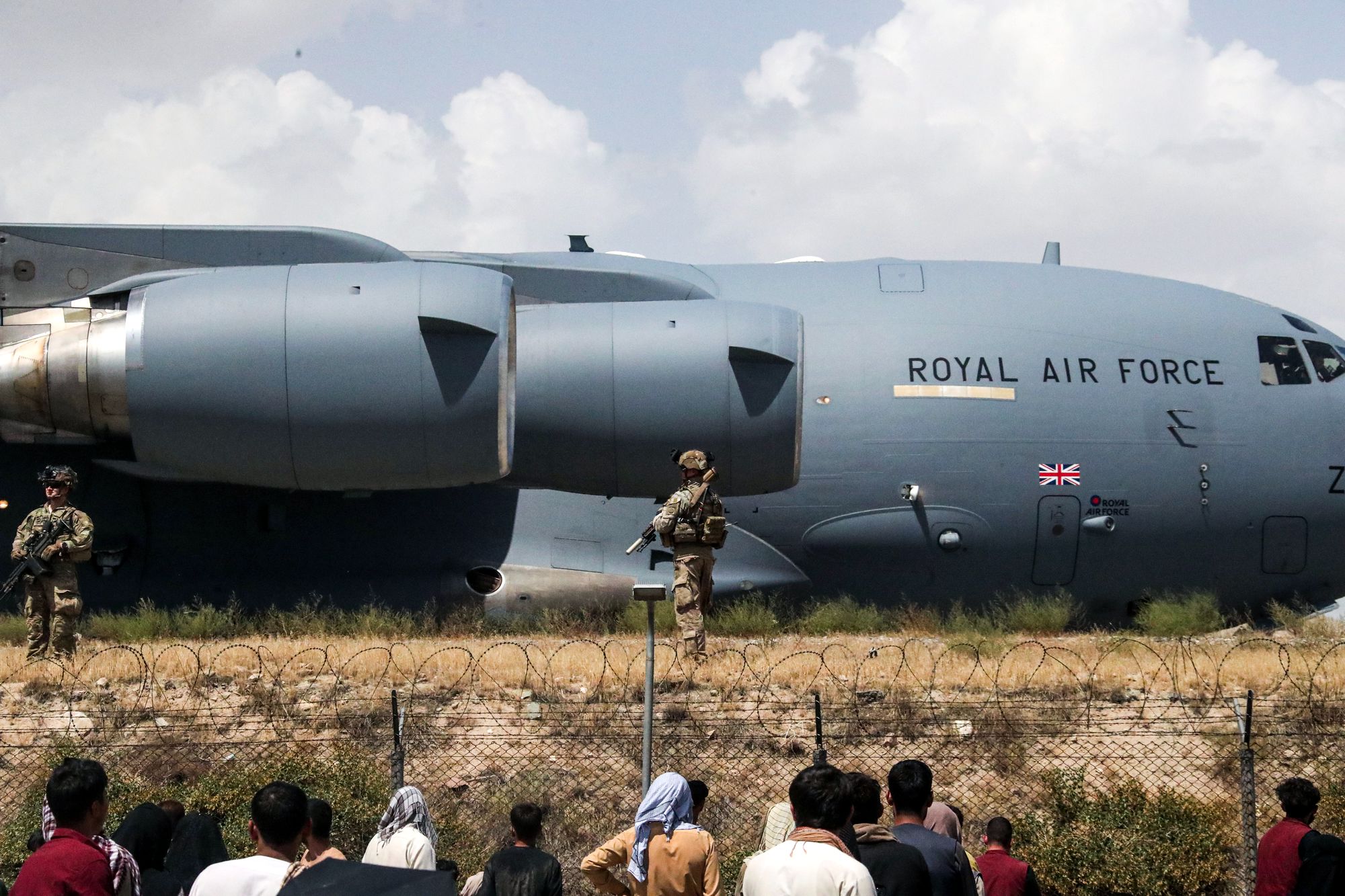
General David Petraeus has said the United States and its allies did not need to withdraw from Afghanistan when they did, arguing that the Western military commitment had reached a sustainable level and that the loss of coalition support helped undermine Afghan forces, the UK Defence Journal understands.
Petraeus, who commanded NATO and US forces in Afghanistan before later serving as Director of the CIA, made the comments during the Lord Speaker’s Lecture at the House of Lords on 1 September. He rejected the argument that the length of the conflict itself meant involvement had to end, saying the relevant question was whether the continuing human and financial cost remained proportionate to the interests involved.
He said: “And here, allow me an aside to observe that I do not believe we had to leave Afghanistan when we did. Nor do I believe we should have done so.”
Petraeus continued: “For years I disagreed with the increasingly fashionable argument that we simply had to ‘end endless wars.’ That formulation asks the wrong question. The issue is not how long a conflict has lasted. It is whether the commitment required to sustain it remains proportionate to the interests being protected and the costs being borne.”
He contrasted Afghanistan with Vietnam, which he said had become unsustainable in terms of lives and expenditure. Afghanistan, he argued, had by 2020 reached a comparatively modest level of Western involvement.
Petraeus said: “We obviously have to end wars that are not sustainable. But sustainability should be measured principally by the expenditure of our blood and our treasure. Vietnam, by those metrics, clearly became unsustainable. By contrast, the effort in Afghanistan by 2020 had become sustainable at a relatively modest level.”
He cited approximately 2,500 American troops and 8,500 coalition personnel remaining by the time of the final withdrawal and said Western forces were no longer engaged in front-line combat. Their principal role, according to Petraeus, was advising and assisting Afghan forces and providing capabilities which those forces could not yet supply themselves.
He said: “The Taliban controlled no major population centers, and our forces were no longer engaged in front-line combat. Their principal role was to advise, assist, and enable Afghan partners and provide capabilities the Afghan security forces had not yet developed for themselves.”
Petraeus also criticised the requirement for the Afghan government to release Taliban prisoners during the process leading to the withdrawal. He said: “Nor should we have required the Afghan government to release some 5,500 Taliban detainees merely to secure from our adversary an agreement confirming what it already wanted us to do—to leave.”
A central part of his argument concerned the withdrawal of civilian contractors alongside military personnel. Petraeus said more than 15,000 Western contractors departed, removing specialist support required to maintain American-supplied Afghan aircraft and helicopters.
He said: “The consequences of withdrawal should have been foreseeable. It removed not only American and coalition forces, but also more than 15,000 Western contractors who were indispensable to maintaining the sophisticated American aircraft and helicopters we had provided the Afghan forces.”
Those aircraft had provided mobility for around 35,000 Afghan commandos who were used to reinforce conventional forces facing Taliban attacks around the country. Petraeus argued that the disappearance of aviation maintenance support consequently affected the ability of those commandos to move rapidly between areas of fighting.
He said: “As that maintenance capacity disappeared, so did the mobility upon which some 35,000 exceptionally capable Afghan commandos depended to respond to attacks around the country.”
Petraeus continued: “Without that air mobility, those commandos could no longer reinforce front lines held by much less capable conventional soldiers and police. The essence of the Afghan strategy was therefore fatally undermined—and once that capability eroded, the collapse accelerated.”
He used Afghanistan to make a wider point about how military capability should be assessed, arguing that personnel and equipment numbers alone provide an incomplete measure of combat effectiveness.
Petraeus said: “Military effectiveness cannot be measured simply by counting soldiers, aircraft, ships, or weapons. It depends upon the institutions, logistics, intelligence, technology, industrial capacity, and professional relationships that enable those capabilities to function.”







Just goes to show how important NATO members were in Afghanistan, outnumbering US force 4 to 1 in the end.
All that sacrifice simply to be mocked by a man who dodged the draft.
Can anyone imagine a British Prime Minister or French President mocking the sacrifice of American GI’s in WW2 coming to our aid.
America should be ashamed of itself.
Not really fair to compare overall forces. The US commitment was it’s air assets both offensive and survalliance, something the rest of NATO struggles to provide, plus intel overall. But agreed other nations involvment is brushed over by the US.
Well it may be controversial but he is correct! We had drawn down front line combat roles, had a large number of Afghan specialists doing jobs they could not have done 5 years before and the Taliban were generally disliked and not trusted by the people! However as always the withdrawal was lead by western politics and political expediency, in order to feather certain self interests by politicians.
The question we will never know the answer to, is would the Afghan government still have failed if the US/nato hasn’t left. Had their draw down in forces meant that it was going to happen just a matter of time, or was their presence preventing it.
We will never know, but as someone who went there in uniform a number of times during the 2001-2010 period, and after 2010 in civvies, the country was a vast improvement in both life and decency. However as I’ve alluded to many times we cannot force our so called western values on countries that in reality don’t want them, or want a bastard version which includes the dominance of a religion. Either way, it’s done now and we have to go along with the choices made 👍
I suspect we will be back again at some point in the future. It’s too strategically important a country for it not to get involved in games of superpowers.
Agreed, but that may depend on how busy we are in Europe over the next 24 months 👍
It was lead by Trump, the bonespur coward, running away, and Biden not having the balls to reverse Trumps shitty deal.
In fairness to Biden, during the campaign he was forced to promise to honour the withdrawal. If he had not he would have won by an even narrower margin and we already had Trump attempting a coup. Having made a public promise he felt he had to honour it. Unlike Trump he had some principles.
As I recall the withdrawal of US forces was first considered by President Biden. In February 2020, the first Trump administration and the Taliban signed a deal in Doha, Qatar, stipulating fighting restrictions for both the US and the Taliban, and in return for the Taliban’s counter-terrorism commitments, provided for the withdrawal of all NATO forces from Afghanistan by 1 May 2021. Thus Trump deigned to speak for NATO which was probably ‘news’ to NATO HQ.
There seemingly was little to no consultation with US military chiefs, let alone allies of the Coalition. Apparently many senior US officers considered that the Afghan forces needed more time to fully assume security roles in their country. Given that is was a NATO operation, HQ NATO should have planned and implemented this. The US set a date, an arbitrary date, and all other nations were obliged to conform to the timings, as the collectiv emission would not be credible with a sudden egress of US forces.
General Petraeus rather confirms this. Apparently the withdrawal of US forces was chaotic and reminiscent of leaving Saigon in 1975. USAF did not even tell the Afghan base commander at their Bagran AFB, let alone plan withdrawal jointly with him. He arrived for work one day to find the Americans gone and most of their kit left behind.
The final pullout was delayed until late August 2021.
GM,
Perhaps most unfortunately, Afghanistan reinforced a pattern of US geopolitical incompetence Generally, democracies should seek to avoid conflict for as long as possible w/out compromise of basic moral and political principles, but if forced, prosecute conflict w/ intent to win unconditionally, regardless of collateral damage. Note specifically US policy in current Iranian conflict, barely two months of intensive effort followed by four months of hand-wringing. Absolutely believe that all the CRINKs are taking copious notes re US conduct. This is a foreboding pattern when the CRINKs collectively decide to annex the Baltics, the Balkans, or both. ENATO is well advised to rearm at the fastest feasible rate, merely to enhance self-survival prospects.
At unlikely best, Afghan may have been a Pakistan type democracy, Afghan surrounded by anti west neighbours how would that have worked? Sadly trump showed the world that Iran can stand up to America. Conventional military strength is less capable against asymmetric warfare.
Hi FormerUSAF, I agree, unfortunately dictator nations often make the same assumption about democracy and are proven wrong. Democracies are bad at sustaining economic pain on pointless occupation missions against the will of the local population. However they can fight in a way that overwhelms any autocratic state when their own security or allied nations are on the line.
The UK was able to devote an astounding 41% of GDP to defence spending during WW2 while Germany couldn’t match that until 1943 because the NAZI’s had to maintain the illusion of victory and that the war was not costing much.
Russia has the same problem today vs Ukraine.
We also had to raise taxes massively and were bankrupt by the end of the war.
Biden bears the blame for not reversing Trumps disasterous policy, but Trump, the draft dodging pedo coward, making decisions without consulting his SME’s and fucking over the US military is a pattern everyone should have seen after Afghan… yet here we are.
Absolutely agree with the guy. I’d like to beleve another 5-10 years would have brought through enough generational change to firmly establish an institutionalised democracy. It seems to me the opportunity garnered by those previous years conflict was simply thrown away – Too late now though, it’s all water under the bridge-what a waste.
It was a political stunt meant as a vote winner to attract the anti-western American left and the ‘American isolationists’ on the right.
Notice how little we hear about the direct impact this US policy is having on Afghan women etc? Yet we never hear the end of the indirect effects of US policy supporting supporting regimes like Saudi etc. The fact that this happened after the formation of ISIS enabled by the premature pull-out from Iraq and Obama’s meaningless red lines, makes it all the worse.
There is no coherence in Western policy making. It is one of the weaknesses of democracy that we in the west have to live with, and one that our enemies have learned to exploit. Western countries have so little political resilience. Even a small economic knock-on effect that a rogue state such as Iran, or even the Houthis in Yemen, can inflict; can topple western governments and lead to more rogue-state friendly policies from the opposing / replacement political party leadership.
It’s going to take something of a monumental scale to wake western populations up to the reality of the world, and the malign intent of our enemies. The unholy alliances we see with western liberals and islamic extremists is undoing western security. The naivety is mind-blowing, and will cost us all dearly in the end.
Petraeus focusses on the wrong question. But applying his cost benefit principle the key issue is whether the post 9/11 intervention under NATO article 5 was a sensible decision. Was the effort to overthrow the Taliban and make radical change to Afghanistan a rational response to a terrorist attack by Saudis whose leader was eventually found and killed in Pakistan? Did the earlier Soviet failure to prop up a friendly government in Kabul not ring alarm bells?
Anyone with knowledge of the history of foreign interventions in Afghanistan should have known that they never end well.
This is a classic example of the fact wars are not won by winning a battle or the power of your standing military.. but by the depth of your commitment to fight and take pain..
Essentially the far weaker side can win if it’s prepared to bleed more and for longer than the militarily more powerful side and if the political will of the stronger nations will is weak…
Korea! How many years have the allies had a footprint in Korea and now we can all see the what a country she has become. The same commitment to Afghanistan would have seen that country take hold of democracy and choke to death the taliban.
Is there a caveat? Yes, Pakistan which plays all sides and is an insincere broker in any negotiation – we created the mess that is the Pastun lands in both AFG and PAK but those lands should have had a clear demarcation zone put in place that stopped the influence of the PAKs into AFG, something should also have been done about the Iranian influence.
And finally, far less emphasis on ‘human rights’ abuses – a bit like the Russians, a dead Talib is a good Talib.
Taking out terrorist training camps was understandable but it morphed into imposing western style democracy. It’s not easy just think of the money and effort to integrate east Germany with west Germany same language religion people but it was big effort.
It’s almost like the people whose job is defence know what they’re doing! Who’d have thought? What next, put a senior judge in charge of the criminal justice system? Surely these roles should be filled by career politicians.
Is there a nation building module at army college, but also Blair should have said that at the outset, we’re gonna make Afghan a western democracy.