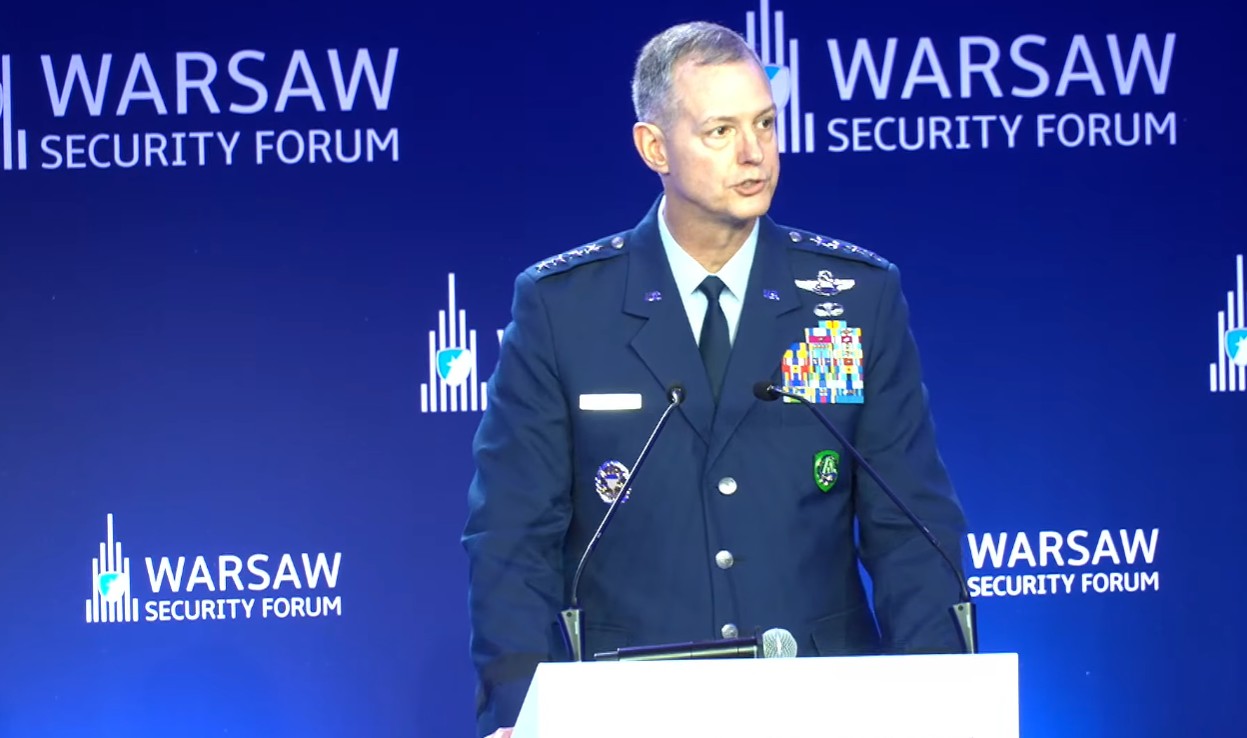
NATO’s Supreme Allied Commander Europe has set out a three-stage approach to defeating an attack on the alliance, which he calls blocking, blunting and breaking.
General Alexus Grynkewich described it as a Theory of Victory grounded in the alliance’s agreed strategy for the Deterrence and Defence of the Euro-Atlantic area. “So, while I referred to it as ‘my theory,’ it’s more than that. It is based on a strategy agreed to by all 32 Allies, so it represents and includes all of us. In other words, it is our Theory of Victory,” he said.
“In recent days, some have called it a plan, but it’s not, at least not in the military sense of the word,” he said. “Rather, our Theory of Victory provides the Alliance a common vision for how we win in deterrence and defence. It provides my ‘commander’s intent’ to help us focus our militaries on the key tasks we must accomplish in combat.”
“I do not assess that conflict is imminent or inevitable. It isn’t,” he said. “We help avoid conflict by clearly articulating our defensive intentions, and by maintaining open lines of communication to resolve misunderstandings and encourage transparency.”
“My Theory of Victory is simple. We will block the initial attack. If the attack persists, we will blunt it and prevent enemy advance. And if required, we will break the enemy’s forces and the operational warfighting system that is arrayed against us,” he said.
He described the first stage as falling to land forces at the point of contact, supported from the air and at sea. “To block, our land forces will move to and dominate any enemy assault at the point of contact. Through manoeuvre, we will fix the enemy formations and deny the seizure of Alliance territory. Land-based forces will attack the enemy and destroy his advancing forces, but they won’t be doing this alone.
“Our air forces and navies, working in concert with our space and cyber forces, will rapidly gain freedom of manoeuvre. With air and maritime superiority rapidly secured in and over the battlespace, these forces will bring mass and precision to bear, denying the enemy the ability to hold their ground.”
“Using advanced sensors, autonomous systems, and multi-domain forces, we will deny the attacker the ability to generate momentum or gain the initiative. Synchronised employment of multi-domain effects down to the tactical level will overwhelm enemy formations in contact, and their advance, if it’s continuing at all at this point, will falter further,” he said.
“Should the adversary choose to press the attack or commit his reserves, we will break the warfighting system engaged against us. This includes not just the attacking force itself, but anything and everything that supports, sustains, or controls that force,” he said.
“To do this, we will layer high-end and highly effective precision munitions with an overpowering mass of affordable and scalable systems. We will apply constant and unyielding pressure, both kinetic and non-kinetic, we will do this across and through domains, land, air, sea, space and cyber space. Doing this will break the enemy system and defeat it in detail. Enemy formations will be starved of replenishment. Any enemy commanders will be unable to control their forces. And enemy forces and support capabilities will be reduced and destroyed.”
General Grynkewich said the alliance expects warning of any attack, through “a sophisticated layering of intelligence provided by multi-source collection assets” interpreted with advanced algorithms. “This means the Alliance is unlikely to be caught by surprise. We will see if an attack is coming, giving us time to assess intent and rapidly position our forces,” he said.
The capabilities he named as priorities for investment were “high-end and affordable long-range precision strike capabilities, sensor networks, and a warfighting cloud”. Forward Land Forces on the eastern flank will exercise to demonstrate the blocking task, and air and maritime forces will demonstrate freedom of manoeuvre and multi-domain effects.
“If attacked, we are ready to fight tonight, but we are not complacent. We will continue to prepare and rehearse each and every day, and will be more ready tomorrow, and even more ready the day after that,” he said, adding that any adversary considering an attack should reach “the only conclusion that matters: Today is not the day.”