

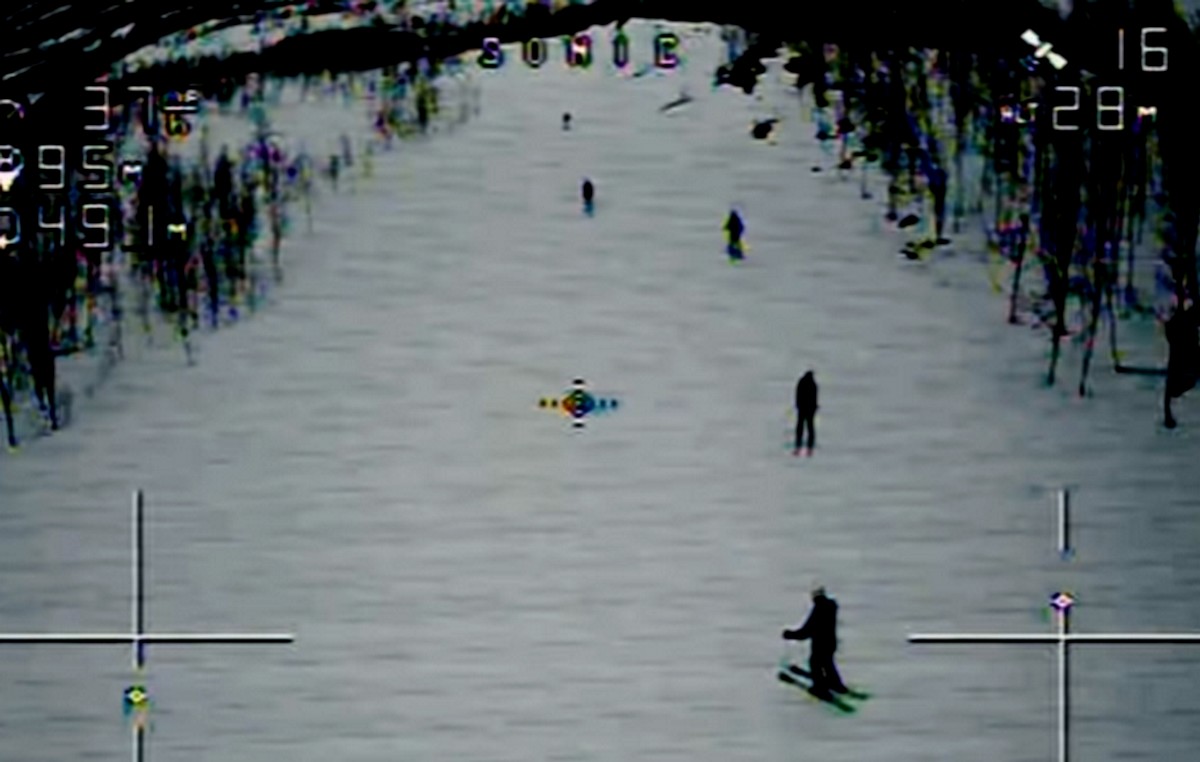
Western militaries do not currently have an adequate defence against the autonomous drone swarms that could emerge as unmanned warfare moves beyond systems requiring individual human pilots, General David Petraeus has warned in an address to the House of Lords, the UK Defence Journal understands.
Speaking on 1 September, Petraeus argued that the war in Ukraine is demonstrating a change extending well beyond the adoption of drones themselves. He described a battlefield in which large numbers of relatively expendable unmanned systems are linked with sensors, software, electronic warfare, artificial intelligence and increasingly rapid targeting processes, while military technology and tactics are being modified continuously during combat.
Petraeus said: “Much of the discussion has understandably focused on individual technologies—unmanned systems, artificial intelligence, electronic warfare, cyber capabilities, precision strike, battle management systems, and others. Each matters. But the principal lesson is larger: the very concept of warfare is changing.”
He continued: “We are witnessing the convergence of technological, operational, industrial, and organizational change into an entirely new way of conducting war. Information is collected, analyzed, disseminated, and acted upon at unprecedented speed. Sensors and battle management systems are connected to vast numbers of attritable unmanned systems capable of precision effects across every domain.”
Petraeus said commercial innovation was also moving directly onto the battlefield, with software, hardware and operational methods adapted during fighting and an increasingly close relationship developing between military operations and the industrial base.
The former US commander said remotely controlled systems are already changing the role of conventional formations by taking over tasks previously performed by personnel in some of the most exposed parts of the battlefield.
He said: “And remotely operated unmanned systems on the ground, in the air, and at sea are increasingly displacing humans from many of the most dangerous functions of front-line combat and profoundly changing the role of traditional combined-arms formations.”
Petraeus also made a strong claim about the scale of drone employment in Ukraine, telling peers that remotely piloted systems now account for the overwhelming majority of Russian casualties and that established land systems are operating under persistent threat from surveillance and precision weapons.
He said: “Those changes will encounter fierce resistance from advocates of existing force structures and legacy systems, many of which are becoming extraordinarily vulnerable on the battlefield we see in Ukraine. Remotely piloted systems, employed there in enormous numbers, already inflict the overwhelming majority of Russian casualties. Tanks and artillery increasingly operate only under extraordinary threat from ubiquitous surveillance and precision strike.”
His warning went further with the development of fully autonomous systems. Petraeus argued that removing the requirement for an individual human pilot for each platform would allow unmanned formations to increase dramatically in size, potentially producing swarms considerably larger than those possible with today’s remotely operated systems.
He said: “And the advent of fully autonomous systems in the months and years ahead will represent another profound development. Removing the constraint imposed by the number of human pilots will make possible unmanned operations at vastly greater scale—including swarms for which we presently possess no adequate defense.”
Petraeus argued that military advantage would consequently depend on institutional adaptation as well as technical development, particularly the ability to incorporate battlefield lessons rapidly into doctrine, force design, training and acquisition.
He said: “In this environment, decisive advantage will belong not simply to those who innovate technologically, but to those whose institutions learn faster than their adversaries. Warfare is becoming a continuous competition in institutional learning and adaptation—the ability to identify lessons, incorporate them rapidly into doctrine, force design, procurement, training, and leader development, and repeat the process before the adversary catches up.”







No s*it Sherlock. This is patently obvious. Fortunately quick and easy to fix given a little willpower.
If all these experts know all this stuff and love talking about it why don’t they get on and fix the gaps? While everyone is fixated on drones and their screens hopefully some are also keeping an eye and ear on ballistic missile threats and the front gate. Wish they’d exercise a bit more common and get a more substantial higher level GBAD network set up for the UK to protect bases, ports, infrastructure and country. Shared CAMM/Aster inventories and maybe greater utilisation of Raven and even a NASAM type systems to fire off older missile stock. Why no newer mobile Shorad systems yet to be purchased? Lots of very open to be hit ports and airfields and god knows what else. A few more T31s into the water wouldn’t hurt either.
He’s an American. Our numbskulls only look at the balance sheet to fit in their pet projects that help Industry the most or are the most politically imperative.
The Armed forces know the gaps, and the risks well enough, but if HMG are more interested in welfare to win votes then the money will never be enough for the regeneration required.
True but finding a vaguely level headed American is tricky right now.
Our new Government must know they need to boost activity or it might be the last Labour Government we ever see. What worries me is they might not have the aptitude to grow the economy and identify funding.
Agree. No sense of urgency. Major mistake.
We lack politicians with balls.
Certainly right there.
We need maggie thatcher back. Now she had balls of steel.
She wouldn’t be putting up with any of this shit
That would be a miracle!
Imagine some swarms controlled 100% by AI. Musk predicts, allegedly, that AI will quickly achieve one billion times the biological brain, then one trillion within ten years. In combination with robotic drones, this union of non-human weaponry could quickly dominate control and override defence commands. Equally, such systems could eradicate man’s ability to wage war as international AI systems merge interests and deny human involvement in the senseless concept of destroying lives for political and geographical dominance.
Neo-Nazi Musk also claimed he’d build a Hyperloop that will get people across the US in 45 minutes by 2020 and would have landed people on Mars by 2025.
SpaceX empire……………….MMMM!
I have to laugh when reading articles like this. The war in Ukraine has shown that at present, no one can defend against them. From a horror video of a Russian attack on a Ukrainian defensive position to the daily drone safari the civilians of Kherson have to live with. There is no defence against the drone. Jam GPS, use Satellite, interfere with that, and they use fibre-optic lines of communication. Until someone comes up with a cheap, easily manufactured system that can create a barrier of some sort that prevents all drones from crossing, the attacks will be able to get through. Irrespective of whom the drone is attacking!
Mate, we may see a rise in individuals carrying shotguns loaded with 00, seems to work in demonstrations. Not so sure when out scrimmaging around a front line, where the focus is not being shot and not looking skywards for threats. In the UK, The MoD have started pushing out the Smartshooter SMASH sight for individual weapons. Which is supposed to make it much easier to target and hit a drone. But the individual has to be actively hunting/looking for the drone in the first place. Though I’ve heard they did do reactive trials and the sight helped a lot. The one thing missing is the ability for an individual to have a piece of kit that they carry that gives them the ability for 360 degree searching. In the 2000AD comic, Rogue Trooper has “Helm”, which is his helmet that uses embedded sensors for searching and tracking of threats, plus a lot more. How soon will we see kit like this, as this may be part of the anti-drone solution for individuals threatened by drones?
I saw recently that some Ukrainian troops are getting something like a signal pistol that launches a net for last-ditch defence which was working quite well. Pretty desperate stuff.