

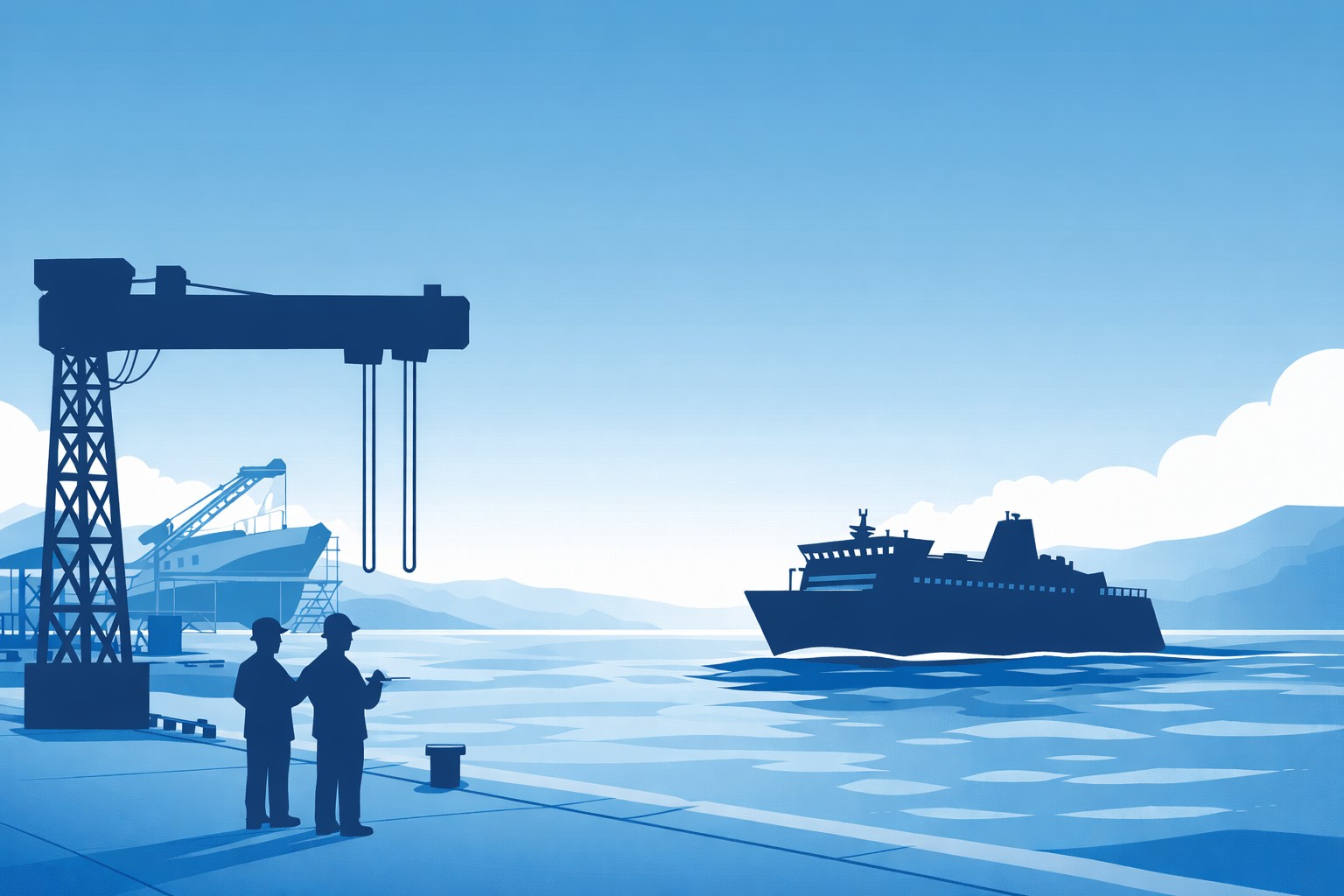
Glasgow is a reminder of what happens when skills, infrastructure and confidence come together, and what follows when continuity is lost. Capability itself rarely disappears. What tends to fluctuate is certainty.
One of the hardest questions I face as CEO of Ferguson Marine concerns how to build lasting confidence in the system so people will stay, train and commit for the long term. Delivering individual vessels matters, but sustaining belief in the future of the industry matters just as much. Skills do not pause when programmes do, and careers rarely wait for policy certainty.
This shapes how I think about sovereign capability. It includes what we can build today, but it also depends on whether people believe there will still be work, skills and purpose in shipbuilding tomorrow.
This article is the opinion of the author. If you would like to submit your own article on this topic or any other, please see our submission guidelines
The UK shipbuilding sector is at a rare inflection point. After decades of contraction, uncertainty and uneven investment, the potential pipeline is stronger than it has been in a generation. In 2022, the National Shipbuilding Office projected that over the next 30 years the UK and devolved governments will require more than 150 vessels across naval and civil fleets, from frigates and auxiliaries to research ships, ferries, patrol craft and other support vessels.
This demand represents a once in a generation opportunity. It also carries wider significance beyond the work itself. A sustained shipbuilding pipeline strengthens national security, supports economic resilience and sustains coastal and industrial communities.
Sovereign capability is often discussed mainly in relation to naval platforms. For an island nation that depends on maritime trade and industrial capacity, shipbuilding in all its forms plays an important role in national security. Our ability to meet defence, economic and environmental demands will be shaped by decisions made today about skills, digital systems, modern infrastructure and support for regional yards that provide flexibility and surge capacity.
Ferguson Marine secures four-vessels from Scottish Government
That opportunity could easily be constrained if the definition remains too narrow. Sovereign capability benefits from covering the full spectrum of maritime vessels, naval and civil alike, alongside the people, skills, supply chains and infrastructure needed to sustain steady output. Support ships, ferries, cargo vessels, patrol craft, auxiliary ships, autonomous vessels and green technology platforms needed for decarbonisation all form part of a modern maritime ecosystem.
At its heart, this remains about people. However advanced digital systems become, however modern yards appear or however efficient supply chains grow, capability ultimately rests on the talent that designs, builds, integrates, tests and delivers ships.
Developing that talent begins early, in schools and colleges, through apprenticeships, degrees and technical training. Retention is equally important. It relies on clear career pathways, flexible qualifications, modern working environments and leadership cultures that invest in people and processes, supported by a visible and credible future.
When people can see that future, they are more willing to invest their talent in it. When SMEs see continuity, they are more likely to invest in innovation. When regions see sustained commitment, they invest in facilities and communities. In many ways, confidence underpins sovereign capability.
Digital transformation and modernisation extend beyond software alone. Shipbuilding has already progressed through leaner workflows, more predictable scheduling, modular design approaches, right first time quality and closer integration between yards, subcontractors and suppliers. That progress tends to accelerate when everyone involved shares a clear sense of direction and long term goals.
Regional shipyards play a central role in this transformation. They form essential parts of a coordinated national network. Multi year, multi fleet work banks help keep yards active, sustain apprenticeships, protect engineering knowledge and smooth the peaks and troughs of defence cycles, providing stability for communities that depend on long term employment.
Strengthening sovereign capability requires several practical steps. One is adopting a broader, capability focused definition that includes naval and civil fleets, workforce development, supply chain depth, modern infrastructure and digital integration. Another is establishing a multi decade, multi fleet work bank that brings together national vessel requirements and links work to the yards best suited to deliver it, allowing long term planning, investment and skill retention. It also means measuring the factors that sustain capability and rewarding continuous improvement rather than focusing only on price competition.
A predictable work bank can help expand the skills engine. It can support more apprenticeships, accelerate digital upskilling, enable mid career conversion and encourage cross skilling between civil and defence programmes. Shared training centres and support for SMEs can widen access to high quality training. Standardisation and modernisation, including reference designs, common standards and model based engineering frameworks, can reduce bespoke complexity and improve efficiency. Supply chains can also be strengthened through domestic co investment and partnerships with trusted allies.
With more than 150 government vessels expected over the coming decades, the opportunity is immediate. The challenge now centres on people and confidence, creating careers worth choosing, an industry worth investing in and communities able to thrive. By prioritising continuity, modernisation and a broader understanding of sovereign capability, the UK can develop a globally competitive shipbuilding sector that delivers consistently, improves over time and continues to innovate.
At Ferguson Marine we are beginning to see elements of that future taking shape. The direction ahead involves sustained continuity, investment and capability across the wider maritime ecosystem. Without that commitment, the sector risks slipping back into cycles of uncertainty. The moment to commit is now.










For many years we have had a policy of only procuring warships from a British yard, enshrined in Naval Shipbuilding strategy documents. The CEO of Ferguson Marine writes interestingly on redefining sovereign capability encompassing naval and civil vessels.
However, why has there never been such a strong emphasis on mandating a sovereign capability for military Land projects? It took many years to even get a MoD Land Industrial strategy (May 2022) and it did not clearly emphasise a need to reverse industrial decline in this sector and mandate or prefer procurement from an experienced and competent British-based company. Bad politics also intervenes to select companies for work for the wrong reasons.
How many will ever forget that the Ajax production contract was awarded in 2010 to a company that was totally inexperienced at building military vehicles. We don’t ever want to experience that again. We once had 5 British AFV companies any one of which could have sucessfully designed, developed and built an advanced, tracked recce vehicle.
Yep very true.. and we still have the same with rotor production.. many saying well just buy Blackhawk..
Essentially sovereign capability is sovereign capability.
Tbf there are also those voices who think we should just buy ships from Korea.
And our Illustrious PM would rather cosy up with the Chinese over British steel
Well in part that’s because it’s harder to define. The entirety of the naval procurment structure isn’t locked to the UK, just ships, and more specifically the hulls (since most of the internals are from overseas). Ship hulls are just a really clear line to draw in the sand. With land, we don’t have something that clear. There is no single land capability that needed to be safeguarded to that extent.
Also the whole “We need to prioritise the navy over the army” crowd but we both know that.
Lack of scale is issue for land.
Uk land would require a very narrow range of core platforms on a continuous build across multiple modeld.
On main article…without continuos activity caoability is erroded.
Back in the real world, the RN ( through no fault of its own) has been shown up to be a wholly hollowed out national embarrassment that can’t even sand a single useful ship to an active war zone to protect our assets in that region, beyond words!!
Blair. Brown. Cameron. Clegg. May. All sitting pretty somewhere with no repercussions at all as the Escort Fleet establishment sank from 35 to 19 and now down to 12 as ships fall apart.
I’d have them on TV lined up in camera explaining themselves, but there’s little accountability is there these days.
Greame Thomson makes a good argument. Quantity has a quality all of its own. High tech warships sit on the top of a pyramid which needs broad foundation layers. Bit like excellence in sport is built bottom up.
Hmmm … It seems that Ferguson Marine, after a reasonably disastrous period attempting to build ferries, decided to right a foundering concern by recruiting talent from Babcock. Cordial business proposition or the first salvo in epic internecine warfare between current and future UK MIC stakeholders? 🤔
I don’t know if Graeme reads the comments , look into the agricultural workboat market it’s a healthy industry, companies like Bakkafrost, Inverlussa marine, Scottish sea farms ,Mowi Scotland all have growing fleets with bigger ships being added to them and bigger emphasis on hybrid and renewable power systems running the vessels , Two smaller Scottish shipyard Macduff shipyards group in Aberdeenshire and Bute boatbuilders on the Isle of Bute have healthy order books from the industry each building 2 to 4 steel vessels a year for the industry, with the bigger ships 40 meters plus being built in Scandinavian and the Netherlands.