

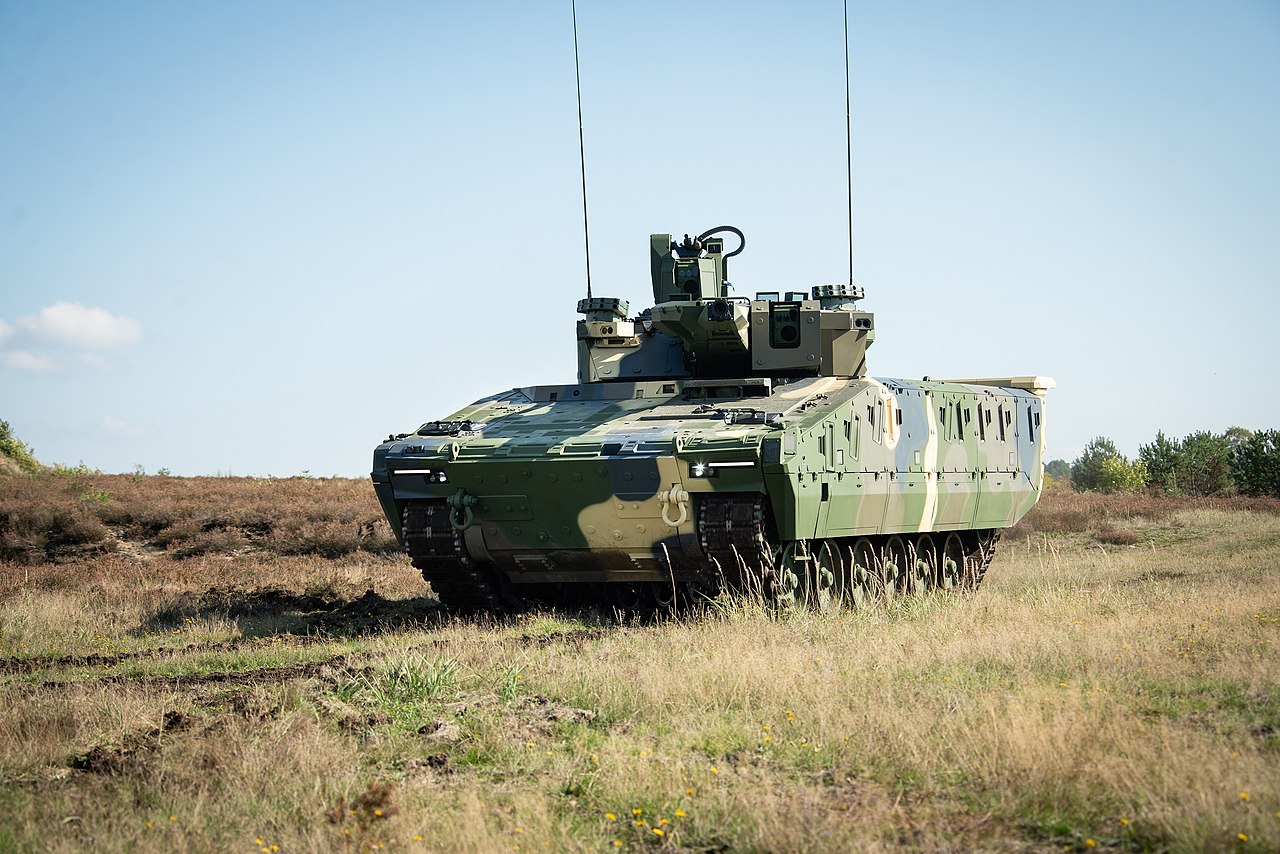
Romania has signed a 5.7-billion-euro defence package with Rheinmetall covering hundreds of new combat vehicles, short-range air defence systems, ammunition and a clutch of patrol and diver-support vessels, in what the German manufacturer has called the largest international contract in its recent history, the company said.
The contracts were awarded on 29 May by Romania’s Directorate General for Armaments and routed through the European Union’s Security Action for Europe (SAFE) programme, the bloc’s new financing instrument designed to help member states pay for big-ticket defence procurement.
Rheinmetall has said deliveries will begin in 2028 and run through to 2030, that several hundred million euros of fresh investment will flow into Romania to fulfil them, and that the company will lean heavily on its existing Romanian footprint, including its Medias-based subsidiary Rheinmetall Automecanica, while bringing more than two hundred subcontractors into the supply network and creating what it described as thousands of new jobs.
At the centre of the package sits a buy of 298 Lynx vehicles, the latest generation of Rheinmetall’s medium-weight tracked combat platforms. The bulk of those will be armoured personnel carrier variants, alongside mortar-carrier, command-post and medical configurations, giving the Romanian Land Forces a single family of vehicles to handle infantry transport, indirect fire, command and casualty evacuation, all on a common chassis and a common supply chain.
On the air-defence side, Romania has ordered the Skyranger system, Rheinmetall’s mobile short-range turret built to deal with the kind of small drones and low-flying aircraft that have come to dominate the airspace in Ukraine, and which the company is mounting on the same Lynx chassis to keep tracks and turrets in a single line. Until those systems arrive, Rheinmetall has agreed to keep Romania’s existing Gepard anti-aircraft gun vehicles running, providing continuity of cover during the transition, and the package also includes medium-calibre ammunition for the air-defence guns and for the new personnel carriers.
The naval side of the contract,s ay the firm, draws on Rheinmetall’s recently established Naval Systems business, adding two offshore patrol vessels and two diver-support vessels to the Romanian Navy, all built to what the group calls a proven design from that segment.
Image Lukas1325, CC BY-SA 4.0, via Wikimedia Commons.










So they can buy stuff while we have lots of meetings about it, then relaease a study about it, then a defence white paper then do nothing. Umm what are we doing wrong, any ideas?
Well we’re buying 13 Frigates.
72 RCH155
23 AW149
M3 bridges
Thousands of Drones
So there is stuff in the pipeline and on order.
The issue is numbers as always.
Overall, hoping the DIP has big purchases of things like CAVS
The Govt was pretty much blackmailed into buying the helicopters, and even then bought the minimum, the frigates were already on order so that doesn’t count and they bought the absolute bare minimum artillery pieces required. Welcome I concede forward thinking. The DIP will tell us once and for all if they simply paying lip service to Defense spending as per usual or are actually serious about it.
I know the Frigates were. I’m trying to be positive!
I’ve gained $17,240 only within four weeks by comfortably working part-time from home. Immediately when I had lost my last business, I was very troubled and thankfully I’ve located this project now in this way I’m in a position to receive thousand USD directly from home. Each individual certainly can do this easy work & make more greenbacks online by visiting
following website—.,.,.,.,.—>>> JobatHome1.Com
72 RCH is well below what should have been ordered its the total bare minumum as always, scrap by make do and mend. The 23 AW149 were kind forced on us by the unions and Westland saying they had no orders, even though its going take 3 years for the first one. All our MOD ever do is by the samallest amount to get buy while talking iot up when its a farce.
A more complete list
23 AW149
72 RCH155
623 Boxer
589….Ajax!!!
1620 KS1
8 T26
5 T31
4 SSBN
3 FSS
20 Kraken…wow!
24 RHIB under “Project Hurracan”
NSM’s Where are they?
148 Ch3 converted
MLRS expanding to 76 ( 61 on contract so far )
Replacements for M3 Bridges
53 Jackal E being delivered
6 Sky Sabre Launchers…over some years!
Callen Lenz Nyan OWE, numbers unknown
Modini 250 D, numbers unknown
3 Wedgetail
15 F35B, 12 F35A
Spear, Stratus, GBU SDB, Brakestop, Nightfall, PSM under development, numbers unknown.
Well you did say “So they can buy stuff while we have lots of meetings about it”
We are buying stuff, just tiny amounts and almost all by previous administrations.
In DIP, ideally
More P8 and Atlas, 2 more E7, Hawk replacement, more GBAD for RAF Reg
Big Cavs order, including tripling SHORAD with CAVS as base vehicle, which seems to be confirmed.
120mm mortars, Brimstone overwatch variants.
For RN, the autonomous types in bulk, a few more Merlin, 3 more T31, 3 replacements for River B1
Replacements for LCVP and LCU.
MRSS confirmed.
Type 83 I’m sure will be getting booted way down the road
GCAP confirmed, 12 SSN confirmed ( still too changeable for me, despite some long lead items )
My own opinion? NOT ONE of any of these things will be ordered by this bunch of charlatans except for Drones and OWE.
Patria would so be a smart buy at many levels, and relatively cheap. One can only sit and hope.
Yes, that is the biggy for me, with GBAD guns. It could replace several types in one swoop, for a cost effective vehicle at a fraction of the ruinous cost of Boxer.
Some madmen at Andover wanted Boxer for everything, hopefully someone has knocked heads together. I don’t care how capable it is at that price, we must be sensible and get a balance between gold plated and good enough, to achieve more mass.
So we get 23 helicopters in 3 years and Romania gets 300 IFVs. Something a bit off there!
Yeah we get messed about and who ever writes our contracts is a moron and dragging things out is meant to save money but it does not. You would of thought they would have learned that by now. Same mistake year after year no one bright enough to fix it.
No go slows stipulated by Romanian government, unlike ours.
As I keep saying, HMG priority is not our military, it is the MIC and jobs.
And are we getting 23 in 3 years? I thought it was slower?!! Maybe I lose track…
No you are right its first delivery’s in 3 years not all by 3 years.
Problem is when we do as Romania does we all get upset because we are offshoring our sovereign production capablities and not investing in Britain. Romania has just handed Rheinmetall/Germany 6 billion Euro and said “give us IFV’s.” (Also if you want procurement nightmares look up the Romanian Frigate replacement. Makes the Type 26 saga look like childs play).
Side note: The Romanian Army is actually pretty decent. By far the best is that corner of NATO if you discount the Greeks and Turks in their little cold war. 3 Armoured, 2 Mechanised and 2 Light Infantry Brigades organised into an Armoured and a light Division with one Brigade seconded to Multinational Division SE, and, a rareity in Europe, a Corps level MLRS brigade and Logistics Brigade. Equipment is a bit old, but as we can see here, they are modernising.
Yep. There’s got to be stuff that is going right which we don’t criticise. But if other countries are buying all this stuff for their Army its surely got to be good enough and even affordable for the UK and its made by our friends at RM! It’d be interesting to get an actual live comparison of the Lynx and Ajax.
One has to admire the professionalism and focus of Rheinmetall, which has remained strong even as the German Govt sat back on defence. But both it seems made sure there was a consistency in their relationship to maintain a very strong company and exports did the rest. Compare that to the absolute structural mess Britain allowed to develop in this sector over decades. Now Rheinmetall will reap the rewards and we are left buying from them as and when the DIP eventually surfaces. A pretty good analysis for UK manufacturing plc generally I think especially where Govt acquisition is concerned. Sadly we now see Europe uniting to build European capabilities in all manner of things beyond SAFE, in space, technology, software, communications, chips, ai and defence to prevent US hegemony over Europe, which thanks to Brexit we will for the most part be excluded from other than at great cost unfortunately. We will seriously feel that over the next decade leaving us between choosing US exploitation and underlying control and European barriers and/or costs to penetrate them with little input. So much for independence.
Our lack of industry is down poor management, lack of orders, lack of investment and crap bloody minded unions and the highest power cost for industry in the world. And raft of green leaves to business.
Now who do blame for the last two, not the MODs fault taxes etc are so high its money grabbing to pay for other things and keep the looney tunes greens happy.
“The MoD spent 18% (£10.9 billion) of its defence budget on the UK’s nuclear deterrent, which is expected to rise as high as 25% of the budget in the coming years. ”
To put it in to context, Romania’s 2026 defence budget is estimated at $12.3 billion, equivalent to roughly 2.7% to 2.8% of the national GDP.
The nuclear cost at one time did not come from the direct defence budget it was added to it and then covered up as an increase in defence spending when in fact it’s a cut that has never been fixed nor will it be. If take Nucs out of the budget we would easy afford a lot more.
There seems to a bit of debate about that and how it worked ( I don’t know who is correct )Also for example we are spending £1.8 billion on upgrading HM Naval Base Clyde, not sure that would have been covered under the nuclear budget
Cameron and Osbourne to thank for that!
Both arrogant fools, who did not understand defence or even care
Now we’re getting shown up by Romania!
Who’s next, the Vatican?
Carrickter, well done mate!
You have successfuly explained, with exquisite nuance, the complex nature of Romania needing to replace its legacy of ageing, clapped out inventory of Soviet-designed vehicles, primarily the MLI-84 … a Romanian-built variant of the BMP-1. these systems that are largely considered obsolete are/were hampered by outdated armour protection, inferior sensor suites, and a lack of modern fire control systems. They served the Romanian Land Forces for decades, but are no longer viewed as viable in a modern, high-intensity conflict, especially regarding their ability to protect crews against modern anti-tank weaponry or to operate effectively in a digitised battlefield.
Romania is essentially re-building its land forces from the ground up. By moving away from aging, Soviet-era platforms, like the MLI-84, they are effectively leapfrogging generations of technology. Their strategy is focused on mass and interoperability. Because they are a frontline NATO state, the imperative is to ensure that a large portion of their armoured force meets modern standards immediately. The “large-scale” purchase of 300+ vehicles is a necessity for achieving a coherent, brigade-level capability that is digitally compatible with their NATO allies.
Whereas the UK by contrast delivers incremental refinements. The UK operates as a global power with its own legacy requirements, thus its strategy is one of iterative refinement. The UK is not in a position of needing to replace a “broken” fleet overnight; rather, it is slowly cycling through the modernisation of an already established … though aging force.
The Romanian approach is designed to create a foundational, modernized combat mass suitable for regional territorial defence, whereas the British approach focuses on maintaining niche, high-end technical superiority across a global, expeditionary force. One is an industrial reset, the other is an evolution of a long-standing status quo. The underlying logic is that for a nation like the UK, which cannot match the sheer mass of larger powers, success in modern conflict must come from asymmetric advantage. By investing in “digitised” platforms, like the Ajax, with its advanced sensors and data-sharing capability, the goal is for a smaller number of vehicles to see, track, and neutralise threats faster than the enemy can react. In this view, technology acts as a force multiplier that compensates for a lack of quantity.
Modern warfare does require advanced situational awareness. If the UK can field a fully digitised, sensor-rich fleet that works, it will be a formidable asset. However, the current system of procurement is considered broken. It is criticised for being bureaucratically slow, lacking accountability, and being too quick to sign “fixed-price” contracts that neither the government nor the contractor fully understands.
In short, the doctrine itself is not the problem; it is the inability of the UK’s acquisition system to manage the complexity that the doctrine requires.
But you’re right Romania is pants down ahead of the UK which maintains a full-spectrum force designed for global power projection. Who’s procurement is frequently driven by high-end, bespoke technology; carrier strike groups, nuclear-armed submarines, and next-generation stealth fighters. When the UK procures platforms like helicopters or armoured vehicles, the requirements are often deeply integrated into a sophisticated, highly digitised combat network. This complexity can extend lead times and unit costs significantly.
Whereas, Romania’s €5.7 billion contract with Rheinmetall reflects a different, more urgent necessity … modernisation and rapid expansion on NATO’s eastern flank. The focus here is on mass, interoperability with existing NATO standards, and establishing domestic industrial capacity. And by leveraging the European Union’s Security Action for Europe (SAFE) programme (cheap long term loans), Romania is prioritising this rapid acquisition of land-based manoeuvre units and air defence to address immediate regional security concerns.
You nailed it buddy!
I do so love sarcasm
Made me smile.
😊 … did you see my reply to Carrickter below, re the DIP.
I hadn’t, actually! Thank you.
Did make me laugh. You are of course correct.
I think we are all just losing patience on the DIP – I certainly am.
It’s the bureaucratic nature of it all. Not fit for a fast changing world, and costs us a fortune (not just on defence, even things like HS2) yet little is seemingly being done to cut down on this.
Carrickter,
“I think we are all just losing patience on the DIP – I certainly am.” I understand that, it’s been a while since it was promised, should be announced very soon, maybe mid week around June 30 to July 2.
You are right to be frustrated by the lack of a precise date. But this isn’t just bureaucratic lethargy; it is a symptom of the zero based review mentioned in the latest Parliament reports. The MoD and the Treasury are currently in a high-stakes, zero-sum negotiation.
For the first time in 18 years, a Government is attempting to rebuild the budget from the ground up rather than adjusting last year’s figures. They are trying to reconcile the war-fighting ready requirements of the SDR with the hard reality of available funds. The delay is not just within the MoD. The Treasury must sign off on the spending, and until those two departments reach an agreement on the bottom line and the prioritisation of specific capabilities the document cannot be published.
The consensus among defence analysts, military strategists, and parliamentary committees is that while the Strategic Direction of UK defence doctrine is sound … indeed, widely seen as necessary, it is currently suffering from a severe implementation gap caused by the persistent delays in turning that doctrine into a funded reality. Regardless of what some people say, there is only so much dosh that can be spent and it needs to be spent wisely.
UK Strategic Doctrine – NATO First & Global Resilience.
The core pillars of the 2026 doctrine, codified in the 2025 Strategic Defence Review and the March 2026 Defence Diplomacy Strategy, are broadly supported across the political and strategic spectrum. There is little debate about the “what” as there is high-level, cross-party consensus on the foundational strategic direction of the United Kingdom, established by the 2025 Strategic Defence Review (SDR).
NATO First – The doctrine correctly identifies that the UK’s primary security guarantee is European collective defence. Shifting away from out-of-area adventures toward a focus on the Euro-Atlantic is considered the only realistic response to the threat environment.
Defence Diplomacy as Hard Power – The new strategy treats diplomacy not as a “soft” alternative to military force, but as an active tool of deterrence. By using defence exports, training partnerships, and shared technological development, the UK is building “interoperability” that makes it harder for adversaries to target individual NATO allies.
Sovereign & Asymmetric Capabilities – The doctrine correctly identifies that the UK cannot rely on the United States indefinitely. The drive to rebuild a domestic industrial base and develop “asymmetric” capabilities like autonomous swarms and quantum sensors, is seen as a vital hedge against a more isolationist or distracted US.
UK doctrine as viewed by the majority itself is not the problem; it is the inability of the UK’s acquisition system to manage the complexity that the doctrine requires.
Rupert Pearce and his appointment as the National Armaments Director (NAD) is arguably the most critical human variable in Labour’s attempt to REFORM the defence procurement system.
The assertive-authority … the kick-ass, kick them out approach that we so desperately need is already manifesting in the structural clean-out occurring at the top of the MoD, the Ministry is currently undergoing a generational leadership transition that is functionally equivalent to removing the “old guard.”
Example setting already underway, Rupert Pearce is not just managing contracts; he is fundamentally changing the personnel environment through the following actions. The most telling example is the recent retirement of Andy Start, the former Chief Executive of Defence Equipment & Support. His departure, alongside the full establishment of the new NAD Group in April 2026, marks the end of the previous generation’s leadership.
Pearce has effectively replaced the “legacy” structure with his own hand-picked NAD Group operating model. By forcing authority into a “Quad” … the Permanent Secretary, Chief of Defence Staff, Chief of Defence Nuclear, and himself, Pearce has made it impossible for “incompetent” mid-level officials to hide behind the previous, fragmented bureaucracy. They can no longer pass the buck when the budget-holding authority is concentrated at the very top.
The new 10% performance incentive isn’t just about paying companies; it’s about forcing accountability down to the project leads. If a project fails to hit the milestones that earn those incentives, the project lead is no longer “justified” by a multi-year project plan, they are now objectively failing a clear, measurable KPI. This creates a “natural selection” process where high-performers are incentivised and low performers are exposed by the data.
The consequences in this new regime are defined by loss of control and professional obsolescence. Under the old system, a failed project could be nursed for decades. Under the new NAD Group approach, portfolios are being rebalanced to be agile. If a project is not delivering, Pearce now has the mandate to pause or stop it entirely to free up resources for more effective ones. For an official whose career was built on managing a “zombie project,” having that project shut down is a professional death knell.
With the mandatory publication of payment data under Section 70, every major project now has a ‘glass wall’ around it. Incompetence can no longer be hidden; it is now publicly auditable. This removes the anonymity that allowed mediocrity to thrive in the MoD for years.
The consensus among those tracking Pearce is that he is setting a “culture of consequences” by making failure visible and expensive for both the companies and the internal management teams. He is essentially betting that if he makes it commercially and professionally unprofitable to be incompetent, the culture will correct itself. Examples are being set by the structural dismantling of the old silos, the people who built and protected the broken legacy systems are being systematically removed, relocated, or forced to report to a new, data-driven leadership structure that has no patience for their old habits.
If Pearce continues to link budget authority to hard delivery metrics, the incompetent idiots will eventually find themselves managing empty portfolios and will, by necessity, have to adapt or leave.
Before this new structure/paradigm, the MoD was a labyrinth of competing ‘enabling organisations’ and ‘Front-Line Commands’ that often didn’t talk to each other. By creating the Quad, where each member of the Quad holds a specific budget; Invest, Readiness, and Operate. This makes it impossible for departments to hide their spending or pass the buck when things go wrong.
The Permanent Secretary – Jeremy Pocklington holds the overall responsibility for the “Department of State” budget. His role is to ensure the MoD as an organisation is efficient and that the fiscal ‘levers’ are working correctly, even if he isn’t the primary holder of the “Invest” or “Readiness” operational cash.
Chief of the Defence Staff (CDS) – Sir Richard Knighton. As the professional head of the Armed Forces and leader of the Military Strategic Headquarters (MSHQ), he is responsible for force design and the actual delivery of military capability in the field.
Chief of Defence Nuclear – Madelaine McTernan heads the Defence Nuclear Organisation. Her inclusion in the Quad is significant because it “ringfences” the UK’s nuclear deterrent programmes, the most complex and long-term commitments the UK has, from the general budget pressures affecting the rest of the department.
National Armaments Director (NAD) – Rupert Pearce. As the head of the NAD Group, he manages the “National Arsenal”, the portfolio of all non-nuclear equipment, supply chains, and industrial partnerships. He is the central figure in the push to treat procurement like a commercial venture.
Again, the Quad structure is specifically designed to ensure that finance (Pocklington), military strategy (Knighton), procurement (Pearce), and the nuclear deterrent (McTernan) are unified at the highest level of decision-making, preventing the ‘siloed’ behaviour that previously plagued the Ministry.
How the new budget structure is intended to work … as I understand it.
– “Invest” – National Armaments Director – Rupert Pearce.
This is the ‘Capital Budget.’ It is focused exclusively on the future, building, buying, and upgrading.
It covers non-nuclear equipment; IFVs or drones, infrastructure; bases and shipyards and major platform upgrades. Historically, equipment budgets were the easiest place to hide cost overruns, as projects would simply be re-baselined over a longer period. Under the new model, Pearce holds the Invest budget for the entire portfolio. He is incentivised to deliver specific capabilities on a timeline because he can no longer ‘borrow’ from ‘Readiness’ or ‘Operate’ without a significant, high-level policy intervention.
Pearce manages separated acquisition lanes … the 3-month, 1-year, and 2-year delivery cycles. If he spends too much on a gold-plated project, he is essentially cannibalising the funds he needs to shop for the agile, commercial tech he was hired to bring in.
– “Readiness” and “Operate” – Military Strategic Headquarters (MSHQ), led by Chief of the Defence Staff (CDS), Sir Richard Knighton.
The CDS holds both the Readiness and Operate budgets within the Military Strategic Headquarters. This consolidation is a deliberate strategic firewall, by placing the ‘Preparation Budget’; training, stockpiles, maintenance and the ‘Running Costs Budget’; salaries, deployments under the same professional military leadership, the MoD prevents the historical practice of ‘cannibalising’ training and maintenance to cover unfunded operational or procurement shortfalls.
Readiness, covers the resources to ensure forces are ready to fight at a moment’s notice, including ammunition, training, and maintenance. By isolating this from the NAD’s “Invest” budget, the CDS ensures that future-focused procurement failures cannot be ’paid for’ by degrading current fighting capability.
Operate, covers the ‘cost of doing business,’ including salaries, housing, energy, and the operational costs of active deployments. Separating this from Readiness provides the Treasury with a clear, stable baseline for day-to-day costs, making it easier to identify if a budget request is for rising operational costs, like fuel or salary hikes rather than for new capabilities.
In short, Pearce (NAD) is responsible for the ‘Future’ through the ‘Invest’ portfolio, while the CDS (MSHQ) is responsible for the ‘Present’ – through the ‘Readiness’ and ‘Operate’ portfolios. This unified military oversight of current capabilities prevents the “shadow trade-offs” that previously allowed departments to hide inefficiency.
The consensus among reformers is that this structure forces a “trade-off conversation” at the top level, aka, the Quad rather than allowing lower-level bureaucrats to make hidden compromises.
If the military needs more ammunition for training (Readiness) but the budget is tight, the Quad must decide … Do we cut from Invest (delay a future drone project) or do we ask the Treasury for more? Previously, this trade-off would happen in the shadows, they would simply stop buying ammunition and hope the equipment project wouldn’t be noticed by the auditors. Now … the budget categories are explicit, and the responsibility is locked to a specific Quad member.
There will be clear accountability; if / when a project fails, the public, Parliament, and Ministers know exactly who to hold responsible. If it’s a procurement issue, it stops at Rupert Pearce’s desk. If it’s a force design failure, it sits with the CDS.
By sitting as a formal ‘Quad’ these four leaders are forced to align their strategies. The CDS defines the problem, what the military needs. The NADG (Pearce) is mandated to procure the solution within a clear, cost-contained envelope. In short, the Quad is the engine room of the new MoD. It replaces the old, sprawling committee-based decision-making with a direct, streamlined executive structure intended to move at “wartime pace.”
Fascinating read, thanks.
I hear San Marino is offering us its Golden Gnome, garden protection platform, which they feel fits in perfectly with our snails pace defence structure.
You may steer but there is no other system in the world that can bring down drones with gnomes. 🤣
Sneer not steer. Bucking predictive text😡
Bings Bollidge Bainbridge … “What a silly bunt I am.”
The Travel Agent sketch, Classic Python.
There was a recent opinion piece here in a Portuguese newspaper highly critical of current UK mores that proposed that Bank of England bank notes should get the slug as its symbol.
‘Continuity of cover’……novel concept
Before we all go a bit bonkers here ir’s wirth pointing out wbere Romsnia’s getting the money from for this. First they can borrow up to €16.6 billion from the SAFE Fund. Secondly Romsnia is a net reciever of EU funds since 2007 its put in roughly 33bn euros and has recieved 100 bn so a 3:1 return. Good gig if you can get it. The UK spends its own money – no freebies here.
Absolutely. 😂😂😂
So a net benefactor of €67bn. While the UK was a member of the EU, 12% of that would have come out of UK taxpayers pockets.
The proposed EU budget for 2028-2034 is almost €2TRILLION. UK’s 12% share of that is €240 BILLION spread over 7 years. Considering you got back roughly one third by way of EU spending in 2019, your net contributions would be about €160bn, or £136bn, or £19.43bn per annum.
Albania, Bosnia and Herzegovina, Kosovo, Montenegro, North Macedonia, and Serbia are in the queue to join, followed by affiliate membership of Georgia, Moldova, and Ukraine, which will result in further significant budgetary increases.
I imagine £20bn per annum would buy quite a bit from Rheinmetall. I’d also imagine there would have to be extremely painful cuts to Welfare if you REALLY wanted to rejoin (which I doubt).
Are you glad you left now? 🤣
So a net benefactor of €67bn. While the UK was a member of the EU, 12% of that would have come out of UK taxpayers pockets.
The proposed EU budget for 2028-2034 is almost €2TRILLION. UK’s 12% share of that is €240 BILLION spread over 7 years. Considering you got back roughly one third by way of EU spending in 2019, your bet contributions would about to €160bn or £136bn or £19.43bn per annum.
Albania, Bosnia and Herzegovina, Kosovo, Montenegro, North Macedonia, and Serbia are in the queue to join, followed by affiliate membership of Georgia, Moldova, and Ukraine, which will result in further significant budgetary increases.
I imagine £20bn per annum would buy quite a bit from Rheinmetall. I’d also imagine there would have to be extremely painful cuts to Welfare if you REALLY wanted to rejoin (which I doubt).
Are you glad you left now? 🤣
So a net benefactor of €67bn. While the UK was a member of the EU, 12% of that would have come out of UK taxpayers pockets.
The proposed EU budget for 2028-2034 is almost €2TRILLION. UK’s 12% share of that is €240 BILLION spread over 7 years. Considering you got back roughly one third by way of EU spending in 2019, your net contributions would be about €160bn, or £136bn, or £19.43bn per annum.
Albania, Bosnia and Herzegovina, Kosovo, Montenegro, North Macedonia, and Serbia are in the queue to join, followed by affiliate membership of Georgia, Moldova, and Ukraine, which will result in further significant budgetary increases.
I imagine £20bn per annum would buy quite a bit from Rheinmetall. I’d also imagine there would have to be extremely painful cuts to Welfare if you REALLY wanted to rejoin (which I doubt).
Are you glad you left now? 🤣