

The Royal Navy will deploy its first operational autonomous systems into the North Atlantic next year as part of a rapid shift toward a hybrid fleet, the First Sea Lord told the International Sea Power Conference in London.
The commitments mark the earliest tangible outputs of the Navy’s new Atlantic Bastion, Atlantic Shield and Atlantic Strike concepts.
General Sir Gwyn Jenkins warned that the UK’s long-held advantage in the Atlantic is under growing pressure, citing increased Russian submarine activity and the expanding presence of intelligence vessels such as Yantar. He said “the advantage that we have enjoyed in the Atlantic since the end of the Cold War is at risk. We are holding on, but not by much.”
Against that backdrop, he outlined four concrete deliverables that will come online in 2026.
First Atlantic Bastion sensors in the water
The Navy will begin deploying autonomous acoustic sensors next year, forming the initial element of a wider undersea surveillance network. Jenkins said “next year, we will have our first sensors in the water,” emphasising that industry investment has already exceeded Government spending at a ratio of four to one.
Atlantic Bastion contracts to be issued as a service
Alongside the initial deployments, the Navy will award “our contracts for Atlantic Bastion as a service” next year. The model is intended to accelerate fielding and avoid long procurement cycles by outsourcing capability delivery rather than buying equipment outright.
Autonomous escort to enter the water
Jenkins reaffirmed a previous pledge that “we will get our first autonomous escort in the water within two years, and we will.” Based on the timeline, that system is due to appear next year as part of Atlantic Shield, the UK contribution to northern air and maritime defence.
Carrier-launched fast jet drone demonstrator
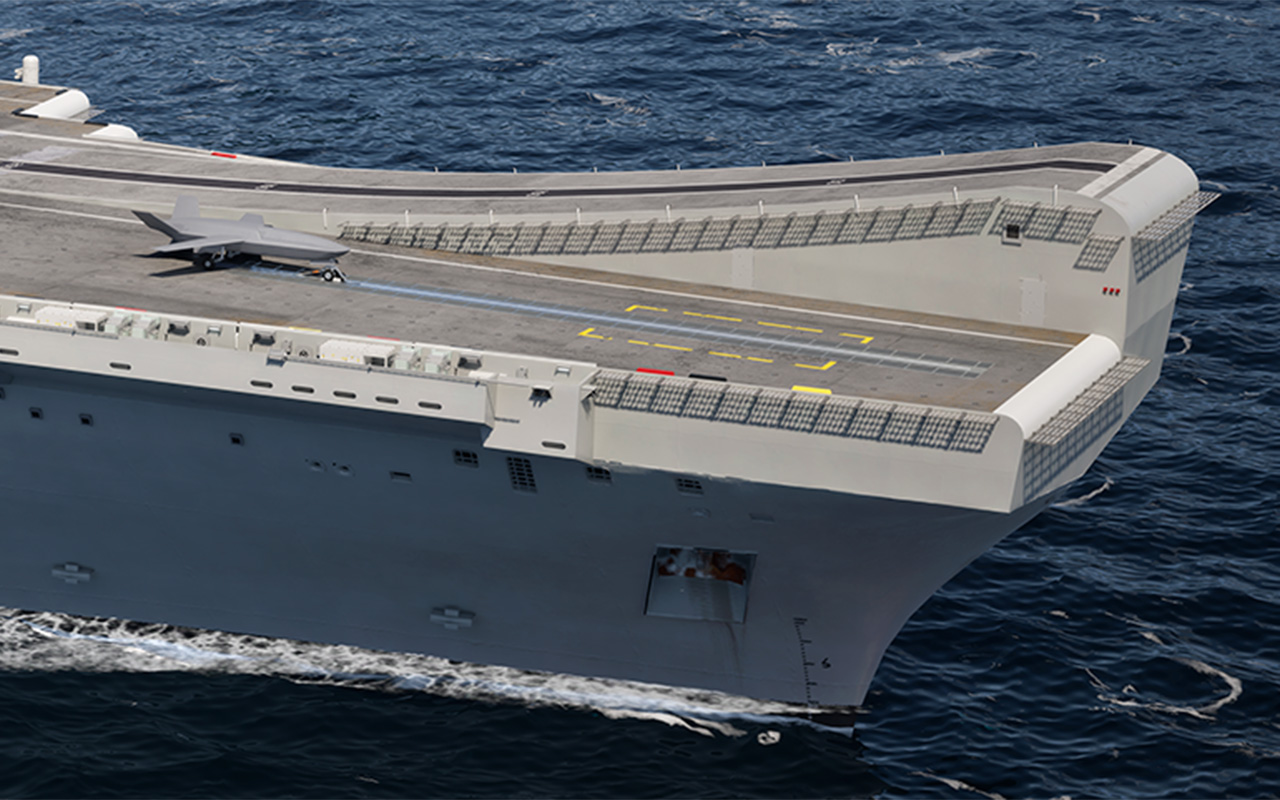
The Navy will also conduct the first launch of an unmanned fast-jet surrogate from a UK carrier. “We will get a demonstrator for our fast jet fighter capability off the carrier next year,” Jenkins said, describing it as a key component of the emerging Atlantic Strike concept.
Allies being invited to join the network
Jenkins stressed that the UK cannot secure the Atlantic alone. He confirmed that Norway intends to join Atlantic Bastion and link its future Type 26 frigates into the network, adding that “we need other allies together. We will build a network that we can connect to our systems and capabilities.”
A warning against delay
Framing the commitments, Jenkins said the pace of technological change and the rising threat environment mean the Navy must build for speed rather than predict the future. “The pace of technological change will never be as slow again as it is today,” he noted. “Now is the time for action.”
He added that attempts to modernise without transforming would fall short, arguing that adversaries are investing at scale while the UK’s legacy Atlantic advantage has narrowed.
The First Sea Lord closed with a call for sustained urgency: “We are moving out because we have no choice. Our job is to be ready.”




What fast jet surrogate? No UK project under way apart from development of Banshee drones.
I understand how we might deploy a General Atomics variant for surveillance, but a fast jet surrogate is going to need major investment in launch and recovery systems.
Turkish Kizilelma or is that too large to launch from our carriers?
It’s an interesting proposal – I don’t think that the Kızılelma requires anything more than a slope to takeoff, given it’s been designed to handle the much shorter runway of the TCG Anadolu. In that sense, it should be easier to have the Kızılelma take off from a QE-class, which has a wider and longer deck to work with.
Landing is a little more tricky – I’m struggling to find information as to whether the Kızılelma would need arresting gear to facilitate a landing. The TCG Anadolu is not fitted with arresting gear currently, nor can I find any proposals to do so, which leads me to believe that the Kızılelma can perform a landing on the runway of the Anadolu, and therefore should be capable of doing so on the QE-class.
So, in short, it’s not too large to launch, but recovery is a little more nebulous.
I did see a piece that made it clear they would need to fit arrestor gear to land it on the carrier.
Yeah, that makes sense. After all, the Kızılelma isn’t that much smaller than an F-16, for example.
The RFI explictly calls for …”able to launch and recover to QEC without Catapults or Arrested Recovery Systems …” Maybe there is wriggle room.
cut n’ pasted from the 715675477 RFI Industry VANQUISH
RFI INDUSTRY – VANQUISH Technical Demonstration Description
As part of the route to the Royal Navy’s Hybrid Air Wing, Project VANQUISH seeks to deliver a technical demonstration at sea of an attritable (Tier 2) Fixed Wing Short Take Off and Landing Autonomous Collaborative Platform (FW STOL ACP); nominal target date by the end of 2026, with options for delivery within an 18 month window from the target date also considered. The air vehicle must be able to embark and operate autonomously from a Queen Elizabeth Class (QEC) Aircraft Carrier and is to be jet turbine powered and capable of high subsonic speed. It should be able to launch and recover to QEC without Catapults or Arrested Recovery Systems and with a credible payload and endurance. There must be an exploitation pathway to the delivery of a wide range of maritime mission sets in support of UK Carrier Strike in due course (ISR/Strike/Air-Air Refuelling), to compliment F35B LIGHTNING, as part of QEC and its Carrier Air Wing.
I suspect a banshee drone being controlled by another platform and they will describe it as job done.
All armed forces appear to be about generating content for social media nowadays.
I suspect you are right with your Banshee guess.
I doubt if will be the Banshee 80+, that would just mean a repetition of the 2021 trials from Prince of Wales. The inability to recover the drones nixed any follow-up. 1SL said that the 2026 demonstration would involve close cooperation with the RAF, so we need to look at what they are doing. Also, for Project VANQUISH the RN is specifically seeking a jet-powered, fixed-wing drone that can take off and land vertically (or at least with a very short take-off/landing capability), without the need for catapults or arresting gear on the Queen Elizabeth-class carriers. The S/VTOL requirement seems unrealistic if any useful payload is to be carried (e.g. for refuelling F-35Bs), but it is quite clear that a cat and trap solution won’t be considered until every possible alternative has been ruled out. Logic, military capability and overall cost have no bearing on this particular chestnut – the policy has been set and woe on anyone who dares to question it.
Maybe something like Shield AIs X-BAT tail-sitter. While their software is in use, autonomously flying converted F16s, the airframe itself is yet to be built, let alone tested.
Anduril’s Omen and BAE’s STRIX are also tail-sitters but props rather than jets.
I hadn’t seen this before, seems interesting. But (1) It probably can’t carry the payload the RN is looking for and (2) they its an American company whilst the requirement is touted as as “strategic opportunity for UK aerospace and defence companies”.
I fear that overly ambitious user requirements, the unrealistic demand for VTOL, implausible time lines, and a completely inadequate budget (£10 million for the 2026 trials?) will soon the kill the project.
No indication of either what payload the RN is looking for, no of the payload the X-BAT could carry either.
Yes it’s American, but then so was half of BAE until they were bought.
Before jets, propellor driven aircraft took off from carriers smaller than the QE class without catapults. So this feels like the obvious route to go.
That said, if these drones are to be F35 wingmen then they need to be jets.
Traditionally jets require catapults for horizontal launch. As the RN wants to be launching next year, this does not leave time for a catapult installation, so maybe some kind of portable catapult launch system??
Or instead of horizontal launch, VTOL. Which narrows it down to
1) Harrier/F35 style
2) a jet version of a tilt-rotor
3) a tail-sitter design.
I don’t know of any drones under development using (1) or (2). And the X-BAT is the only jet tail-sitter I know of in development.
I think the RN is hitting the classic project management triangle of cost versus timescale versus capabilities. They’re not going to hit all three.
Close cooperation with RAF isn’t good if RAF then end up owning the drones and prioritising other taskings.
The main point of QEC drones is persistent tasking.
Banshee certainly isn’t a ‘fast jet fighter’ and the way the 1SL structured that sentence suggests to me that the language was deliberate. Banshee has been done now. IMO it will be a STOL gambit or possibly a new SME design, a very small CCA.
Didn’t the Aerelis project include an unmanned combat and refuelling version ? We need a replacement for the Hawks so could they leverage both requirements ?
Yes but that doesn’t make arealis carrier capable
Hmmm. …. part of the 4 concrete deliverables. 1st lord is a general.
definition of ‘fast jet’
Slightly off topic the RAAF’s MQ28 Ghost Bat CCV drone yesterday launched a AIM 120 AMRAAM missile and shot down a jet powered target drone.
It is only the second (publicly acknowledged) air to air BVR drone engagement after Turkey’s Kizilelma drone achieved the same milestone a week ago.
Ghost Bat is a similar size and has a stated range of 3,700 km range (so combat range with loiter time and fuel reserves of at least a 1,000kms).
If the RN was contemplating a drone the size of Kizilelma, the Ghost Bat would be a more logical alternative especially given the AUKUS relationship.
While drones of near fast jet fighter size could launch from the QE carrier ski ramp, recovery would almost certainly require arrestor cables.
The Ghost Bat is an interesting topic. Australia are investing heavily in it, and there’s very little specific information on its performance or capabilities. One thing of note though is the pre-production versions have been limited to +4g manoeuvres. This is highly restrictive for air based combat. But this restriction is probably in place to sort the flight controls aerodynamic laws.
At an all up weight of around of 4000kg, for carrier operations, where the drone is launched off the deck without using catapult assistance. The engine must be capable of delivering the equivalent or preferable a lot more thrust than the aircraft’s weight. If the engine’s thrust output was greater that 1:1 vs the drones overall weight. It will be capable of a straight deck take-off. With the right time of undercarriage, it should then also be capable of a ramp take-off. If the Ghost Bat is powered by the P&W300 series or the Williams FJ44. Neither of these engine variants has the thrust output for 1:1 power to weight ratio, let alone greater than 1. Which means in its current guise, it is not suitable for carrier ops.
Landings will be a problem, as the wing profile and shape are not conducive with short take-off and landing (STOL). The aircraft doesn’t currently use high lift devices, which will need implementing if its to be used from a carrier. Unless the Ghost Bat and carrier are modified with cable arrest.
The Turkish Kızılelma drone, with its close couple canard wing layout and more powerful engines is probably more suited to carrier ops. It will still need an arrested landing though!
The Australian Ghost Bat and Turkish Kizilelma have been created to address different strategic priorities and taken different design paths but ended up with very visually similar and sized platform.
The RAAF has prioritised long range for Indo Pacific operations and modular (swappable nose cone) mission packages (ISR, EW, jamming, IRST, AESA radar etc.) so engine efficiency has been more important than engine power. While one of the primary purposes for the Kizilelma has always been shipboard launch from its LHD (which interestingly is based on the same design as the RAN’s Canberra Class that opens up a whole other debate for Australia).
General Atomics have demonstrated with their Gambit CCA design that it is possible to adapt the underlying engineering (the autonomous software, flight systems and powerplant engineering) to different mission sets using (in some cases quite radical) different wing planforms. The fundamental engineering of the current Ghost Bat could be optimised for carrier-based operations.
So yes, a more powerful engine would be needed. Options for minimal fuselage redesign include variants of the Williams FJ44A (up to 16,000kN thrust) or with varying degrees of redesign to intakes, fuel systems, fuselage shape and mounting points etc. options from Honeywell/Garrett (to 21kN) and Pratt and Whitney Canada (to 36kN) all without going to afterburners.
Similarly, the wing would need to be redesigned to increase lift. A range of engineering options here with varying and increasing degrees of complexity from simple LEX extensions to Fowler flaps, LE slats, ‘blown” flaps, thrust vectoring etc.
Other changes like a high flotation undercarriage and corrosion resistance would also be required. But it should be achievable if the UK chose to leverage the AUKUS partnership. Keeping in mind that the ‘digital twin’ design process has allowed Boeing Australia to rapidly develop prototypes and make design iterations in record time from drawing board to actual flight.
I’d query that you need a 1:1 thrust ratio (especially if the RN has decided to fit catapults to the QEs) to launch a combat aircraft. If that were the case most combat loaded Super Hornets would never make it off the deck of USN carriers. Ship speed and wind across the deck contribute.
One advantage of Ghost Bat (say versus a General Atomics platform) is that it has been developed to be ITAR free. Working with Australia under AUKUS to develop a carrier capable CCA would give the UK far more sovereign control than relying on the US. At the same press conference announcing the AMRAAM BVR success, the production target for Ghost Bat was announced as a ‘minimum’ of 3 per combat aircraft. With 108 fast jets in RAAF inventory that equals 324 Ghost Bats. With the production scaling up, running a second line for a RN carrier based variant would have huge economies of scale for the UK (the stated target for cost per airframe is 10% of a fast jet – so about $10 million on less per copy).
I’d suggest you are the right that the 4G airframe limit is for developmental work and the actual G limit is likely to be much higher. Given that one of the RAAF design parameters has always been ‘fighter like performance’ that suggests a minimum of 7G perhaps 9G as the design target but I wouldn’t be surprised if its much higher since one of the advantages of an uncrewed platform is taking the human out of the loop allows for much higher G loads.
Hi OZ, all really good points. If you look at how Turkey has recently announced that they may be joining Spain in designing and building a larger “CATOBAR” carrier, kind of points at how difficult they may find or are finding integrating something like the Kızılelma drone on to their modified Juan Carlos LHD. If they aren’t going to use catapult assistance as is rumoured, then the aircraft will be using the ski ramp. It will need the greater than 1:1 power to weight ratio, to make sure the engine can sustain it long enough after lobbing it off the ramp, for the wings to get up to speed to generate the required lift. Which is probably why they are looking at an afterburning engine or replacing the single with twin engines.
Landing is still going to be an issue, as the Anadolu is not very long. Nor does the current version of the Kizilelma use a high lift wing along with the high lift devices. It will need an arrested landing! Perhaps they will develop a specific maritime version for the Anadolu? The Kızılelma is slightly larger than a Harrier II. The Spanish normally have 10 Harriers embarked but have doubled this number before. So its likely that the Anadolu would embark a similar number.
The Ghost Bat could be modified for maritime operations. As you say chucking in a larger more powerful engine would be the first requirement. But the wing will need a radical redesign, as the thin lambda will not provide enough lift at the slower take-off and landing speeds needed for a non-catapult equipped carrier. If the carriers do get modified with catapults, this solves so many issues. Especially on the size and weight of aircraft that you can now operate from the deck.
The Ghost Bat “apparently” does not use radar absorbent materials (RAM) in its design. But instead uses careful shaping to reduce its radar cross section (RCS). Coating it in a wideband RAM paint optimized around the X-band frequencies, will certainly help it. I don’t see why this couldn’t be an option for the production version, as its relatively easy these days to apply and maintain.
We could easily go to town on redesigning the wing, to make it more carrier compatible. I do feel that the “blown wing”, i.e. the circulation control wing (CCW), offers significant advantages, even though it would be relatively complex to build. Using this type of wing does mean you can gain over 200% more lift from a normal high speed wing, such as the the current lambda design the Ghost Bat uses. The main wing will need a leading edge flap, trailing edge flaperons; each of which have blown air jets, plus jets near the centre chord. You would also need to add blown air jets to the fins. Including a 2D variable exhaust nozzle would also help.
By including the above, it will significantly help its take off distance, max all up take off weight, as well as significantly reduce the stall speed and landing distance. Which would give the aircraft the option of using the current ski ramp without catapult assistance. The downside of the CCW, is that it takes a lot of power to operate, anywhere from 30 to 50% of engine power. As it uses a direct feed from the engine’s low pressure turbine section. Hence why I’m still suggesting the engine will need to have a greater than 1:1 power to weight ratio (calculated at max all up weight). But it could then be adapted for launch form the current QE class ski ramp. For landing, although the approach speed will be much lower, for safety reasons I’d still install an arrestor system.
There have been a number of drawings showing the size of the weapons bay. One of which showed it would be possible to carry 4 AMRAAM sized weapons internally. Plus what ever fits under the fuselage and wings. would offer a significant boost to ours F35Bs.
What is the distance needed to launch a MQ9B short take off version off?
We could buy them but unsure how quickly it would come.
Its not a fighter though, and the americans still dont have it in service.
It can be launched from the qe carrier. There’s a few videos of it landing and taking off and landing.
That’s Mojave not the larger MQ-9B.
Yeah, my mind went straight to Mojave because it’s on a new article for QE.
Outsourcing again. Not great. I recall they claim they’ll bring it in house in time.
Considering how terrible we are at building our own stuff e.g. Ajax, I wouldn’t mind quick buys from abroad
The Ajax hulls were built in Spain.
Last I checked they were built in South Wales
Try again: Ajaxh hulls are manufactured in General Dynamics Santa Bárbara Sistemas. That’s in Spain.
My point still stands. I’d rather buy off the shelf from abroad, than wait years and pay more for a product that may or may not be any good.
It’s the MOD way after all
Buying from abroad as with Ajax and mucking it up isn’t mutually exclusive sadly. Indeed Watchkeeper was another example if we want to go with aviation. There’s always and inevitably going to be some changes so the opportunity is always there.
Final assembly is Wales. The hulls are shipped over from Spain.
By outsourcing, I meant a service provider for Bastion, not build. Though as said they say that in phase 2 it’ll end up GOMO rather than COMO.
I think Peregrine was an example of this kind of thing where we got a couple of drones COCO, whose running was handed over to the Navy on Lancaster. I hope with Peregrine they will soon be purchased GOGO. Bastion will be on a much larger scale and presumably over a longer period of time.
The hulls are from Spain.. very badly built in Spain.. it was one of the first big issues, that Spain shipped a load of miss aligned hulls to the UK for assembly.
The initial phase is COCO, it will shift towards government owned and operated from 2028 if they follow the plan.
I assume that means smaller USVs and sea gliders until then, then shifting onto T92 as they are built.
Can’t see how this is a priority, especially with resources being so oversubscribed. Still can’t see how carriers will be a asset not a liability in the atlantic. We have plenty of airbases that can cover the relatively short distances required, this isn’t the pacific. Thier deployment will require diversion of finite escorts which will be desperately needed else where. Even in harbour they will require diversion of anti air assers. We also tried using fleet carriers in asw role in ww2 and it went pretty badly. They couldn’t suffer inevitable attrition on regular asw patrols, that’s why escort carriers proved vital.
Short distances over the North Atlantic? Are you drunk?
Yeah from greenland to iceland to newfound land. Land based fighter can intercept any russian aircraft trying to get into the atlantic zone. ~1000km between them so you need a combat radius, with air to air load out, of 500km. Eurofighter more than capable, even gripen. Also 2 carriers cannit provide persistent cover. Biggest issue is we can’t risk them on asw patrols, they are too valuable and difficult to replace. We learned this when we lost hms courageous in 1939 on asw patrol, we couldn’t afford to risk losing the carriers and withdrew them, and this is when we had 7 carriers not 2.
We also withdrew them from Salerno fearing submarines, leaving the escort carriers to do the job … which had the unfortunate side effect of serious Seafire attrition as they were not very suitable to the smaller carriers in low wind conditions but that’s another story.
Totally agree but it seems the people that make decisions have never studied a history book, all generations z or whatever they are known as…
Reality only really comes home when you start losing assets in war.. Then it’s time to act.. I read comments about how many ships you need in a war but nobody mentions the fact that some may go down very soon.. It’s sad but we are talking about war.
You do know the Invincible class were built as ASW platforms for work in the Atlantic?…
I take your point but there is a big difference between a 22,000 ton invincible class and an 80,000 ton elizebeth class when it comes to replacability or how willing you are to risk it on asw patrols. I do think going for amphibious warfare flat top like a san carlos would of been better. We could of conceivably afforded 6 with the 6 billion we spent. That would of been great for boosting availability, especially with upgrades and repairs, and in peace time they could deploy with no escort or in war time with a single escort, just because your loss tolerance is that much better. Also we would of filled our amphibious warefare needs before we ran out of money like we have now.
But a San Carlos cannot do power projection, the larger QE class is more versatile in what it can do.
The San Carlos wouldn’t be large enough to carry enough F35Bs to operate a CAP.
We are not doing amphibious landings anymore, only raiding operations. The casualty rates of an opposed landing are now as unacceptable as the WW1 slow walks towards machine guns.
Why can’t san carlos do power projection, if you need more f35s bring more san carlos into the task force. Even if the combined sortie rate and f35 carry rate of all san carlos isn’t as much as 2 QE, so be it. Power projection isn’t the the RNs primary mission. The UK needs the rn for the existential mission of guarding the north atlantic for the nuclear deterrent and guarding supply lines, projecting out to the falkands or the like is a mission which comes second to this. Ultimately the rn should be designed to do its primary mission but be able to cobble together a sub optimal option for greater power projection. Thats what we did with the falklands, a north atlantic escort force doing power projection, it was sub optimal but it was adequate and allowed us to meet the primary mission and cover the secondary mission just about with the limited resources at hand.
First you incorrectly claim the RN isn’t for power projection, then claim you could cobble something together with multiple San Carlos, then cite the RN’s most famous triumph, the Falklands War – which was pure power projection 😂
The RNs primary purpose is defend U.K. interests at sea. Preferably as far from U.K. waters as possible, in the same way our army is traditionally expeditionary in nature. It’s better to fight on other nation’s territory and in their waters than in your own.
Guarding the GIUK gap is a major tasking, but not the only one.
Nor is it existential.
The san carlos is a pretty close analogue to the invincible that went to the falkands. My point is the op rate of carriers that went to the falkands wasn’t great, they were designed for that mission rather asw support in the atlantic is what they were for, but they were good enough to get the falklands done. I think we should of kept that strategy, go for a fleet for protecting supply lines to the uk and protecting the deterrent. Long range power projection comes second. This fleet looks like it is primarily designed for long range power projection at the expense of supply line protection and deterrence protection(aka escort and asw in the atlantic and north sea)
And we were pretty damn lucky in the Falklands War.
Had the Argentine carrier dated to venture out of port after the Belgrano, or if they had jets based in Stanley, the situation in the air would have been far more precarious.
Escort duties will be for warship task groups. We aren’t going to be reviving WW2 style conveys in any future conflict.
By ensuring the GIUK gap is closed, there won’t be any threats to shipping in the Atlantic. Besides which all high-value or urgent items will be air-lifted, an option that didn’t exist 80 years ago.
LNG shipments are likely the most critical shipment. As well as the defence of gas lines to norway. Electric transmission is increasingly key. I get the sense that the rn really aspire to force projection and resent thier primary missions of nuclear deterrence and securing supply lines, and prioritize force projection over the protections the british people need the most critically. The british tax payers foots the bill so their priorities should be the RNs priorities, we haven’t an empire to protect anymore
If the GIUK gap is closed then the gas pipelines, electricity transmission cables, and internet links in the North Sea and Atlantic should be safe. The Baltic Fleet is never going to survive let alone breaking out of the Baltic. The same should be the case for the Black Sea fleet getting from there all the way through the Mediterranean.
Which only leaves the Russian Pacific Fleet sailing from Kamchatka all the way via the Cape of Good Hope. That feels like a rerun, in reverse, of the Russian Baltic Fleet sailing to fight the Japanese…
LNG shipments are a new dependency for the U.K., with up to a couple of hundred shipments per year.
But these days proactively hunting submarines is better than passively waiting for them to come to you.
I have no “sense” that the RN prioritises one area of operations over another. I suspect like any large organisation emphasis will vary greatly between senior officers and between successive 1SLs.
For example, it might be expected that the current 1SL would prioritise RM related operations. Yet so far his focus seems to be on all other areas: Atlantic Bastion, drones for carriers, submarines, etc.
Probably be Valkyrie. Especially since airbus have bought into it.
We’ll have to see what demonstrator Project Vanquish turns up, but the idea that it will take off next year suggests there’s something off the shelf already close to being decided on. The issue of course isn’t trials. We are very good at trials, less good at buying operationally.
As for an autonomous escort within two years of the initial pledge… I can’t wait to find out where it’s being built.
Converting hms triton. Hull already there.
RV Triton.
Twenty-five years old, never designed for lean-manning let alone autonomous use. It would be a waste of money buying it and trying to convert it.
Are these being added to our “Invisible Ships and Fighters” ?
Russian submarines?
If only the RN hadn’t let itself get down to just 6 very old – well ancient – Frigates
I’ll believe it when I see it but I am looking forward to the endless discussions that will take place once we have flown one off a carrier. !!
Funny eh? A Bootneck doing a Chief Fishead job. Does he buy his own crayons being a hofficer?
When we detect the subs, we will need something to punch a hole and sink them. Maybe like Jerry they will surface and duke it out. We need more means to sink at stand off range like Asroc or Ikara. Our likely single SSN on patrol will have its work cut out to cover 12-16 m sq miles of ocean.
There are reports that a major Australian newspaper is claiming that RAAF is about to order 6 block 2 Ghost Bats (this is on top of the 3 already building). This suggests (if true), that block 2 will be the operational version with weapons bay. A weapons shot with AIM120 is promised either this month or early 2026. Turkey & Australia would seem the most ready to go off the shelf options. Valkyrie still has questions around its non flying (on the ground) ability at this point & a carrier is not the place to get that part wrong.
The take-off runway requirements of the Ghost Bat aren’t in the public domain, so it’s impossible to know if it requires a catapult or not. It’s feasible it might be able to launch via the ski-jump like the Harriers used to (it’s 12m v 14m in length). As the engine hasn’t been disclosed either it’s difficult to be sure, it’s likely less powerful than a Harrier, but it will also be a lot lighter.
Interesting times.
“The Boeing MQ-28 Ghost Bat is powered by a single, commercial off-the-shelf Williams FJ44 turbofan engine.
More specifically, some reports from flight demonstrations have identified the engine as a Williams International FJ44-1A model. This engine is designed to be relatively quiet and affordable compared to traditional fighter jet engines, while still allowing the aircraft to achieve high-subsonic speeds and a range of over 2,000 nautical miles (3,700 km).”
Re the Vanquish project it’s supposed to have a technical demonstration at sea by the end of 2026 … or within 18 months of the contract being awarded, yet the contract is planned to be awarded in early 2026, so in reality the Demo might not be ready until around August / Sptember 2027.
It’s now been confirmed that a successful missile shot has now been carried out. It appears they used a block 1 aircraft & successfully hit the drone target. Less than 2 weeks after Turkey. Development of a new block 3 was also funded.
The Ghost Bat’s engine isn’t powerful enough for the drone’s weight, for unassisted (catapult) carrier take-off. For carrier ops, it will need either a much more powerful engine or catapult assistance