

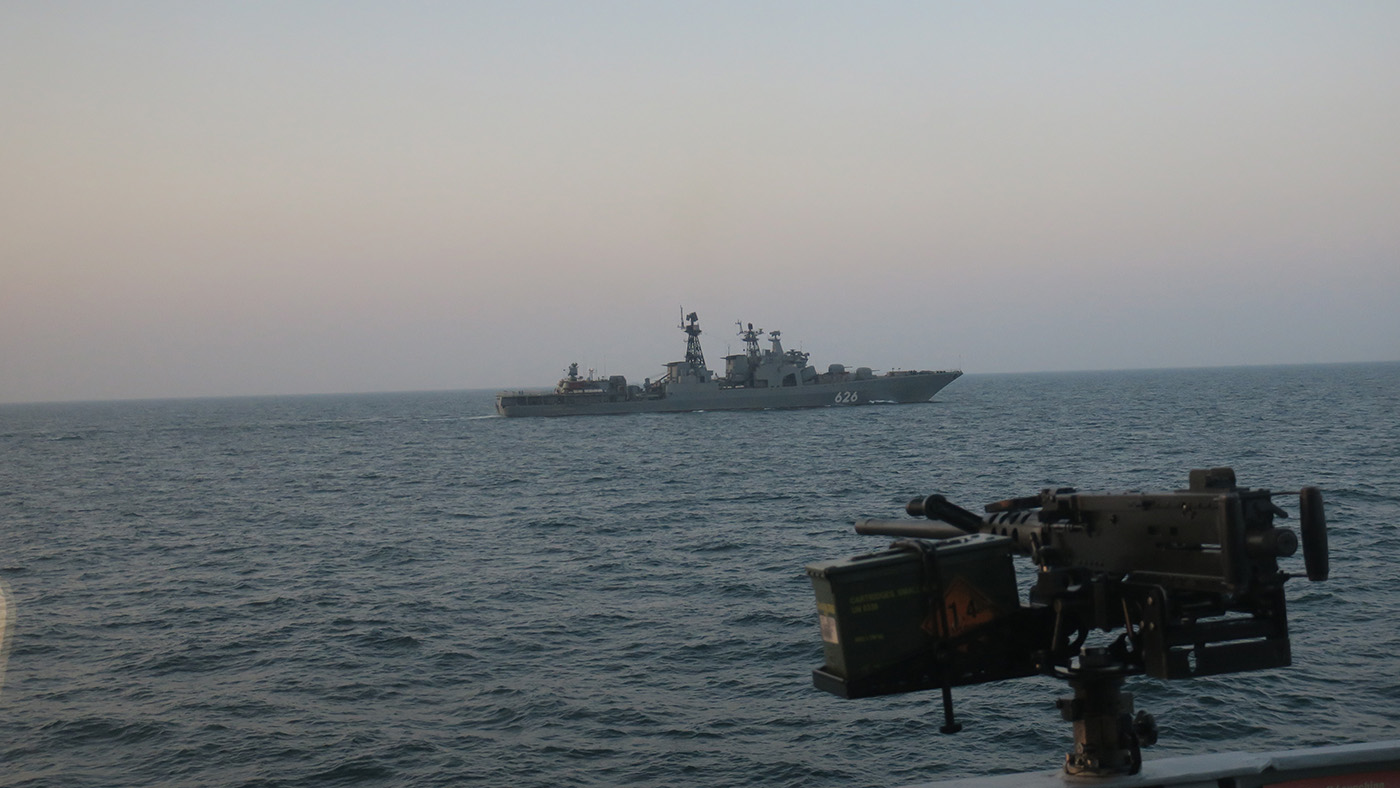
Russia’s disappearance from the Mediterranean shows a navy stretched considerably thinner than its paper strength suggests, but the ships it does have remain dangerous and well handled, a naval analyst has told the UK Defence Journal.
Tom Sharpe, ex-navy Commander and Daily Telegraph columnist, who wrote about the Russian retreat from Tartus in December 2024, was responding to our report that a NATO official had confirmed Russia has had no sustained naval presence in the Mediterranean since June, the first time in ten years.
He told me: “Russia is clearly stretched thin. Their loss of the Med as a base shows this. But what they do have still has teeth, and some of it is well run. As their war in Ukraine goes from bad to worse, we are entering a worrying period, just at the time when our ability to counter or deter is equally low. Any sense that the new Prime Minister, Chancellor or Defence Secretary was going to inject funds to help reverse this are fading by the day.”
NATO outnumbers Russia at sea as Mediterranean presence ends
Terminal decline
On the Mediterranean itself, he said previously that the position had been in terminal decline since the loss of Tartus, and that while there had been talk of Russia using ports in Libya, he was not convinced any of them were suitable for long-term logistics support. Russia has recently been reduced to refuelling from a repair ship, a vessel built as a floating workshop rather than a tanker and carrying none of the equipment needed to pass fuel safely between two moving hulls.
NATO Maritime Command has meanwhile continued to draw attention to Russian movements through the region, making a distinction between vessels transiting the Mediterranean and the permanent or sustained presence Russia previously maintained there. In a message issued on Thursday, MARCOM stated: “We. Are. Watching. From the #BalticSea to the #Mediterranean, #NATO maintains constant vigilance at sea.”
It added: “#SNMG2 contributes to this maritime picture, monitoring Russian vessels transiting through the Med. We’re keeping a close watch across the Euro-Atlantic. From north to south, NATO’s maritime forces remain alert 24/7.”





I think people forget the northern fleet only has about 5 large combatant’s.. the Baltic fleet is mainly small combatants, the Black Sea fleet again is about five but it’s locked away and the pacific fleet has about another 5 but is to far to matter much..
The problem is their submarines and given the state of our T23s – let alone numbers, only the P8s are our only offensive capability. And they are stretched thin – bring on the T26s but then they are replacing the T22s and 16 T23s; far too often we forget about the T22s and the Invincibles that sailed to support them.
Russian subs are marauding around the UK and we have no counter given the limited number of P8s; those subs could launch both nuclear or conventional weapons on the UK and as Keir Giles demonstrated on the Channel 4($) documentary, Russia would win.
If Russian subs attacked the UK with conventional or nuclear weapons, NATO would declare Article 5. Russia would lose.
But again this is a far far smaller fleet than most realise.. Russia has 5 modern SSNs in service ( 3 northern fleet 2 pacific), about 5 Akula class in service ( which were not up to a trafalgar class and built in early to late 90s ) again split between the northern fleet Pacific and about 3-4 even older boats ( victor3s and oscar2s that were essentially lesser to the old swifsure class) that are essentially battling on from the early 90s..
What it shows is the pressure Even a small number of SSNs can have … but it’s a whole different level of pressure needed to actually beat a country into losing.
Judging by the state of their surface fleet, I can’t imagine boat availability is great either. I know they are flippant about nuclear safety, but they also lost the Kursk within recent memory, which may limit their risk appetite a bit in terms of condition & maintenance. And Ukraine is consuming most of their defence budget and manpower – Russian sailors have even been sent to die en-masse on infantry assaults.