


The NATO Secretary General Mark Rutte has rejected the suggestion that recent United States changes to the alliance’s force model mean Washington is stepping back from its allies, casting the move instead as Europe and Canada carrying a fairer share of the burden, the alliance has said.
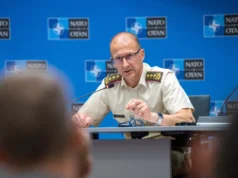
Speaking in Brussels on Wednesday, ahead of a meeting of NATO defence ministers the following day, Rutte turned to news of “the US adjusting its contributions to the NATO Force Model”, which he said had in some quarters “been cast as a problem, as the US pulling away from its Allies”. “But that is not the reality,” he said.
The United States, Rutte said, “has made clear that it is committed to NATO”, but that commitment came with “an expectation that Allies will more fairly share the responsibility” for European security. Washington had “made clear that the US nuclear deterrent is solid”, he said, while stressing it was “crucial that Europe and Canada do more on the conventional front”, understanding that the United States “has obligations around the globe that it needs to account for”.
The change, Rutte stressed, was “not primarily about where forces and assets are currently”, but rather “about who would do what if our defence plans were activated”, a division of labour he said had “historically” been “overly reliant on the US”. With other allies now stepping up to contribute more, he called the result fair and a sign of what he termed NATO 3.0, “a stronger Europe in a stronger NATO”.
The framing matters because the scale and posture of the US commitment to European defence has been one of the most anxious questions hanging over the alliance, with repeated signals from Washington about rebalancing its global force laydown prompting concern in European capitals over how much of the continent’s defence they will have to provide themselves. Rutte presented the adjustment as managed and mutually agreed, describing it as a sign of “better burden sharing” rather than a unilateral American drawdown.
The message lands on a United Kingdom still working out how to present its own contribution, with the government having committed to publishing its Defence Investment Plan before the summit.







I’ve gained $17,240 only within four weeks by comfortably working part-time from home. Immediately when I had lost my last business, I was very troubled and thankfully I’ve located this project now in this way I’m in a position to receive thousand USD directly from home. Each individual certainly can do this easy work & make more greenbacks online by visiting
following website—.,.,.,.,.—>>> JobatHome1.Com
He would say that though wouldn’t he. At this stage I think Mark Rutte is just damaging NATO’s reputation by continuing to suck up to Trump in the most embarrassing ways.
Interesting now that Americas greatest ally Israel has also been cast aside. If it wasn’t for all the damage that these two countries have caused to the world it would almost be funny to watch.
China has missed a golden opportunity to step up and replace the US in the Middle East however the complete lack of any Chinese presence in the region, diplomatic or military appears to show that China itself is in an incredible weak position.