

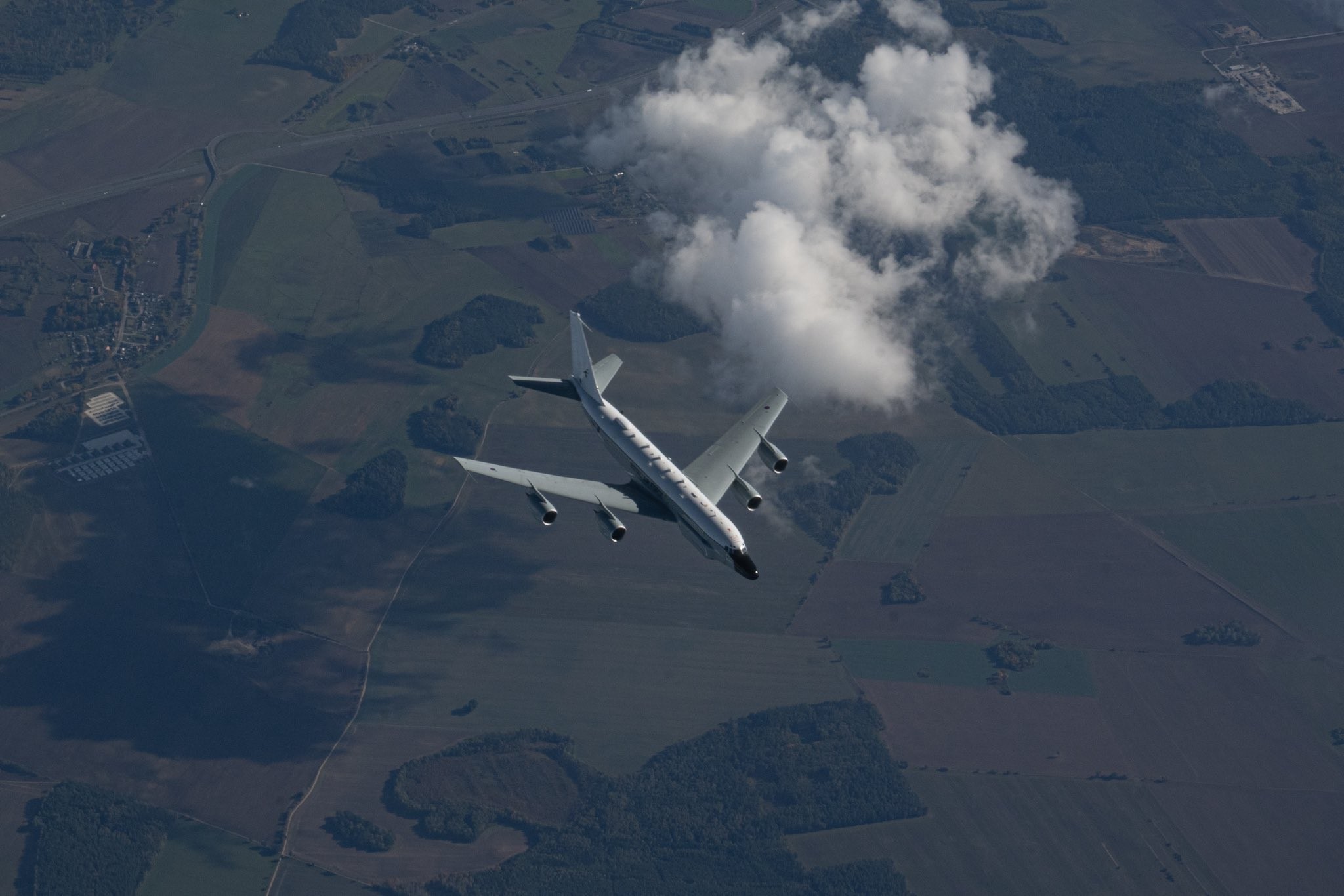
Two RC-135W Rivet Joint surveillance aircraft, at least two P-8A Poseidons and American tanker support are operating across the High North in a concentration of intelligence-gathering flights rare in both scale and composition, according to open-source tracking.
The account DefenceGeek, run by one of our team members Jon, logged the aircraft operating from the United Kingdom and Iceland, watching across the border into Russia. Among them were the Royal Air Force Rivet Joint ZZ666 using the callsign ASCOT 7202, an American RC-135W as JAKE 17, and a KC-135R tanker as RAKE 67 providing refuelling.
A United States Air Force Rivet Joint is operating within the European Command area for the first time in a while, flying near Russia’s naval base complex at Murmansk. It is likely to be operating with fighter escort given an active tanker bridge in the area. A second Rivet Joint, this one British, was tracked along the border between Russia and Finland, with a Poseidon monitoring the Baltic at low altitude. American Rivet Joint aircraft have concentrated elsewhere in recent years, which is what makes an appearance over the Barents notable.
NATO Eyes on Russia Continues
Two RC-135 “Rivet Joint” SIGINT platforms and at least 2 P-8A “Poseidon” aircraft are operating out of the UK & Iceland today in the high north, watching across the border into Russia, supported by US tankers:
🇬🇧 RC-135W “ASCOT7202” ZZ666 #43C39D… pic.twitter.com/dqKU3KIQuv
— DefenceGeek 🇬🇧 (@DefenceGeek) September 2, 2026
What they are looking at
Murmansk and the wider Kola Peninsula hold the Russian Northern Fleet, including the ballistic missile submarines that carry the sea-based portion of the Russian deterrent, along with the attack boats that transit south into the Atlantic. It is the single most concentrated collection of Russian naval power anywhere, and the point from which any submarine deployment towards the Greenland, Iceland and United Kingdom gap begins.
The RC-135W does not take photographs, no, it is an electronic surveillance aircraft, and its crews survey the electromagnetic spectrum to collect communications, radar emissions and other signals, building a picture of what is switched on, where it is, and how it behaves. Flying a track along a border allows the aircraft to map air defence radars and communications networks without entering the airspace they cover.
The P-8A Poseidon does a different job, of course. It hunts submarines, using sonobuoys dropped into the water and its own radar and acoustic processing, and the Royal Air Force operates nine of them from RAF Lossiemouth in Moray. A Poseidon working the Baltic at low altitude is looking at what is on and under the surface.
Britain operates three Rivet Joints from RAF Waddington in Lincolnshire, converted from KC-135 airframes under a co-operative programme with the United States Air Force, which flies a larger fleet of the type from Offutt Air Force Base in Nebraska.
The flights come at the end of a fortnight of unusually heavy allied air activity along the Russian frontier. Around 25 aircraft from several nations operated over the Baltic region on 18 August in a package overseen by the United States, including an EA-37B Compass Call electronic attack aircraft and an ARTEMIS II intelligence platform, with further flights on the two days following. NATO E-3A Sentry aircraft and Multinational MRTT Fleet tankers have been operating over Lithuania and Poland since.
Germany formally attributed the attempted drone attack on Leipzig/Halle Airport to Russian intelligence on Tuesday, announcing the closure of the Russian consulate in Bonn along with new sanctions and entry restrictions, in a step Estonia’s prime minister described as Russia taking its hybrid attacks in Europe to a new and dangerous level.
Surveillance flights of this kind are deliberately visible, as readers will know. Aircraft on these missions generally transmit, and their tracks appear on civilian monitoring platforms, which is a choice rather than an oversight.
The Russian Navy has meanwhile had no presence in the Mediterranean since June, with a NATO official telling us last week that allied warships outnumber Russian vessels in European waters by roughly three to one.
Neither the Ministry of Defence nor United States Air Forces in Europe comments on individual intelligence, surveillance and reconnaissance sorties.








Also worth noting the Norwegian’s have lifted self-imposed restrictions on surveillance flights. Norwegian P8s flew with RAF RC-135s a few days ago up there as well.
I don’t think I would consider 4 to be much of a ‘swarm’…
We are frequently warned of the possibility of a Putin move against or to split off the Baltic states by seizing the Suwalki Gap between Poland and Lithuanian.
One small problem for Putin. Poland, even on its own, is not the push over it was in 1939. Everyday Poland is becoming stronger. Also, it is now a cornerstone of NATO. Ignoring the actual capabilities of the Russian Army, theoretically, if Poland falls, the route to the North Sea becomes a possibility. Having said that, NATO could absorb the loss of Poland, but would have to defend Germany with every weapon it had in theatre.
So, an attack on the Suwalki Gap carriers a lot of risk for Putin, and little strategic reward.
A thrust across the Arctic tundra, across the top of Finland, Sweden, Norway to my mind is however far more attractive. Russian military infrastructure on the Kola Peninsular is far more capable of supporting such a thrust. NATO has much less in comparison. The Royal Marines are tasked with defending Northern Norway but they are a shadow of what they were in the Cold War.
It is almost certain that NO American President, especially this one, would go nuclear to halt a Russian thrust across the tundra. But capture of this region would be an enormous strategic prize for Russia as competition for control of the Arctic ocean becomes more Globally significant. Spitzbergen would probably be next on the list.
Aren’t these scenarios at least part of the rationale for the formation of the JEF? Presumably, Astute class will ultimately be able to iassist in interdiction of Orcs in the northern scenario, once maintenance issues resolved?
… assist …🙄