

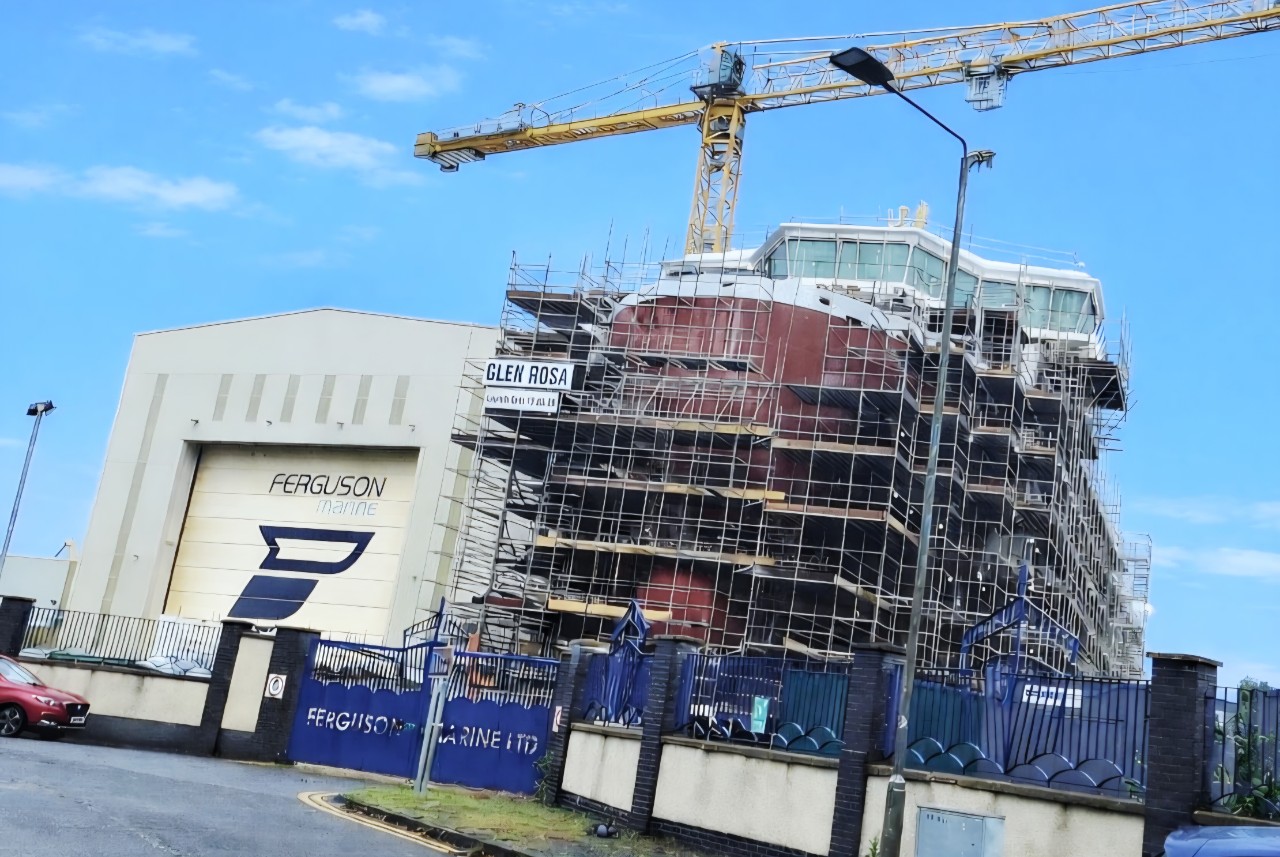
Ferguson Marine has outlined a series of operational, management and infrastructure changes aimed at stabilising the Port Glasgow shipyard and improving the delivery of future vessel programmes.
Appearing before Holyrood’s Net Zero, Energy and Transport Committee, the yard’s leadership described a programme of reforms introduced over the past year, alongside plans to modernise equipment and production processes after years of disruption surrounding the MV Glen Sannox and MV Glen Rosa builds.
Chair Duncan Anderson said the yard is attempting to move away from practices that contributed to earlier delays and inefficiencies.
“With an effective modernisation programme and improved build processes, it could be a leader in the industry,” he told MSPs.
He said many of the challenges now being addressed stem from historic shipbuilding methods and poor sequencing of work.
“The past management of vessel construction has involved mistakes, largely due to the use over several decades of poor or outdated shipbuilding techniques,” Anderson said.
He added that “the governance and management of those workers’ tasks have been very poor indeed” and that poor sequencing meant “it appears that we have built the ships twice.”
According to Anderson, the current leadership team is attempting to dismantle those practices and introduce clearer production processes for the workforce.
“We seek to dismantle those poor practices and implement new ones, while keeping the processes and tasks clear for the workforce,” he said.
He said improvements were already visible since the appointment of a new management team.
“With the appointment of a new senior management team, I have seen considerable changes in the yard and much improvement,” Anderson told the committee.
Chief executive Graeme Thomson then outlined a number of operational changes introduced since he took up the role roughly ten months ago, particularly around programme management and project oversight.
“We have now implemented a much more robust planning process,” he said.
A central element of that reform has been the creation of a programme management office, which previously did not exist within the organisation.
“I have established a programme management office, which did not exist previously, and we have brought our own planners into that,” Thomson explained.
Historically, planning had been largely handled by subcontractors. The yard has now recruited internal planners, project controllers and project managers to improve oversight of schedules and cost performance.
The new structure includes a general manager for programme management and a ship delivery director responsible for overseeing the execution of major projects.
“We have also brought in a general manager programme… and a ship delivery director to manage the execution of Glen Rosa,” Thomson said.
The shipyard has also introduced new project management tools and controls. These include the adoption of the Primavera planning system, the introduction of formal risk management processes and the use of earned value management to track cost and schedule performance.
“We have driven hard the adoption of a common project management planning tool called Primavera,” Thomson said.
He added: “We have also implemented a robust risk management process… and we have a risk engineer to support us in developing a comprehensive risk register.”
The company has also changed how responsibility is distributed across the workforce. Managers and supervisors are now assigned control accounts, meaning they are directly responsible for understanding the scope, budget and schedule of the work they oversee.
“We have broken that down into the schedule by establishing that everyone is a control account manager,” Thomson said.
“People in the organisation understand… the scope, risk, schedule, resources, budget and time available for their work and understand that they will be held accountable for their performance.”
Asked by MSP Kevin Stewart whether project management had been a weakness in the past, Thomson replied frankly: “Yes.”
Beyond management reforms, Ferguson Marine is also preparing for upgrades to the physical infrastructure of the yard through a £14.2 million capital investment programme backed by the Scottish Government.
Chief financial officer David Dishon said the funding would allow the yard to replace obsolete equipment, repair machinery and introduce more modern production capability.
The investment includes the installation of a semi-automated panel line used to fabricate large steel sections for ship hulls.
“One of the items is a semi-automated 13m panel line,” Dishon said.
The system would automate parts of the plate processing and welding process, allowing steel panels to be assembled more efficiently before being incorporated into larger ship sections.
“It will allow us to be more productive—our man hours per tonne will reduce significantly and there will be a 50 per cent productivity increase,” he said.
Thomson explained that the equipment would automate the preparation of large plates, including fitting stiffeners, welding and cutting penetrations, so that sections can move directly into unit assembly.
However, the investment programme has moved slowly so far due to legal and financial due-diligence requirements linked to public funding. Around £570,000 has been spent to date, largely on safety-related or obsolete equipment.
Dishon said the remainder of the investment is now expected to move ahead as the yard prepares for potential future vessel work.
“The £14.2 million spend has been fully mapped out, and we will be starting that work very shortly,” he said.
The investment is intended to bring the yard closer to the level of ongoing capital expenditure typically seen in commercial shipyards.
According to Dishon, modern shipyards usually invest between £1 million and £2 million per year in equipment upgrades.
“The £14.2 million will be phase one,” he said, adding that continued annual investment would be required to keep the yard competitive.
Alongside equipment upgrades, the company is also examining ways to improve the physical layout of the site to create a more efficient production flow.
Thomson told MSPs the yard’s footprint had developed organically over decades and now required optimisation.
“We will look at how to optimise space so that there is a proper production flow that makes best use of it,” he said.
The company is also exploring potential expansion options around the Port Glasgow site or nearby facilities if future work increases demand.
The reforms outlined to the committee suggest Ferguson Marine is attempting a broad operational reset, combining new management systems, upgraded infrastructure and revised production practices.










Hope it does well,
It is almost unbelievable that there was no formal project management in place.
Likewise. One thing I missed was any reference to Union activity, not that I have any knowledge of its history in that yard. Perhaps they have finally learned that you have to bake the cake before you can slice it up?
Actually genuinely good news. Actual numbers given, proper plan made, in house planning instead of the constant British theme of subcontracting everything then wondering why it’s all more expensive