

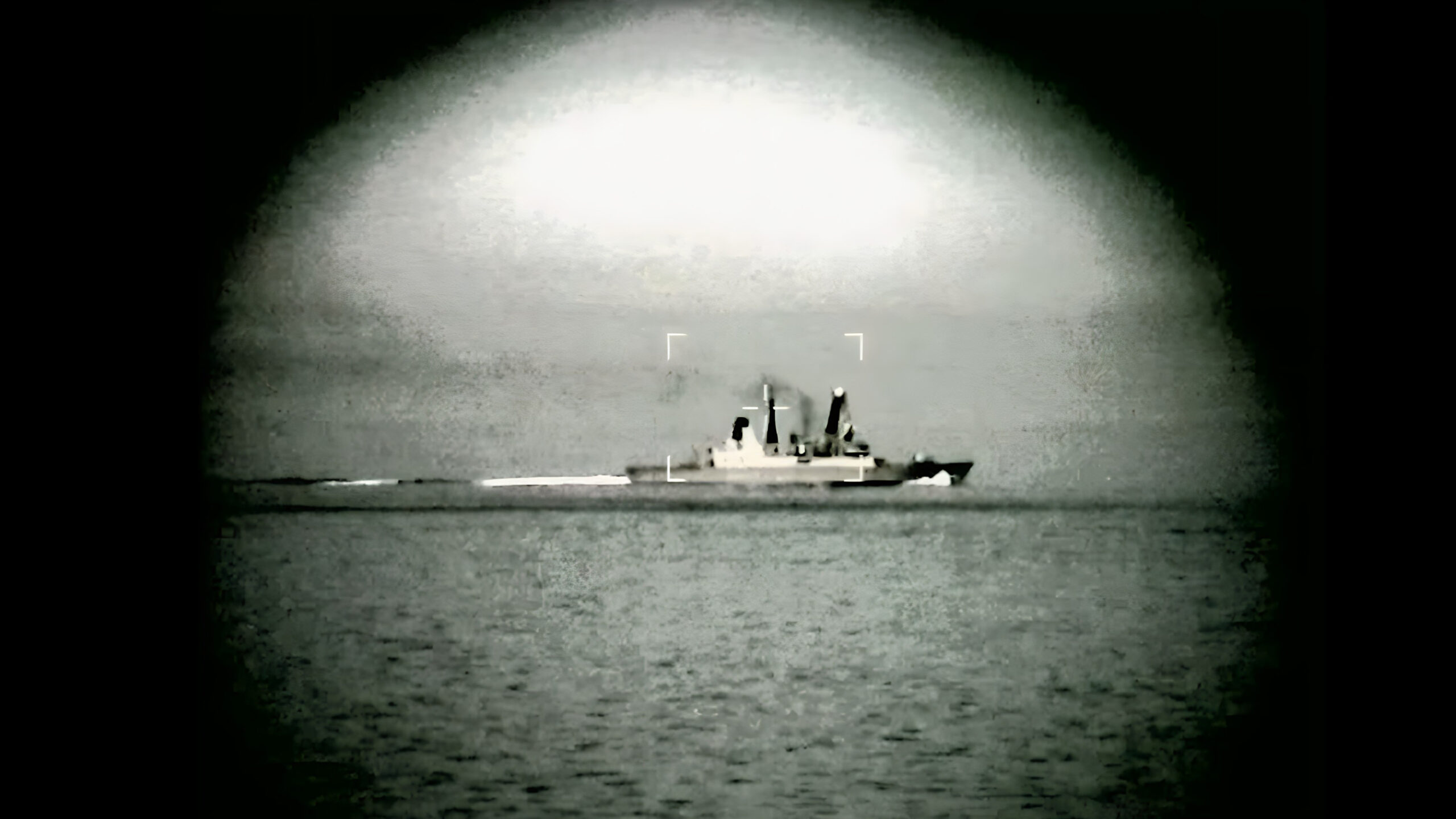
The Ministry of Defence has left open the possibility of extending the life of the Royal Navy’s Type 45 destroyers, saying detailed transition planning will determine whether an extension is implemented and that a final decision is not expected until 2027-28.
The position came in a written parliamentary answer from Minister for Defence Readiness and Industry Luke Pollard on 10 July, responding to Andrew Bowie, the Conservative MP for West Aberdeenshire and Kincardine, who asked whether an assessment has been made of the potential risks in maritime air defence capability as the Type 45s approach retirement without a replacement.
“The role of Maritime Air Defence, currently delivered by Type 45 Destroyers, will be delivered in the future by a mix of crewed Common Combat Vessels and uncrewed, autonomous missile (Type 91) and sensor (Type 94) ships,” Pollard said. “The decision to move to this hybrid approach was taken after detailed analysis of current and future threats, including lessons from ongoing conflicts. The specific analysis is necessarily classified, but the mix of crewed and uncrewed systems will produce a more flexible force, with greater missile capacity while also improving mass.” He added: “Detailed planning for the transition between Type 45 and the Hybrid Navy Maritime Air Defence capability will be undertaken in consultation with industry, which will determine whether a Type 45 extension is implemented. A final decision is not expected until 2027-28.”
The language is a big shift from the position set out when the Defence Investment Plan was published, when a senior defence official said the six destroyers would leave service from 2035 without life extension, with the plan timing the arrival of the Common Combat Vessels to their out-of-service dates. The answer now makes an extension an open question to be settled through transition planning with industry, and in doing so it acknowledges the risk Bowie’s question probes, since the destroyers begin retiring in the mid-2030s whether or not their successors are ready, and the seam between the two fleets is precisely what the planning must manage. A prototype Type 91 uncrewed missile platform is intended to be in service by 2030, with no service entry date yet set for the class, while the Common Combat Vessel remains in its early design stages with hull form options still being explored.
The answer also gives justification yet for cancelling the Type 83 destroyer, the ship once intended to succeed the Type 45. “The alternative, an expensive, exquisite platform such as the Type 83, would have resulted in too few ships to cover all the Royal Navy’s tasks, increasing risk,” Pollard said, an argument that echoes evidence given to the Defence Committee this week by Strategic Defence Review author General Sir Richard Barrons, who described the Type 45 as likely to prove the last of its kind and defended the shift of resources towards systems that deliver mass. The department told Parliament separately on the same day that the Type 83 was an early-stage concept on which no build decisions had been made.
The Type 45s are themselves mid-way through significant upgrades, with the Sea Viper Evolution programme improving their capability against ballistic missiles and all six ships receiving power and propulsion fixes, investments that would carry additional value should an extension be chosen. The answer does not say what an extension would involve, how many of the six ships it might cover, or what conditions would trigger it, with those questions now folded into the transition planning running to the 2027-28 decision point.




Seems reasonable. Why does it take a further 2 years to make a decision, though?
I suspect they are waiting to see how the CCV and the Type 94 and Type 91 concept works out.
It makes a lot of sense to keep T45 as long as possible or until we have confidence in the new systems. The platform has loads of life in it and could even have a radar upgrade that would keep it relevant for decades to come.
The R.N. is going to be in an awful lot of trouble if the concept doesn’t work out. Pioneering a completely new system is great, but given our track record over the last thirty years…?
apologies for going off subject , but, could the sloop be considered to be built from a reinforced polymer? as is used in the construction of the visby corvette superstructure FRP, like our drone fleet it could be the future. it is lighter, non corrosive, non conductive has a highter weight to strength tensile strenghth than steel. its also more workable.maybe another area that the u.k could exploit.
This means that the Type CCV just got postponed to 10 years later… albeit that is more realistic for tech maturity,
An issue for CCV ship is they are too few and controlling AAW, ASuW and ASW can be conflicted.
I’m sure the experts will be figuring it all out.
I presume you mean Type 83 being postponed ?
CCV is coming in 2030’ish no matter what and looks to basically be a T31 Batch 2 for drone control.
CCV is being said to replace the T45, If T45 is extended than CCV might get delayed.
I honestly think the CCV is a bit of shady compromise.. the RN probably has little or no interest in replacing its AAW destroyers with anything other than AAW destroyers.. it just knows
1) it can keep its T45s running into the mid to late 40s..
2) we will be spending 3.5% gdp by 2035 so it can get a nice new AAW destroyer ordered then.
And it also wanted some more escorts build in the early 2030 so we have the CCV a dice roll game with the treasury
So the CCV is the type 32?
Depends what on it… At the moment it seems to have replaced the T83 and the T32 has been allowed to die on the vine. My guess is that they are hoping to get a T83 capability with a low(ish) cost ship the size of T32, but carrying sensors and coms kit to allow it to control and/or direct drones. The trouble is the CCV could be anything, a Destroyer, ASW Frigate or GP Frigate or even a Patrol Ship given that PODS and Drones are developing at such a rate. All future escorts could be CCV’s some day or not as the case turns out, and therein lies the jeopardy.
Cheers CR
Quite possibly the CCVs will start to enter service while the T45s remain. For starters, they need to prove both a new class and a new concept of operations, but also the Norwegian T26 order could see the RN getting its final units much later than originally planned, leading to a hull gap retaining T45s could mitigate
a properly configured ccv might be an ideal falklands guardship controlled from the canteen in the mount pleasant base.
All the drone ships are currently ideas, not even really at the point of design. It’s a huge gamble and I suspect the MOD realise their time frames are hugely optimistic due to the above plus high chance of political interference /different ideas should a new government replace labour in 3 years, which seems likely currently. Capability holidays have become the norm but not sure any government would get away with a complete naval capability holiday with no ships existing.
It will have to if only to cover up the folly of all the hybrid navy shit which will finish off the navy altogether. The technology to deliver the fantasy fleet doesn’t exist yet
What pennant will these toys carry?
J = joystick?
e=experiment. i hope they carry names and count in the main front line fleet directory.
Because they have time mate.. these ships are nowhere need expiration date and will have all been fully updated by 2032. It’s not really even an active decision to keep them running, the active decision would be the decommissioning process..
Plonk a Samson on the carriers
We plan to have a load more tech in the pipeline relatively soon.
Once timelines are established and an understanding of when this new tech might start to take over from the T45 might decide exactly when T45 will become redundant and/or it might have an alternative purpose.
Is it sensible to have sensor ships seperate to missile ships?
Anyway, in futue a CSG will need three ships to do the bare minimum AD with no redundancy – a crewed Common Combat Vessel and uncrewed, autonomous missile (Type 91) and sensor (Type 94) ships…instead of a single ship (T45).
I hope the availability of each type is super-high!
It is if you want to make the ship smaller and more numerous. I suspect that’s what they have split the type 91 into two vessels now. The type 94 can spread out over a wider range while the type 91 with the expensive missiles stay close into to the task force and the command ship.
It also means you can rotate type 91 back to shore to be reloaded and not loose a radar sensor in the task force.
The tech for all of the whole folly doesn’t exist yet I hope, but doubt I’ll still be around for reminding everyone that ‘ I told you that it was utter pants. and demanded that all those responsible are made to walk a short plank.
You will however lose the Type 91 whilst it’s rotating because it has no sensors to defend itself from any attack.
The issue is that a 10000t cruiser would have much more power available for radars than an eventual 2000t T94. Also keep in mind that the T94 will need radars in various frequencies. splitting the power even more.
And we would have zero redundancy if something happened to a T45.
It might be a bit second tier but they could improve the AAW abilities of the current T31s and build a few more for a 20+fleet. Drones ships may well protect their motherships and simultaneously even advertise their presence.
Will this ‘navy’ be operated by a spotty gamer with a keyboard and joystick in a portakabin in the MOD carol? Only five type 31 was a ridiculous idea
Agree . I had high hopes that the one bit of good news to come out of DIP would be three more T31 to make a class of eight and more balance the force with T26 . Whilst some on here might rightly criticise the production process the fact is Babcock are popping out T31 at a much faster rate than T26 and tomme this has got to be the fastest ( and most cost effective) way to grow the fleet . DIP did finally seem to confirm that all T31 will get MK41 and by all accounts 32 cells as well as NSM. This will make them very capable surface combatants with the ability to act as magazine/arsenal ships for T45 in the AAW role if Aster 30 can be carried too. Plus is it is a large proven and capable hull, it exists now and should be more than able to double ( triple? ) hat as a mothership for sea drones, UCSV or whatever if required. To me all this talk of fantasy fleets and hybrid navies with large completely unmanned monstrosities bobbing around in the north Atlantic is a distraction we don’t need just now . What we do need as proven by the Dragon fiasco is more hulls in the water now and a balanced fleet of 6 x T45 8 x T26 and 8 x T31 plus OPV whatever is well within our means and what we need urgently to meet the tasks and threats we have today. Hurrrumpth! 🇬🇧👎🏴
To be honest I bet the common combat vessel is essentially a T31 with a bit more focus on AAW and some drone control
And tender related stuff.
In the end Babcock are going to build the Ship and what they have is the arrowhead 140… they need a new hull laid down in 2030 as from present schedule bulldog will be launched in 2029… so there is not long to develop and agree the design.. which means an adaptation of the arrowhead 140…
In reality the common combat vessel is going to be a T31 batch 2….
Morning Jonathan, I totally agree, there simply isn’t any choice.
It will be a T31 batch 2. They might possibly reconfigure the mission bay area, if more space was needed to pour the necessary drone control magic source.
I reckon The smart thing is to build 6 new T45’s with mods as required. Strip out the old ones reuse parts, install the T26 engine arrangement. You know the one with the newly german owned gearbox.
Evening Jonno, the problem with T45 is that it’s a large crew reliant 1990’s design.
I would suspect the replacements will be T31 based, probably still heavily armed, the T31 having the real estate for missile silos and guns, with a crew half that of a T45.
Hopefully the worst of the RNs crewing issues will be behind it now, the T26 and T31s having much smaller crews than the outgoing T23s and the crewing numbers beginning to edge in the right direction again.
Once sailors can actually go sailing again crewing will fix itself much quicker as well.
Rrconfigure T26 to a destroyedet giving us more than one six Existing T45.
Yes but they say the T26 hull is too fancy and not stable enough for a destroyer. With CAD I would have thought they could redesign out that problem double quick.
We cant go on with our division of escorts into ASW and AA can we?
The japanese Mogamis seema very good GP Frigates which could improve.
Personally I think its all about BAE cost gouging and the Treasury interfering as they have done for over 100 years. Churchill had this problem in 1940 when the Treasury blocked the Lions.
You should see what “spotty gamers” with keyboards and joysticks are achieving in Ukraine. They are the deadliest force on the battlefield bar none.
e=experiment. i hope they carry names and count in the main front line fleet directory.and we can get the fleet up to 30.
saw a design for an arrowhead 120 th other day tentatively described as a river class datch 3 design looked a tidy ctheT26 is big enough to be called a cruiseroncept.or even maybe a type 32.
Could easily be done by upgrading the CAAM to the latest MR model
In reality the common combat ship is going to have a not unreasonable AAW capability all of its own anyway.
We don’t even know how many missles the Type 91 will carry. If its 32 Asters, then you’ll probably want 4-6 Type 91s, which would be the equivalent to 2-3 Darings. And, you’ll probably want 2 Type 94s just for simple redundancy. At the same time, you’ll want a few Type 93 ASW along as well.
We need to also remember the Type 45 carries the fewest VLS per tonne of any modern destroyer.
It should have been rocking 72 large VLS cells initially.
We can’t just match or slightly surpass the VLS count. We need to be aiming for a minimum of 96 per system with hopefully 128.
Sensors might well end up in some form of lightweight aerial drone which solves the height issue. Missiles could be put in quite small vessels with maybe only 4-6 missiles at a time. Not quite sure exactly where they are with the planning or design here. My guess would be they haven’t got much further than the back of a fag packet (or post-it note as the modern equivalent).
TECHNICAL REALITY DEAD AHEAD!
HARD APORT!
Didn’t a few people bet a tenner on this? lol
👍
This is why we should have a Like button.
Extending them at least 5 years ideally more would seem a no brainer? After all of the money spent upgrading the propulsion and combat capabilities it would seem such a waste to get rid of them without extension. I would also imagine there’s plenty of hull life left since some of them have been inactive for a long time.
10 years alongside in some cases.
Alas, we’re now in a buggers muddle having fitted a ‘cheap quick fix’ mushroom farm in the space 16 Mk41 VLS cells – proper land attack or ABM capable missiles – were meant to be fitted.
Hopefully we’ll see the pointless 4.5” gun finally binned and replaced with a 57mm Bofors
I honestly don’t know why they did not do this as a priority.. essentially once the T23s are gone ( by 2030 probably) they could have binned an the entire 4.5in gun system, all its training and logistics and support pipelines, that’s a lot of ongoing budget saved… it would also improve the T45s anti air capability.
Here you make the mistake of thinking that the CAPEX budget could wear the extra.
There is no shortage of 4.5” spares.
Risk problem is integrating 57mm into T45 CMS.
4.5 has no anti air mode or AA natures.
Integrating Mk110 57mm gun onto T45 is literally little more than plug and play
It really isn’t plug’n’play.
57mm isn’t integrated into BAE CMS.
It will have to if only to cover up the folly of all the hybrid navy shit which will finish off the navy altogether. The technology to deliver the fantasy fleet doesn’t exist yet the royal navy should have no less than a 25 ship front line that must be within a 48bhour readiness. So reliability is vastly better than it is currently will these nee unmanned ships have names and a new prefix like T for toy.
Ah yes but the Treasury will say no, sell them to Brazil or Argentina.
Reading between the lines, funding of Type 83 ceases. So, that’s a bit more cash, today. The remainder of this Parliament will be taken-up scoping-out the Type 94 and realising it can’t be done. So, the next Government has to resurrect something that looks like a Type 83 but with fewer missiles cells as the Type 91 is feasible.
The Flight III Arleigh Burkes are over 9,500 tons. They’ve got SPY6 and Aegis 10. Those two pieces of kit need so much electrical power that the USN can’t put the HELIOS directed energy weapon on the Flight III ships as there’s not enough ‘spare’ power! Type 94 just won’t work with the current technology available….
The ability of these designs will evolve and the fact that they are unmanned will be less of an issue.
Who in their right mind would send an unmanned asset worth say 150 million GBP out into the Ocean. It could be boarded by Pirates or the enemy.
The first part is the give away. Those deciding this have no knowledge of naval matter, are penny counters that have seen “cheap drones” in Ukraine and just went with it.
Reading between the lines, funding of Type 83 ceases. So, that’s a bit more cash, today. The remainder of this Parliament will be taken-up scoping-out the Type 94 and realising it can’t be done. So, the next Government has to resurrect something that looks like a Type 83 but with fewer missiles cells as the Type 91 is feasible.
The Flight III Arleigh Burkes are over 9,500 tons. They’ve got SPY6 and Aegis 10. Those two pieces of kit need so much electrical power that the USN can’t put the HELIOS directed energy weapon on the Flight III ships as there’s not enough ‘spare’ power! Type 94 just won’t work with the current technology available….
To get the sort of power we need for these directed energy wunderwaffe that we are told is the future, you bed the power plant of CVF in a very large destroyer hull.
I think Dragonfire has a ‘flywheel’ to build and store power and even the nuclear reactors on the USS Ford can’t produce enough instantaneous power for EMALS so there’s a hefty storage and discharge subsystem.
One ‘shot’ for a directed energy weapon is easier than a series of shots in quick fire scenarios against a swarm of drones which seems to be the current thinking. However, a long range surveillance radar is always going to need quite a bit of available and continuous power. Tie that to a data centre sifting through millions of square metres of air space, simultaneously looking for ballistic missiles travelling at hypersonic speeds and sea skimming missiles and drones and you need an awfully big power supply.
Most people think @ 50MW of electrical power to feed to weapons and sensors is the right ball park to be aiming at.
And your only getting that from gas turbines and gas turbines are maintainer heavy.
The power supply issue on the flight 3 for HELIOS is a design issue, Helios does not have FESS… that’s its big issue.. Dragon fire as system has a FESS this essentially stabilities the draw on the ships power system and why T45 can take it.
The UK must be, and stay at the forefront of this technology and it’s a
With these drone ship’s if they come across maintains issues with Radar etc ? What then ,at least with a crewed vessels you can have hands on depending on the degree of the situation . The DIP may be out in the public domain so we know what the plan is but I fear in the departments of the MOD there is still arguments which is the right plan for the way forward .
I just dont see how these humanless ships will work they will need constant human maintenence especially after first year of use . They would have to be very cheap disposable ships and plenty of them to be viable i am currently thinking .
I’m pretty confident that we will see initially is the drone missile barges controlled from T45.
Then the radar barges feeding data to T45 – over the horizon and up threat.
So that’s Portsmouth and the Isle of Wight covered then.
Is Daring out yet ?
I wonder if any thought has been given to using the 45s as static missile defence around the UK after their sea-going life ends?
Anything coming to the UK from Russia is a MRBM – T45 cannot engage MRBMs
The LIFEX FOR TYPE 2E didn’t extend any of the ships much.
The Russian Black sea fleet, what’s left of it, has fired a lot of cruise missiles at Ukraine so, no, not everything will be MRBMs.
Ukraine is getting 95%+ shoot down rates against Russian cruise missiles
Will this ‘navy’ be operated by a spotty gamer with a keyboard and joystick in a portakabin in the MOD carol? Only five type 31 was a ridiculous idea how much money was spent on the thTproba83 project before the decision to bin it?
I meant car park not carol sorry
I can see them starting to quietly row back on the Type 83 decision. Leaving air defence entirely to drones is a massive risk. While I can see the scenario where the carrier has the big radar it is escorted by missile ships. I can also see instances where the ships will be operating alone or providing air defence to merchant men.
Having just watched the both excellent and frightening “ Undeclared war” it shows how vulnerable data links and computers are.
Uk carrier group is defended by a spotty kid in a broom cupboard in the first sea lords office it’s fantasy, pure folly and doomed to fail.
What will a u. K carried group look like? Toy ships with tog aircraft. Failure doomed
Interesting point of view
The plan to retire them by 2035 was completely unrealistic anyway. CCVs or not, they will have the same lifespan as the Italian and French Horizon destroyers which will be retired in the 2040s. These are ships that can easily last 35 years. It doesn’t make sense to replace them after only 25 years, especially since they’ve spend more time in maintenance than deployed.
Mmm this sounds to like a bit of a “hang on a second, this may be a great idea that ex used car salesman sold 1SL but what if it doesn’t work ?”
Or some bright spark asked the bloody obvious question “As we aren’t world leading on AI, Radar, Electronics or Missiles, why are the countries who are not doing this as well ?”.
South Korea, Japan, USN, Italy, France, China are all building bigger and more powerful AAW destroyers but slowly going towards a lean manned ship !
Maybe our Political and Military Leaders are just way smarter or we did a last minute rush job to placate NATO and avoid much immediate expenditure, knowing full well it will be another Party running the country come 2030 🧐
My bet is we see the T45s going through a Lifex refit after the present series is finished with upgrades to the Aster, S1850, Sampson and CMS possibly plus Leonardo Kronos S & X band AESA panels added (just like Italy and France).
I shudder at the idea of ships full of explosive Will be bobbing around the sea lanes with nobody driving them
The sensible thing is too keep T45 on and first connect the missile barges then the scout radar pickets to them.
Even if we ordered more T31+ today we wouldn’t see them fully in service till 2033 which doesn’t give much time to debug the new networked radar system for combat.
The DIP wasn’t really a plan at all, rather a list of vague intentions. Previous equipment plans have tried to calculate detailed expenditure over 10 years. The DIP covered 4, with anything beyond 2030 limited to vague aspirations. Overall, it was a rather pointless exercise.
It is highly likely that T45 will remain in service to 2040. Given the PIP is nearly complete, availability will be better than past years, with the addition of Sea Ceptor increasing effectiveness.
Droneships may work but if they fall short of the hopes placed on them, there will be time to reconsider the successor to T45.
I meant car park not carol sorry
It was always obvious that the drones would be delivered before the CCV and that the Type 45 would initially fill this role. It makes sense as it will better inform what the CCV needs to be.
How many times have I said this.. these T45s can easily run to the mid 45s without any intervention other than having an extra 5 year loyds Renewal Surveys, which they will pass due to how thick their hull plating was at build.. this is the process that always fucks the T23s because it’s a full survey of hull plate thickness.. and the T23s kept failing and needing massive hull work.
So the active decision is actually more about the choice of when to decommission not when will they be forced to decommission.. due to poor surveys.
I will bet good money the 6 common combatants will be run alongside a fleet of T45s until the mid 40s…
And let’s look at the recapitalisation and building plans
1) BAE will be busy to 2040 with T26s
2) Babcock will be busy with T31 and the common combat things till the late 2030s
3) Belfast now has 12 big ships to build.. so again late 2030s
But in the early mid 2040s what will need replacing ?
1) the patrol ship fleet so that’s Babcock sorted
2) the tanker fleet so that’s Belfast sorted
BAE will need a build programme or we repeat what we did in 2010… so I’m betting there will be a very high end essentially carrier escort AAW destroyer programme to take over T26 production in 2040.
We forget that this DIP was essentially what can be managed under 2.7% GDP.. the planning for 2035 comes under a 3.5% assumption.. and I bet the navies main aim for 2035 and its share will be AAW destroyers… I see a long game play with the common combat ships..
I will bet my arse the 2040 navy will have:
4-6 T45s
6 Common combat ships
5 T31s
8 T26s
Anyone with half a functioning brain can see that happening. Otherwise, what is the point in spending all this money to upgrade them in the first place? By enabling the Type 45s to truly reach their full potential, with hulls that still have years of life left in them, it sets them up to stay in service until the beginning of the 2040s. In any case, there is bound to be a drift in the design, development and construction timeline of the CCV.
Quelle surprise. More will follow as it unravels.
Just order 12+ T83s and be done with it!
.
.
It is complete lunacy to think these concept [They do not exist in detailed design] unarmed platforms can replace a fully manned warship.
.
.
While you are at it, order more T26, T31 or derivatives, since it is also complete lunacy to think [sic] 13 frigates are enough ASW or GP platforms for the UK now or into the future.
T26 is £680m for the latest batch, which is a bargain as far as these things go, remove the mission bay and add mk57 silos (which are updated mk41 – slightly bigger = more options) we really should be able to launch 1 per year if we wanted to, but need to commit. Added benefit is we get a known ASW hull form that can replace T45 as an AAW asset.
If we are going down the mothership route, we then need to take a good look at what an upgraded Karel doorman type ship could give us & commit to 10-12 of these, perhaps in 2 variants, amphibious & logistics.
A cross between the KD JLSS and Canadian G-LAM may be optimal, for me we don’t need ships that can land 2 chinooks at once as it’s unlikely to ever happen so some of the landing deck can be reclaimed for other needs. Mk57 VLS & the best radar going is the key.
We need to get a UK version of the San Antonio class with a cost ceiling of £600m per vessel, this may well be the vessel we need for the new joint amphib with 🇳🇱 but reality is we need more & we need them to be fully loaded as the will be targeted
Bargain? an obsolescent radar, no own torpedoes …are the towed sonar even new or picked from retired T23s?
Here again, the T31 has the space for a considerable missile load as it stands.
It would obviously require a more capable radar though.
The reality is, if you are trying to get the same radar capability out of a distributed network of radar picket drones, then they will need to be spread ‘widely’ to look over the horizon, in order to have the same effect as Sampson, elevated by the nature on a large T45 type hull platform.
Heres a hypothetical, what about a scenario where a task group is constrained by geological features and forced relatively close together?
Radar horizon would be significantly compromised.
Perhaps they are planning a radar array thats elevated on its own 21st century take on a barrage balloon??
A bit of realty really, as lets not forget UK Government assessment has stated there is the expectation that we along with NATO may be in conflict, with Russia by 2030. But fortunately the Labour DIP has ensured that we will get 1/3rd of what is required, by 2035. Lets hope the guys and gals going to war, (who most will become casualties), are excited that as they enter combat it will only be another 5 years until they are ready! Something to look forward too as they deploy i suppose!!!! Ah but who cares eh, as they mostly don’t vote labour and that’s probably 2 elections away, therefore the current Labour scrotes will be long gone once Burnham folds to the PLP just as Starmer did.
Relatively modern high-end naval assets good for at least another 10-15 years of service at a rock-bottom fire sale price are rarely available – except from the UK.
The likes of Brazil and Chile are probably already making enquiries as to when the first T45’s will become available – knowing that “from 2035” may well mean ships actually decommissioning several years earlier than that to avoid the cost of a final refit.
Brazil would also love a surplus Queen Elizabeth class carrier to replace NAM Atlântico (ex- HMS Ocean) when she reaches the expected end of her viable service life in the early 2030’s. DCNS once offered Brazil the French PA2 version of the QEC, but the new build price tag was just too high.
Of course they will have their life extended. Given the sclerotic state of defence procurement there is no way a new class could be inservice by 2035 if the decision to go ahead is taken in 2028. More like 2040 for the first in class!
If the T83 order was scrapped due to a lack of money, Then government should try outsourcing it to Korea—they might actually manage to get it built.
You couldn’t make it up.
DIP gets released. Seems to fail in most aspects in terms of increasing defence capability, if anything reducing it by announcing T45 to go.
During their time in office, no fewer than 9 RN ships have been retired without a single replacement being ready.
2 weeks later … U turn.
The arse has no clue as to what the elbow does, and vice-versa
I think we all know that we haven’t heard the last of the t45 life extension (lifext45) or indeed their Cancelled Replacment the t83….! We may yet see a number of returns to this subject in future ukdj articles..
the underlining problems of Cancelling both on cost grounds rather than operational needs remains..
Dispite the fanfare of t9Xs. Drones..!