

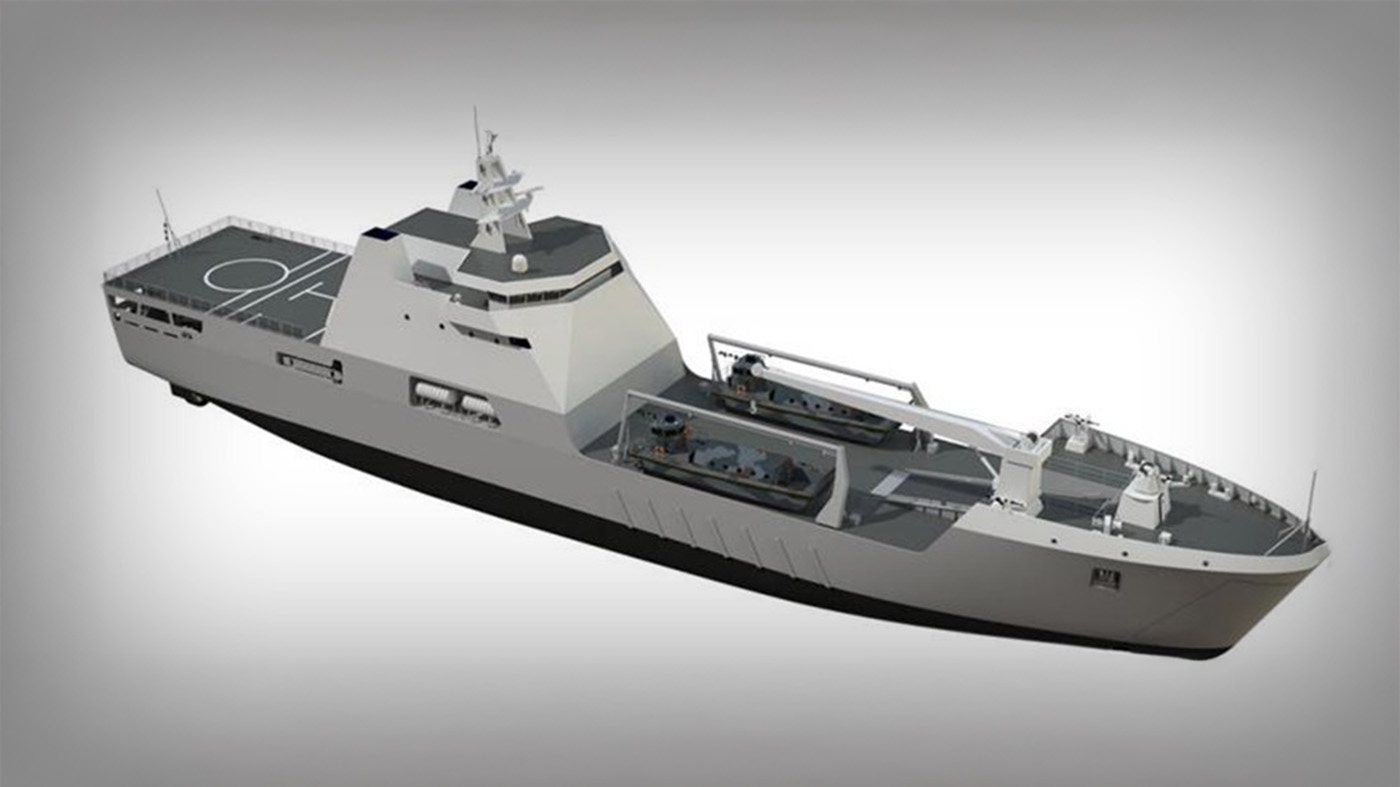
The U.S. Navy has issued a Request for Proposal for a Vessel Construction Manager to oversee the acquisition of its new Medium Landing Ship (LSM), with a contract award anticipated in mid-2026, the service stated.
According to U.S. Naval Sea Systems Command, the Vessel Construction Manager (VCM) approach is intended to make greater use of commercial shipbuilding practices in order to accelerate delivery timelines, improve cost discipline, and broaden participation across the U.S. shipbuilding industrial base.
Under the initial production plan, the Navy will direct the selected VCM to manage construction at two shipyards: Bollinger Shipyards and Fincantieri Marinette Marine. Bollinger was previously awarded a contract in September 2025 to support long lead time procurement and lead ship engineering design work, while Fincantieri is expected to build four ships under the programme. The Navy said the VCM will also have the ability to determine the best strategy for awarding the remaining three ships authorised under the base contract.
The Navy said the VCM will hold the prime contract and will issue and manage subcontracts directly with shipyards, placing the manager in direct contractual control of shipyard performance. The service stated this is expected to reduce cost and schedule risks when combined with a proven design.
Rear Adm. Brian Metcalf, programme executive officer for ships, said: “The VCM approach not only accelerates construction timelines but also strengthens our industrial base by engaging multiple shipyards.”
Metcalf added: “By providing a mature, ‘build-to-print’ design and empowering a VCM to manage production, we are streamlining oversight for this acquisition. This approach accelerates the timeline and strengthens our industrial base, ensuring we have the capacity and expertise needed for sustained maritime advantage.”
The Navy said the VCM will be responsible for managing the construction programme from design through vessel delivery and post-delivery support, while coordinating production across multiple shipyards in parallel with fewer Navy personnel than a traditional shipbuilding programme would typically require.
The service said it will provide a mature “build-to-print” design to reduce technical and schedule risks. In December 2025, the Navy and Marine Corps announced that Damen Naval’s LST 100 design would serve as the baseline for the Medium Landing Ship, describing it as a non-developmental platform intended to support rapid fielding.
According to the Navy, the Medium Landing Ship is intended to bridge a capability gap between smaller landing craft and larger amphibious warfare ships, supporting the movement and sustainment of Marine forces in littoral environments. The programme is planned to deliver a fleet of 35 ships in support of the Marine Corps’ distributed manoeuvre and logistics concept.




Australia is also building 8 of Landing Craft Heavy (LCH) also based on the same Damen LST 100 design but they will be operated by Army and not the RAN.
Contracts have been let under project LAND 8710 and construction is planned to start this year. Under the same project Austal are also building 18 Landing Craft Medium (LCM) capable of carrying payloads up to 90 tonnes over 2,000 nautical miles. LCMs are based on design by Australian company Birdon with builds starting in 2026.
Ideal for supporting operations in Norway
Meanwhile we in our wisdom are planning to get out of the amphib game all together leaving the Royal Marines stranded as a pretty much land bound force up in the high high north. 🇬🇧👎
I’m sure we can hire some civilian RORO to drop them off at port close to the Russians.. that would end well.
😄👎🇬🇧🤣
Ironic that fjr the first time in history the 1st SL is a Royal Marines and it is the RM and our amphibious capability that has taken the biggest hit of all 🇬🇧👎🏴