

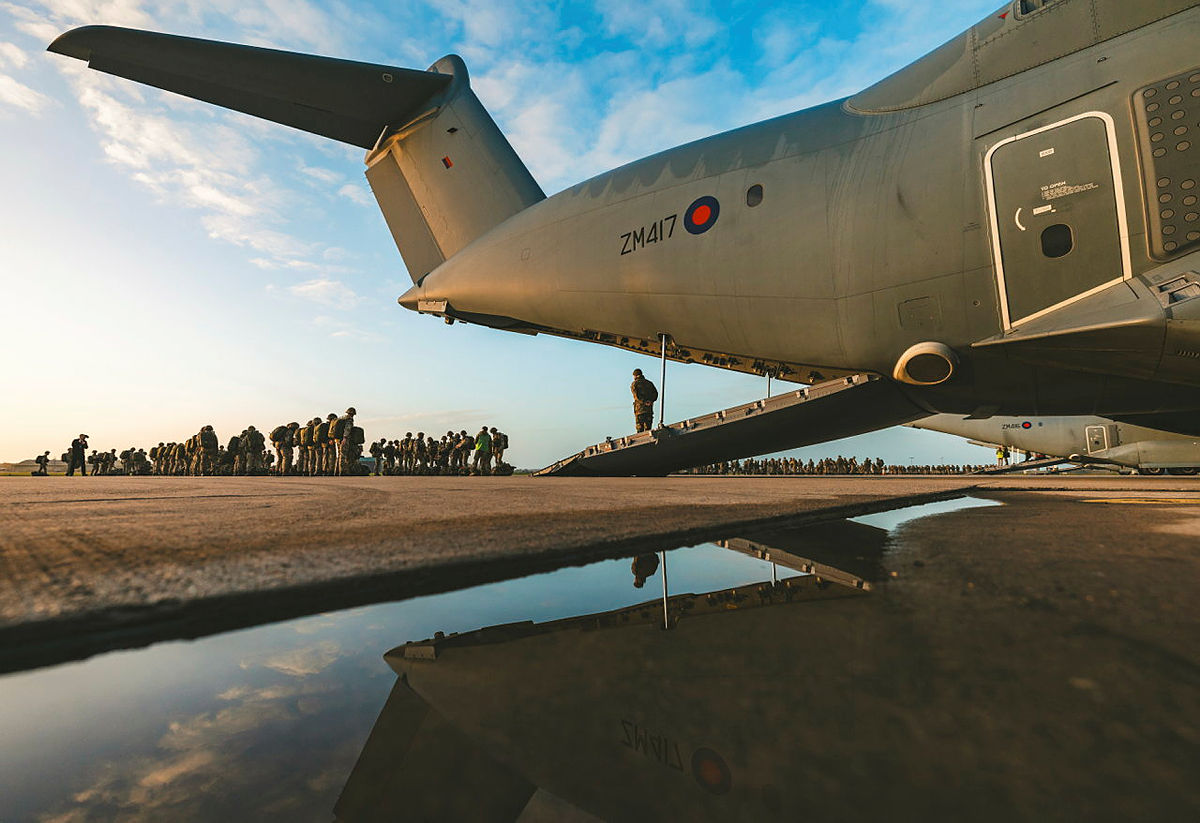
The Government has ruled out introducing compulsory military service, saying Britain will continue to rely on professional Armed Forces manned by volunteers while expanding shorter voluntary routes for young people.
The position was set out in a written parliamentary answer to Conservative peer Lord Naseby, who asked what work had been carried out to assess the feasibility of introducing some form of military service for young UK citizens.
Defence Minister Lord Coaker said: “This Government has no current plans for compulsory military service. Since 1963, it has been the policy of successive Governments that the best way of providing for the defence of our country is by maintaining professional Armed Forces which are manned by volunteers.”
Instead, Defence is putting greater focus on voluntary schemes intended to give younger people experience of military life without requiring the longer commitment associated with joining the Regular Armed Forces. That includes the Armed Forces Foundation Scheme, described by the Government as a military “Gap Year”, which was introduced following the 2025 Strategic Defence Review.
The scheme is aimed at people aged between 18 and 25 and offers a shorter period of paid military training and service.
Coaker said it was intended to appeal both to people who had never previously considered joining the Armed Forces and those interested in military service but uncertain about making a longer commitment.
Those completing the scheme can move into Regular or Reserve service through what the Government describes as a streamlined transition route, while participants who decide against a military career can return to civilian employment.
The Armed Forces are also continuing outreach work with schools, colleges, universities and community organisations around the UK. That includes careers activity, leadership and skills programmes and Science, Technology, Engineering and Mathematics outreach designed to give younger people greater exposure to the military and the range of roles available within it.
Coaker said: “Through this combination of military experience, engagement, education, skills development and voluntary service opportunities, Defence is already helping more young people understand the role of the Armed Forces, experience Service life, develop valuable skills, and explore opportunities to contribute to national security and public service.”






For now! Such a statement should reside in the pending tray. At this point in our history, we have few options left in terms of defending these Isles, as the cost of money globally rises at an alarming rate and our prospective adversaries grow more militant by the day.
The Army is currently full with 600 more soldiers than its contracted for and it’s turning away thousands of recruits, there is no need for military service.
On the other hand we should triple the active reserve force just like every other NATO Army including the US. The size of the Army reserve is a national disgrace.
Hi Jim,
I would suggest that all of the armed forces need to be expanded and if the army is full then the only reason for the Army to remain at an authorised strength of 73,000 is because of money – HMT.
There a very interesting article on the BBC News website Indepth page at moment, “War may be coming. Are we psychologically ready?” It highlights that our politicians need to step up and start tell the truth – bluntly.
The article also highlights that war with Russia will likely be about societal disruption in the UK, although it also hints that it would be kinetic in NATO’s frontline states.
The above 1 year military service scheme sounds a bit like a voluntary version of the Norwegian compulsory 1 year scheme, so may be we are starting to take the risks more seriously, even if it is behind closed doors and quietly. We certainly need to and the politicians need to turn up the volume.
Cheers CR
Hi CR, I suspect a limited NATO-War will start with “Green Men” incursions, making it initially deniable by Russia. But I also feel it won’t be restricted to the front line. Transport hubs throughout Europe will be a major target, especially key choke points, so I’d expect to see a lot of motorway over-passes being blown up to block motorways, not to mention west to east rail lines. Russia aren’t completely stupid, they know technology wise NATO trumps them, so they’ll do everything to try to level the playing field. Which in my book would be looking at logistic tails, supply depots and industry that supports the military.
The key advantage NATO has over Russia, is airpower. So I fully expect NATO’s airfields to priority targets for them. Especially the ones that have the key enablers such as tankers and AEW aircraft. Perhaps using the same tactics Ukraine used during Operation Spiderweb against Russian airfields, by using local drone blitzes to attack aircraft parked in the open. Iran has shown how vulnerable even the USAF bases in the Middle East are to such attacks, along with effectively using traditional cruise and ballistic missile attacks. A prime example of how vulnerable our airbases are, was the drone attacks on Akrotiri. Which spurred a knee jerk reaction to field something that could placate not only the Cypriot Government, but also be effective in stopping drones.
There most definitely will be cyber attacks, particularly against the mobile phone networks. The UK in particular will find it hard to function without mobile phones, especially if the hard line network is fully switched off as well.
I think I have said before that perhaps the UK should look at the Swedish or Finnish model for reservists.
Totally agree, the need for reserves is a fundamental requirement to sustain any defensive operation, let alone thinking about going on an offensive. But there is also another major issue that they are glossing over, which is the lack of reserve materiel, i.e. vehicles and other kit. Its great the full time Army, has most of the kit. But what are the reserves supposed to use when that gets used up? Similarly if the Chally 2s that aren’t getting upgraded are kept as a war reserve, will they have sufficient rifled main gun ammunition to keep them effective for a week or two of sustained fighting? On the face of it there doesn’t seem to be any long term thinking, in how to sustain an attritional war that Ukraine is currently facing. Its not just the Army, the RAF and Navy face a similar dilemma. How do you quickly replace materiel and personnel losses. How quickly can a T26, Astute or a Typhoon be built? The UK has no effective reserve, so if we do incur significant losses, we are screwed, no glossy PowerPoint plan is going to save you then!
Sorry rant over. But I do feel the UK could look at a Swedish/Finnish reserve model.
Hi DaveyB,
I wouldn’t call that a rant rather a well put statement of facts. The UK has war fight depth to allow it to fight a long drawn out war and Putin has shown he is willing to engage on long drawn out wars for decades now, i.e. Second Chechen War which started in 1999 and lasted until 2009. Ukraine has been going on for 12 years! We’d be lucky to stay in the fight for a few weeks as there are just too few regulars and as you and Jim point out little or no equipment for the small reserve forces…
Plus our civil defences simply do not exist, there is little or no community preparedness and worst of all psychologically we totally unprepared for war. Part of the problem is that war tends to be thought of as missile strikes and in the UK’s case convoys been sunk in the North Atlantic. I reality whist there could be some of that the real kinetic war will likely be fought in the frontline states with Western European NATO members send troops in to support our allies. In the western region, UK, France, Spain, Netherlands etc., any war at home will more than likely severe disruption of civil supply systems and shortages, with possible clandestine attacks just to frighten people. We are simply not ready for any of that and our politicians need to start being honest about the threat.
We should also think about our rescue and emergency services none of which are ready to ‘fight’ a war. A few wild fires and our fire services were badly stretched in some parts of the country and there would be no military forces available to back them up. We have all but disarmed and we are not responding fast enough.
When ex-generals talk of the possibility of war by the end of the decade they should point out that it is not about Russian tanks rolling into our capital cities, it is about troops fight in Europe and the home front face power cuts, internet outages, food shortages and terrorist style attacks from Russian sleeper units. They should also point out that Russia can stay in a fight for decades…
Cheers CR
Left unsaid is the invasion of our island by the wogs, aided & abetted by Government, and the low birth rate for native white Britons compared to that of the invaders.
MOD is broke. I mean deep, deep dark cold broke to the degree that overtime authorisation is now a 3 star decision.
Even to suggest such a thing as conscription is comic.
Perhaps if the government ever decisdes to get real and frees up some of that sweet, sweet Breakfast Club money we might be able to have a conversation about using conscription to build up the military.