

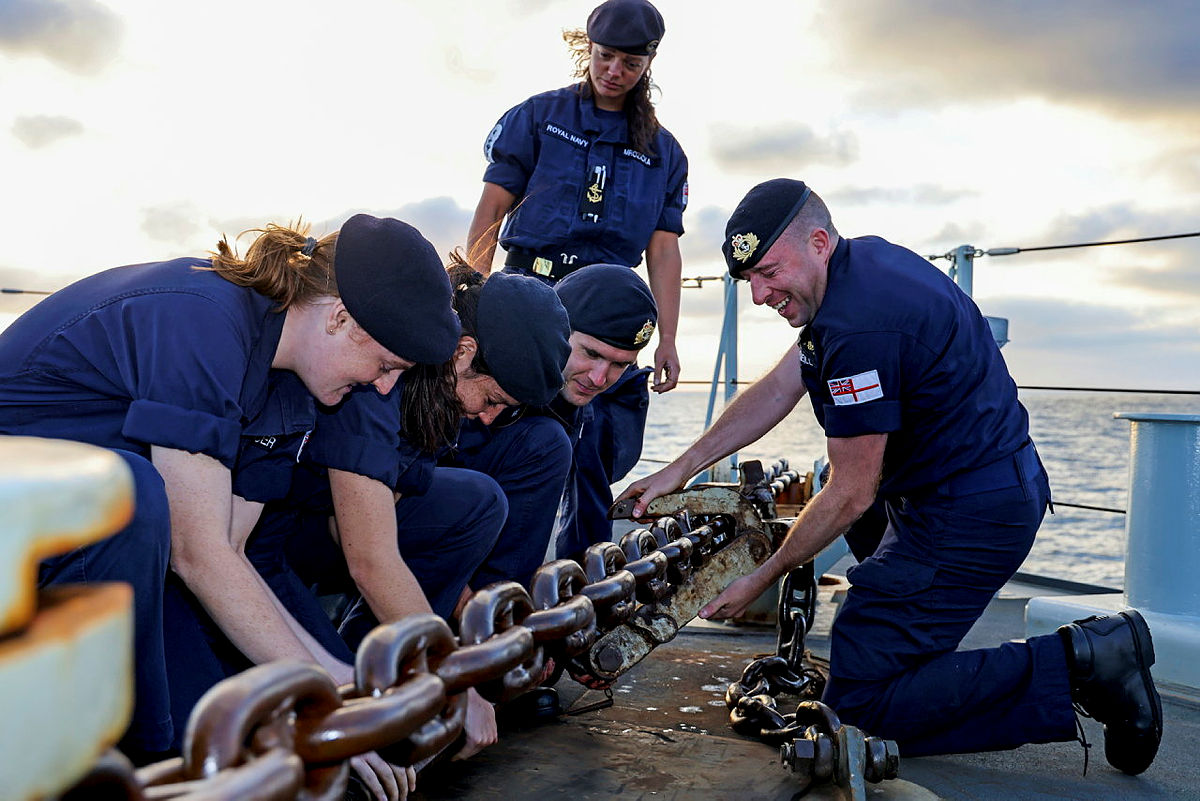
Participants in the new Armed Forces Foundation Year will serve at entry-level ranks across all three Services, with the pilot scheme set to launch in 2026 at a cost of £13 million.
The Ministry of Defence has confirmed that participants in its new Armed Forces Foundation Year Scheme, often described as a military “gap year”, will enter service at standard enlisted recruit ranks across the Royal Navy, Army and Royal Air Force.
In written answers to Parliament, defence minister Louise Sandher-Jones said the scheme is intended to widen access to military service by offering shorter, more flexible entry routes, in line with recommendations set out in the Strategic Defence Review 2025.
“The Armed Forces Foundation Year Scheme (‘Gap Year’) helps deliver on the Strategic Defence Review 2025’s recommendation that Defence must offer novel ways of entry into the Armed Forces that attract more people from a wider range of backgrounds,” she said.
According to the minister, participants will undertake their Foundation Year on enlisted terms of engagement, receiving pay and allowances equivalent to Regular personnel, with pension arrangements to be finalised ahead of implementation. Upon completion of initial training, Royal Navy participants will be classed as Able Seaman Class 2, Army participants as Private soldiers or capbadge equivalents, and RAF participants as Air Specialist 2.
The scheme will begin as a pilot in 2026, initially involving around 150 entrants. The total cost of delivering the pilot is expected to be £13 million, drawn from existing defence training and workforce budgets. No firm costings have yet been set for later cohorts, with future funding decisions expected to be informed by the results of the pilot.
“The schemes will start as a pilot during 2026, to understand the impact and measure success,” Sandher-Jones said, adding that capacity could be expanded if the approach proves effective.
Each Service is developing its own version of the Foundation Year. The Royal Navy’s one-year scheme is expected to place participants on operational surface ships in non-technical roles, with recruits living and working alongside regular sailors at sea. The Army is planning a longer, 18-month programme, with roles spread across selected trades in the Infantry, Royal Artillery and Royal Logistic Corps. The RAF, meanwhile, is developing a one-year programme allowing participants to work alongside regular personnel across its twelve professional groupings, giving exposure to a wide range of roles and career pathways.
Details of Phase 2 training and formal qualifications are still being finalised, with the MOD emphasising that Services will have flexibility to tailor training, employment and skills development to balance participant experience with operational value.








My son is in GCSE year, pretty settled on a military career but unsure what role or even which service. This would be perfect. To make it more perfect, allow them to sample the different services as well. Sometimes having 3/4 different silos of personnel can stop sensible things from happening
Pretty unambitious to only aim for 150 entrants. How about 1000. It will give more of an insight if its a valid recruitment method.
It’s the pilot year; going from zero to 180 in 9 months is going to be a ‘task’ in the modern world. They’ll learn improve and expand; looks like a sensible approach to me.
this is fine – but we should find ways of ensuring 50% of the 200k people who applied in the past year are allowed to join faster.
I would like to see every able person to be offered a place within 6 weeks of application, we can then sort people into fitness levels and train accordingly
the less fit have a longer basic than those who are fit. We really need to get them through the door and have a process that funnels people to the right role
all services will need to be far smarter and agile and of course we need a commitment to increase the armed forces to do this, but better they are employed and useful than receiving benefits or being antisocial (not all but some)
The military really does produce better citizens in my opinion and offers opportunities to some groups that just wouldn’t get them. We really should be investing in our younger people and just reccruiting those that want to join would be a start.
no real need for this scheme if we got our act together on recruitment
13 million for 150 personal over 18 months to include a apprenticeship type training programme OKAY… that is about 5,500 per full year per person… ummm what are they paying them.. how are they getting equipment, who,s paying the cost of the personal training them etc…
I take it you meant £55,000 a year, which sounds about right for what it is tbh. This is more about exposure to life in the Forces. If they want to join properly afterwards, they would still need to complete the full basic and trade training that regular recruits do.
I miss counting I worked it at 1.3 million missed out a zero… mid fifties brain wobble 🤷
Ha I gathered that 👍
I like this scheme, there are a lot of youngsters who hesitate to sign up full time, as it’s a bit of a career leap at that age, but who may be happy to have a go at a 12-18 month interregnum.
It’s interesting how each service is planning a different way of employing these gap year recruits. The RN is sending them to sea, without it appears any trade training, army is doing 18 months, and channelling recruits into three specific arms or services where I assume they are short, RAF is doing trade training across the board. Should be interesting to compare the results of the trial.
We wouldn’t need to do be doing this if the service recruitment process was a whole lot faster, slicker and less bureaucratic, we’d likely have all the recruits we need. But this gap year plan may well bring in others who would not have applied. If it progresses to 1,000 a year, in 5 years time, we could have an additional 5,000 in the reserves who have at least done basic CMS training and a good chunk of Phase 2 as well. You can never have too many reserves.