

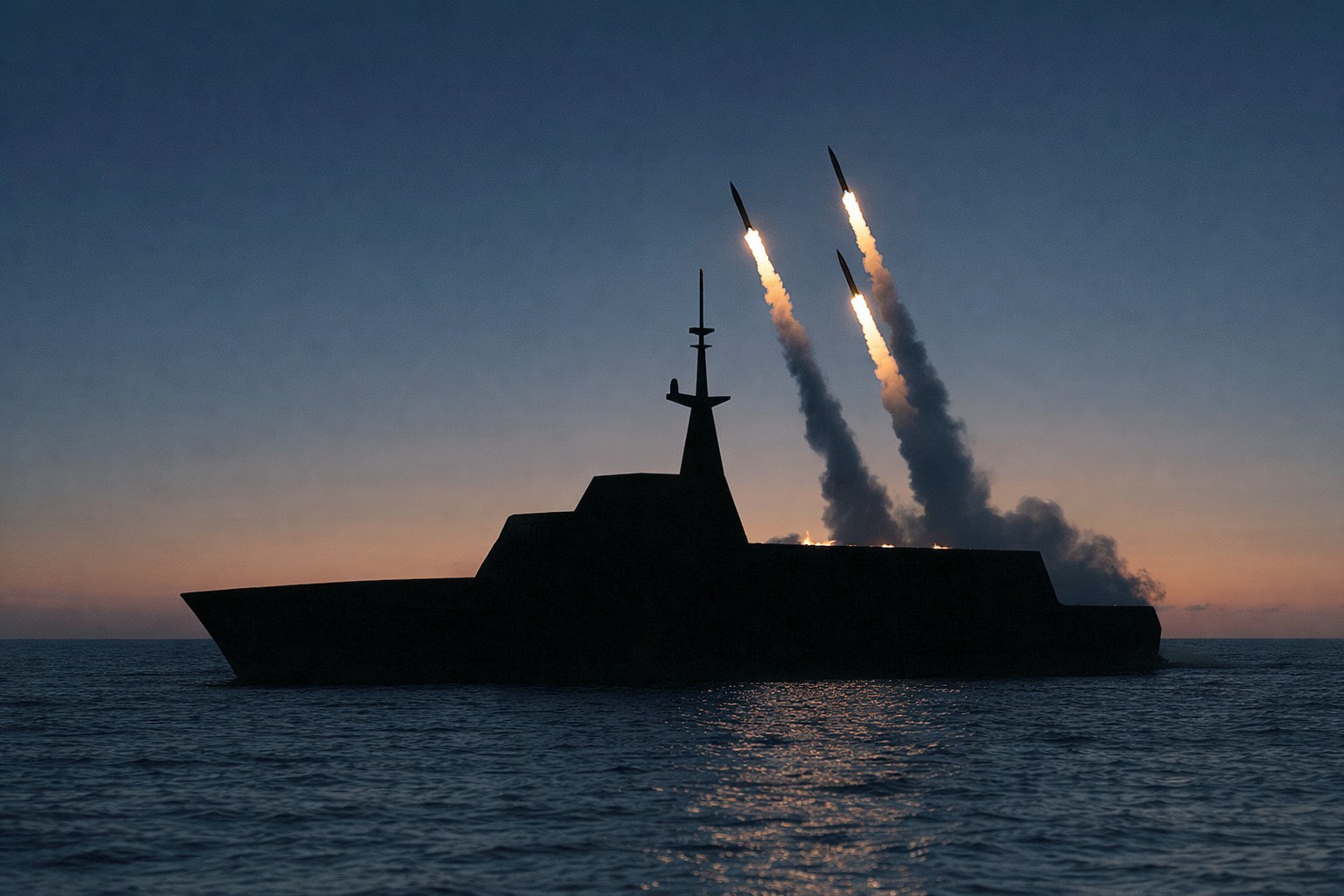
The Royal Navy is seeking industry input on new modular weapons designed to counter large numbers of uncrewed threats as it transitions toward a future “hybrid navy” combining crewed and autonomous platforms, according to a Request for Information (RFI) issued by the Ministry of Defence.
The notice relates to Project METIS, short for Modular Effects, Tactical Interchangeable System, which aims to develop modular systems capable of deploying low-cost effectors against drones and other uncrewed threats. The initiative is currently in the early market engagement phase and is intended to gather information from industry about potential solutions before any formal procurement process begins.
According to the Ministry of Defence, the project is intended to help the Royal Navy respond to the growing threat posed by uncrewed systems across multiple domains. The RFI states that the authority requires “low-cost effectors to counter the mass of threats from the proliferation of uncrewed systems (UXS) to complement current Complex Missile Systems.”
Project METIS forms part of the Royal Navy’s broader shift toward a hybrid force structure combining traditional ships with autonomous and remotely operated platforms. The RFI notes that as the Navy moves toward this model it intends to increasingly exploit autonomy and modular systems, allowing capabilities to be adapted more rapidly in response to emerging threats.
Under the concept outlined in the document, the project will deliver modular Persistent Operational Deployment Systems or “PODS” capable of carrying weapons or other effectors. These pods are intended to be easily installed across a range of platforms, allowing mission packages to be swapped depending on operational requirements. The system is designed to provide flexibility and scalability by enabling the use of multiple lower-cost effectors alongside more complex weapons.
The MOD said the project will adopt a broader system-of-systems approach aimed at delivering mass and flexibility. According to the RFI, this would involve introducing “numerous low-cost effectors providing flexible mission loadouts to augment complex weapon systems in an increasingly fluid threat environment.”
The proposed systems are expected to counter both aerial and surface uncrewed threats using a combination of electronic and physical attack methods. Because of the wide range of possible threats, the MOD anticipates that multiple solutions may be required rather than a single system.
The modular pods are expected to be compatible with both crewed and uncrewed platforms, allowing them to be deployed across ships, ground vehicles or other platforms as required. To support rapid installation and flexibility, the pods are expected to use standardised interfaces for power, cooling and command-and-control systems.
The RFI indicates that the pods will follow a containerised design, based on the footprint of a standard 20-foot ISO container, with a maximum weight of around 20 tonnes per loading point. Solutions could also use smaller or multiple footprints to fit different platforms.
While systems may initially receive targeting cues from other sensors or platforms, the MOD said high levels of autonomy are desirable in order to reduce operator workload and allow systems to operate across multiple domains. The project also places significant emphasis on sustainability and scalability in production. The document states that solutions should be capable of being produced in large numbers using robust supply chains, reflecting the need to scale capability in a wartime scenario.
Operational requirements outlined in the RFI specify that systems should be capable of operating for extended periods without maintenance and should not restrict the operational availability of the platform carrying them. For example, systems should be capable of firing daily for up to 30 days without requiring intervention.
For demonstration purposes, the minimum viable capability is expected to show the ability to defeat uncrewed systems from an uncrewed maritime platform operating at sea while being commanded from a crewed vessel. At this stage, the MOD has not specified whether solutions must use kinetic or non-kinetic methods.
The market engagement exercise runs until early April, with companies invited to submit responses through the MOD’s procurement portal. Officials stressed that the RFI is purely an information-gathering exercise and does not represent a pre-qualification stage for a future procurement. Companies that do not participate at this stage will still be able to compete in any formal competition launched later under the Procurement Act 2023.










Having read both the METIS and TALON RFIs, they are asking for very similar systems. The main difference is that TALON is talking about a larger defended area and METIS is containerised, but the overall aim to get dedicated low-cost systems on warships is very similar.
Wow, I can see it all now, multiple promising young minds from across the navy and MoD are brought in to a committee, several staff positions are formed. The project then spends several months to craft the right acronym for the project. Soemthing clever and Ancient Greek sounding but with four letters. What if we went for five letters this time one of our inspiring young hero’s says?
Yes, that’s it, they all agree and just like that after several months project MÉTIS in born. Quickly everyone races to update their CV’s. Then they write a f**king letter to industry asking if they have any ideas and also attaching their now updated CV’s to the RFI.
This is why we can’t have nice things 🫡🇬🇧
Bit cynical? Inviting industry input worked for the T31?
The type 31 was a competitive tender with an actual budget. BAE and Babcock both submitted designs. There is no issue with the MoD asking industry for input and information. However it’s the way in which it is done with these self aggrandised project names which generate nothing except staff positions and more bureaucracy to make more roles ashore for senior officers in a navy with less and less vessels at sea.
The cost of these “projects” is bad however the slow mindset they produce in the military is absolutely toxic. Now every procurement must take decades and come with multiple gates, support contracts and IOC’s that seem to come and go with no impact on what is being delivered.
The MoD has been told by parliament to use the UoR procurement capability already at its disposal but it refuses to do so in almost all cases.
I think questions should be asked why?
You are obviously closer to the ‘system’ than I am. Just saying, from the outside it seems smart to invite ideas from suppliers especially in new technologies if you do not have the expertise in house: then use what you learn it to write your rfp. The article does say there will be a formal competition after the ‘market engagement’ ends in April. Point taken though about the nature of bureaucracies – turkeys don’t vote for Xmas 🙂
😀
I agree these things sound and are great in theory, it’s just the system within which they operate that generates the cynicism I think. It’s why I am happy to see these new young often Ukraine inspired or originating companies starting up now, because if anything can penetrate and/or call the bluff of that crusty system and political shenanigans generally often epitomised by the eternal committee set up, then I suspect they do so, otherwise they will go the the way of other great white hopes like Orbex in the Space sector. One can only hope the defence urgency (even if Govt tries to deflect it) can help their ability to succeed as their solutions are often financially astute, well thought out and (almost) ready to be introduced so pressure is returned on the forces/politicians to pull their finger out and highlighted if they don’t. Is that enough, let’s hope so.
Agree the problem is ‘the system’ which generates cynicism. Changing culture is difficult. The people concerned have to want to change.
I disagree. It’s the individual’s choice as to whether they become a skeptic (disbelieving, but open to being proven wrong) or a cynic (disbelieving despite contradictory evidence).
Given all that’s gone on, scepticism is completely understandable.
Now I could be wrong but…..I think the idea, whether you are an observer / blogger or actively involved, is to ditch both the natural ( understandable) skepticism and the cynicism in favour of rolling up your sleeves and getting stuck in. 🤔
The skeptic will, the cynic won’t. That’s the difference.
More words a surfeit of those in fact but an utter deficit of actual equipment orders.
Suggestion to make this quicker and more cost effective – bring in the Ukranians to build something
Well in another article here today, we see that is exactly what is happening, hopefully to apply pressure on the procurement authorities to actually add action to the endless words. It will at least be more obvious if they try to deflect their decision making.
😴😴😴😴 Saves me a four letter word!
On the strike front, I would like to see a deck launched version of Spear 3.
Project METIS is a new one to me.
A whole fleet of Thunderbird 2s?
Britains new Navy
Everything fitted for, but not with, weapons
… as long as they have room for crates anyway.
Project METIS is a new one to me..
If launched from a POD then these effectors will have to be launched horizontally (through the Type 26/ 31 side doors). Perhaps the small anti-drone drones that Ukraine has been pioneering?
Wild Hornet’s Sting springs to mind, which the Ukrainians have already deployed from Magura drone boats. Tail-sitter design that quickly rotates to conventional flight. Cost $2k each.
Other commentators have already said this but a renaming of PODS does not make it a new programme or project.
There seems to be an inordinate amount of R+D projects going on at significant tax payers expense and spaffing away the defence budget without resulting in any actual hardware, weapons or sensors.
The type 31+32 sloops of war, optionally manned are one example. Just base them on the river batch 2 hull form and propulsion and get them ordered and in service PDQ. Project METIS should then be instructed to end with direct orders for anti ship, anti submarine, anti air systems that can be plugged into these sloops of war resulting in increased lethality for the RN.
If these vessels are going to be the outer screen for anti submarine units then they’ll need anti torpedo defences, drone submarine and mine hunters as well as very long endurance drone surveillance units