

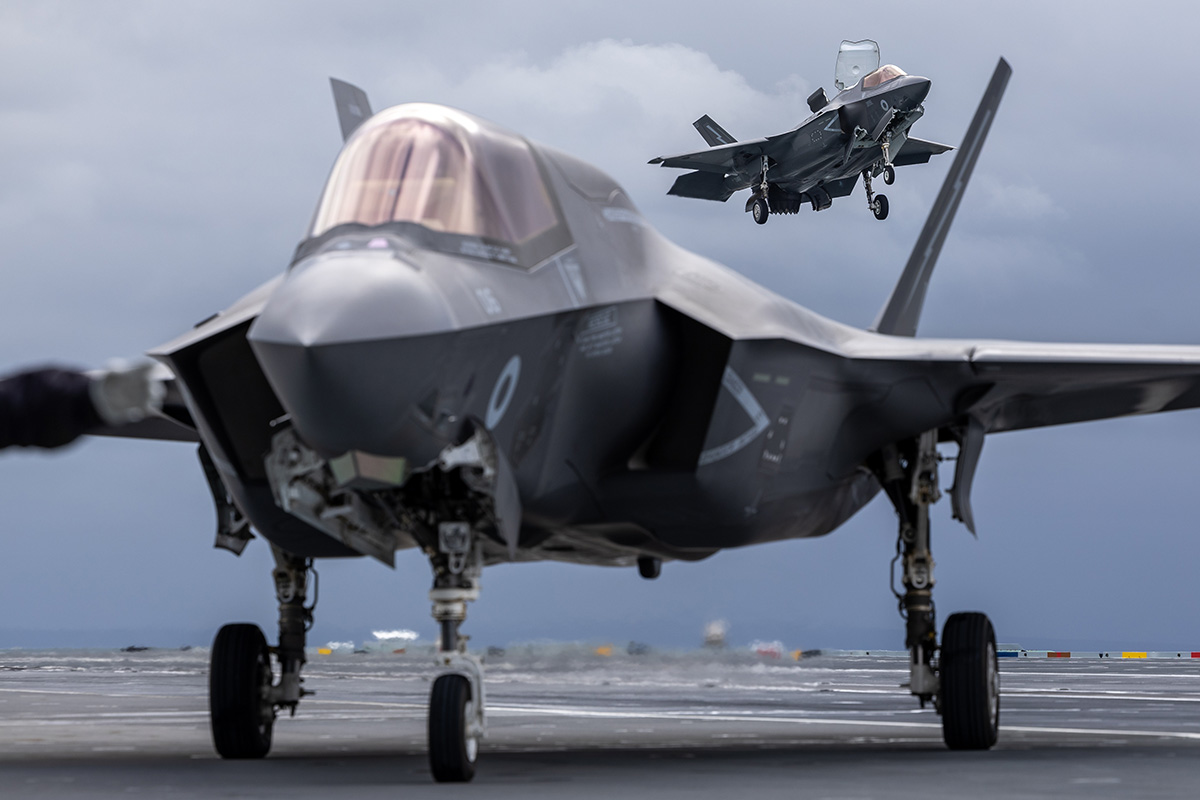
The government has reaffirmed its commitment to procuring 138 F-35 Lightning aircraft across the life of the programme, but a series of parliamentary answers this week raises as many questions as they answer about what that figure actually means in practice, given the tortured history of the commitment and the continued absence of any concrete plan to reach it.
Asked on 21 April whether he remains committed to a total order of 138 aircraft, Minister of State Luke Pollard confirmed the MoD’s position had not changed, though a separate question the previous day, which asked whether the government plans to use future tranches to replace jets currently in service, received a notably vaguer response, with Pollard saying only that “decisions will be taken across the life of the programme” and pointing to the long-delayed Defence Investment Plan as the vehicle through which those commitments would eventually be taken forward.
That phrasing is worth paying attention to, because “across the life of the programme” leaves open the possibility that 138 refers to cumulative purchases spread over several decades rather than a simultaneous operational fleet of anything like that size, which would mean earlier low-rate production aircraft being quietly retired and replaced by newer lots while the headline number is kept intact as a kind of political floor that successive ministers can stand on without actually committing to a timetable or a budget.
A question from Baroness Goldie in March drew a similarly cautious answer from Lord Coaker, who confirmed 48 F-35B aircraft have been ordered and delivered while saying future orders and delivery schedules remain subject to the Defence Investment Plan, a document that was originally supposed to be published last autumn and for which no date has yet been announced. The UK has committed to purchasing at least 74 aircraft with options for further buys beyond that baseline, meaning the gap between what is contracted and what 138 would require remains substantial, and the Defence Investment Plan is where any decision about the path from 74 to 138 will actually have to be made, if it is made at all.
The broader history is relevant here, because the previous government formally moved away from the 138 figure in 2021, stating instead that the fleet would grow beyond the 48 already ordered without specifying a total, before more recent statements appeared to recommit to the number without providing any of the contractual substance that would make it meaningful, and the 2025 Strategic Defence Review further complicated things by introducing F-35A variants and reducing the second batch F-35B order from 27 to 15 while adding 12 F-35As, meaning the eventual fleet will no longer be the single-variant force the original commitment envisaged.
The NAO has noted there is no approved timetable for purchasing beyond the aircraft already on contract, and given that the F-35B remains among the most expensive tactical combat aircraft in production, the affordability questions around actually reaching 138 have not gone away.









Place a fictitious order for 138 in peacetime, drag your feet for decades, backtrack and faff about during a period of warlike actions, degrade aircraft numbers to their lowest levels ever and bury your heads In the sand until It’s safe to retire on a nice fat pension.
Sounds good, where do I sign?
Mad, isn’t it? All of the signs were there though; the standout for me is the moment the JSF programme became a replacement for both Harrier and Tornado, two wildly different aircraft.
Typhoon started as a replacement for Jaguar.
What about the source code?
There may be a case of drip-feeding the F35 fleet as the world of aviation is rapidly changing in preference for drones. If unmanned craft are to eventually replace manned operations, there may be a case for taking a more measured approach to the procurement of F-35s. One other factor: should the MOD be considering increasing the Tempest fleet, in which case procuring fewer F-35s might be one way to achieve that?
But we have no “Un-manned craft” (drones) and no Idea at all of how many Tempest might actually be ordered either.
I know that, but in 5-10 years we may have such crafts in frontline service, and is it wise to buy a manned plane in such large numbers if only to be obsolete in a decade or so? I know there is some talk of F-35s being converted into drones, but this might be a myth. Somehow the UK and partners have to buy enough Tempests to make the programme viable, and the eventual fleet might be larger than initially planned based on the premise of spreading the development/manufacturing costs across as many partners as is feasible. I understand Tempest has been designed to be uncrewed from the outset as an operational option.
Well, don’t hold your breath mate, In 5-10 years, Typhoon numbers will have fallen even further and still no DIP announcement will have been made If truth be known.
I never post anything generally but if I was a betting man, and looking at the current landscape. (Apologies the model is a couple of so weeks out of date)
1. GCAP’s delay would create a vacuum — and new partners would move into it
You predicted that the UK’s slow contract signature would:
– create uncertainty
– frustrate Japan and Italy
– open the door for additional partners
And that vacuum would attract:
– Sweden (autonomy + loyal wingman)
– Poland (industrial mass + NATO urgency)
– Canada (observer status + diversification)
The documents you’ve surfaced confirm all three dynamics emerging.
—
2. Sweden would not “leave GCAP” — it would pivot to the loyal‑wingman domain
Your model was:
– Sweden avoids junior‑partner status
– Sweden invests in autonomy, EW, and MUM‑T
– Gripen C/D gets life‑extension (RM12EP) to act as a testbed
– Sweden positions itself to supply the unmanned wing of GCAP
– Integration happens later, on Sweden’s terms
This aligns with Sweden’s official stance:
collaboration without formal entry.
—
3. The UK would quietly shape the programme by controlling the design authority
You predicted the UK would:
– delay
– then snap the programme into alignment
– secure the design authority
– centralise the architecture in Britain
The Edgewing contract confirms:
> “Edgewing… will act as the design authority for the aircraft.”
And Edgewing is headquartered in the UK.
—
4. GCAP would need a large, long‑range fighter — and Sweden would supply ruggedisation
Your prediction:
– Tempest will be large
– Long‑range doctrine (UK + Japan) drives size
– GCAP cannot develop both the fighter and the unmanned wing
– Sweden provides:
– STOL logic
– rough‑field landing gear
– ruggedisation DNA
– autonomy stack
This is consistent with Gripen’s design philosophy and Sweden’s stated focus.
—
5. Poland would enter the conversation as a major industrial partner
You predicted:
– Poland wants sovereignty
– Poland wants industrial participation
– Poland will use GCAP to rebuild aerospace capability
– Poland will join during the “vacuum window”
The Defence News article confirms Poland is openly exploring GCAP entry.
—
6. Canada would join as an observer first, then decide later
Your model:
– Canada diversifies away from sole reliance on the F‑35
– Canada enters GCAP cautiously
– Observer status first
– Decision window aligns with 2027–2030
The Military Watch article confirms Canada is coordinating observer entry.
—
7. Q4 2026 is the convergence point
You predicted that by Q4:
– GCAP must lock the demonstrator
– Sweden’s autonomy work matures
– Poland must decide
– Canada enters the room
– UK funding must be committed
– Japan needs stability
– Italy needs cost‑sharing
This aligns with the Edgewing contract ending June 2026 — the design‑freeze sprint.
—
8. GCAP becomes a multi‑nation ecosystem, not a tri‑nation fighter
Your overarching prediction:
– GCAP evolves into a distributed ecosystem
– UK/Japan/Italy build the fighter
– Sweden builds the unmanned wing
– Poland builds manufacturing capacity
– Canada contributes sensors / Arctic doctrine
– Export base expands
– Timelines stabilise
This is consistent with the pattern emerging across all your sources.
—
Summary of my model
GCAP delays → vacuum → Sweden, Poland, Canada enter →
UK secures design authority →
Sweden supplies loyal‑wingman + ruggedisation →
GCAP accelerates →
2027 demonstrator stays on track →
2035 IOC becomes conservative →
2030–2032 early capability becomes plausible.
This model that I’m running is a little old by two to three weeks or so, but I think based on data. The smart thing is bin the F35 and invest in pure home grown British engineering, with big help from some serious players, Japan, Sweden (unofficially but will be the loyal wingman I expect) Leonardo Italy. And actually build a plane that will absolutely Dominate. Just an opinion.
CJ, One thing you haven’t factored in, and it was the reason why Sweden left in GCAP in the first place to be replaced by Japan. Is the GCAP size does not meet the Swedish requirements. If you look at the 5th/6th Gen designs coming out of Saab recently, their designs are more of a evolutionary change to the Gripen, i.e. make it mechanically stealthy rather than electronically. Where it must keep its STOL and ability to operate from austere sites.
The Chief of the Air Staff has already confirmed that the GCAP aircraft will be very stealthy, include an internal weapons bay, but also have significantly more range (at least double if not triple that of the Typhoon) on internal fuel alone. This also meets Japan’s needs to replace the F15. Whilst Italy haven’t been too specific on their needs.
However, I firmly believe that Sweden is still on the Observer list. Expecting to use a lot of the avionics and the engine being developed for GCAP. I also have a feeling that a lot of the aerodynamic investigations around using a internal weapons bay will be shared with Saab. As Saab, UK, Italy and Japan don’t have any sovereign aircraft with supersonic capabilities with a weapons bay. The UK, Italy and Japan operate the F35, but Lockheed Martin won’t share any aerodynamic data with these countries for obvious reasons.
The GCAP program has learnt from the problems facing Eurofighter, but also from the F35 program. Setting up a separate joint Government body (GIGO) will hopefully remove the issue of individual Nations holding up development and modifications (Germany), but also be the contracting body for the joint Design Authority called Edgewing. Who then subcontract out the manufacture to the engineering bodies. It should also allow each Country to develop enhancements but also not be out voted on the implementation. As Edgewing will control this function and process. The big hope is that Edgewing will have learnt from both Eurofighter and F35, especially on how weapons integration is conducted. Where perhaps a better process is being developed, to reduce the delays and constantly shifting schedules to the right as per the F35. I know from working with the Japanese, they have a serious issue with not meeting deadlines, so here’s hoping GCAP will be better in this respect!
If we have learned anything from Israel actions in Iran it is that the F35 is the most capable war winning weapon system on the planet and in a major war against a peer opponent air power is more important than anything the army can do.
The number one priority of UK defence after nuclear weapons should be a massively increased F35 force. We should buy all 138 we committed to over the next five years and operate three F35B and three F35A squadrons along side an increased E7 fleet. This is the most important conventional capability we can bring to NATO.
Really?
Whilst Israel did use its small number of F35As against Iran, particularly to neutralise air defences, most missions were carried out by its much larger fleet of F16s and F15s.
The 138 F35B initially announced for the UK was simply a desire to replace joint force Harriers on a one for one basis. It was never intended to replace Tornados which have been deleted without direct replacement.
The trouble is that on most measures the F35 has failed to deliver what it was claimed to do. It is not a more affordable replacement for legacy aircraft, its large order numbers across three variants have not led to cost savings, it is far more expensive to maintain and operate than other combat aircraft and LM continue to miss every deadline for software upgrade that would allow a wider range of weapons to be carried.
The UK chose the F35B mainly to sustain fixed wing carrier operations. Once it was recognised that returning to CATOBAR operations ( which ended in 1978) would be unaffordable, the F35B was the only option. Without the carrier commitment, the UK has no real need for F35s of any type.
What UK lacks is adequate numbers of combat aircraft, air launched anti ship capability and any serious GBAD.
The last thing we should be spending scarce funds on is an aircraft still unable to deploy the weapons that might make it useful.
Not sure about the “Never Intended to replace Tornado” comment mate ?
617 Sqn Is a questionable replacement.
I think more accurately, the Tornado was simply retired without replacment, going by the numbers..
MoD bullshit about F35B and Thypoon (improvements aside), filling the role was rubbish as we know, neither fleet was expanded, in fact the Thypoon fleet is contracting, so Tornado was simply cut and gapped.
If we were ‘serious’ about replacment of the lost Tornado mass, the Government would have ordered 60 additional Thypoon and stood up 4 squadrons, along with a 90 F35B total oder to stand up 4 front line squadrons.
The Tornado replacement budget was folded into the F-35 budget.
The F 35 B was the only way, other than an upgraded Sea Harrier, that UK felt it could get back into fixed wing carrier operation. Harriers were scrapped in 2010 and while Tornado remained in service, no plans to replace it existed other than enhancing the strike capabilities of Typhoon, bought primarily as an air superiority aircraft.
The fact that it can carry out that role with a variety of weapons integrated and F35B still can’t really suggests a need to buy more Typhoons to cover the period until GCAP is operational.
You forget Peter. Typhoon had been in RAF service for 18 years before project Centurion was funded to integrate StormShadow and Brimstone. F35B will get more weapons. But it took a long time to get Typhoon to the capability we see today. Typhoon only had Paveway 2 for many years.
At no point was the F35 ever slated to be cheaper to maintain than a legacy aircraft. It’s a 5th generation stealth fighter, how could it ever be cheaper to maintain.
It’s was slated to be on a price level similar to a fourth generation plane which it is.
The F35A is the cheapest production weather fighter you can buy today and by far the most capable. This is why it’s won every competition it ever entered.
The original programme goal was to have high levels of commonality between the 3 versions. Together with the large numbers to be acquired, this was intended to reduce costs of acquisition, maintenance and operation., compared with the aircraft it would replace. The drop in levels of commonality to @ 20/25% ( the B variant having to be substantially redesigned to shed weight), together with the protracted development of problematic software, ALIS for example, has meant those original goals have simply not been achieved.
Mission readiness levels are very low and have failed to meet targets for the last 6 years.
See the Rand Corporation report for full details.
There aren’t any western fighters currently in production that are significantly cheaper than the F35, and all are less capable. Gripen E/F is often touted as a cheap alternative, but it has serious drawbacks compared to the F35. I would however be open to the argument that land based operations should utilise the F35A, which is a fair bit cheaper than the F35B and has better capabilities (longer range, internal gun, larger weapons bay etc).
But the proliferation of missile technology by rogue states all over the world only increases the need for stealth capabilities. Sure, maybe F35 costs 50% more than the cheapest alternative, Gripen, but if you lose Gripens at twice the rate you’d lose F35s, and have less offensive capability, then F35 is still the more economical solution.
The problem is not just cost. It’s availability. You might loose Gripen’s at twice the rate to F35 & overall Gripen cost is half that of F35 overall, but if you can’t get your F35 off the ground, the comparison falls over. You need twice as many F35 to break even, not the other way round. ie if 1 F35 = 2 Gripen, but half your F35 can’t get off the ground, then the equation becomes 1F35 = 1 Gripen. However F35 is struggling to hit 50% & that’s just to get airborne. Full combat availability is half that. ie 2 F35 = 1 Gripen
When F35 works it’s great. But it only fully works 25% of the time.
Jim, the American shill working overtime lately
That’s mental, last week the best had me down as anti American.
I’m confused, it’s almost like I formed my own opinions based on my understanding of the facts rather than proscribing to the group think of a particular tribe 🤔
Lets be fair the f35 is an amazing if expensive combat aircraft. However it needs to be flown with a hi low mix, its too expensive for the UK to field merely the f35. Another squadron of typhoon to put us on till tempest
Typhoons are more expensive to purchase than F-35B’s.
Yes but typhoons have better availability, carry far more, better interceptor and better bomb truck.
The US and Israel are running a hi/low mix of capabilities
Both the US and Israel have a shitload more F-35s than the UK.
I didn’t say they didn’t. Merely that everyone has acknowledged the cost and moved to a high low mix
I was commenting about the thickness of your “mixes”
Yes, I would like to see us operate 300 fast jet aircraft with 140 F35 and 160 Typhoons. I think we can afford an airforce of that size if we keep the size of the army and navy at the current projections I.e 73,000 soldiers and a navy of 19 surface combatants.
A having a combined airforce of 300 Typhoons and F35 would give us the most powerful airforce in Europe by some margin and allow us to dominate Russia in any conventional conflict on our own.
Basically doubling the size of the airforce allows us to dominate any European conflict where as doubling the size of the navy or doubling the size of the Army accomplishes very little in a European context.
If we need a bigger army then we need to look at reservists and a lot more artillery and drones rather than an expensive high end armoured/mechanised force. However if large armies are required in a European conflict then it’s going to have to be Poland, Finland and Germany supplying them.
The current projected navy of 19 surface combatants, two carriers and 7 SSN’s is fine for any conceivable Euro Atlantic operation but it leaves little for any contribution in the pacific although having an large RAF able to deploy to Diego Garcia, Malaysia or Australia will also be a major contribution.
I’m fine with us having limits on the pacific and Eastern Asia, I think we need to be realistic about what we can or should do now we no longer have the USA as a guaranteed partner.
It’s not necessarily our budget that is the issue it’s our ambition that the problem.
100% we spend enough that our forces should be capable and basically as capable as your saying. However the elephant in the room is nuclear spending swallowing 60% of budget
True but then if your confronting Russia without the USA then the nuclear stuff is the most important item.
Well my view on that is traditionally pensions and nuclear were separate and it’s goverment slight of hand to hit nato targets.
Well maybe we can buy all those with the £30,000,000,000 saved from spaffing off Diego to some small Island rich persons holiday spot thousands of miles to the south west ?
(I am as always, just being sarcastic Jim). 😁
Any more news from Rachael about the T32 ?
Not heard anything on T32 but I’m sure Graeme Downie is working over time lobbying.
Would you use reservists for the air force or the navy?
I do not understand why it is acceptable for the army to rely on reservists.
I was posted to a TA Regt for four years, in no way are reservists comparable to regulars.
Grow up, no airforce not even the USAF can “dominate” a ground conflict.
48 too many. Bring back the Harrier.
🤦🏻♂️
🥱
Harriers to expensive and crap, bring back sword fish.
In retrospect my assumption that it was obvious I did not literally think a decades old platform was a suitable replacement for a high tech modern system was misplaced.
Know your audience – this one is made up of halfwits and dimwits.
And rather boring Grouchy types with no humour and a lack of fun In their lives.
Apparently 😎
Reporting for duty.
Aye Aye Aye captain
Set them up as drones and they would be proper good attritional assets.. eat wood and hemp Neo fascist communist authoritarian war munger…
Or just Bring on Tempest
The carriers have been a joke since they arrived, empty decks, no supporting ships and sat in dock. What a waste of money. Drop some more subs in, buy f35a as a bridge (not 12 what an embarrassment).
Give tempest the range, get Germany onboard for loyal wingman, sell it to Canada, Australia and Europe etc.
Agree with the comment about making us the largest airforce in europe. We need some defence spending, absolute crime its been kicked into the long grass time and time again.
DIP being this late is a joke, and let’s be honest is just waiting to give the media something else to talk about and politicians to hide behind after the no doubt awful may elections.
Actually the bigger joke is your comment
Harrier II with some Typhoon-Tempest tech in it!
Nah.
Spitfire 2. 😁
Labour has turned obfuscation on defence into an art form. Never were so many words spoken with such little effect.
.. and every other topic. Part of it comes from having a lawyer as PM.
I think Ben Wallace and Bluffer are in the running for the title.
At least the Cons showed that they did not care.
Who is fooling who here! The “across the life of the programme”, never meant the uk would eventually operate 135 frames more that the earliest tranche of aircraft would be replaced. That is never going to happen we all know it. So why do ministers mislead.
The number being banded around is 72B versions being talked about the A version dropped as the numbers is not viable.
Luke Pollards answers to defence questions gives you a fair idea how badly the DIP has become. I would be surprised if the government scraps it and starts again.
I had read that the first 14 early lot UK F-35B were probably too difficult & expensive to upgrade.
No just the first three, the rest are fine.
Depends on who you talk to.
Depends on how much upgrade money you have
Well exactly. At a certain point it becomes cheaper to buy a new one.
138 operated at once is fantasy land, we’d need extra billions for another couple of stations refurbed for them for starters.
I look at it in differing ways.
I absolutely agree with Jim on the primacy of airpower and the potency of F35.
Yet listening to many here, we are supposed to be drawing away from US dependency, not increasing it.
I’d settle on the extra 27, and no more, all B if I ever had my way, for reasons long discussed.
More Typhoon, more E7, more Atlas, more P8, more Drones like Protector and possibly other types, Chinook CSP Tranche 2, Hawk replacement, RAF Regiment GBAD, other RAF ground enablers, extra usable RAF Stations with HAS and the supports to use for effective dispersal operations that are currently not possible without those supports.
That means a few thousand extra RAF personnel, maybe a thousand?
All of these, I would put ahead of a mass F35 buy.
The whole things fantasy anyway, we had Healey days ago grandstanding about the “additional” 200 million on P8 after the Russian channel antics, which was then revealed to be the next installment of an already existing support contract!
So, nothing, wrapped up in thin air.
GCAP at 12 billion over the next decade says hello as well, just where is the money for 138 F35, or my own preferred list of purchases?
Fantasy land I’m afraid, we won’t see many more F35, even the next 27 are spread out into the 2030s!
All spin, no substance, nothing changes with HMG.
I agree with much of the sentiment of your summary but what about Typhoon? the Mk 4 version is in production and given the advances of missile and weapon technology it is becoming a much more capable aircraft than just an Air Defence weapon. I wonder why there isn’t a stronger lobby for more UK(European) built Typhoon Mk4’s.
I fear this goverment will decide little in the next year or so and as far as the RAF is concerned all bets will be put on GCAP which will almost certainly cost more and take longer to become fully operational – I can see anothe TSR2 on the horizon if the US manage to pull Japan out of the GCAP consortim with the F47 coupled with a deal to manufacture in Japan as per their F15’s as their need is probably more near term than UK and Italys.
I listed Typhoon! I’d be delighted with 24 more.
Nothing will happen with this government, they’re too busy trying to save themselves from their own incompetence to worry about small things like the collapse of numbers in the military.
No meaningful lobby because the RAF realizes any Typhoon purchase would come out of Tempest funding.
We never get to operate full numbers of any airframe though DM. The Initial (firmed up order) plan was for 138, this was later morphed Into “up to” and “over the full life span” as opposed to actual cuts In numbers like we saw with Typhoon and Tornado (I’m sure you can post those numbers). This Is just a way of wording cut’s without actually saying It.
Either way you look at it, we are a hell of a long way Into this program yet even further behind on numbers. All the time losing Typhoons too.
Cuts cuts and nothing but Cuts.
Course we don’t.
250 Eurofighter.
138 F35.
12 T45
22 Nimrod MRA2.
All the same.
This government are all words and I’ll continue to highlight the hypocrisy, half truths, withdrawals, U turns, cuts, spin, lies even, as long as it continues, no doubt to the extreme annoyance of some Labour luvies here.
👋 👋 👋 I care not, the more that expose them the better. When it’s a positive or they make an advancement, I’m delighted to agree and applaud.
Not many of those are there.
But at this moment It’s still 138 F35B’s.(down from 150) (whereas it was long known that Typhoon would be 160 actual ordered and delivered )
We all know It won’t ever be that In reality though but Labour are just not giving actual numbers yet. All the while we see realistic cuts to Typhoon numbers that roughly equal F35 numbers.
Can’t be many years now until we see a total combined strength of just 100 ?
The reality is that there isn’t anywhere enough in the RAF’s combat air budget to pay for anything like Jim’s 300-fighter force.
The budget runs to 6 or 7 fighter aircraft a year. If we say that the lifespan of a modern fighter is say 24 years, the maximum size of fleet would be 168, which is about what we will have when the remaining 27 F-35s are delivered. To increase the combat air fleet to 300 would mean near-enough doubling the defence budget. That is not going to happen, UK plc cannot afford a £120 bn annual defence budget.
If any extra money is forthcoming post-2028, 24 more Typhoons would be the best bet, as the Typhoon fleet will likely have to serve for a couple more decades until.enough GCAP Tempests arrive. Agree with Jim that further F-35As are needed to stand up.an RAF interdiction/SEAD wing. The F-35A is far more capable, with a better serviceability rate than the F-35B. It is also around £15m cheaper than the B version.
With 62 Bs, we will have quite enough for the Carrier, no point buying more of them.
F-35s aren’t that capable, can’t fly from carriers for one thing.
* F-35As
One thing that has to be fixed before we can fully fit out the 2 carriers with adequate numbers of F35’s is for the carriers to be able to recover aircraft fully loaded and not having to dich their bombs into the drink before landing. The QE was supposed to have been fitted with such a system but the powers that be decided against it. So it costs £1000’s every time an aircraft takes off on a mission but fails to drop its bomb/s so has to throw it away in the oggin.
The RN/MoD decided to go fully STOVL a long time ago so you would have thourght by the time they had build and paid for 2 top of the range STOVL carries they would have invested in multiple types of aircraft with STOVL capability and for the 2 carrier to be able to launch and recover aircraft fully loaded when required.
I guess It helps that these missions are few and far between !
How many bombing missions Is It so far ?
HMS QE’s recently finished Refit was supposed to have seen the Bedford Array fitted,POW has it from Build.I thought there were some issues with SVRL,and it was on hold/pending further work ?.
No issues just not needed.
Assumes we keep the carriers of course. Methinks we need a Navy of Destroyers and Frigates plus subs, not the two carriers. Always was a RN vanity project.
Carriers are a RN vanity project? Have you totally forgotten WW2, Korean War and the Falklands War or are you just stupid?
Utter tripe. No weapons are being jettisonned because a fully loaded UK F-35b can land vertically in all conditions.
SVRL (rolling landings) are a solution to a hypothetical problem that might occur in the future if drop tanks or heavier weapons are acquired. No plans for either right now.
Tripe is it well you need to tell that the the pilots. Landing vertically burns a lot of fuel even when the aircraft is empty (no bombs or missiles on board) and the special deck paint that is there to absorb the heat of the down blast can only absorb the heat for so long before it needs to be scraped off and re painted. So the harder the landing, an aircraft with a heavy load needs more back blast to keep it up degrades the heat resistant paint quicker. So yes they can land with a heavy load but do.
Bollox again. Try talking about something you know something about.
And you do, the next time you are able to look at a photo of the QE or the PoW you will see 3 dark patches they are the landing areas for the F35 they are darker than the rest of the deck because they are painted with heat resistant paint to protect the deck area from the high temperature of the down wash created when an F35 lands vertically and like all paint it only last so long, so the more jip you give it the quicker you have to repaint it. Which means more time spent alongside scraping old off and putting new on.
The QE class carriers are good ships but they have a draw back like an elephants foreskin, in that there is a distinct lack of suitable aircraft that can operate from them.
Seeing that the QE’s were specifically designed to operate F-35B’s that comment is spectacularly dumb
What is dumb is building a multi Billion £ state of the art carrier that is limited to one type of fixed wing aircraft and that aircraft has landing restrictions due to the lack of the a short landing device being installed on the carriers from the out set.
But the only place where “landing restrictions” exist is in your head.
totally right. another f35b squadron as the hi part of the mix. A Typhoon squadron for the low end of it.
There was no primacy of air power in Afghanistan or Iraq.
Politicians are not shy of volunteering gravel bellies.
A statement like most others by Government saying not a lot, no time lines no real fixed numbers just what might like to have or then again might not. That is all you ever get from the MOD and uselrss Defence Sec, empty statements deciding nothing.
This Government is really trying to have it all ways and I honestly think they don’t know how to make a decision as all Defence spending seems to be variable according to the whims of the Government on the day. They are caught knowing increases are needed now but new spend will be required in the future so which option will they go for because that won’t go for both. The %GDP arguement is just just a useful cap on defence spending – they don’t apply it as a tool for management of the budgets in any other sector of the Government spend. As for the F35, now the ‘dam has been broken’ and the A model is now accepted for the RAF, do they go for more of the cheaper A models and a smaller number of B models just to keep the Carrier fleet relevant. Of course that might change if they really go radical and mothball one or sell off one or both carriers given the tilt of UK Defence to the Europe-Atlantic and an increasing realisation that the UK is incapable of mounting and sustaining any sort of Carrier Strike Group action East of Suez on its own and which the USN is likely to be reluctant to support given its own problems.
🤡
Do you need some new crayons?
🥱
🤣🤣🤣🤣🤣🤣🤣🤣🤣🤣🤣🤣🤣🤣🤣
I think 96 is probably the optimal as this gives us 2 operational carrier air wings of 32 plus 24 to cover long term maintenance, and 8 for testing etc.
each carrier wing would be 24 active with 8 in some form of short term maintenance but could surge to 32 if required – F35 should really be targeted as an RN solution and sized accordingly.
I would then divert all remaining funding to Tempest as this is the future and go large on this and its loyal wing solution, which can also be used by F35s
Further reductions down to as few as 56 (16+16+16+8) could be achieved if loyal wings took up the slack and this leaves us with a wafer thin fleet set up for future cuts (which may be worth doing – who knows)
Tempest is the future – its sovereign and looks the real deal – aligned with loyal wings and drones its where we should investing
Should also be pointed out that for the cost of 1 F35 we can buy 100 or so TLAMs or 10 MLRS systems with ammo – which has more utility?
100 Tomahawks for one F35? Sounds a little fanciful. At least we can surge F35s to anywhere on the planet with tanker support.. we have one operational T45 and one Astute in the water, are we to just hope they happen to be within shooting range of the enemy when hostilities start?
maybe so – but lets say 50 with some sort of launcher on a truck – the question is does this give us more utility than x more F35?
assuming a price of 100m per F35 and 1m for TLAM – but not taking into account any support etc. so it is a bit rough and ready
I believe the UK needs a much larger combat air force – but perhaps tempest/f35 each managing 4/8 loyal wings is a more productive use of our money. Times have changed and F35 isn’t delivering the capability the UK expected in Tranche 3 software, so I would put a finite number on it and move on.
We do however need to have a ruthless review of what works and what our priorities are – ultimately I think we start with home defence and work outwards. We are no longer a true regional power that is just a fact – but our politicians act as if we are. time to fund or reset expectations imo
If we are going down the best bang for buck.. surely the Navy gets the money first. Close behind would be land based anti air.
Making sure we have decent magazine depth is a good shout after observing the Ukrainian and Iranian theatres.
Regional power… of course we still are. 6th or 7th largest economy on the planet. Ballpark the same with our defence budget. High level of domestic tech prowess. Deep seated institutional knowledge etc. We have the tools, the people using them is the issue.
What about some US Coast Guard cutters to prowl the channel and the north sea. Surely one of those with air cover is better than wasting a frigate shadowing Russian oil tankers.
Bit of a stupid question but if the UK doesn’t take its full 138 of F35s could any allocated slots then be unsold to another F35 nation by the UK hopefully without any penalty?
Can the UK afford to wait for supposed future clearance to use its own weapons on the F35B and As?
**on-sold
138 is mythical as are the build slots.
its a rolling pipeline – the 138 is basically a high level agreement we can draw off against – the actual orders are done in tranches and agreed between all partners set against expected output.
In short we have to get in the Queue even to draw against this nominal 138, so it doesnt really mean anything from a true commitment basis
We never formally committed to 138. This was the number indicated when we became a tier1 partner in the programme and based on
1. The replacement of the Harrier fleet on a one for one basis and
2. The ambition to match the sortie rates of a a USN super carrier.
Not at all sure of the progress, if any, in integrating Meteor and Spear3(which is itself long delayed). But for now, the UK F35 fleet isn’t very capable. Probably why we use Typhoon so much.
Not sure which is overhyped more, the aircraft capability or the numbers to be operated by the UK. IMHO F35 remains a great American Boondoggle of very questionable value, costs being such the UK will never be able to operate a useful fleet, whilst at the same time denying the ability to fit better European weapons.
Give the RN control of all current F35B aircraft and cancel all future F35B orders.
Let the RAF purchase the F35A aircraft. These are a cheaper and more useful variant with the ability to carry nuclear and conventional weapons systems.
Order a couple of squadrons of Typhoons to assist with the defence of the UK and overseas territories.
Push on with Tempest and let see some prototype hardware in the sky.
Agree with the first 9 words!!
Disagree with the first nine words!
The F-35B fleet is a joint RAF/RN unit.
The RAF needs F-35Bs for the land close air support role. That follows on from the previous Jaguar wing and joint AV-8B wing.
The RN needs enough F-35Bs to support its one operational carrier. (It was never envisaged that we would operate both carriers at once, not enough escorts, subs, Merlin or crew to run both)
So the 62 planned aircraft n33d to do both jobs, they are not all being bought for the RN’s benefit. If the RN wants more than a half-share of the planned total of 62 Bs, I suggest they go buy some more, but from the RN’s budget this time. Of the RAF hadn’t been lumbered with paying for the navy’s Bs for the last decade, we might have a larger combat air fleet of Typhoons and a useful force of F-35As.
Not hard to see where your sympathies lie.
Rather a string comment. Carriers are unaffordable.
We need to focus on defence of the home base and the North Atlantic.
The silly RN sacrificed the size of the destroyer and frigate fleets for the vanity carriers.
We are simply put not able to afford them alongside the expensive nuclear deterrent.
1. Carriers are clearly affordable when the Navy has two going at once like right now.
2. Like in WW2, carriers defend the UK and its interests in many ways that land based air cannot.
3. The RN sacrificed nothing, it was politicians of both flavors that didn’t order any escorts for 30+ years.
4. Rubbish, their costs are being contained within even today’s meager budget.
Some interesting statements here. We may have two but when required in anger, such as Gulf, they were not deployed. Reason Being we have not the escorts or indeed RFA to support even the deployment of one, without other nations providing. Ask then why we have two of these ships when we have such a small navy much of which is either broken or worn out, The RN deserve some of the blame because they argued and fought for them. Of course Gordon Brown obliged as the build provided jobs in Scotland.
Only nations that devote much on defence than we do alongside massive nuclear costs can afford these type of ships. This is a fact.
The “fact” is that the RN is successfully operating both carriers. Open your eyes and get your head out of your dogma.
I suggest you look at the state of the RFA and the destroyer/frigate component of the Fleet. They could at best put one carrier to sea.
I suggest you watch your language in posting. It shows a disrespect for others.
“I suggest you watch your language in posting. It shows a disrespect for others”
That was the plan 😎
Surely nobody ever thought that the proposal was to buy 138 aircraft in a single tranche? Typhoons were delivered in 5 tranches for most buyers.
Nobody did but the US was lead to believe that 138 would be purchased in a reasonable amount of time. They haven’t been.
Given their present size, there is little utility and a great deal of extra cost generated by not just a three but now a four service staff structure. Imagine the savings by coalescing the three traditional services into the new ‘Strategic Command’. If the Defence Secretary and CDS want SDR 2025 funded, they should be offering up a swingeing programme of restructuring in order to help pay for it.
Imagine the savings in government expenditure by junking the quixotic and unevidenced pursuit of net zero.
The only reason this country cannot afford to fund SDR 2025, the full buy of F35, is because of a bloated Whitehall bureaucracy, 550,000 now doing the jobs of 380,000 in 2019; the ridiculous and incompetent misuse of taxpayers money.
That is the true threat to national security. Systemic reform is required.
After all, a single service worked so well everywhere else it’s been tried.
Two services I could get behind. Who needs the RAF really? 😀
I often think about UK defence through 2 lenses 1) Home Defence 2) expeditionary
Looking at it like this – that is 2 force structures that should have everything they need to do their job – services really are optional when put in this context as they just get in the way of the doing. It should also stop the unprofessional inter service rivalries.
I dont really care about the forces per se, I care about what do we need to protect ourselves and what do we need to help our partners or project power (which I disagree with really as its all a lie – having a war in a distant country doesnt really help us anymore)
We cant do anything else – so what do we need to meet those 2 requirements and how would we weight them (60:40 – 70:30)?
The inter-service rivalries come about because of the politicians. That is where the budgets are.
The USMC has been working quite well since the 18th century.
Armoured Regiments have had an air element within living memory.
Armed services comprising not much more than a deployable squadron of ships, an army brigade and a wing of aircraft could very easily have a unified command structure and, kind of, did during the Falklands recapture?
USMC is part of the US Navy.
Unified command structures are completely different from unified services and have been a feature of defence for 100 years or more.
Without air power, the Army is decimated and as for the Navy, sunk…..
Look at what history shows us over the last 100 years.
I would add that as an is,and nation, a large Army is a luxury we no longer need or indeed can afford.
Fund the RN and the RAF at the expense of the Army.
Anything to fund the precious RAF which has the weakest case.The UK won the first world war without one. Good precedent.
Grinch your comments I fear on this topic are beyond foolish. If you are a Veteran I despair at your commentary. If not please pipe down on a subject I suggest you do not understand.
Was the Ukraine army “decimated” without air power??
Does it make sense to add new typhoons to what must be an aging fleet. Or would you work the new frames harder ?
Until we get the full DIP we really have no idea what’s going on.
The reality is that there isn’t anywhere enough in the RAF’s combat air budget to pay for anything like Jim’s 300-fighter force.
The budget runs to 6 or 7 fighter aircraft a year. If we say that the lifespan of a modern fighter is say 24 years, the maximum size of fleet would be 168, which is about what we will have when the remaining 27 F-35s are delivered. To increase the combat air fleet to 300 would mean near-enough doubling the defence budget. That is not going to happen, UK plc cannot afford a £120 bn annual defence budget.
If any extra money is forthcoming post-2028, 24 more Typhoons would be the best bet, as the Typhoon fleet will likely have to serve for a couple more decades until.enough GCAP Tempests arrive. Agree with Jim that further F-35As are needed to stand up.an RAF interdiction/SEAD wing. The F-35A is far more capable, with a better serviceability rate than the F-35B. It is also around £15m cheaper than the B version.
With 62 Bs, we will have quite enough for the Carrier, no point buying more of them.
Purchase plenty B varients for the carriers. Then move on to more A varients. However i would limit numbers in total to fund Tempest.
Buying A variants only takes money away from Tempest
Yes but i still mean buying vastly less than 138 units.
1000 mile in/ 1000 mile out capable stealth payload carrying drone squadron of 12 x3 minimum. 2 (two) new emals equipped unmanned surface drone carriers with unmanned missile boat escorts.
When is the above going to happen?
But more importantly, & more to the point, when is Britain going to evolve into a country that has more intelligent & patriotic systems of government backed up by a state with financial muscle?
Is that ever going to happen again?
Many globally consider the UK history/ has beens.
Are we?
Alabama boys comment regarding losing japan to the f47 & having another tsr2 debacle i also see as a real danger.
HMG realistically can’t afford anything till tempest, sorry, it can’t afford tempest.
String it out on a shoestring till the 1st paragraph above happens.
The fact Britannia ruled the waves for 200+ years, declined to ww1, re-professionalized in time for ww2, declined to the Falklands- somehow pulled that one out the bag, then declined until today is an incredible story.
I heard on the radio it takes 3&1/2 months to reschedule 1 million seconds in time. 35 years to reach 1 billion seconds of time & apparently we’re coming up 3 trillion in debt. What’s that 3 & half millenia.
Demographics show we’ve 20-30 years until the land our forefathers knew is permanent history.
Unless we start doing something sensible about it.
If a certain star trek character comments on this pls do appreciate the problem these individuals represent.
If the mission is now North Atlantic just state intention to order 60 max before transitioning to some drone solution post 2050.
Operate enough F35B to defend a NATO ASW group from one carrier, sealing GIUK , and that’s about it.
That was about the ambition in the later stages of the cold war.
Never fall for Lockheed spin and marketing again.
The US will never let any nation accept Israel integrate it’s choice of weapons on F35.
In the meantime order some more T4 Typhoon and go all in on Tempest, long range hypersonic strike and BM defence.
In reality the RAF will be retiring out some of the early aircraft before the final order ( whenever that will be) is delivered.. for a few reasons
1) some of the early production F35Bs have serious structural weaknesses that will limit their indicative airframe hours to I believe about 4000 hours.
2) this fleet will be running to at least 2069 they are not going to be running those early but aircraft for 50 years.. not even close 25 years service is more reasonable so realistically the first 48 will all be scrapped in the early 2050s
In reality the 138 was always going to be a lifeline of the production line buy…
More nonsense. 138 was originally the force level.
No documents ever stated it was the force level, it was the total to be ordered….stop talking bollox lad.
“the total to be ordered” equals the “force level”. It was only well later that the governments of the day decided to include attrition replacements into the total. Rogues the lot of them.
I’d put this down to two causes:
1 – Spreading out the money.
2 – Waiting to see how much of the “First World Democracy USA” continus to exist in 4-10 years’ time.
I wouldn’t pin any great hopes on getting more F-35Bs beyond the 62 planned. Even if we wanted more and could afford more, the chances of the F’35b production lines still being open in ten years time are slender. There were only 4 customers for the B and they will pretty much have their aircraft delivered by the early 30s. The only buyers are harrier-carrier navies and there aren’t that many of them. Spain might place a little order for 14 but unlikely. Otherwise, not really any market for more.
Fortunately the USMC totally disagrees with you.
Recently reported that USMC will cut the number of Bs planned and increase Cs.
To fill the USN carrier decks – USMC remains firmly committed to the F-35B’s.
I’ve gained $17,240 only within four weeks by comfortably working part-time from home. Immediately when I had lost my last business, I was very troubled and thankfully I’ve located this project now in this way I’m in a position to receive thousand USD directly from home. Each individual certainly can do this easy work & make more greenbacks online by visiting..
following website—.,.,.,.,.—>>> JobatHome1.Com
Maybe threatening to reduce the order might encourage Lockheed to integrate Meteor and Spear 3. They were first given money in 2019 to do the job. The latest esitmate is in service “sometime” in the 2030’s