

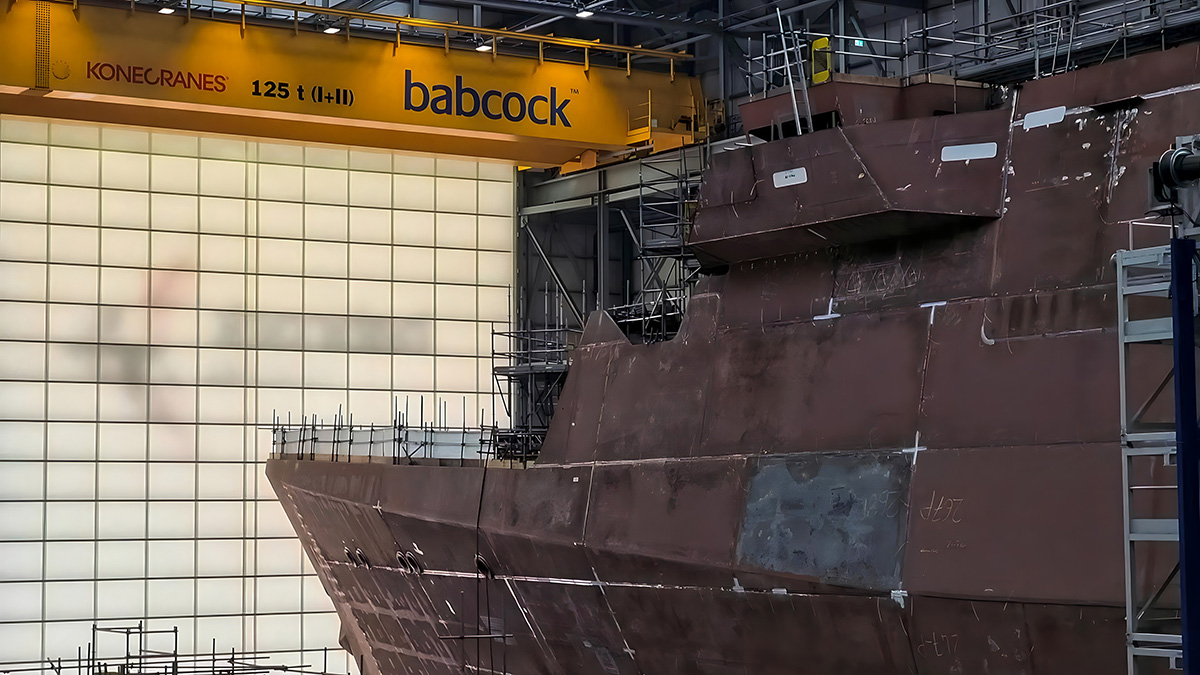
Shipbuilding has been designated a priority sector for procurement reform under the Procurement Act 2023, in a move the Ministry of Defence says will bring more work to British yards, Defence Minister Luke Pollard has said.
The position was set out in a written answer to the Labour MP for North Durham, Luke Akehurst, who had asked what assessment the department had made of the impact of the Procurement Act 2023 on increasing the volume of MoD-related work for the UK shipbuilding sector. “The Government recognises the importance of a sovereign shipbuilding sector for our national and economic security,” Pollard said.
He said the Cabinet Office had recently announced further policy updates to the Act, with shipbuilding listed among the sectors marked for priority procurement reform on the grounds that it is critical to national security. That designation, Pollard said, “will mean more contract awards at British shipyards, boatyards, and small-to-medium enterprises.”
The National Shipbuilding Office is leading the work for the sector in collaboration with the Cabinet Office, Pollard said, and is developing a new framework intended to deliver more shipbuilding work in the UK. He said the office’s forthcoming Shipbuilding and Maritime Technology Action Plan would “go further than previous strategies in delivering for our powerful sovereign shipbuilding industry” and would set out the government’s approach to supporting the sector.
The Procurement Act 2023 came into force across UK public bodies in February 2025, replacing the previous regime with rules the government has said are intended to give buyers more flexibility and to make it easier to take account of factors beyond lowest price, including social value and national security considerations. Designating particular sectors for priority reform allows the government to steer contracting in areas it regards as strategically important, of which shipbuilding is one.
The National Shipbuilding Office coordinates shipbuilding policy across government and oversees the National Shipbuilding Strategy, which covers naval and civil vessels and seeks to sustain a domestic industrial base capable of building for both the Royal Navy and commercial customers. British naval shipbuilding is concentrated at a small number of yards, among them BAE Systems on the Clyde and Babcock at Rosyth, with a wider supply chain of smaller boatbuilders and equipment firms that the reforms are intended to reach.
The talk about bringing more work to small and medium-sized enterprises echoes a theme the government has pressed across defence procurement more broadly, with ministers arguing that directing a greater share of spending to smaller firms supports jobs and skills and strengthens the resilience of the supply chain.












With a 1,000 ship navy, better get building!
The word ‘ship’ in this case is doing some very heavy lifting for what they will actually be purchasing. They will be basically speed boats in large quantities.
I know, I know, and quite obviously.
You’d hope there are a few dozen T91,92,93 in there !
I’m sure there will. But it’s just a minister trying to sound profound, but being misleading. However, everyone can see through it knowing that the majority will be speedboats.
I’ve gained $17,240 only within four weeks by comfortably working part-time from home. Immediately when I had lost my last business, I was very troubled and thankfully I’ve located this project now in this way I’m in a position to receive thousand USD directly from home. Each individual certainly can do this easy work & make more greenbacks online by visiting
following website—.,.,.,.,.—>>> JobatHome1.Com
Sunseekers?
I would just like to see a few more Type 31’s in the DIP We need continuity of build
They are large versatile GP platforms which the Poles and the Indonesians have impressively adapted
I think we are not fooled by Pollard and wish he knew the difference between a ship and a boat
From the left wing Independent it seems that the Treasury have dug their heels in again when the said was going to be announced today
in Parliament
Ahh….. There’s Plenty of these Speed boats In the various south coast Police Compounds.
You can also buy them complete with life jackets and crew from the former Duty Free markets on the French coast.
Tremble afore my mighty RC RHIBs ye Chinese
This 👌
(Cracking comment again Mr Goldsteinberg…. Keep em coming 😁)
RHIBed not for their pleasue
Any news is bad news eh Lewis?
Procurement Act 2023. Well done the Tories.🤔
Indeed. Just a pity they didn’t manage to actually procure many ships or ANY frigates at all in their 14 years at the helm!
Yeah. It rings incredibly hollow when they criticise the current frigate gap, knowing that it was their delays in the 2010s leading to plenty of other gaps (and contributing to the frigate gap) ongoing currently.
Everything in build today and tomorrow is thanks to Conservatives. Better late than never, eh?
The Type 26 project (Future Surface Combatant then the Global Combat Ship) was started under the last Labour Government. That is how long we have been waiting for the wheels of eternity to turn.
It was started that long ago.
Buuuuut it was never a fully designed and specced ship…..ready to build.
The FSC was started under Labour but nothing was done for three years until it disappeared at the end of 2009. It was in 2010 that Bae was conracted to design what became the GCS, which in turn became the T26.
I was being ironic, but having said that they did manage to order five River’s, eight T26 and 5 T31 and had plans for five T32’s so a bit better than now. 🤔
Now all we need to see are positive results… more ships, better equipped (fitted with, not for), built faster with an actual strategy to replace ships before they fall apart through old age…
Or give away RN capabilities to other nations like our assault landing ship.
That doesn’t help.
I’ve gained $17,240 only within four weeks by comfortably working part-time from home. Immediately when I had lost my last business, I was very troubled and thankfully I’ve located this project now in this way I’m in a position to receive thousand USD directly from home. Each individual certainly can do this easy work & make more greenbacks online by visiting
following website—.,.,.,.,.—>>> JobatHome1.Com
Designated for, additional orders for nowt!
Kick the Spanish out of NI for a start. No foreign power should be building navy supply ships. Tax payers money should be going back into the pockets of a British company. Liebour destroyed Harland and Wolf scrapping the 20 million loan arranged by the Tories.
Too true. Spain is a pain we could do without, mostly. Open ship building in North East.
It wasn’t a £20m loan, it was a export loan guarantee requested for up to £200m , the Tories didn’t arrange it, they sat on it for months as the company bled out, and Labour ended up refusing it, killing off the company’s management. They then paid UK money to a Spanish nationalised industry to take away the shipbuilding side. Neither Labour nor Tory governments covered themselves with glory there.
No defence procurement should go overseas, none. Cap badges from china with trackers and explosives aren’t needed. Ships from Korea whether supply or fighting ships aren’t needed, planes from America that don’t even make it to the UK before they break down are not needed. Did the Falklands teach us nothing? The Argentinians lost because they couldn’t make exocets, it’s that simple, had they been able to they would have sunk every single British ship.
My concern with this is that RN and others are forced to buy uncompetitively priced UK produced tugs and dry docks etc that would be faster produced abroad rather than expensively generating a capability which then withers and is ‘kept alive’ with idiotic orders.
I’d far rather see the cash used to run Rosyth, Belfast , Appledore and Govan full blast doing what they are good at…..although I accept that wether they are ‘good at’ warship fitout remains to be tested….
Belfast H&W”navantia uk” will be the best shipyard in the uk next decade they are upgrading like mad!!