

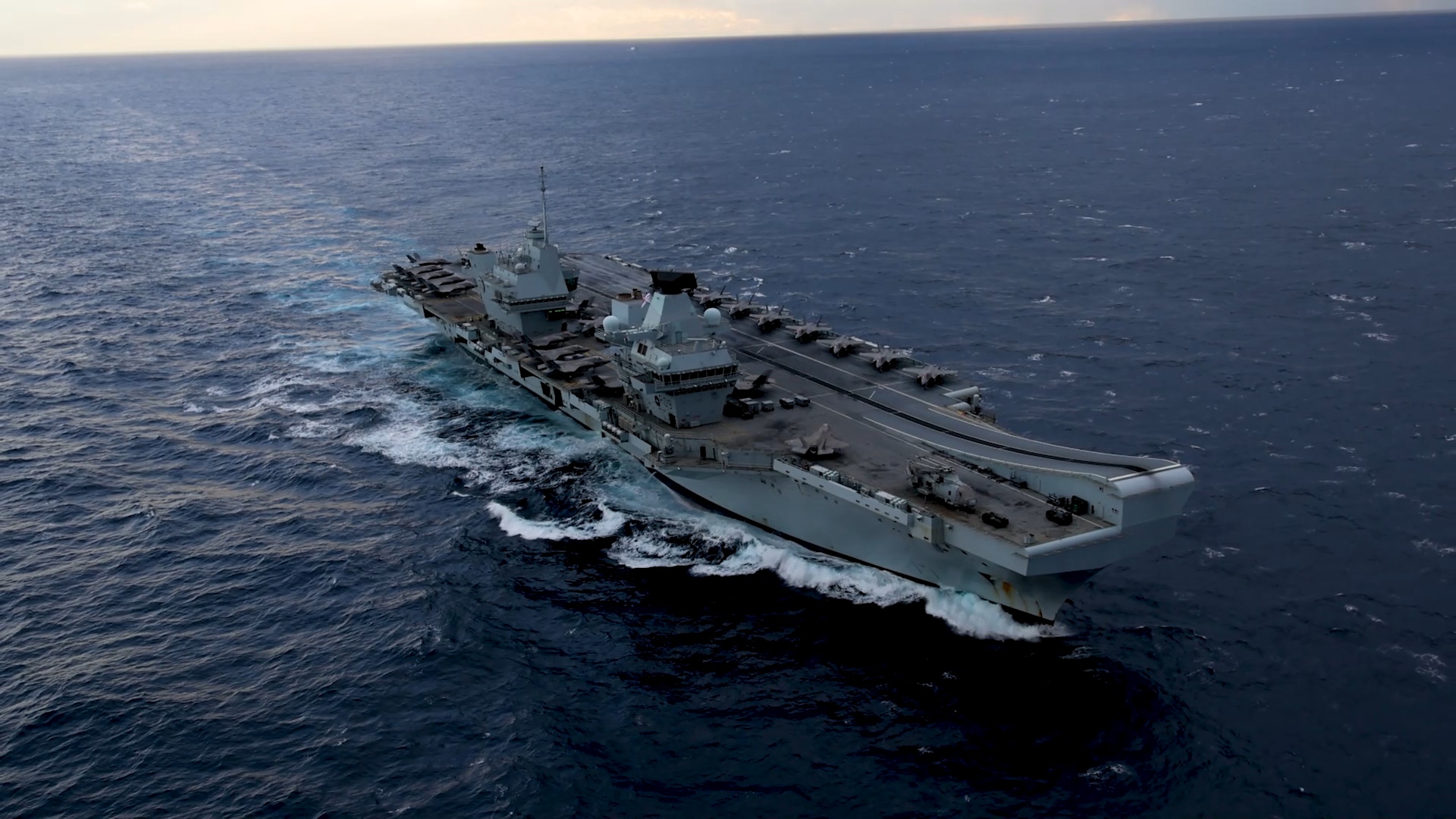
The UK will deploy a Carrier Strike Group to the North Atlantic and High North in 2026 under Operation Firecrest, in what the Ministry of Defence describes as a major show of force aimed at deterring Russian aggression and protecting critical undersea infrastructure.
The deployment will be led by HMS Prince of Wales and will include warships, F-35 aircraft and helicopters, as part of a broader effort to strengthen NATO’s deterrence posture in the Euro-Atlantic and Arctic regions.
According to the Ministry of Defence, the move comes amid growing concern over increased Russian naval activity in the North Atlantic. The government claims there has been a “30% increase in Russian navy vessels threatening UK waters” over the past two years.
The strike group is expected to operate closely with the United States, including activity off the North American East Coast and a port visit in the US. The MOD said American aircraft are also expected to operate from the flight deck of HMS Prince of Wales during the deployment.
Operation Firecrest will also contribute to NATO’s new Arctic Sentry mission, launched this week, with the government citing the strategic impact of melting sea ice opening new routes and increasing the risk of hostile activity in the High North.
The MOD highlighted concerns around Russian operations in the Greenland-Iceland-UK (GIUK) gap, as well as the vulnerability of undersea cables and pipelines.
Defence Secretary John Healey said the deployment would reinforce British leadership in the region.
“I’m proud that we’re stepping up UK leadership on High North and Atlantic security,” Healey said.
“This deployment will help make Britain warfighting ready, boost our contribution to NATO, and strengthen our operations with key allies, keeping the UK secure at home and strong abroad.”
The operation will involve thousands of personnel across all three armed services. The MOD said the Carrier Strike Group will also exercise alongside NATO’s Standing Naval Maritime Group1, which will be led by the UK throughout 2026, with HMS Dragon acting as the command ship.
Parts of the deployment will fall under NATO command and will include cooperation with Joint Force Command Norfolk, which the government said is expected to be led by a British officer for the first time.
Operation Firecrest follows the UK’s 2025 carrier deployment to the Indo-Pacific, which the MOD said involved more than 1,000 F-35 sorties and engagement with over 30 nations, and resulted in the Carrier Strike Group being declared fully “mission ready” for NATO operations.





Good news, but not unexpected. She’s been up there before so it’s good for ongoing training. Let the media build it up how they like. Good PR.
British F 35s don’t have anti ship missiles
The Russian navy threat is submarines, not their surface fleet. More people should be asking questions about the availability of the Merlin fleet.
And aircraft.
And the few remaining T23s.
Our Politicians have been asleep for 10 years. How they could have slept thinking about their negligence is anyone’s guess. We should have been spending 3% since Russian took Crimea.
Meanwhile LM need a kick up the A to fit Meteor on the F35’s. By far the Best in the West. Scale it up and you have a hypersonic attack missile.
Yes and we need 30 new Merlins. Lots of Naval updates a going forward at a glacial pace.
Pave-way IV is more than capable enough of taking out anything Russia can put in the surface.
Bombs vs long range SAMs – yes dear
I think Paveway requires laser target designation to hit ships. I’m sure the F-35Bs would have that, but would they want to hang around ships with SAM missiles or would they use a support aircraft/drone to target? I think we’ll all feel better when Spear becomes available. However, there should be at least one support ship with NSM for the larger ships, hopefully more. Sea Venom can be deployed on Wildcats for anything corvette sized. When you get down to fast attack craft there are Martlets and even CAMM.
Jim and Jon It’s a bit like WW2 and Norway. We’ll drop bombs on the Russian ships, assuming we can get near them, given that there is every possibility that our carrier will have ben sunk by Russian submarines by then, or Russian aircraft, or Russian missiles, or Russian surface vessels, perhaps one of well over 100 corvettes in their navy. A carrier with 12/15 aircraft (?) operating in a very hostile environment, relatively close to land, is fine as long as nobody fights back.
In reality the Russian long range maritime strike fleet is not going to survive engagement with a squadron or two of F35bs.. most of them are bears and probably 20 backfires.. these big high altitude bombers are going to glow like firefly on radar.
The other danger is the SSN fleet.. Russia can probably get out one of its modern SSNs that probably sit between a Trafalgar and an astute.. and 1-2 old Cold War SSNs that will sit at trafalgar level.. and the thing about the astute is actually probably the best SSN at just hanging around slowly waiting for the fly to come to it.. add in the fact the RN still has the best ASW frigates and rotors anywhere and the RN will have air control ( because Russia has nothing that can live in the same sky as an f35 ).. which means the RAF strategic air and RN rotors can have complete freedom.. P8s, wedgetails ( soon) and rivet joint and air to air refuelling).. the Russian navy could not live under that sky.. because a ship on its own can only see 20 miles.. they would die blind…. It’s why a surface and sub surface fleet cannot operate against carrier battle groups outside of their own air cover.. they must avoid them.
💯👍🏻👏🏻
I would be hesitant to place the Astute-class so firmly ahead of the Yasen.
It’s well-known that the Yasens are very quiet, very well-armed boats.
Similarly, I hesitate to claim that the Type 23s remain the best ASW frigates available. That title has been lost to the FREMMs for some time.
The bones of the Yassen are a lot older than the astutes.. there reactors are also a little noisier and RN propulsion is known to be quiter…. So it’s a good bet Asute is the better ASW platform.
Yeah, that’s more reasonable, but the strengths of the Yasen don’t lie in ASW – they far more adept at filling the old role of the Oscar IIs – long-range, virtually undetectable missile batteries, that don’t need to close with a CSG to threaten it.
Unfortunately, that makes it virtually undetectable for a carrier escort force and their airborne assets. In contrast, the Astute lacks that kind of anti-ship firepower, being capable of rapid consecutive launch through the VLS.
As an aside, acoustic stealth is sort of an irrelevance, at least in the highest circles of submarine design. New improvements yield diminishing returns. For example, the collision between the British and French SSBNs indicates that neither submarine were able to detect the other (at least until they’d closed to a very, very short distance), despite the British SSBNs being generally understood to be more acoustically stealthy, and possessing a more powerful sonar suite. It’d be worse with SSNs.
Really, the single biggest advantage the RN submarine force has over the rest of the world is the quality of its crews. The boats of various nations are approaching an acoustic equality, but the training of British submariners still vastly outperforms that of Russian conscript crews. That’ll make far more difference in any hypothetical 1-on-1 scenario. Well, that and the non-acoustic tracking and detection systems. 😉
The RN and wider NATO then needs some really outer screen ASW then, a sort of submarine equivalent of what the Tomcat was designed for.
May I suggest Protector STOL as an MPA with Stingray and sonobuoys, getting initial cueing from T93 ACUA MROS with a big fat passive array?
Kill chain still matters.. the Russians don’t have the capability to set up a long range kill chain against a Carrier battle group.. long range missile strikes against ships are still not a reality unless you have the kill chain with networked sensor platforms and the launcher platform of the kinetic effector. and that is something the Russians don’t have and SSNs specifically are problematic in working as part of a networked kill chain.. it’s why they practice closing to kill.. SSNs kill ships closer than everyone thinks.. it why RN SSNs are so respected they practice getting close and why photos from attack periscopes are considered proxy kills in exercise.
kill chain is why CBGs are so much more effective that surface action groups.. you have a surface action group with 1000km range anti ship missiles it’s still going to loose against a carrier battle group that has achieved air and sea control.. because the CBG will kill any airborne sensor platform before a networked kill chain can be achieved and will be able to use its own airborne ISTAR to get a kill chain in the surface group.
We certainly seem to have a good acoustic advantage.
The Russians would be idiots to throw the only really difficult to manage conventional strategis assets they have… a Yassen is not an attrition asset.. the Russians would be utterly mad to throw it away again a western AsW screen.. essentially into a trap designed to kill it.. instead it will do the think that makes an SSN a nightmare it will hide in the deep ogin or the northern bastion.. and make long range strategic attacks on key infrastructure or hit softer targets that have strategic impact.. because finding and killing a Yassen doing that will be pretty impossible.
Everything you have said here is spot on accurate / plain common sense 🙂
So why is our carrier going? If the Russians,and sometime soon potentially the Chinese, are incapable there is no point.
To show Russia that if it fucks around it will have a carrier battle group in the high north to deal with.. essentially the 3 Cs of deterrence, capability.. credibility and communication.. essentially floating a carrier battle group past the face of your potential enemy is just that.. and deterrent is the very first purpose of the armed forces.
I have had several replies in the last couple of days telling me that Russia is not a threat to our CBG. If this is the case and given that we are unable to attack Russia with anything other than what is in effect a guided bomb, I merely question whether sending a carrier to the high north is s good use of resources. I would have thought a carrier in the Gulf would been more useful for example, taking pressure off the USN.
It’s not so much Russia is not a threat.. it’s that Russia would essentially put its irreplaceable SSNs and strategic air into the teeth of a CBG.. which without its own CBG is a losing situation.. but at the same time without a CBG in the high north .. Russian strategic air would roam.. its surface fleet frigates ( which have better ASuW than European frigates and destroyers would be on a more equitable footing and our ships and SSNs would be more at risk… essentially the CBG is the queen of the board … she is the make or break piece..
I agree the Middle East is important.. but
1) the levant can be covered by European land based air.. including Cyprus.
2) the UK and Europe has good relationships with a lot of middle eastern countries that will not go near the US with a barge pole if they can help it.
3) there are two large and 3 medium sized European NATO nations in the med who can and do cover the Middle East.. with 3 modern carriers 1 old harrier carrier and a drone carrier…
The UK is the largest Northern European Navy so it’s probably best that our carrier battle groups are the ones focused on air and sea control in the high north.. we need a presence in the Middle East as its core interest to us.. but we are probably better dividing the carriers 1) UK high north and Atlantic.. 2) France/italy Indian Ocean.
He didnt say the Chinese are incapable
I don’t think he mentioned them at all.
That haven’t demonstrated any of that capability against Ukraine. Do why do people think by magic they can against us/NATO.
You might well be right Robert, but it only takes one torpedo or one missile to take out a carrier. Remember the Falklands…
Our battle space situational awareness will keep them at arms length. We have been playing this game a very long time. And we have vastly superior capability.
H.M. Ships Antelope, Ardent, Coventry,Sheffield, RFA Sir Galahad.? I’m sure we were confident of our situational awareness then as well.
RN frigates in the 80s were essentially not able to defend themselves so their situational awareness was irrelevant.. the carrier force was vestigial. and let’s be really really clear the RN went in under another nations land air umbrella and won.. going within 300 miles of a competent airforce and making a successful contested amphibious assault assault was always going to create a situation in which you lost ships.. a f35s whole purpose is complete situational awareness and to destroy enemy air power BVR.
A type 23 frigate is as capable or even actually more capable than a T42 in AAW.. a Type 45 can in theory destroy 48 aircraft in a 1 minute engagement. A type 42 was designed to destroy 2-4 targets in an engagement at standard RN frigate of the 70s was designed to destroy zero targets.
Technology and capability has rather moved on since 1982 Geoff. And looking at Russian capabilities in Ukraine, they haven’t so much.
But to get that one missile or torpedo Russia will essentially be sending its own irreplaceable conventional strategic assets on very high risk likely to fail suicide missions.. the handful of peer Russian SSNs are not attrition assets neither are its small number of strategic strike bombers.. and if it sent either against a CBG it would know it would be sending them again somthing that was specifically designed to kill them… instead the Russians will use its SSNs for what they are best at.. hiding in the ogin and making strategic ( long range ) strikes against key infrastructure or attacking soft maritime targets that disrupt a nations ability to fight ( oil tankers and such like) the Russians to put it bluntly would be fucking idiots to smash their irreplaceable and tiny number of strategic assets against a Prepared and ready CBG.. Infact NATO would want them to do just that… your never going to reliably find a yassen in the mid Atlantic and your going to be fighting under Russian air cover if you try and kill it in the bastion.. but if it comes directly to you and attacks your strength.. well if the Russians want to throw out the art of war let them…
This might be a step too far, but I do wonder whether the point of Atlantic Bastion, Shield and Sword (better name than Strike) should be to try to roll back the Russian bastion and deny them that doctrine they have held since the early 1950s. I can’t see why with supporting air power on Norway and Greenland our carrier group shouldn’t be relatively safe as high North as Svalbard and the North Cape, it’s as far from the Russian bases as it is from our own and we would have naval air power. We could then send forwards naval MPAs and helicopters, along with SSNs and flooding the area with underwater gliders, to try to make as large an area around the CSG uninhabitable for submarines.
It’s a little more aggressive than what the 1SL has in mind, I’m sure, but with T83 and better AEW we should be able to survive what the Russians can throw at us from ashore and also degrade it using F35 spear, Stratus LO and any other new missiles we develop. It’s then just a matter of ASW.
Yes essentially what the CBG does is allow air dominance in the high north.. this then allows free range of your strategic air assets, rotor and surface assets.. you get sea control from that, then because you have the air and the surface the sub surface units of your enemy are operating where the air and surface are hostile.. the best way to attack the bastions is to use F35bs to gain control of the air and everything else then can roll into place.
We don’t and it’s a huge gap imo, it would add some real punch to our carriers, even if it’s a small number of JSM to be carried externally.
Will Richmond deploy given it’s this year – make the most of the vessel whilst we can?
I doubt it has enough time left. It came out of LIFEX refit in March 2020 and it’s supposed to have a full inspection and hull fix within 6 years.
👍
It’s possible. She should be in decent enough condition considering she successfully deployed last year. I hope they can keep her running on for a little longer, at least until HMS Glasgow commissions.
Where is ‘Lizzie’? It seems that the Prince of Wales is taking all the ‘lift’ at the moment.
Under scheduled refit.
In planned refit. Finishing in the next few weeks.
I wonder why not send QE in that case, seeing as PoW has only just returned from such a big tour?!
The refit’s ~1 year long, and started about the same time as Highmast, so it’s not surprising it’s still going on. PoW will likely go into refit afterwards so it isn’t a huge problem and if we have both available at the same time that just frees QE up to do the hybrid air wing trials that I think are supposed to be late this year.
HMS Prince of Wales is still the high readiness Carrier and will be until HMS Queen Elizabeth has completed the refit in Rosyth and gone through FOST and workup.
Besides, once the second Carrier has it’s refit done, they’ll be free and clear to operate properly for a decade.
Since this deployment is closer to home I wonder if they might deploy so Apaches for training? I’d imagine in this age of boat drone swarms the Apache would prove useful with its main gun and missile pods. I know the RN has the wildcat but it is still not a dedicated attack helicopter like the Apache
Who’s support vessels will we borrow this time…
Norway, Denmark, both would be happy to work with us again and the former were with us throughout Highmast, so it’s not outside the realm of them being more involved closer to home.
Presumably part of the intent is to demonstrate the ability to operate effectively in Arctic conditions.
Mixed feelings. It’s always nice to see a British carrier out doing its thing. Sad that we are rapidly losing / lost our ability to deploy an independent carrier group, due to a lack of escorts and capability.
We haven’t lost the ability to deploy a Carrier group. They are always multi national anyway, and should be. This one is no different. It’s been planned out long in advance anyway.
I disagree, we should have the ability to deploy a decent sovereign carrier group without any allied escorts. I can’t imagine any of our European allies risking their ships and sailors fighting a Falklands style war. But as things stand I dont think we could do it without abandoning other responsibilities.
We will once T26s and T31s start becoming operational.
If we’re going to be serious about our deterrent, the North Sea, a carrier strike group, trade protection & defending our overseas territories we’ll need to order more than the 13 frigates currently in the pipeline. At least one of those commitments either needs to be dropped or the RN needs to grow beyond the 1-1 replacement.
Aye. We’re not exactly lacking on money or experience for it and anyone saying we don’t have it now or can’t do so in the future because of other spending is just worried about diverting money from somewhere else into an economic benefit for quite a few sectors… And end result is, we’re able to respond ourselves.
Mixed feelings about visiting the US when we need to also be detering US aggresion towards Canada & Greenland.
Agree.
The US is going to invade Canada or Greenland, so give it a break…
“is” is the problem..
I have no reservations about us visiting our USN/USMC counterparts. We are going to be doing this with their support. Its Trump and his cohort that are banging the drum about Greenland, i don’t think they are representative of the majority of the US populace.
Interesting comments from Rubio. Trump was right to poke Europe in the eye… we needed to step up.. but maybe, just maybe, the fact that they do know they need us to protect them, as well as vice versa, means there will be less upping the ante? It’s gone curiously quiet on Greenland. What interesting times. The Falklands issue is often brought up in these discussions… the only place I can think of where we would need a go-it-alone is operation is, well, the Falklands, and that’s a very different place to 1982. Where else would we need to act alone… answers on a post card?
Scotland.
I don’t understand. Why would Scotland invade someone? It’s as much of the UK as anywhere else. Being Welsh, I can tell you the Celts have often felt like pulling the plug on England but you wouldn’t last 5 minutes without us. So sleep tight, the Welsh, Scots and, yes Irish too, are making sure you’re safe! But then you could worry about Ynys Manaw (not to be confused with Ynys Môn on which all fast jet pilots train, by the way) and Portland Bill. And St Michael’s Mount, and Camber Sands. What happens when the Scillies invades the Lizard? It’s touch and go right now.
The serious point I’m making is that England does NOT own the armed forces. If Scotland leaves, it takes it’s share. I think it is less likely that they will go for independence now, geopolitics being what they are, but who knows!
Scotlands share? Best joke I’ve heard all day. £200 billion plus of national debt.
Glad I made you smile… but’s remember, their not England’s armed forces!
Indeed.. they belong to the Crown.. upon independence, any cap badge not formed specifically under the “Scottish Crown” would cease to exist.
Hi Wyn, on the Celts v England point you mention, just to say they are more ethnically Celt English than there are Welsh living in Wales, and most of those consider themselves as fully English, likewise many Welsh and Scots are actually Anglo Saxon in origin. The history of this place demands we act together for all our good. The union offered a new way of being together and being distinct, not perfect but it worked. The Welsh have deep roots here and I’m proud of their Celt origins and I say that as a Yorkshire English Dane in origin, so too the magnificent Scots, where would be without the pragmatic and industrious Scots and all those others here who are patriots to the idea of the UK, we are in it together and if there was ever a time we needed to stick together it’s now, despite forces at play here and abroad trying to undermine the union. Yes we need Wales and they need us too.
You are absolutely right. I’m, as it happens, being a Beynon, rather more DNA Celt that many (clan O’Niel, I think, my biology qualified brother tells me) and although I make a lot of noise I don’t for one minute think independence is a real future for anybody… in fact I voted Remain and it’s clear we have to build a new EU, not fight for fiefdoms. Down with the UK and freedom for the Isle of Dogs!
I tried wasp snorting once, Got quite a buzz.
That’s the prepare for war based on the last war approach. Conflict can arise in so many ways that were never anticipated and the point of having a decent military is to analyse the ‘known unknowns’, but have the cupboard prepared for the ‘unknown unknown’ (to quote Rumsfeld). No one could have predicted we would supply challenger tanks to fight a proxy war with Russia, who would have thought the yanks would threaten Greenland? We have to cover all bases which is why we have to have a carrier strike force that is not dependent on allies, which is not that hard, just a few extra escorts. The hard bit was getting the carriers and an airwing to begin with.
Diego Garcia.. would we fight the US for it? The history of these islands is murky, ( but we have a long history of displacing inconvenient people) to say the least and as no one is going to turf the US off it’s a non problem, which is why the Tories started it (Nov 22) and Labour finished it… despite Kemi’s rants. I think Mauritius gets a pig in a poke, but what do I know?!
I suppose I want to say Yes and No. I quite get your point… but increasingly we hang together with other nations, or we’ll all hang alone. Where I’m bothered is how we would really support OZ and NZ if China really expanded. Could we, would we? AUKUS is “just” subs, after all. But if we do rapidly develop hypersonic weapons, what does that mean strategically? Can they be air launched? I’d like to hear the team’s wisdom as it’s way out of my usual area of pontification.
Diego Garcia springs to mind, but it’s ok, we are in the process of giving it away….problem solved.
We are not ‘giving it away’ voluntarily,, we are heading off the likely result if Mauritius takes the sovereignty question back to the ICJ. It is widely recognised that we would lose the case and have to vacate Diego Garcia. At which point the Chinese would come along with a handsome offer to Mauritius and turn.DG into a Chinese naval base.
All this has long been known by HMG and the US State Dept and intelligence agencies. Trump is of course grumpy about it, in his myopic world view, f**k international law and the ICJ, if we want it we will grab it. Not a route likely to endear him to the rest of the world, a bit too Herr Hitler for people’s liking
Of course Badenoch does a volte face and jumps on the Trump bandwagon, eagerly followed by Farage. They are both contemptuous and somewhat ignorant about international law and Britain’s firm support for it.
Nobody Voluntarily vacates after over 200 years. Its a crackpot of nobodies at a corrupt UN who need to vacate!
I don’t care if Mauritius has the UN’s backing… They haven’t got a navy to take it… Nor an air force nor a claim. Shit, the Maldives have a closer stake to it and frankly, they’d definitely make use of them for tourism and whatnot.
Queen Elizabeth class carriers are probably the best adapted aircraft carriers in the world for operating in the high north and Arctic regions where CATOBAR operations can be challenging.
QE class ships will probably be the backbone of the UK commitment to JFC Norfolk moving forward and Putin has almost nothing that can counter them. Mixed air groups of F35B, Merlin’s and wildcats armed with sea venom is the perfect counter to a Russia navy that is heavily reliant on submarines, corvettes and long range maritime aviation.
As part of bolstering JFC the UK should look to other JEF countries to supply escorts to this carrier strike group.
Such a force can be the center piece of JEF capability as the nucleus of NATO JFC Command.
Agree with the positivity but i think its a bit much for Starmer to claim that ‘he’ is sending a ‘fleet’.
A carrier strike group certainly meets the definition of a fleet. How many ships do you think he needs to send to describe it as a fleet?
The Russians operate in the propaganda space, we need to counter that and language is an important part of that. We need to stop selling ourselves short while our enemies continually big themselves up.
Well strictly it’s a squadron, innit? A fleet would be somewhat bigger.
Agreed. Multi-national escorts and cross-decking F35 is well practiced and is the way we would go if the doda hit the whatsit.
If we can get the Astutes up to readiness, and Starmer doesn’t cut back current orders (a big ‘if’ I know), I think we’d be ok.
Didn’t we recently get another delivered Astute? Depending on the current sea trials, could be slated to go with.
Agamemnon is on season trials. Don’t know if that means she’ll be ready. Maybe.
It’s the only one I can see being made ready in time… Since we sent our only active/ready to sail Astute to Australia.
Those F-35s that got sent to Cyprus might need to come back now. Navy need em. And ask Yeovil to knock up some more Merlin’s. Could do with doubling that fleet.
Given the non existent state of Russia’s Airforce I think Merlin and Wildcats on the PoW will be more important. 12 F35B will be plenty for an Artic mission.
The USMC always seem to enjoy a rare opportunity to spend a few weeks on a Limey ship, whilst ending(?) the exercise with a port visit to the USA will be popular with the crews. A sensibly modest compromise solution that ticks lots of boxes, gets new joiners up to speed, but avoids unnecessary strain on the handful of operational assets that the RN/RFA has left.
Had a chat with a Marine Aviator about his time onboard, he likes the class. Made a joke that he wouldn’t say no if the Marines acquired the license to build their own and make merry with the skijump.
Our carriers would not be safe against a kid with a spud gun. no SAMS no guns bar the 2 Phalanx, I think a drone swarm could sink them.
Oh and no escorts of course.
Oh and maybe Glasgow goes to a European ally to keep Vonder whats er name off Starmer’s back
🤡
Dominic Cummings (remember him?) said the same thing. As I recall he claimed a spotty-faced teenager could use a Kalashnikov suicide drone to sink a carrier. He was wrong and so are you. Have you any conception of what it would take to sink a modern 65,000 ton carrier?
In WW2, it was said that a Japanese kamikaze plane carrying a ton of high explosives could crash into the deck of a British carrier, the resulting mess being cleaned up with brooms and buckets and the carrier able to launch planes in under an hour. Despite the obvious exaggeration, there was much truth to the propaganda. The aluminum and titanium coating of the QE’s deck can withstand temperatures up to 1,500°C for maybe ten seconds at a time repeatedly for 50 years. I wonder if a 5kg 3000°C RDX detonation lasting a second or two would damage it at all.
Hmm… I wonder why the USA installs a massive amount of defensive weaponry on its carriers, maybe they know things you do not know ^.^
I believe that the deck coating you describe applies only to areas on which will permit F36Bs to do vertical take offs and landings.
They also did that before the prevelance of drones; there are many possible vectors of attack to defend against. They also need to stop attacks that won’t sink the carrier. I agree that the QE carriers should have better organic defences, and you are correct that I exaggerated the point for effect, but so did you. You won’t sink a carrier using drone swarms and I get a little cheesed off that people keep saying that a drone or even a swarm can shink a carrier. Read up on a Sinkex to see what it actually takes.
Am I mistaken or did Ukraine destroy most of the Russian Black Sea fleet with drones?
With these refits does this mean the carriers could be getting Dragonfire and Ancilia decoy mounts down the track along with the T45/26/31s? Not sure if the T31 is getting DF.
Thought that the Dragonfire ordered was only scheduled for the T26s?
Just need the 30mm, that we have in storage, and Ancilia to be fitted to the carriers PDQ.
Has no-one learned from the lack of a layered defence in 82?
Speak quietly of the Atlantic Conveyor and no “Chaff” dispensers.
the odd thing is ukraine are the only country to have deliberately attacked the wests undersea infrastructure, they deliberately blew up nord stream2, yet it’s russia that we think we need to guard against, and it’s the west that allowed nato to spread eastwards (despite the assurances given to russia it wouldn’t happen, see ‘nsarchive, what gorbachev heard’) right up to russia’s border
our politicians, and military, live in a topsy turvey world that they don’t understand
That’s because President Putin is a good, kind and deeply misunderstood individual, so pure of heart that his political opponents are struck dead in a variety of ways by heaven itself. The West lied and cheated the dupe Gorbachev, causing the break up of the Soviet Union and allowing the Nazi Zelensky to take control of a piece of Russia. It’s obvious that the righteous Putin should try to take it back, but the West doesn’t understand.
Do I have the narrative right, Comrade?
putting silly hyperbole aside, see ‘nsarchive, what putin heard’
all you need to know anout this conflict is that in the aftermath of the US (obama/biden) sponsored revolution in 2014, the biden’s made $millions from ukrainian oligarch’s
it ain’t rocket science is it ?
I believe both Russia and Ukraine blamed each other. Last thing I saw was it was all conspiracy theory stuff
See the wall street journal, and why are Poland refusing to extradite a Ukrainian national to Germany for questioning ?
That’s nice… however, I would have thought the POW would have had a wee break, and the QE would have taken the gig to arctic waters, or is that ship in bits somewhere?
Yes lets send the aircraft carrier on an operation, as Starmer will soon sell the carrier to the Brazilians cheap.