

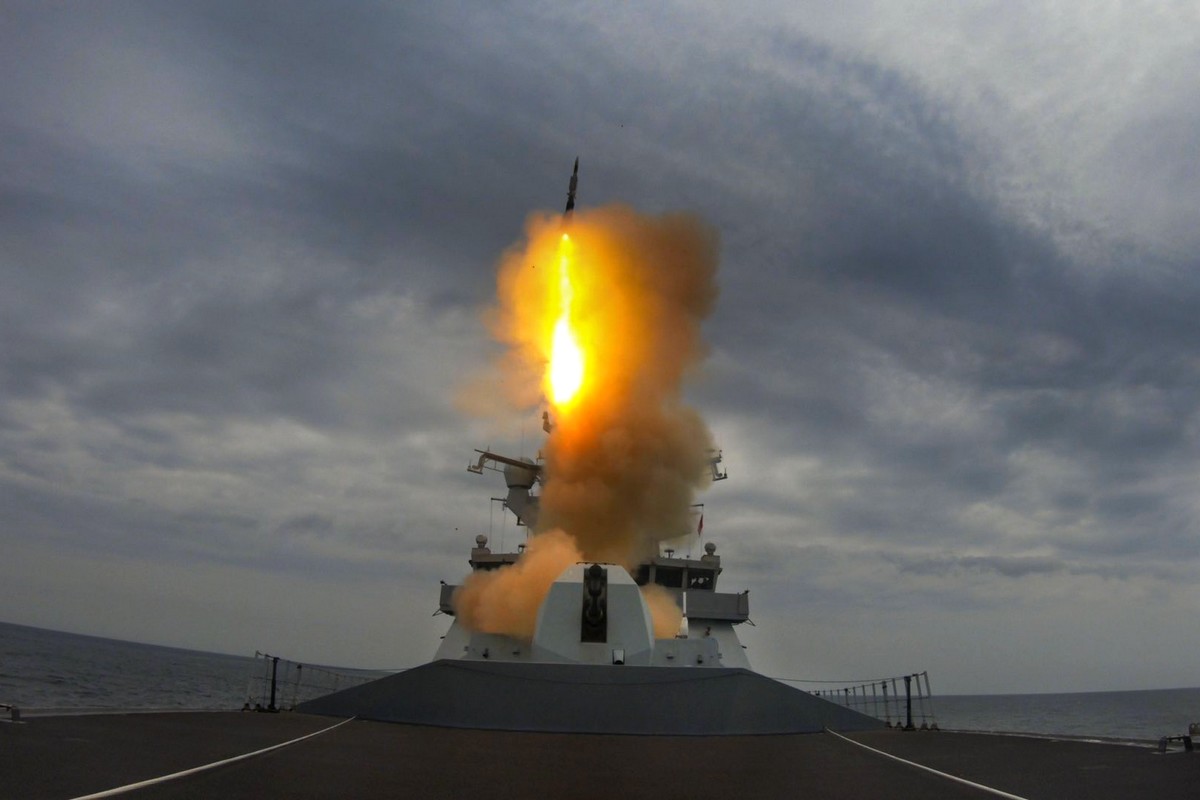
The Ministry of Defence has awarded a £2 million contract to MBDA UK to examine the feasibility of integrating the Mk41 Vertical Launching System with the Aster 30 missile.
According to a transparency notice published on 30 January, the contract will fund a one-year integration study assessing the technical viability of operating Aster missiles from the widely used Mk41 launcher system. The work is expected to run from February 2026 to March 2027. The study will explore compatibility between the Aster missile family and the Mk41 system, with the aim of informing future capability development and improving operational flexibility across the Royal Navy’s surface fleet.
The Ministry of Defence said the findings would support longer-term decisions on launcher commonality, potentially reducing the requirement to maintain separate vertical launch systems for different missile types. MBDA UK was selected through a direct award process on technical grounds. As the original equipment manufacturer for the Aster missile, MBDA holds the specialist design authority and technical data required to assess integration feasibility. The company also retains contractual rights to relevant Mk41 technical data from Lockheed Martin, the launcher’s manufacturer.
The department stated that there were no reasonable alternatives capable of conducting the work to the required level of technical assurance. The contract, valued at £1.67 million excluding VAT, falls under military research and technology services and does not constitute a decision to procure or install Mk41 launchers on Royal Navy vessels, the MOD added.
Instead, the study is intended to test viability and identify potential risks, costs and constraints associated with integration, including regulatory, technical and programme dependencies. The Mk41 Vertical Launching System is in service with numerous NATO navies and supports a wide range of missile types, including air defence, strike and anti-submarine weapons. Aster 30, currently deployed aboard the Royal Navy’s Type 45 destroyers as part of the Sea Viper air defence system, is launched from the Sylver vertical launch system.
The Ministry of Defence noted that the study’s outputs will be used to inform strategic choices rather than commit to a specific configuration, with any future decisions remaining subject to affordability, operational need and the Defence Investment Plan. No timelines or platforms have been identified for any potential follow-on activity.









Good news, and hopefully a pathway to broader deployment across the fleet, given that all our future escorts will be armed with a significant quantity of Mk41 cells (as planned – I know the T31 is nebulous). That of course would require changes to the radar systems on the frigates, but it’s a start. It also makes British pitches to both Denmark and Sweden for the Type 31 frigates more appealing.
I’m glad this process is starting more than a decade before the Type 83 is provisionally due to enter service. The British procurement system has a history of delays, and a moment in the 2040s in which our air defence destroyers lack their missiles would be far too familiar.
I am worried about how this process will function, however. LockMart and the integration of foreign weapon systems onto their products, specifically British products, is hardly a combination that inspires confidence. For all the marketing mumbo-jumbo about various systems being Mk41 compatible, the actual pool of integrated foreign missiles is tiny – just the Japanese Type 07 anti-submarine missile (which is a slightly different situation, as Japan constructs its own Mk41 systems).
Doesnt necessitate changing the frigates if they dont plan to use Aster on them.
I know, I’m saying that would be required IF they decided to use them.
Can’t they be cued from the T45 radar? Obviously a limitation when they’re on their own, but they’re less likely to need BM interception for those types of missions.
Not without a system like CEC
It doesn’t.
We’ve been over that loads of times.
And yet T83 radar and drone ship program requires the creation of a CEC alike
The ability to hand off control of a missile fired from a T23 to a Typhoon and from a WildCat to other platforms has already been demonstrated and put out in press releases.
Then explain the continued ambition for a superior system
You are wrong in that.
A30 has a compact form factor and will continue to be the medium range effector.
AQUILA has a totally different intent and different form factor.
They are not mutually exclusive as products.
I’ll step in here. There is a data-link system already in place that can do a lot of what CEC can do, ie Link-16. However, it has its imitations in both bandwidth and download and upload speeds. CEC solves a lot of these issues. CEC gives you significantly more capability especially when you want to control multiple weapons as well as giving live sensor data. Something that link-16 can’t do.
Now I don’t know what you’re talking about, we’re talking about CEC not missiles
Try Googling – Digital Targeting Web….elements of which have been tested.
All I can say is I read an article recently referencing such a future concept and its feasibility. It’s desirable exploiting Samson considering its capabilities until its replacement on future platforms but as Hugo mentions would involve widespread sensor fusion and upgrade to the ships fire control. Will it happen I’m sure there will be a Committee or 5 for that over the next decade.
We don’t know that Hugo.. we have no idea what the RN may have in their heads.. they may be thinking of using the type 31 as arsenal ships for an integrated air defence system… the May be planning what vertical launch system they have on the type 91 arsenal ship.
This project won’t be done anytime soon, nor will T31 have Mk41 anytime soon.
And t26 again needs to carry our strike missiles. And would require a radar upgrade to use Aster 30
T91 won’t come till T83
Yep this is naval stuff what you design today you will not have for a decade.. but that is what it is .. the navy we have now was set down by 2015
MOD is clearing the decks for an AAW variant of T26.
Given a choice, the RN would jump at the chance to ditch ASTER and move over to SM-6 which has become the de facto primary 5 eyes AAW missile.
Hardly, this is related to T83, and why wouldnt the RN be interested in SM6 arguably more capable and more likely to be upgraded.
T83 = powerpoint ware
Hardly, this is the second program of note in relation to it along with development of a new radar.
I’m not entirely sure if they would. The treasury hardly allows in the funds for a decent size stockpile and that is with the price of the aster. The standard series is far more expensive and if we opt for getting SM-3 for BMD those are about 15 million a piece. You would have to spend upwards of 10 billion just to get enough missiles for a decent stockpile if using SM6 and SM3. While SM6 is quite arguably a better missile than aster we also have to acknowledge that just being a better missile doesn’t mean that much if we can only buy a couple hundred of them
The SM-6 is best used in concert with two other types of missile – a dedicated BMD solution and a cheaper dedicated solution for air-breathing targets. The USN has this nailed down by the SM-3 and the SM-2, which compensate for the SM-6’s main issues (it’s comparative weakness at terminal phase BMD and the high price per unit).
On the other hand, the RN doesn’t have the luxury of a dedicated exo-atmospheric interceptor, nor is it able to field a dedicated medium-range interceptor purely for air-breathing targets, due to cost issues. As a result, the RN uses the Aster to fill both the terminal-phase BMD role and the AAW role, which necessitates sacrifices – those principally being made to the extremes of capability. For example, the Aster’s range is at best 150km, meaning that the SM-6 outstrips it in that role by far. But, the Aster is designed with terminal-phase BMD as a greater priority, making it better at that role in its later versions. By replacing the Aster with the SM-6, you lose that dedicated TPBMD design in exchange for greater prices, fewer missiles, but longer range.
The SM-6s seeker is basically a BlockC AMRAAM’s which is already feared to be massively vulnerable to jamming. I would acquire SM-6’s if they were free. The range is good but pointless if nothing happens at the end.
I think that’s a bit of an overstatement there…
For starters, SM-6 and Aster30 are not even direct equivalents, for that you’d be looking at the SM-2.
SM-6 is a very expensive all-rounder that even USN ships carry in small numbers, as it is cost prohibitive against normal targets (including jets and AShMs) unless there’s nothing left. A truer equivalent of SM-6 would be the supersonic version of Stratus.
The RN may very well be interested in SM-6, but not to replace Aster30, they wouldn’t be able to afford a full magazine for all the T45s…
I thought that BAE were involved in the design, development, and production of the Mk 41 Vertical Launching System (VLS) and that BAE as prime contractor awarded a contract to Lockheed Martin in 2018 to supply the MK 41 VLS for the Royal Navy’s new City-class Type 26 frigates.
Thought exactly the same.
I’d suggest it’s more likely to be Type 83 related.
Sadly the MoD are playing catch up. Studies were down very a decade ago. Which at the time ran a theoretical study as well as computer simulations. From what I understand it stopped at doing a physical fit check or the physical integration work.
So I’m a bit confused on what this study is actually for?
For Type 83
Initially to increase the T45’s loadout (remember this was pre CAMM). But at the time the integration costs were deemed too high, which is probably why the RN went down the CAMM route for the T45. MBDA shot themselves in the foot, for not supporting the funding of the integration. As the Aster 30, if it was fully integrated with the Mk41, could have been competing directly with the SM2. It would have had a significant advantage, as the Aster has a much better chance in achieving a direct hit on a target in the terminal phase part of the interception, compared to the SM2. It was definitely a wasted opportunity, especially when you consider how many Frigates/Destroyers of other Nations use or will be using SM2.
I presume this is in order to equip T83 with MK41, enabling Aster/CAMM/strike/ASM all in one flexible VLS.
I wonder if Aster 30 can dual pack+
Definitely not, the interceptor may be small but the booster is not.
MBDA in France has already done some investigative work on this potential option simply as a precaution to losing out on Aster sales, clearly not desirable for them and their gated platform but certainly was deemed feasible should it be deemed essential. So will be interesting to know where that left off and this new very wise new feasibility study picks up. Hopefully there won’t be any internal conflicts, which might be the biggest hurdle knowing French intransigence, so let’s hope they are on side (if reluctantly no doubt) with opening it up. With fears over US mischief it might be a real opportunity for MBDA to cash in.
There are a lot more Mk41 slots on the high seas than A50.
So it is really a question of ‘do MBDA want the exports’ the French answer is always yes.
No, only 1 aster 30 missile can be packed into a strike length MK41 VLS cell
“…does not constitute a decision to procure or install Mk41 launchers on Royal Navy vessels”
What utter drivel! We have already contracted for Type 26s to have Mk41s and announced that Type 31s will have them added. We declared the full integration of Stratus missiles with Mk41, so what’s with the coy messaging? It’s like announcing that buying a frigate doesn’t constitute a decision to employ sailors. What are you afraid of, MOD? That someone might actually believe you capable of making coherent strategic decisions? Do I really need to explain that’s a good thing? Do I?
Its not drivel, its stating that this isnt related to the purchase of Mk41 systems for ships such as say T31, which has had nothing contracted.
And stratus hasnt even flown yet, so its years off intergration.
Indeed clearly it is about as wide options as possible to use in a system we are clearly increasingly committed to. There will be great reluctance to have to design in inflexibility to our future warships or restrict the options of those being built. Incorporating Sylver and Mk41 would be a very unsatisfactory solution so knowing your options to avoid it are essential. It will as you referred to earlier overlap decisions on all manner of support systems and sensors, so starting with the basics to underpin planning and decision making even if years ahead is more than wise.
Why is it unsatisfactory to use two VLS systems?
A50 is already integrated into BAE CMS
Mk41 is already integrated into TACTICOS
Mk41 is being integrated in BAE CMS for T26
It depends on how the ASTER family of missiles develops.
Equally if ASTER and its future spirals are all Mk41 certified then Mk41 makes more sense from the PoV of the range of loadouts.
I’d so find the idolisation of SM6 quite odd as it is super expensive and I can’t see HMG buying a mountain of those.
Equally having gone so far down the A30NT route, which by all accounts is looking good, why would we abandon that route, which we have a tech stake in and its journey to AQUILA and go all in on the $$$ ludicrous SM6 system which we don’t have any sovereign tech or control over.
NT and AQUILA will have learned from SM6 and be a generation or two more advanced.
Multiple VLS systems is not space efficient as well as being maintenance inefficient
ASTER is a dead end – it’s a single role missile with a glacial development cycle now at its end.
It’s an OK medium range SAM
It’s only going to be usable against low tech IRBMs
It has zero anti surface capability.
Aquila? A PowerPoint missile just like ASTER Block 2
You’re completely US biased as usual
Seriously!
It’s arguably the best medium-range SAM in current use globally. Far superior to the SM-2, for example. Only PAC-3MSE comes close, or maybe HHQ-9C.
😆
Maybe they are concerned that any future purchases of the MK41 VLS system might not be possible from the US, although it might be possible to purchase MK41 VLS systems from Japan as an alternative
Yes, of course – 🙄
Good news, the Artisan radar is capable of queuing aster 30 so this may see the T26 eventually become more of a destroyer along the lines of the River class from Canada with a better theatre level of air defence while the T45 moves up to ABM capability more like a cruiser.
I think Aster 30 on T26 rather than T31 or the T91 providing additional missiles for a T45 using CEC is a more likely outcome from this trial.
I don’t think Artisan can use ASTER to its full potential at the moment, especially not against BMs. It just isn’t a powerful enough array.
The Artisan NG that BAE are developing should be able to, though, that thing looks beefy. If Tacticos is as modular as Thales say we should replace the NS110 with that and start demoting Artisan to MHPC vessels.
Filling up the mk41s with Aster on the T26s will mean taking silo space away from other missiles. Wonder if they’re looking at putting in one or more mk41s, replacing the forward CAMM farm? What does this mean for quad packing of CAMM/CAMM-ER and potentially dual packed CAMM-MR? The BAE T91 model was showing the Artisan-NG with mk41s so maybe there’s some pre-working on this? Hope this can benefit the CIP and development of T31/AH140 for RN and exports.
This isnt for T26….
How do you know this isnt for T26?
Because it does not have the radar or the VLS space to effectively employ Aster
Surely it has both. The spec of the latest version of Artisan is a pretty good fit for Aster 30 Blk 1. Also consider the implication of the Digital Targeting Web, that sources off the ship might relay targeting information. Right now, as you pointed out to me elsewhere, Stratus might be delayed, so while Glasgow comes operational over the next two or three years, why wouldn’t it have space in the 24 Mk 41 cells?
Artisan is not up to the task, most agree on that.
And this work won’t be finished for years, certainly not till the 2030s.
We don’t have a CEC equivalent
It has more vls space than the italian fremms which all use aster 30. A french fremm shot down ballistic misilles in the red sea with only the pesa heracles as its main radar. Bae are developing arisan ng which will be more advanced..Again , how do you know it wont be fitted to the type 26?
Because it will be our only source of VLS strike missiles for 15-20 years, so out of 24 cells on each ship there is little room for aster.
And it required Artisan NG to use Aster 30 effectively, if it’s even that capable
With NSM on our T26 then a war load of 6 Aster + 6 VL-Stingray +12 STRATUS seems sensible. Upgrading T26 AAW was a stated part of the Norway deal.
Conflating ‘probably won’t’ and ‘can’t’ helps nobody
Thus far we haven’t indicated we’re putting NSM on T26 though
The indication has been that the frigates are going to be absolutely identical between us and the Norwegians, and there’s no way they don’t want to fit NSM. Healey mentions it in this article.
wwwforsvaretsforumno/forsvarsminister-forsvarsministeren-fregatt/fregattavtalen-er-signert-det-blir-copy-paste/454423
Thats for the norweigans, not for us, and NSM is not a major design change between the 2 classes.
Not sure what you mean in the other post.
The Norwegians want to have their ships and ours share exactly the same equipment, as part of an Atlantic ASW partnership. The Norwegians also want their ships to have NSM. There is a lot of buyback associated with the frigate deal, part of which is NSM.
All of that points to our frigates also getting NSM.
I mean the Norwegians are following our design, not vice versa
I feel like aster 30 is better put on a type 31 than a type 26 given the locations both will be deployed to. Type 31 will be doing independent deployments in possibly quite hostile locations such as the Persian gulf and indo-pacific whereas the type 26 will only do solo deployments in the North Sea and, GIUK gap and Norwegian Sea where they are already kind of kept safe and if they are ever travelling to somewhere like the Persian gulf it will be part of a larger task force.
Perhaps T31 is the more natural fit, but when will MOD get around to ordering their Mk41s or applying the capability inserts?
Supposedly immediately after they finish sea trials. But then that asks the question why didn’t they just build them with Mk.41 to start with, it would have been cheaper than building the ship then cutting it open again.
I doubt it. CAMM-MR and perhaps even CAMM-LR would make more sense.
If the Americans can’t be relied on anymore, shouldn’t the Royal Navy be considering whether to fit Sylver instead of Mk41 VLS in future?
SYLVER is a dead end.
The Italians are using it for their next-gen destroyers, I believe.
The issues was, and continues to be, timing.
When the Type 26 and Type 31 were being selected and developed, Sylver was a dead-end. A50 was unable to carry larger missiles, whilst A70 couldn’t carry anything smaller. For the RN, Sylver was no different in its flexibility than the cold-launch CAMM VLS. So, it was Mk41 all the way, because at that point, it was the only option.
Then, the A70-NG began to enter the public knowledge. Still, with the relationship with the US still warm and predictable, the Mk41 remained a decent purchase, given this newer universal European VLS was still of way off.
Now, that’s changed, and if you look at things from a pure convenience perspective, the A70-NG would probably be the best choice. All the planned future British vertically-launched missiles are of European (MBDA) origin, and there are extended-range BMD missiles in the works for France and Italy that would serve the RN well. But, because of the commitment to the Mk41, British warships are too late into construction to avoid a major capability gap if a switch was approved (Type 26), or are built specifically to take the Mk41 as part of their design (Type 31). That leaves the RN stuck with the Mk41, and therefore obliged to carry it forward into the Type 83 destroyer and its accompanying programmes.
Japan produces the MK41 VLS system, might it be possible for the UK to purchase them from Japan instead of the US ??
Japan would need a license to sell Mk41
Given that BAE holds significant contracts from the US Navy to manufacture missile canisters for the Mk 41 VLS. Would it not be easier for the UK to build MK41 under licence?? instead of buying direct from the US??
No? Because we aren’t build enough to warrant that.
I was afraid the answer might be something like that. Thanks for the explanation.
We are going to buy ASROC – the last issue to its adoption has been resolved
No we arent? For one the US doesnt even make Asroc anymore
VL-ASROC is, to be frank, a bit shit. I don’t think the US even produces it anymore.
It would be nice if Germany gets with the Program and goes for switches to Sylver A70 on F-127 instead of buying American Mk41 and SM-2/ESSM but I doubt it, they’ve been on Mk41 way too long to swap.
A70 can’t launch Aster, they’d have to wait for A70NG
I mean F-127 isn’t going to be hitting the water until the 2030’s, so plenty of time, if not then A50.
They want strike missiles as well. Slyer is just a bad system, have to use a different version for each capability and limiting capacity.
F-127 is being equipped with Cannister launched NSM. So whatever VLS it is equipped with, the strike missiles are not going into it. So non issue. Sylver (not slyer) is a good system and it’s not US derrived so we need to go all in on it.
NSM is incredibly short range compared to what our opponents have. Also the Germans want tomohawk
Not really, unless you are counting ballistic missiles. Even the Americans are going in for NSM so that seems a moot point.
Also the Germans are considering Tomahawk (not Tomohawk), but don’t seem to be making a lot of noise about the naval variant, while NSM seems to be further along as it will go on all their ships.
Also the entire concept of the original: “Germany should be moving away from American equipment” comment seems to have gone entirely above your head.
Also Naval Group seems to claim in their brochures that Aster 30 and 15 will fit in Sylver 70. Google and Wiki both say that Aster 30 can be fired from Sylver 30. So I’m going to go with that.
All IRL evidence is to the contrary with the Fremm DAs removing their A70 cells for A50 cells to provide more Asters, or the current development of an A70NG to create an actual universal VLS
Every source I can find says one thing, random commentator Hugo who seems to have a bee in his bonnet about Sylver and can’t even spell it right says otherwise.
Yeah I’m going to have to go with “not listen to Hugo” on this one.
So explain to me then why everyone is not just installing A70 on all their designs exactly? Because all the new French and Italian designs have space for them.
The idea that the Aster-30 fits into the A70 stems from the fact that the internal dimensions of the A70 technically can house the Aster-30. However, the A50 and A70 are not particularly similar, despite sharing a name and a lineage, with the latter being designed significantly later with the sole intention of launching the MdCN. Naturally, then, the design makes significant concessions in its design – those familiar with the product inform me that the electronic systems in particular are quite specific, with the usually reputable Naval News also suggesting that integrating the Aster-30 in the A70 would require structural changes.
So, unfortunately, the suggestion that Aster-30 could potentially fit into the A70 was taken by many to indicate that it had already been integrated and was essentially ‘ready to go’, in the same way that an ESSM can readily be packed into a strike-length Mk41 cell. This is not the case, and no integration work has ever been funded, or even studied seriously by the French or the Italians.
As Hugo says, the French actually changed their A43/A70-equipped design for a purely A50-equipped design, to enable Aster-30 carriage. Similarly, the Greeks and French, when considering whether their FDIs ought to be equipped with the MdCN, did not opt to switch the entire VLS complex for the A70, instead choosing the design incorporating a single A70 module and three A50 modules. Again, during the Italian FREMM EVO and DDX design stages, a mixed A50 and A70 set-up was the standard, before the current A70-NG thinking began to arrive.
So, the evidence is to the contrary of what assumed by many – there is something prohibiting the easy integration of the Aster-30 into the A70, which is now spurring on the development of the A70-NG.
There is a problem with the Mk41, which is that it has an exhaust temperature limit. This is due to how the exhaust gas is directed as it pushes out of the launch canister, dies a 180, to come out of the combined exhaust port.
The Raytheon Mk57 used in the Zumwalt’s fixes this with a u-bend below the canister. Thereby allowing to handle much higher temperature exhaust gases. Be interesting to see if Sylver can handle the higher exhaust temperatures?
why so categorical?
Sylver is not dead since other navies use it and it fires MBDA weapons. Additionnally Sylver continues to evolve and will fire new weapons like Stratus, etc…
FYI as of today the Mk41 VLS only fires US weapons.
The main difference is that many navies have decided to buy US weapons and therefore use MK41.
you mean like the promises from Lockheed Martin ? ie integrating foreign weapons on F35? to date only Asraam is available.
FYI as of today the Mk41 VLS only fires US weapons. ofc there is talk of integrating foreign weapons, but it hasn’t been done yet. Just like a decade since UK has received its F35 and Meteor is still not fired from F35.
Sylver fires MBDA weapons. Additionnally Sylver continues to evolve and will fire new weapons like Stratus, etc…
The main difference is that many navies have decided to buy US weapons and therefore use MK41.
Slyver does not have a universal launcher and wont for many years, were finishing a T26 this year so what exactly are we supposed to install on it.
T26 does not use Sylver, T26 was always planned with Mk41.
Question is what weapons will UK use on it? an interim buy of US weapons while integration of foreign weapons drags its feet as usual?
in french there is a saying “les promesses n’engagent que ceux qui y croient” -> Promises only bind those who believe in them.
FYI Japan uses the MK41 and both their Type 07 (ASW ASROC Replacement) and Type 23 (SAM) are MK41 compatible (see Mogami class for details). IMHO the Type 7 would be an excellent choice as a stand off ASW weapon for that very reason.
Hopefully, that will be what we get. As long as its stingray compatible
Err, The Type 07 is hardly better than the VL-ASROC. Roughly 22-25km range for the former, compared to 30km for the latter.
The RN would be better off developing their own in scenario. There’s a gap in the market for a truly modern, vertically-launched ASW missile.
Other way round with the range figures, apologies.
Decades back when the RN was casting a sideways glance at Mk41, DCNS claimed ASTER could be retrofitted to Mk41.
But lessons are never learned, the DCS explicitly warned MOD that SYLVER was a risky dead end and the T45 should be fitted with the Mk41- at the time cheaper, and much more flexible and everyone uses it.
The VLS is cheaper, the missiles are not.
Italy will use sylver on they future ships and very probable so will the french. it’s not a dead end.
you mean like the promises from Lockheed Martin ? ie integrating foreign weapons on F35? to date only Asraam is available.
FYI as of today the Mk41 VLS only fires US weapons. ofc there is talk of integrating foreign weapons, but it hasn’t been done yet. Just like a decade since UK has received its F35 and Meteor is still not fired from F35.
Sylver fires MBDA weapons. Additionnally Sylver continues to evolve and will fire new weapons like Stratus, etc…
The main difference is that many navies have decided to buy US weapons and therefore use MK41.
Question is who is more reliable? who imposes more restrictions? etc…
But the T45 was built around the Aster missile system so why bother
More nonsense, more feasibility studies and more future plans, all to make an effort at placating those who actually know how much bullshit HMG and the MOD are spewing out. Nothing they do now will impact our capabilities in the next couple of years, aside from taking their balls in their hands and ordering off the shelf kit, in preparation for the war we will all be seeing in the next 24 months.
And what exactly can we do in the next 24 months, hmmm?
Exactly, nothing tangible mate!
🤣😂🤣
Your head seems to be a nice place to be, many thanks 🤡🤣
Yet another T45 design decision that continues to gift the navy with crippling pain as time goes on.
You can have less than a handful of bespoke platforms that won’t have compatibility between each other and we’ll can the production before we figure out the design flaws.
Crippling pain how exactly? We have no weapons that can currently go in Mk41
One just has to wonder why no one has looked at integrating Aster 30 with the most widely used western VLS system at the design stage ? This is 101 basic stuff when you spec and design any weapon system, you look at the potential customer baseline numbers and work from that unless there are serious advantages to not doing so.
Ask yourself a question would anyone seriously design an assault rifle to use a 7.63 bullet ?
The RN has already committed to fitting Aster 1 NT to the T45 and fitting CAMM instead of using the pre allocated space to fit MK41, surely this was looked at before that decision was made ?
We dont need Mk41 to launch Aster on T45, this is for future ships like T83
And Europe wanted indepndent VLS for carious reasons but ultimately failed to expand upon it. However yet to be seen if the US allows Aster to be integrated.
They probably would as Lockheed Martin lists the Aster as a “future missile integration” candidate on its official Mk 41 product documentation, emphasizing the system’s open architecture designed to support allied weapons.
MBDA holds contractual rights to use the necessary technical data from Lockheed Martin (the U.S. manufacturer of the Mk 41) to facilitate this integration.
Integration is seen as a key step for AUKUS and NATO interoperability, allowing allies like the UK (on it’s type 26 and 31 frigates) to use European missiles within a standard U.S. launcher framework
This is for T83 in all likelihood
Just speculating and presenting it as facts. Consider this, the Norwegians are buying an identical version of the type 26 as us with an identical upgrade path. When they were deciding their final choice for their new frigate, the one thing that the fdi frigate had over the type 26 was longer ranged air defence. Bae have now anounced artisan ng radar. Now we are exploring intergrating aster on type 26. I think ot is no coincidence that this happened after the norwegian order.l would also be very surprised if the type 26 did not get nsm as well because we have agreed to reciprical buys of equipment from them.And before you say artisan ng wont be capable of guiding aster 30 , standard artisan has already proved capable of tracking balistic missiles.And again, the Pesa heraclrs radar on french fremm frigate was able to succesfully intercept houthi ballistic missiles.
Heracles is a better system than Artsian. But also this is not expressly for T26, more like T83
MK41 family is most used system or planned to be, since most navies buy US weapons. To date MK41 does not fire a single foreign weapon.
Similarly Sylver family fires MBDA weapons.
We’ll see how long it takes Lockheed to integrate foreign weapons on their system. Hopefully not as long as Meteor on F35 … because still waiting.
Seeing how unreliable the US has become not sure betting on that pony is best long term bet? Trump’s replacement could be far worse -> JD Vance does not speak highly of Europe, esp the UK
You are wrong. Mk 41 supports CAMM for one thing.
you speak without knowing. so far CAMM is only launched from mushroom farms. CAMM integration to Mk41 is still in development and not operational in any navy currently. powerpoint promises are one thing, reality is another matter cf Meteor integration on F35B
Actually Sweden has ordered CAMm in a Mk41 derivative so it’s already done.
No, Sweden ordered it as part of the ExLS. So far, there ExLS can theoretically be used inside the Mk41, but it’s not been qualified yet.
Extensible Launching System Either stand alone or as the EXLS host MK41 liner.. LM were very keen to get CAMM in its silos.
Lockheed paid for CAMM to be qualified in its Mk 41 ExLs insert. Google away to find details and photos of launches.
But won’t it be Europe via MBDA that will be integrating Aster onto the MK41 VLS and not Lockheed ??
The MK41 is modular, systems like the Typhon on land and containerised MK41 look like the option the USN is going to use on the Coast guard cutter based frigate. Shopping containers based.
Some sources say Germany is looking at Mk41 integration for IRIS-T, presumable to increase export potential.
Lockheed Martin is integrating, PAC-3 into MK41 for is aegis based customers.
Mk41 is going to be the choice platform so makes sense that for exports it’s integrated.
For the T31 export hopes or could mean better competition for sales to those countries that use Aster currently.at present they would look at the FDI, or Fremm.
Arrowhead with Mk41 then allows them to buy a wider selection of weapons and not be reliant on what fits sylver.
Or maybe the existing Sylver cells are becoming obsolete and for just 6 destroyers that will remain good until 2040, a change to Mk41 would be cheaper?
Theyre not going to change out the VLS on Mk41 again
On T45 not Mk41
Hello Hugo, just to clarify, I’m not on NL and I’m deffo not your mum !!!
😁😁😁 If any of that makes sense 👌
@2012, RN was very minded to swap out SYLVER for Mk41 as part of a SLEP for T45 with plenty of thinking on the concept. A lack of an ABM capability to defend the carriers was high on the reasons, along with the dead end SYLVER had become – none of the great promised developments in missiles had happened.
Alas, all the money was eaten up by the carriers and that, along with other essential programmes, were kicked into the long grass or filed under forget.
1. Don’t be an early adopter.
2. Don’t buy into a niche system when 99% of the market uses an existing proven system.
The RN never wanted SYLVER or ASTER, the original baseline to replace Sea Dart was Mk41 and SM-2. The choice was entirely political – ministers naively hoped by buying Euro, the grateful Europeans would buy loads of our gear in return. They bought nothing.
I’m not holding my breath to see VLS of any kind on the Legend Class Frigates tbh.
And Today,
Everyone’s a Rocket Scientist 😁😁😁😁.
Are you commenting on NL now?
Not the most dignified name.
Ermmm ?
Not me, what name is it ?
I thought given the duplicated ‘rocket scientist’ jibe that you might be Hugo’s Mum. If not, my mistake.
Not me mate.
I’ll go take another look but I think You’ll find It’s probably someone either with a fake name or someone who also post’s here that maybe wants to “Deflect”.
Probably someone I have upset on here by just acting the halfwit and they seem to have an issue with it ?
dunno, probably will never know.
Looks like someone made up a name to take the piss out of Hugo/ HugoJP and I can’t really see any link to me or this site, just the words Rocket Scientist which sort of makes me smile as It’s exactly what I thought this morning when I read all the comments here !!!
Oh and thanks, I now remember why I don’t look at that site 😁
OK, I just had a look, what am I looking for, I can see a whole bunch of names from here, can’t see my name and just to say I seldom even look at that place let alone comment.
There seems to be two Hugo’s and his Mum ! lol.
A year to figure this out?? Gimme a break, a month would be too long.
I wonder whether this is related to the Dutch interest in replacing their Iver Huitfeld AAW ships with a T31 AAW ship which uses European missiles. Maybe even Artisan-NG? How many Mk41 could you fit on an Arrowhead 140 hull if you really tried?
Hang on, I reckon probably thousands (If it’s just a bare hull) 😂
Just musing on possible FAD architectures. For example….say T83 is delayed, T45 is extended and T32 = half a dozen Arrowhead140 with NG radar, 72 or more Mk41 and a mix of Aster, CAMM and ‘Aquila’.
You’re not getting 72 mk41 on a T31….
As Hugo says you probably couldn’t fit 72 Strike length into an AH140 hull.
You could however fit 48 Strike length with an extra 16 in B position, and then add essentially as many ExLS or GWS.35 cells for CAMM as you liked in the boat bay spaces on either side of the main ‘tub’.
Ok, so 72 was a challenge, but you get my drift.
Standard loadout of MK 41 VLS on Arrowhead 140 Frigate is 32. Some design studies suggest the platform could potentially support up to 48 or even 56 cells
That’s the kind of thing I was imagining. 48 Mk41 + 24 CAMM tubes, like the T45. How capable is Artisan-NG going to be? Could ABM destroyers become cheap as chips? 😂
No, look at future destroyer design, those are the requirements for BMD
Ah! Type 83. There are usually more than one way to skin a cat though. A back up plan maybe?
If the T31 gets its full 32 cell Mk41. It would be wise to install a few Aster 30s, whilst leaving the rest for strike missiles and possibly a few ASROC type weapons, if the ship does get a ASW capability. The Asters are primarily there to protect the ship from anti-ship ballistic missiles. Although the ship’s NS100 was not intended for use in tracking ballistic threats. In today’s world, anti-ship ballistic missiles are becoming more prevalent. The NS100 should be capable of providing both detection and tracking of ballistic threats. From what I’ve heard of the Artisan NG, it would be a step change in capability over NS100 and more in line with what Sampson is capable of.
However, if what I’m hearing from the CAMM-MR program is true? Poland have insisted that CAMM-MR has an ABM capability to back-up Patriot. Which could then mean the ship doesn’t need Aster and just uses a mixed complement of CAMM variants. Which then should be enough for the ship to protect itself from the majority of airborne threats it may face. It also means you’d be able to fit a pair of CAMM-MR in a single Mk41 cell. Which could double the number of medium ranged surface to air weapons the ship carries and thereby increasing your defensive options.
Thx DB. It’s complicated, and gives me brain ache. There are a lot of variables and unknowns; above my amateur pay grade really. One perspective would be to ask what the T31 needs in order to do the patrol frigate role originally intended for it – an upgrade to the B2 Rivers, not much more than the guns and a dozen CAMM it will have on day 1. But the Houthi Red Sea episode has transformed the spec required – swarm cruise and drone attacks + ballistic missiles: not too dissimilar to Russian tactics in Ukraine. The ballistic missiles if fired by state actors will have better targeting, seekers and longer ranges. The Aster 30 is a great missile and looks to be a good foundation for capable ABM. CAMM-MR might turn out to be as good as ‘Aquila’ but I think it’s smart of the RN to cover the Mk41 option. The Japanese ASROC weapon sounds good for T31 – would it need a towed sonar array?
The Iver Huitfeldt frigate was armed with 32 MK41 VLS cells and 24 MK56 VLS cells. 32 x SM-2 IIIA Surface-to-Air Missiles Housed in Mk 41 Vertical Launch Systems (VLS) for medium-to-long-range air defence and 24 x RIM-162 ESSM (Evolved Sea Sparrow Missiles): Housed in two 12-cell MK56 VLS for short-to-medium-range point defence.
The type 31 could in theory have 32 MK 41 VLS for various missiles and 24 MK 56 VLS for CAMM Missiles
I’m not sure about a true BMD-capability being indicated by the Polish intention to fit the CAMM-MR to their Patriot batteries. Rather, I think the expectation is that the CAMM-MR just takes the pressure off of Patriot interceptors by improving performance against cruise missiles, drones and fighter aircraft.
That said, of course, BMD is a spectrum, and CAMM-MR will have its place on that spectrum. The currently confirmed performance figures assert a 100km range, but a 20km altitude (from Polish sources), which does place it in the same band as the Aster-30 Block 0, which is making interceptions of SRBM in Ukraine and the Red Sea. Of course, the smaller IRIS-T SLM is also acknowledged as having a capability against SRBMs as well, so it’s not unexpected.