

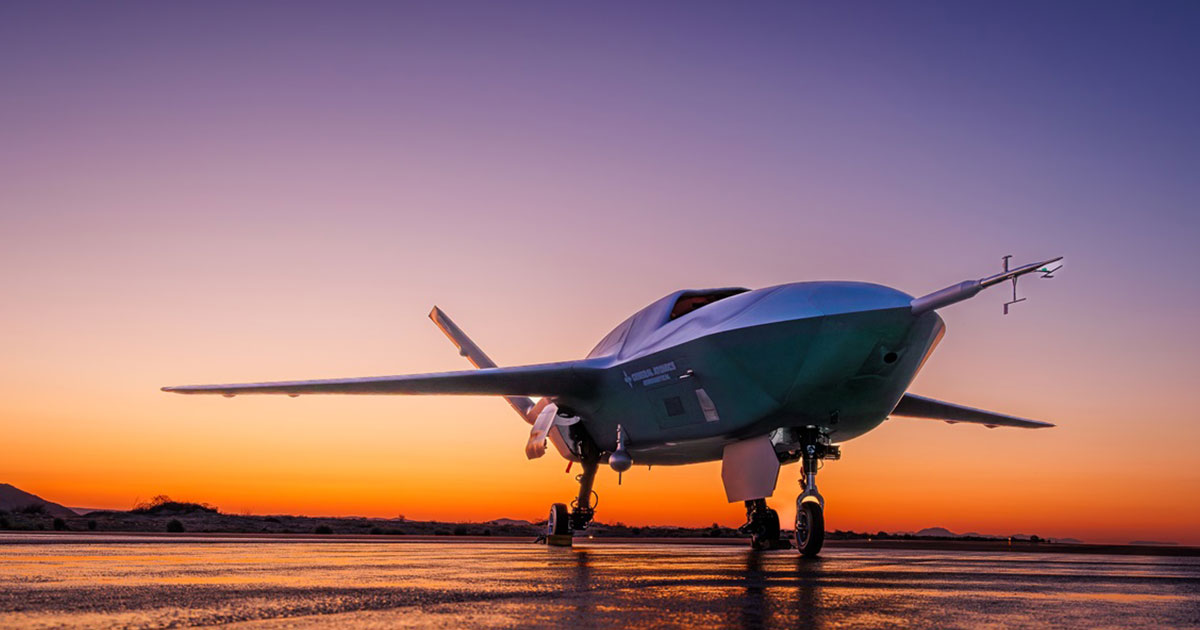
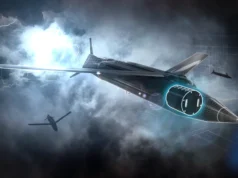
General Atomics Aeronautical Systems has won a production contract from the United States Air Force for the FQ-42A, a purpose-built uncrewed fighter designed to fly alongside crewed combat aircraft, the company has said.
The initial order marks a significant step, beginning the delivery of production aircraft after a development effort the company says was run on an accelerated schedule unlike any fighter in recent history, with manufacturing already well under way. The company’s president, David Alexander, called it “an exciting day for our company and the nation”, saying the move to production was the result of “an extraordinary partnership” and years of investment between General Atomics and the Air Force.
The FQ-42A is a semi-autonomous combat aircraft built under the United States Air Force’s Collaborative Combat Aircraft programme, the effort to field uncrewed jets that operate as so-called loyal wingmen to crewed fighters, carrying sensors and weapons and taking on tasks that would otherwise put a piloted aircraft at greater risk. Its modular design allows the rapid integration of mission systems and autonomy software, with the company describing its flight-tested software architecture as the foundation for human-machine teaming in complex combat scenarios.
The development was fast-tracked, the company said, with the aircraft moving from contract award to first flight in just 15 months, one of the quickest rollouts of a new fighter in history. General Atomics was selected by the Air Force in 2024, alongside Anduril, to build production-representative flight test articles for the first increment of the programme, and its prototype, then designated YFQ-42A, made its maiden flight in August 2025.
That first flight validated what the company calls a “genus/species” concept, developed in partnership with the Air Force Research Laboratory, in which a common core aircraft can be rapidly adapted for different missions and service requirements. Under its Gambit Series concept, General Atomics envisages multiple variants tailored to specific needs, ranging from long-endurance surveillance to air-to-air superiority and air-to-ground strike.
General Atomics has been building and flying uncrewed jets for nearly two decades, beginning with the company-funded, weaponised MQ-20 Avenger in 2008, and more recently the XQ-67A Off-Board Sensing Station developed with the Air Force Research Laboratory, which served as a flying prototype for the FQ-42A concept.
The award also brings a new piece of aviation nomenclature into service, with the production aircraft among the first in history to carry the FQ designation, the “F” denoting a fighter and the “Q” indicating that the platform is uncrewed, where the pre-production prototypes had carried the “Y” that marks a prototype phase.








Had a FQ400 once.
Made by Mitsubishi…. It was “Fecking Quick”.
Anyway, It’s great to see the direction that future wars will take.
Wasn’t that one of those insanely overpowered street legal rally cars?
I’ve gained $17,240 only within four weeks by comfortably working part-time from home. Immediately when I had lost my last business, I was very troubled and thankfully I’ve located this project now in this way I’m in a position to receive thousand USD directly from home. Each individual certainly can do this easy work & make more greenbacks online by visiting
following website—.,..,.,,,,,,.,.,.—>> LIVEJOB1.COM
Yup.
Bonkers fast It was.
I remember the EVO beating a Murcielago around the Top Gear track 👌
That’s the funniest thing mate, It was a fraction of the price.
It’s like a little race I had a few weeks back. My 31 year old Triumph Daytona 1200 against a new (ish) Gallardo… the bike won !
Gambit is such a good and obvious idea. Wonder why BAE could not copy it.
Because no one paid them to develop it. The fundamentals of the business case is that this is designed to work with the F35 and will be able to share data with that aircraft. The very concept of the F35 was acting as a quarter back for uncrewed escorts. Seeing the F35 is the best selling 5th generation fighter, any private venture would be directly competing with the gambit programme. Very hard to integrate without Lockhead’s support as the F35’s design authority.
Can’t speak about how the Anduril and General Atomics CCAs are integrated with USAF fighter jets, but Boeing Australia’s Ghost Bat seems to be platform agnostic. The recent test firing of an AMRAAM by the Ghost Bat destroying a BVR target was deliberately staged to mimic a real operational scenario and demonstrate its autonomy and flexibility. The Ghost Bat was launched by an RAAF ground controller, flew an autonomous air patrol, was handed over to an E7 Wedgetail crew and used data from the AESA radar of an RAAF Super Hornet to acquire, engage and destroy a target at BVR range.
Maybe the US wants a more exclusively “US” CCA? Read in aero-mag.com that Boeing US/AUS is teaming with Rheinmetall so maybe a deal with Germany first up and then others. Wonder if NZ would be interested?
Ghost Bat is being developed free of US ITAR arms regulatory controls so Australia should be able to export Ghost Bat to any country hence potential sale to Germany
It could offer NZ some kind of limited air combat capability at a relatively affordable price but would require a couple of AWACS (SAAB??) to provide effective control and targeting data (unsure if the AWACS can provide weapons grade targeting tracks though)
Both General Atomics and Anduril were awarded production contracts yesterday under the same CCA Increment 1 decision. The USAF has therefore put both the FQ-42A and FQ-44A into low rate initial production at the same stage of the programme. The first batch is expected to be roughly 100 to 150 aircraft in total, split between the two types, with a longer term aim of around 1,000 aircraft. Interesting times ahead.
Yup, no idea why UKDJ is only bothering to report half the story 🤷🏻♂️
Makes you wonder who they will attack next 😁
Boeing Australia has just announced details of the Block 3 Ghost Bat in development for the RAAF. It features a larger wing for increased payload/range, improved autonomous features and most importantly internal weapons carriage. Block 3 includes two side ejecting weapons bays (port and starboard) behind the air intakes. Each bay can carry a single AMRAAM (2 per aircraft) or two Stormbreaker small diameter glide bombs (4 per aircraft). The Block 3 will also have 3 external hardpoints for non-stealthy carriage of weapons in the same class as AMRAAM and SDB.
Having already demonstrated the ability to engage a BVR target (only the second CCA platform after Turkey to publicly test this air to air capability) the Block 3 will form the basis for Ghost Bat full rate production variant for the RAAF to be produced at the factory currently under construction at Wellcamp outside Toowoomba in Queensland.
Arguably this will be a more versatile platform than the UASF’s two CCAs.The Anduril CCA is focused on (external) weapons carriage and fighter like performance while the General Dynamics offering is primarily a long range sensor and ISR platform With its swappable nose cone the Ghost Bat can be configured for either mission and offers stealth internal weapons carriage that no USAF platform has (so far) achieved.
Reported unit cost of $25/30m. Not exactly an attritable platform.
Bayraktar latest designs are far cheaper.
But they aren’t stealth nor can they fire long range air to air missiles. Chalk and cheese
Latest Bayraktar kizilelma is stealthy and has tested BVR air to air missiles against target drone.
I am still not convinced by the loyal wingman idea. If the UCCAV has true autonomy why pair it with an F35?
If it remains partly controlled by the F35, the workload on the pilot may be too much. The Chinese are proposing to use 2 seater aircraft to avoid this problem.
Force multiplier. 1 piloted aircraft with 3 drones can carry the same number of air to air missiles as 4 aircraft but at the costs one extra aircraft. The pilot can make tactical choices that drones can’t particularly in tight RoE. You can one drone set up SEAD, one for stike and F35 armed for air to air. A strike package at the fraction of the cost. The F35 can also share data with the E7 and Aegis baseline 9 or later.
Precisely – it’s a force multiplier especially relevant for smaller fast jets fleets (just over 100 airframes) like the RAF and RAAF. The Australian Ghost Bat CCA also has a high degree of autonomy and can be controlled by multiple platforms not only as a wingman for fast fighter jets.
The recent scenario used by the RAAF for the destruction of a BVR target with an AMRAAM was set up to demonstrate just that. The Ghost Bat was launched by a ground controller, flew an autonomous patrol flight path, was handed over to control of an E7 Wedgetail and used targeting data from a Super Hornet to acquire, engage and destroy the target.
Its not clear if the USAF CCAs will have this degree of autonomy or be utilised solely as loyal wingmen with fighter jets, but Ghost Bat offers the flexibility to operate closely with manned fighters or conduct independent missions.
Certainly any airforce that lacks CCAs in future peer state aerial conflicts will be at a disadvantage tactically and not be able to sustain the sortie rates or deal with attrition and loses (especially of trained pilots) compared to those that do.
What he said. CCAs will be a true force multiplier especially for airforces with relatively small fast jet fleets (around 100+ fighters) like the RAF (154) and RAAF (108). Any airforce without an effective CCA in inventory and in numbers (the RAAF is planning a 3 to 1 ratio suggesting around 300 operational Ghost Bats) will be at a significant disadvantage in any peer state air campaign in the very near future.
Without CCAs they will struggle to generate sortie rates and be particularly susceptible to airframe attrition (and particularly the loss of skilled pilots). A weaponised Block 3 Ghost Bat will be able to conduct autonomous missions (both counter air and strike), operate as a wingman to piloted fast jets, escort high value targets including tankers and AWACs, or be a dedicated swarm tasked by controllers on the ground or in an E7 or be reconfigured for long range ISR missions.
What are the RAFs plans for CCAs?
Simply adding to the F35 Boondoggle playlist.
I’m sure the workload issue will have been at the heart of these platforms development. They will integrate seamlessly with the F35s sensors. Adding to the situational awareness picture is the same way the jets own radar or dass or datalink does.
I think that counts as attritable for the Americans. It’s not single-use or disposable, it’s just not the end of the world if they lose a few. I completely agree we should be looking at the Kizilelmas, especially the dual-engine one if it’s nearing ready. I know it’s STOBAR at the moment, but with more powerful RR engines a blown wing variant could be developed removing the need for arresters.
However, I have a feeling you are underestimating the costs of the Baykar CCAs.
Difficult to get a precise cost figure but everything I could find pointed to a much lower unit price than the chosen US platforms.
Given Turkey’s experience of carrier operations, it is hard to grasp the reasoning behind the RN requirement for a jet powered UAV that needs neither catapults nor arrestor gear.
As I understand Vanquish, it’s to be a fair bit smaller than the Kizilelmas. People were talking about 3 or 4 tons MTOW, although there’s nothing official; I wonder if that came from the old Vixen estimates. Kizilelma-A is over 8 tons. I’ve seen cost estimates for it vary hugely from $3m to $35m per unit. Despite Indonesia having made a small evaluation order, it seems the price details aren’t being discussed.
Interesting insight Jon. I’ve been trying to get clarity on the shortlist of contenders , so thank you.The Kizilelma seems impressive but no doubt requires landing traps/wires. To my knowledge. it has yet to flown onto or .off a carrier?
I wonder if the Yanks will design anything similar to the Kizilelma?
I’d guess that they are waiting on a better engine for testing ramp take-offs. 3,790 pounds of thrust pushing a 18,000 lb aircraft doesn’t sound too ramp friendly to me. The upcoming improved engine version (Kizilelma-B) will still struggle on afterburners. It will either need to be weight capped to about 6 tons or will rely on the carriers providing strong wind over deck to reach MTOW (the thrust to weight ratio for use of ramps drops from about 0.75 to about 0.5 at 35 knots). I’d expect the dual engine version (Kizilelma-C) to be fully ramp-carrier friendly: maybe testing in 2028/29.
Boeing Australia’s target unit cost for the MQ28 Ghost Bat in production for the RAAF is set at 10% of a fifth gen fighter and typically quoted as $10 to $15 million (USD). LRIP numbers are currently small (8 Block1 development airframes and 9 Block 2 operational). Attempts to calculate a unit cost for Ghost Bat based on total program cost are fraught given that it would include development costs which will be amortised over the full production run.
While no target build numbers have been publicly announce the RAAF’s CAF has stated that they are aiming for around a 3 to 1 ratio of Ghost Bats to frontline combat aircraft. With 108 fast jets in RAAF inventory this would equate to a fleet of around 300 Ghost Bats for the RAAF.
Boeing Australia has partner with Rheinmettal to offer a variant to the Ghost Bat to the Luftwaffe. If the Germans come on board that could also drive down the unit cost of the Ghost Bat.
I’ve gained $17,240 only within four weeks by comfortably working part-time from home. Immediately when I had lost my last business, I was very troubled and thankfully I’ve located this project now in this way I’m in a position to receive thousand USD directly from home. Each individual certainly can do this easy work & make more greenbacks online by visiting
following website—.,.,.,.,.—>>> JobatHome1.Com
I like the Ghostbat, certainly if the cost can be kept under control. From a UK perspective, we ‘need’ carrier capability too.
Ghost Bat block 3 is what the RAF need.
If the unit cost ends up exceeding £25 million, then the number acquired simply won’t be sufficient, ‘especially’ if as predicted Labour refuse to increase defence spending in any meaningful way.
think we have to put our efforts into tempest which will have the range and big payload. unmanned will come to the uk carriers but has been surprisingly little on offer so far
I would put both of equal importance Simon, along with GCAP we desperately need a capable muti role loyal wingman.
Alas, as Labour simply refuse to invest in defence, we have seen the needed pre cursor ‘Ark Royal’, QE loyal wingman refit abandoned, I thoroughly expect to see one of the Carriers sold off, to make the F35B fleet fit the Carrier capability, a classic tail wags the dog move and sod all done about Loyal wingman for the Carriers.
The money isn’t there and they won’t finance it.