

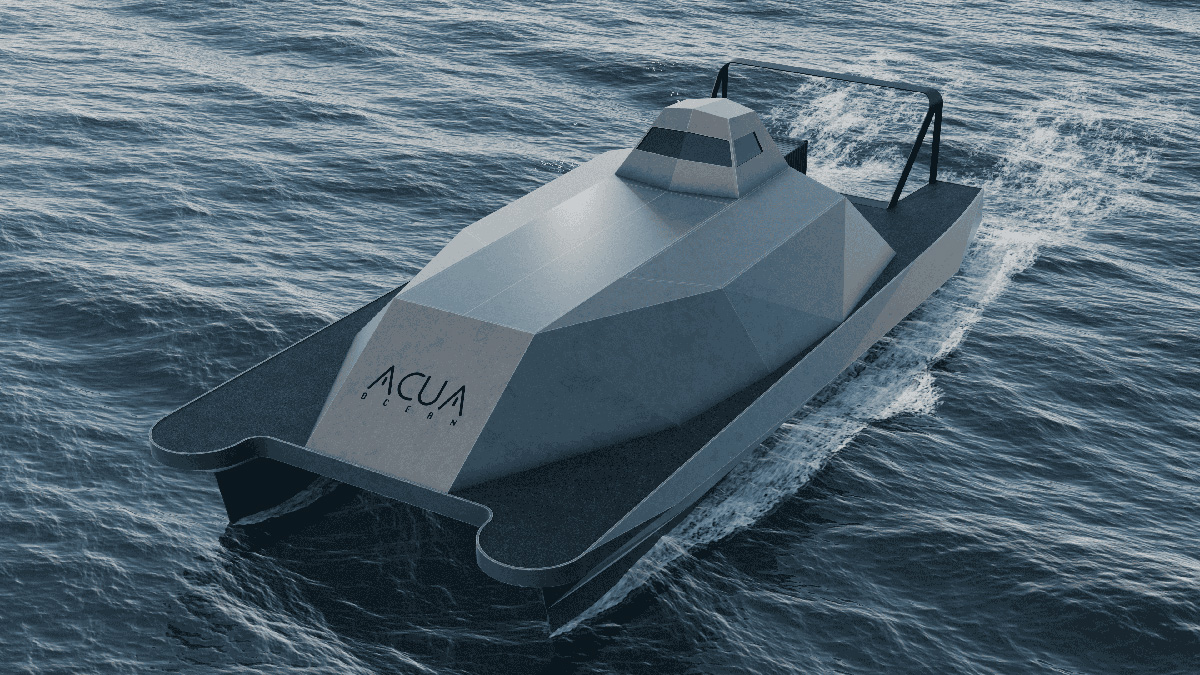
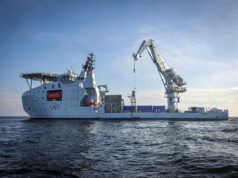
ACUA Ocean and its partners have secured UK government backing to advance a 145 foot multi role uncrewed offshore support vessel under the Department for Transport’s CMDC programme, the consortium stated.
The group includes Houlder, Ad Hoc Marine Designs, Trident Marine and the University of Southampton.
The project, known as MROS, has moved from initial funding awarded in May into tank testing at the Southampton Marine and Maritime Institute and the Wolfson Unit. The hybrid electric vessel is being developed for autonomous or optionally crewed operations, with prototype designs examining methanol as a potential fuel and comparing it with hydrogen, ammonia and diesel for efficiency, maintainability and emissions.
The design draws on ACUA Ocean’s fourteen metre Pioneer class USV, which the company says provided a proven systems testbed. Pioneer is described in the release as the first uncrewed vessel to meet the UK Maritime Coastguard Agency’s Workboat Code 3, and its data is being used to inform the larger platform. MROS adopts a small waterplane area twin hull configuration to reduce motion and improve stability in higher sea states.
The consortium says the vessel is intended for tasks that require persistence in demanding offshore conditions. Planned specifications include DP1 station keeping, a range of 2500 nautical miles, more than twenty days endurance and a sprint speed above twenty knots. The design includes an eighty tonne payload capacity and a moonpool with space for twin launch and recovery systems for underwater assets such as ROVs and XUUVs. Payload bays are arranged for ISO standard container footprints to simplify logistics.
ACUA Ocean expects to announce partnerships with systems developers to expand the suite of mission payloads for both Pioneer and MROS. Chief Executive Neil Tinmouth said “the MROS project builds on ACUA Ocean’s proven ability to deploy proven and certified vessels” and described the design as offering capability and cost benefits for offshore users.
John Kecsmar of Ad Hoc Marine Designs said “we firmly believe in this larger platform going beyond the norm and setting new standards of offshore operability.” Rupert Hare of Houlder said the project aims to turn credible autonomy into offshore capability and noted that Houlder will lead work on launch and recovery concepts as well as hull optimisation and integration of alternative fuels.
Lee Sidaway of Trident Marine Electrical said the company is contributing electrical design and sees the programme as part of a shared effort to develop autonomous and hybrid systems. Professor Stephen Turnock of the University of Southampton said the effort aligns with emerging requirements for minimally crewed, clean fuelled ships and highlighted the institute’s work in naval architecture, autonomous systems and future fuels.
Founded in 2021, ACUA Ocean develops uncrewed surface vessels for ocean monitoring and data collection and is positioning the MROS design as a scalable platform for long endurance offshore operations.






Type 92 sorted, then?
Only one container width aft in that concept though, which isn’t enough for Compact CAPTAS-4. Would fit Ultra Maritime’s Sea Lancer, though.
I read “Ultra Maritime’s” as “Ultra Marines” for a minute!
God some Ultra Marines would be great for the military
Not more Ultramarines!!! 😀
How about some Salamanders?
At least they’re green (not dark enough though).
For the Emperor (and the MoD)
Warhammer is such a cool universe. Although I think technically speaking its our universe…you never know maybe the MoD have got something “super” up their sleeves.
The geeks are in the room😂🤣😂
Too right we are! 😀 haha
We’re everywhere 🙂
Will it have MK 41?
It’s not a military ship
And? My wife’s not a life coach, but it doesn’t stop her from sounding off every 20 minutes
Neither was RFA Argus but it did not stop it becoming one of the most useful military assets the RN could call on.
That’s different, for one it had space. This is tiny
So is an FPV drone, but it has military use.. many civilian platforms are adapted and used by the military.
This is not what the Navy wants for T92 weve already seen far larger concepts, how far is this piddly thing going to be able to escort a T26
If you note I did say it’s to small for the T92 as an ocean ranged patrol vessel.. but it could have utility as a EEZ patrol vessel or short ranged missile platform.. the ask was not could it be the T92.. it was could it have military application
I do admire your capacity to remain calm and focused Jonathon. I think that’s a sane and worthwhile question in this very quickly changing and difficult to predict World, as General Sir Gwyn Jenkins himself was working hard to get across. Seems like all manner of concepts, designs and commercial platforms are being rightfully examined fir military purposes, frontline or support its somewhat blurred presently. After all Bae’s autonomous submarine is a development of a commercial design. Time to Think Different as a famous and innovative company once promoted itself to great effect.
Yes I think fundamentally at present the military and MOD needs to look at what can the Uk produce and provide that aids in its security.. that is the real fundamental difference between a peacetime military and essentially a wartime military.. we just need to look at how many times the UK has fought and won wars using essentially what were happy accidents and the military taking a punt not spending years planning some gold plated HMS massive.. the Falklands war was won because we somehow ended up with cheap as chips carriers that officials should never really have existed… infact they were called through deck cruisers for a time.. because we no longer did carriers.. but the navy saw an opportunity that industry offered..look at the US it never in the interwar period planned and ordered a medium tank.. its entire paradigm was based on “we will fight with what industry can come up with at the time and produce in numbers”…. We in the west have sort of forgotten that wars are won not by standing forces and a few gold plated wonder weapons.. but the practical weapons industry can build and churn out in massive numbers.. if the UK and Russia ever had a spate and NATO failed politically to support us.. wonder weapons are not what will win or keep us going… but practical mass in sea denial and control as well as practical mass in throwing things that go bang deep into Russia..
Well said and 6 months later than this article and Babcock is proposing it for some purpose exploiting Frankenburg missile tech. I’m sure there is scalability in these early designs too. We are still in the early stages.
Are you saying size matters 🧨
Just imagine a couple of these, out of the AI minds on sniffing methanol, firing off their Mk 41 and NSM.
This is not T92
Whyever not?
Look at the language they have used in the press release. ‘sprint speed’, ‘endurance’, and the deployment of XLUUVs. ACUA know that the two only applications of this design are T92 and deep sea survey. This is just them getting some seed funding from a source apart from the MoD.
Just look at the concepts weve actually seen for T92, radar, VLS, multiple container space. this aint it
That’s BAE’s T91 concept, for AAW. They opportunistically stuck some Herne in containers on the back, but it’s a missile barge at heart. T92 is supposed to be an anti-submarine sloop for the North Atlantic, to act as the initial stage of detection of submarines and guide T26 and P8 to localise and track them.
This is exactly what T92 is supposed to look like, and the only other explicit T92 concept (not widely publicised, from BMT) was for a 70m monohull, simple sonar tug. A 40m SWATH fits in quite nicely IMO.
Guarantee the MOD wont even look at this, its going to be a gold plated solution as usual
So we we are talking 500 tons and 45meters.. not bad for an EEZ patrol asset but not for the type 92, which will probably need to be 90 meters and closer to 2000 tons.
I wouldn’t be so certain.
ACUA claim that their 14m, 30t Pioneer design has equivalent seakeeping to a monohull of 40m and 300t. If the SWATH hull can achieve similar performance at this category, I see no reason to go for a larger monohull instead.
20kts sprint speed is also impressive, SWATH vessels don’t usually go above 12-15.
Youre not putting any weapons on this
A 40foot monohull hardcore sailing in really serious Atlantic swell..it turns a human into a head to toe bruised, vomit machine in need of a weeks sleep.. sensitive payloads would be smashed to pieces. The other issue is boats of this size must avoid weather systems.. if they don’t they may sink.
But the issue for a military vessel is ability to loiter in the OA and a small boat with a 2000 mile range is only any good for EEZ work..say you want mid Atlantic range that’s 3000 miles range to get to and from the OA.. if you want it to operate At low cruising speed ( say 8 knots ) in the OA for 2 weeks is another 2000 miles endurance so for a mid Atlantic patrol T92 you need a range of about 6000 miles.. which is a bigger boat.
You’re comparing grapes with coconuts.
ACUA Pioneer is 40ft long, it has a range in diesel electric configuration of 6000nm (4 knots times 9 weeks) and full oceanic seakeeping, it could deploy a 1t ROV in sea state 6. Look up the video of Pioneer next to its equivalent-sized monohull chase boat in swell, it’s really quite impressive. I see no reason why a much bigger SWATH vessel would not be able to survive full Atlantic conditions except in situations where the waves were steep enough to start slamming on the underside of the raft, and if built strong enough it could do even that.