

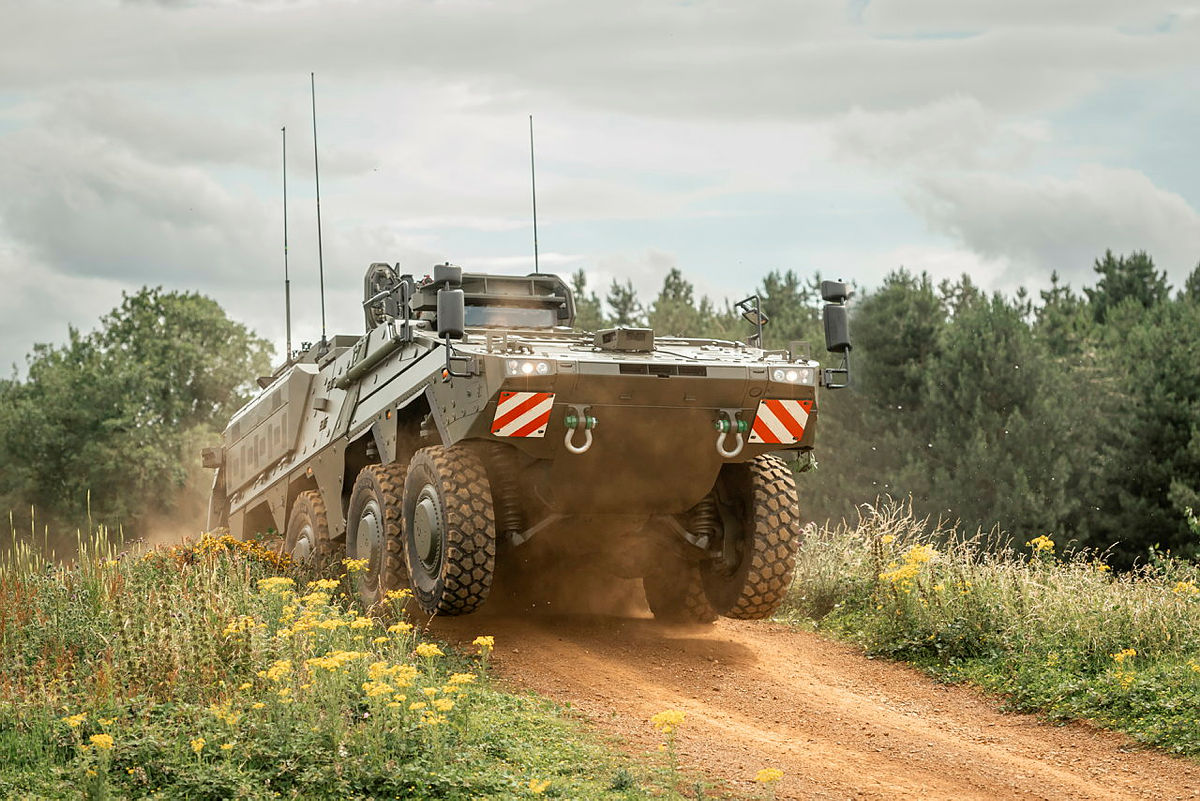
Britain’s armoured vehicle programme contains headroom for increased output, according to information provided to Parliament.
Recent ministerial comments indicate that the UK’s existing Boxer manufacturing arrangements have been structured to handle higher demand if required during a prolonged conflict, although no new expansion measures have been announced.
The question was raised by Labour MP Luke Akehurst, who asked what steps were being taken to expand the UK industrial footprint to allow surge assembly in the event of a prolonged conflict.
Responding on behalf of the Ministry of Defence, Defence Minister Luke Pollard said the government has made “significant investments in the UK industrial base, including factories, the workforce, and supply chains, to support the manufacture of Boxer vehicles.” Pollard added that the programme is “now in full production,” and that the UK’s current industrial setup has “the potential to accommodate additional orders for surge delivery or export customers.”
No additional expansion measures were detailed, but Pollard’s answer indicates the production model already contains capacity designed to absorb increased demand.
Boxer is a modular eight-wheeled armoured vehicle developed through a multinational programme led by ARTEC GmbH, a joint venture controlled primarily by Rheinmetall. Its design revolves around a common drive module that can be matched with interchangeable mission modules for roles that include troop transport, command and control, reconnaissance and fire support. Production began in 2009 and more than 1800 vehicles have been built or ordered by participating nations. Rheinmetall holds a majority stake in ARTEC and oversees manufacturing activity that spans sites in Germany, the Netherlands and Australia.
The United Kingdom joined the programme with a contract awarded in 2019 for 523 vehicles, valued at 2.3 billion pounds. A further order for 100 vehicles followed in 2022, taking the total to 623. The British Army intends to bring the system into service in stages with initial operational capability targeted for 2025 and full operational capability planned for 2032. The purchase covers three principal configurations which break down into nine sub roles, reflecting the modular structure of the platform.
Role based quantities published by the Ministry of Defence illustrate the spread of tasks the fleet is intended to cover. The largest allocations support infantry mobility and command functions, with 146 infantry carriers and 158 command and control variants in the expanded order. Specialist roles include engineer section vehicles, reconnaissance and fire support variants, mortar carriers and electronic warfare platforms. Ambulances and observation posts round out the mix. In addition, a separate programme is expected to introduce the Boxer RCH 155 artillery variant with up to 96 systems planned.








IOC in 2025. In the next 2 or 3 weeks? Really? I presume IOC is delivery of all units to the training org plus one mech battalion?
To be announced at the same time as the DIP perhaps?
The pace does not reflect the urgency of our current predicament. In the case of a protracted conflict, the UK will have capacity, so that is reassuring, but is the timescale out of sync with the events of today?
If we build them all really fast then the factory closes and we have zero production running…
They need to build all the Ajax replacements. So they need to speed up.
Boxer isn’t going to replace Ajax.
This website has become a cluttered mess. Please make it more presentable.
Very true!
Agree, ads spring up everywhere
Rubbish. We couldn’t even defend the factory from drone attack
Let alone airbases, ports, sub bases, key infrastructure around the country. The near absence of a GBAD network is the “roofless house” of the UK. Do they think what’s happening in Ukraine couldn’t happen to the rest of Europe and the UK? And what happens if its at very short or no notice? Mr Putin’s rhetoric the other day seems to show him that he’s very confident of Russia’s abilities to take on Nato?
The stuff that should be available or made available for the UK, CAMM, Aster/SAMP-T, LMM-Starstreak, Boxer Skyranger, Sky Hammer/Star Hammer, Terrahawk, GraveHawk/Raven, so much choice. And all the drone/c-uas. Time for some more shopping?
No mention of any Stormer replacement Boxer based Skyranger 30 with Starstreak/LMM to protect tanks and other armour, even for shorad for bases?
Patria apparently will be the new carrier for mobile SHORAD HVM/Starstreak.
Just not official yet.
Agree a mobile AA system is needed, but can the Army operate it? Does it have the capacity in existing units? If not, what gets cut?
Not even a 30mm AA capable RWS. Timed AB & proximity fused 30mm exist from multiple suppliers. EOS, Konsberg, Thales etc all have 30mm based RWS with optional AA missile & ATG missile available & fielded ie these are real products. Everyone says they are learning the lessons of Ukraine. There does however appear to be a drastic disconnect. Too many are learning the lessons want to learn & ignore anything that doesn’t match their thinking (ie wearing blinkers – a horse thing, if you are confused).
Ridiculously underamed at present.
Read reports a single Javelin ATGW will be mounted on a RWS, and stories that they are looking at the 30mm RWS you describe.
Until then, these are world beating APCs for their price.
And certainly not IFVs no matter how much they pretend they are, neither is ARES.
Something NATO know clearly enough regardless what the MoD or HMG claim.
Todays piece of comedy. I really could die laughing at the tripe being churned out of political mouths.