

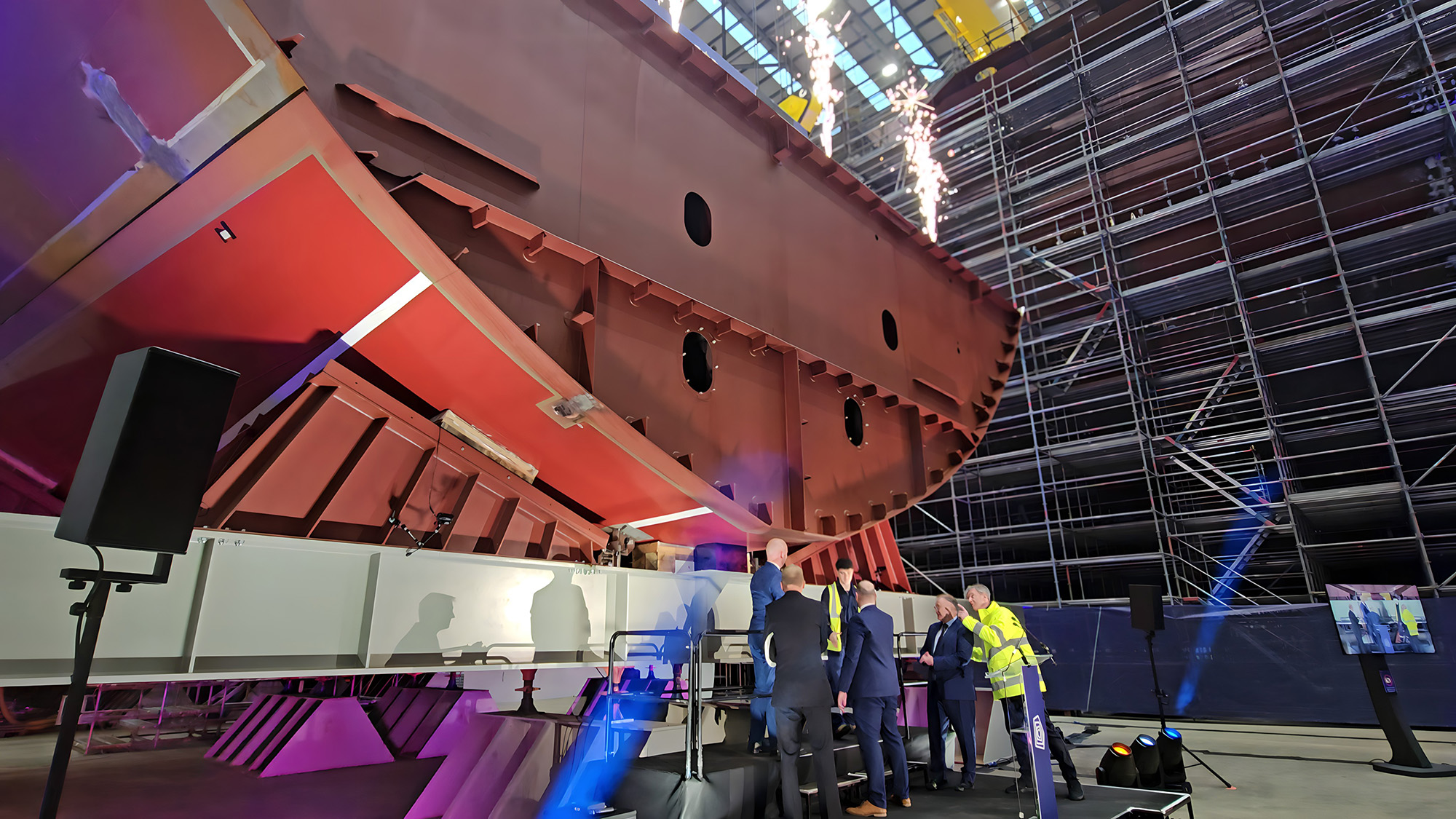
Babcock has laid the keel for HMS Formidable at Rosyth, marking the next scheduled milestone in the Type 31 frigate programme, which will deliver five ships to the Royal Navy within 10 years of contract signing.
The first modular section was lowered onto a commemorative coin in line with naval tradition, witnessed by Babcock staff, Royal Navy personnel and international guests.
HMS Formidable’s keel has been laid at Rosyth, marking the next step in the Type 31 programme. @geoallison spoke with Babcock leadership about build pace, innovation and the role this frigate line is set to play in the future fleet. 🎥 Full video below. pic.twitter.com/KNPaIAEDAh
— UK Defence Journal (@UKDefJournal) December 9, 2025
Sir Nick Hine, chief executive of Babcock Marine, said the moment reflects the yard’s growing output and capability. “This is an important week in the history of Rosyth,” he said. “As the keel of HMS Formidable is laid in this vital UK defence programme, our workforce is delivering advanced programmes, driving economic growth and providing highly skilled jobs.”
Commander Thomas Hetherington, the senior Royal Navy officer for the T31 project, said the ship will play a central role in the future frigate force. “HMS Formidable’s keel laying marks a significant milestone,” he said. “The third of five ships, she will help modernise the Royal Navy’s frigate fleet and enhance the lived experience for our sailors.”
DE&S Type 31 team leader Steve Ranyard said the programme continues to meet key milestones. “Today’s keel laying marks another key milestone towards the Royal Navy’s future capabilities,” he said. “This demonstrates the excellent progress we’re making in delivering these versatile frigates.”
Based on Babcock’s Arrowhead 140 design, the Type 31 platform is also driving export work in Poland and Indonesia. Apprentices at Rosyth are already contributing to the build. Seventeen-year-old Joolz, a welding and fabrication apprentice, said: “I’m learning from experienced professionals and contributing to something that matters for the UK and has such a positive impact for our local community.”
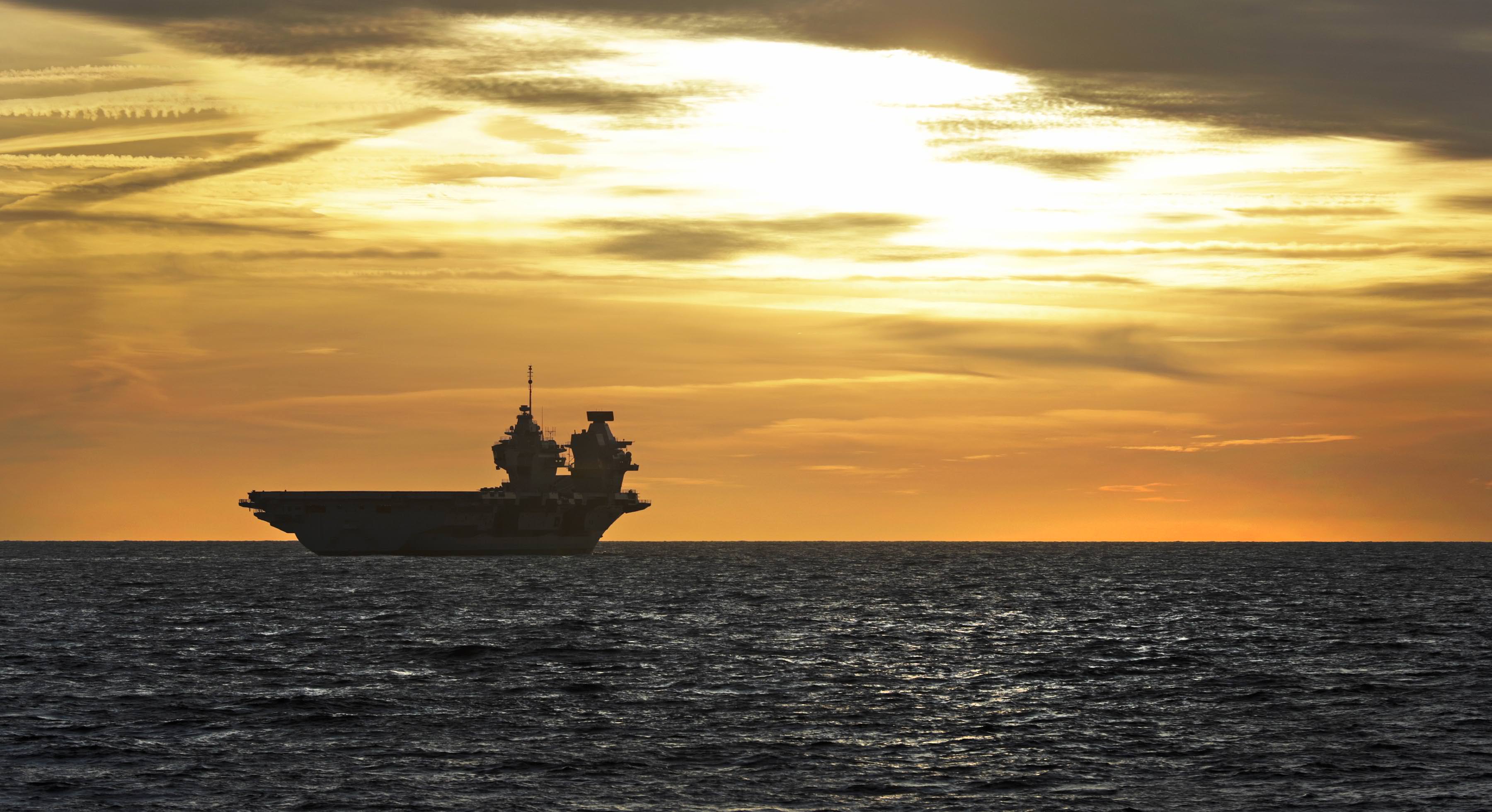


Looking at Babcock’s build schedule for the 5 x T31s. There is an uncomfortable question that needs asking. When the last T31 is fitted out and goes through trials and in to commission. What next for Babcock’s Rosyth facilities?
Apparently they could build the MRSS there. If that’s the case that jobs for 6-10 years.
However we honestly need a batch of 5 type 31/32s. Just build 5 more with added ASW capabilities and bang. That means we can get 5 extra in service by 2035 and remove the frigate gap so much quicker
There’s no ambition for more frigates
we don’t know that yet Hugo, only when the DIP comes out will we find out. There are some key questions
1) what is happening about the T32 and the five ships
2) how many MRSS will be purchased, how big and what capability
3) when and how many T93 will be built
4) how big what capacity will the Type 91 have and how many will be built
5) how many and what capacity will the Type 92 have
6) how many and what capacity will the type 93 have
7) how many next generations SSNs will the RN get
8) what will the Point class replacement look like, how many and who will operate ( at present its looking like a ship that is more auxiliary amphibian, that pure commercial RoRo
9) what will the new generation mine countermeasure force look like and how many
10) what will the new ocean surveillance and patrol ships look like and how many will be ordered
These are the ten unanswered questions that we don’t know, only speculate on and we all have our favourite view on each.
That’s why Babcock have been hunting for export orders and trying to suggest a different version of the Arrowhead for the Type 32. Whether or not any of that pans out is the other question, I imagine to keep industrial supply chains running something will need to be decided relatively soonish.
Maybe they will build the Kongsberg Vanguard MCMV design.
I say scrap the Mk41 integration as a concept, at least until their MLU. If you’re going to spend that money, use it to procure additional CAMM systems that’d be cheaper, and dedicate the remaining money to something else, or focus on purchasing a small containerised towed array sonar.
There isn’t room for more CAMm systems, maybe another 12 missiles for a paltry 24 but that’s pathetic
Do you hear yourself lmao?
‘There’s no room for more CAMM systems, except for the areas where we can add more CAMM systems’
Confrontation for the sake of confrontation. Mental age of a 12 year old.
Mushroom farms are exteremely space inefficient, youre not going to get 36, 48 in the space available.
Always the “Fun Guy” !!!!!
Not Mushroom on a T31 !!!
😁
You’re arguing against a point I never made. I never said 36, or 48. I just said ‘additional CAMM systems’.
“Additional” isn’t enough to defend itself!
24 is fine for a second-rank patrol frigate. Also, quit moving the goalposts – that’s very clearly not what the argument was about.
how is it fine, we need more ships for a potential war not an oversized OPV.
How many OPVs do you know that carry 24 medium-range SAMs?
Short range SAMs, the German Corvettes carry 42 RAM missiles and the upcoming European EPC will have VLS as well
You’re comparing RAM to CAMM? RAM is a PDMS, CAMM is generally seen as an MRAD by those familiar with its operation. Be serious.
The EPC is not an OPV, nor does it seem likely that it will actually hit the water.
I am comparing RAM to CAMM, even if they fired 2 RAM at every target theyd still be able to take down 21 targets compared to 12…
Just ignoring the different engagement range, the different efficacies, the advantages against massed raids offered by the VLS, the different minimum engagement ranges, et cetera…
Your view is incredibly simplistic.
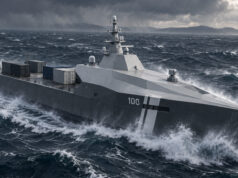
The bigger news is Babcock suggesting that the Type 31’s be converted in to a Common Command Vessel (CCV) configuration, each controlling a networked force of large autonomous uncrewed surface vessels and systems. This seems to be a clever attempt to reposition the role of the T31, goodbye world-wide forward deployment, hello Atlantic Bastion.
Time between first steel and keel laying for HMS Venturer was 6 months. Time between first steel and keel laying for HMS Active was 8 months. Time between first steel and keel laying for HMS Formidable was 14 months. I’m assuming this is a knock on effect of the delay to launching Venturer. Having only two slots in the build hall and assembling there over a longer period of time could lead to long delays, but perhaps that’s not the problem. Maybe the issue starts earlier in the build process. I’d hoped the blocks would all be stacked up awaiting fast assembly, but that doesn’t seem to be so. Active will be rolled out of the build hall “next year”, as will first steel be cut on Bulldog, but when during next year?
The schedule is supposed to get faster after the first ship, with times between ships dropping to one every year. Instead they seem to be stretching. A build every 18 months taking 4 years would see the final ship delivered to the Navy in early 2032, at least two years and a half years over schedule. Nevertheless, Babcock would still need to speed up to achieve it.
You think we eve even paid for the Mk41…
Ignore the other comment is was replied to the wrong message.
There are blocks lying all over the place but they can’t get hulls out quickly enough to make space.
There’s also only one dock for fitting out
Well, they’ve never built a warship from scratch before and are learning as they go. I just wish they’d learn a little faster.
That isn’t the issue here.
There was a massive time gap between the roll of out #1 and keel lay of #3 which doesn’t suggest super tight time utilisation or that everything was ready to slide into place.
when it comes to conflict with RU I hope Hunt, Sunak, Johnson, Starmer and their families will be in the T31 – without credible ASW capabilities and a minimal stock of Sea Ceptor they’re floating coffins. They’re bigger than most frigates and armed like corvettes
hopefully that will be changed.. put lets be honest they are still heads and shoulders above the capability of the previous generations of RN GP frigates..
lets not forget the RN of the 1980s faced the massive power of the soviet maritime strike forces with sea cat and at best 12 seawolf on a ship.. that could engage at best 2 targets. even the type 23 when first deployed and up to the mid to late 2010s could engage only 2 targets at a time out to a range of about 5 miles and to 10,000 feet.. hardly stellar… in reality the baseline T31 is probably the most effective air defence wise that any frigate the RN ever had until the refitted T23 and the T26… and you could argue in some cases it may be better than a refitted T23 as that has no AAW gun armament that could effectively engage air targets.
its not an endorsement of only 12 CAMM ( I think they should have 24-36) but a bit of context around the reality of RN frigates pre the T26
Thanks Jonathan – a good perspective. Any enemy will plan their tactics around weakness – with just 12 CAMM and minimal ASW capability (I assume they’ll be fitted with NSM) it’s not difficult to work out a plan. A sinking ship then creates 1. An immediate rescue headache (do we have the resources for this?) 2. A gapping hole in the RN which with so few surface vessels any loss is irrecoverable.
I would really like to see a follow on order for Babcock otherwise what is the point of a build hall, training staff etc. I do think that the stretched T31 concept for the T32 is a good concept six such ships. I also would like to see a pool of containerised CAPTAS 2 or 4. The pool of equipment could be a European resource.
Good luck sharing with any other navy? And six ships? well be lucky if we get 6 of any class anytime soon
If nothing else its a cool name.