

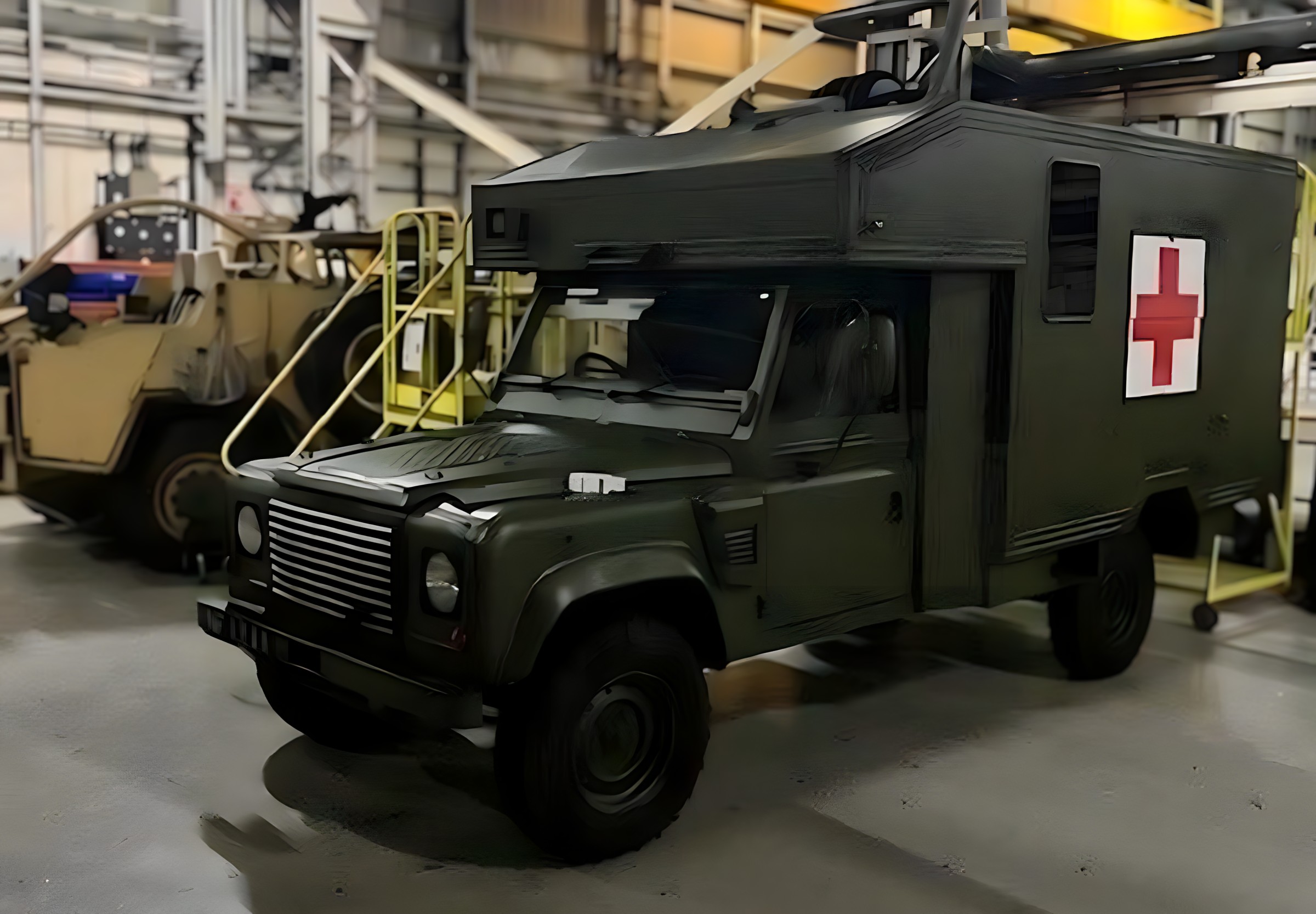
Teams at Babcock’s Donnington and Ashchurch sites have been recognised by the British Army for rapidly returning two Rapid Battlefield Ambulances to operational service after their condition was found to be significantly worse than expected, say the firm.
The vehicles were initially returned to Donnington for routine repair, but inspections revealed extensive structural degradation. One ambulance required a complete chassis and bulkhead replacement, while both vehicles underwent full regeneration work, including comprehensive structural repairs and a full repaint.
Despite the scale of the task and tight timelines, the work was completed within an intensive eight-week period. According to the company, teams across both sites worked collaboratively to engineer and deliver a solution that ensured the vehicles could be returned to frontline service.
Following completion of the work, the Ministry of Defence site at Ashchurch transported both ambulances to SMC Marchwood in January, where they are being prepared for onward deployment by sea later this month.
Brigadier Matt Wilkinson praised the effort, saying: “I was delighted to witness the extensive and prompt repairs that Babcock undertook, to ensure that we could maintain a casualty evacuation capability overseas. It again reinforced to me the ingenuity, determination to succeed and pride in supporting HM Armed Forces, which we witness in the best of our industry partners, and for which I am hugely grateful.”
Babcock said the project highlighted the technical depth of its land sector workforce and its role in sustaining critical operational capabilities at pace, particularly where unexpected degradation risks frontline availability.


Surely, you could find an image that wasn’t AI. Surely?
That will be a very low-resolution image that’s been passed through an AI upscaler like Topaz (Other AI upscalers are available).
It’s retouched not fully AI. I don’t think AI can replicate actual models of vehicle.
Is that a land sector workforce that was originally the DSG? Part of ABRO, and thus an in house part of the MoD?
All sold off by Labour, along with lots else, such as DERA, from 97 onwards.
Has a cost analysis ever been done which was cheaper?
As far as I’m concerned, these private companies are out to milk MoD for as much as possible.
Danielle, yes. The major workshop at Donnington was 34 Base Workshop REME opened from c.1960 and commanded by a REME officer, with a small number of REME SNCOs and a predominantly civilian (civil servant) worksforce. Then it was renamed ABRO Donnington but still REME-commanded. Then DSG. Then contracted to Babcocks.
Of course many static workshops have been closed over the years.
I wonder how much money has been saved by having a profit-motivated contractor running the show!!
Many claim that repair standards have fallen too. I don’t know if significant combat equipment goes through a Base Overhaul anymore in this contractor era, but the contractors would certainly be cutting corners if they did. A Base Overhauled tank (done about every 7 or so years) was as good as new when it was returned to a Field Force unit in exchange for their stopgap Repair Pool tank.
We know the answer mate.
Having worked for DERA Chertsey and the various other names we had I can say that the very experienced workforce was scattered to the four winds, some stayed as DSTL, many were made redundant and an establishment that served this country from 1940 was swept away hence no independent testing of vehicles such as Ajax.
Defence Support Group (A trading fund of the MOD) was sold to Babcock International in 2014. The decision to sell DSG into private industry came about from the 2010 Strategic Defence and Security Review. The government that oversaw this was the then Conservative -Liberal Democrat coalition.
Thanks, memory fades.
This was what I had in mind.
“On 22 May 2007, it was announced by the Minister of State for Defence Equipment and Support, Lord Drayson, that ABRO would be merged with DARA, the Defence Aviation Repair Agency to become the Defence Support Group with effect from 1 April 2008.[1]”
Tories then finished the job later as you say.
Top story as not much going on, two landrover Ambl are fixed, thats it thats a head line. Just shows the mind numbing nothing going on in defence while every other nation seems be finding cash to re arm we find time to do nothing and try and make it look like some thing.