

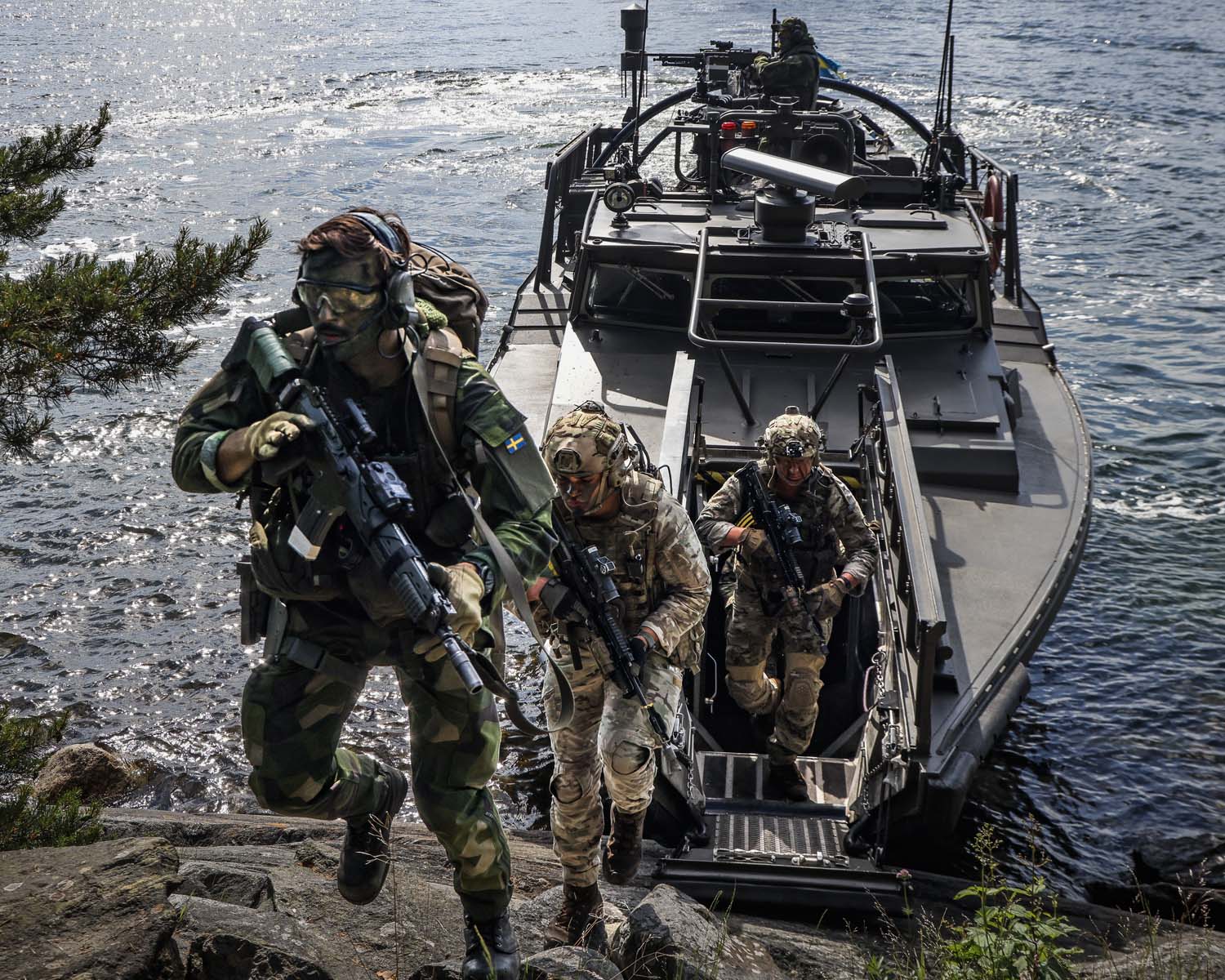
NATO Secretary General Mark Rutte said Defence Ministers concluded a “productive” meeting in Brussels centred on deterrence, defence investment and continued military support for Ukraine, describing the atmosphere as a turning point for the Alliance.
Rutte told reporters the meeting felt fundamentally different from previous ministerials, stating “what I saw and heard today is unlike any NATO meeting I have taken part in” since he began attending NATO meetings in 2010. He argued that the effects of last year’s Hague Summit decision to raise defence and security investment to 5% of GDP by 2035 were already visible, but said the more significant development was political momentum behind a stronger European contribution within NATO. According to Rutte, ministers demonstrated “a real shift in mindset, a unity of vision, a much stronger European defence within NATO.”
He highlighted examples of states already reaching or exceeding NATO’s spending ambitions, including Denmark, Estonia, Latvia, Lithuania and Poland, describing their progress as being “a decade ahead of schedule.” Germany, he added, is on track to double defence investment compared with recent years. Rutte said the purpose of the spending drive is to ensure NATO can deliver the forces and capabilities required for “warfighting readiness”, warning that meeting capability targets will require more than political commitments alone.
Rutte repeatedly emphasised that increased spending must translate into industrial output, arguing that the Alliance must move faster to meet growing demand. “We need quantity, and we need quality, and we need it quickly,” he said, calling for “more air defence, more ammunition and stronger supply chains across the Alliance.” He stressed the need to expand production capacity on both sides of the Atlantic and said multinational procurement arrangements were increasingly central to NATO’s approach.
Pointing to agreements signed during the meeting, he said Allies are pursuing cooperation on “deep precision strike capabilities” and “capabilities for ballistic missile defence.” He also highlighted the development of NATO’s Task Force X Baltic initiative, launched a year ago to enhance security of critical undersea infrastructure following incidents in the region. Rutte said the pilot effort is now moving into adoption by participating nations, noting that “eight Allies are now adopting and integrating these innovative multi-domain capabilities.”
He argued such multinational frameworks provide industry with the demand signals needed to expand production, describing cooperation as a “smart way” to deliver agile capability development while improving value for money. Rutte also linked this approach directly to lessons emerging from Ukraine, describing Ukraine’s defence sector as a driver of innovation in areas such as drones and counter-drone technology. “Ukraine is not only resilient, but remarkable in its ingenuity,” he said, praising Ukrainian battlefield adaptation and the work of Defence Minister Mykhailo Fedorov.
On military aid, Rutte said Ukraine continues to face persistent Russian strikes on civilian infrastructure and warned that the requirement for air defence remains urgent. He reaffirmed confidence in the NATO Prioritised Ukraine Requirements List (PURL), which funds rapid procurement of US equipment for Ukraine, saying he was “absolutely confident” the flow of US air defence systems would continue. He described PURL as central to meeting Ukraine’s needs, particularly in relation to Patriot systems.
Rutte also addressed repeated questions about US representation at the ministerial after Defence Secretary Pete Hegseth again did not attend, with Under Secretary of Policy Elbridge Colby representing Washington. Rutte rejected claims this signalled a weakening of US commitment, arguing Colby’s remarks reinforced Washington’s strategic view that NATO remains vital for American security, particularly given risks of simultaneous crises in Europe and the Indo-Pacific. He said European Allies stepping up would strengthen the Alliance overall, calling the meeting one of the most pivotal he has attended.
Responding to questions on internal Alliance tensions and recent US comments regarding Greenland, Rutte argued NATO’s nature as a democratic alliance inevitably produces debate, but said it consistently “finds a way forward”. He said the defining feature of the current moment was Europe’s acceptance of long-term responsibility, stating the shift is now politically embedded rather than temporary. “People realising we will never break up. We will always stay together,” he said.
Rutte also defended the continued US role as Supreme Allied Commander Europe (SACEUR), arguing that a strong American conventional and nuclear presence will remain essential, even as Europe takes greater responsibility through European-led Joint Force Commands. He described this as a logical balance in an alliance where the US economy represents over half of NATO’s total economic weight.
Closing the press conference, Rutte said NATO’s support for Ukraine remains inseparable from wider Alliance security, stating “NATO stands with Ukraine” and stressing that deterrence efforts such as Arctic Sentry demonstrate NATO’s commitment to defend “every inch” of Allied territory.






The USA has decided to take over control of MARCOM, the NATO maritime forces command based in Northwood in England. That is a major snub for the UK, indicating that the USN (and others?) have decided that the Royal Navy has become so weak that it is no longer capable of leading NATO’s defence at sea.
Vice Admiral Robert Pedre RN has only just taken over as MARCOM commander, he now faces having to handover command to an American Admiral in just a few months’ time.
That’s BS, the US was given MARCOM because it’s largely irrelevant and the US gave up the Joint Force Command. The UK and the US both basically swapped commands because JFC is much more relevant to fighting in Europe.
Jim, The MARCOM optics are so very bad. A USN Admiral probably becoming the senior naval officer at Northwood is humiliating for the RN, Mountbatten will be rotating at high speed in his grave.
A key problem is that MARCOM’s main peace time assets are the standing NATO Maritime Groups, and the RN now rarely contributes to the naval groups and has stopped completely contributing to the mine countermeasures groups. The collapse of the RN (frigates, subs, MCMVs, amphibs, auxiliaries ..) over the last 5 years has dismayed not just the USA but also our European allies. For example Türkiye can reasonably claim that it now makes a much larger contribution to NATO naval operations than the UK does.
RB, you are accurate in your assessment.
Even the assets the RN does have, very few are put to sea. It’s a self inflicted tragedy.
What is it a £1 million a day to put a ship to sea, Admiral Reeves has decided it’s a masterpiece of strategic economic forward planning it seems.
Agreed. MARCOM has always been a British Command, at Britain’s premier military headquarters.
Very bad optics indeed whether we’ve done swapsies or not.
Jfc is about the painful, costly planning of day to day operations and exercise in a limited area. Marcos is way more strategic.
and if the government gets its way, even more cuts are on the way.
where will it all end. ? and who will pay the ultimate price…
just a thought.
The RN is so now small there is almost nothing left to cut. Selling one of the two aircraft carriers for peanuts is the most obvious potential immediate cut – no doubt the buyer will then convert it to CATOBAR and show just how much potential capability they have. Also, the sale of two in-build T26’s to Norway without replacement in order to fund Bastion Atlantic seems all too likely. Six T26’s would be enough to allow one to be continuously operationally deployed in UK/Bastion waters, whilst a second could be scheduled for occasional CSG tasking.
🤣
I worry, because what we are seeing is an EU approach to NATO.. what is happening now is essentially the alliance starting its divorce ( slowly at first).. but what does that mean for the UK.. because when Essentially the EU takes over European NATO and the US essentially leaves.. we are in a bit of a spot.. Russia hates our guts and would so very much love to take a pop.. would an EU based European NATO leap to the defence of the UK.. if Russia decided to take a pop.. after all Russia could not take the UK just humiliate and hurt it.. that’s not existential for the EU as we are not a member and actually are a competitor economically, and some EU nations would not give a shit.. ( may even think perfidious Albion deserves a bit of a put down.. the US will not give a shit…
I see very dangerous waters for the UK. We are at are weakest ever hard power wise and are potentially going to be the most isolated we have been since we were a superpower that could stand alone.
Norway and Iceland (and to a lesser extent Canada) are in the same spot. I think the key for all three countries is to have strong bilateral defence treaties with the EU. I don’t see a situation where any assertive EU defence organisation does not grasp the need to keep NORUKICE on friendly and off limits to Russia. IMO the bigger ? is Turkey. Like NORUKICE Turkey is in NATO but not the EU, and as strained as EU-UK relations are, EU-Turkey Relations are worse and arguably Turkey is less vital to EU security than NORUKICE.
I think you conflate EU with the defense of Europe. The EU is an economic union primarly (certainly not a military union or function) whereas NATO is a military alliance which includes non EU members such as UK and Canada.
The UK may have left the EU and the US may leave (or ignore) NATO, but there is no european defense without the UK included as a prominent member.
True that it’s a bit of a rough patch for the armed forces at the moment, but governments change whereas the UK is not floating away from the european continent.
my 2 cents
and forgot Norway as a non EU NTO member. Turkey is no ally of Europe, just a strange bedfellow imposed by the US at the height of the Cold War – an idea well past its sell by date
Turkey is in NATO because post war Stalin demanded Turkey surrender land to it (sounds familiar) and in particular equal control over passage through the Bosporus. Suited the western allies and Turkey to thwart that and had Turkey not joined NATO that strategic disaster would likely have come to pass, which shows how NATO’s preventative power has worked even if too many in the West used to a soft life refuse to acknowledge it.
The UK may have a small Military although highly trained at the moment but UK has a large population to call on in time of threat to National-European-NATO security.
UK Military industrial base has started to go on a war footing but not fast enough. UK Shipyards have and are being upgraded and full of new ships for the RN etc.
UK has some of the best university’s in the world & Not Just Oxford or Cambridge. (Liverpool. Manchester. Bristol. London. Edenborough. Cardiff & more. UK has many leading university’s.)
UK IMO should buy more military frontline hardware off the shelf and build under licence in UK. How many latest versions of CV90 or Bradley could the UK have bought with the £5 Billion the AJAX has cost up till now and still not in service use?.
UK also needs a version of Civil Defence volunteers in near future like in next 12to 24 months. We had them in cold war in Europe. Now we have a hot war in Europe and we don’t have a modern civil defence organisation?. It’s mad and negligent. IMO Only of course.
Gemma, a reminder that AJAX is an off the shelf product like CV90 or Bradley.
Yes Canada is creating a citizens army as a base to quickly add mass to the defence forces, we need to do something similar to supplement the reserves.
The Universities, this is an important question I am glad you raised especially as it was mentioned in Govt that despite having the second highest rated University system in the World especially at the top we don’t sufficiently exploit that to generate economy boosting businesses and that is particularly so in defence, where some universities even look dimly upon participating. That’s got to stop we put a massive amount of money into Universities and we need to ensure we get more back for the Nation as opposed to individuals so often exploiting it and then going off abroad to make their fortunes and companies often being absorbed to feed into US economic and intellectual growth which makes me so angry when Trump has the front go claim we are living off of the US.
Recently we have seen Hypersonica which is developing a European hypersonic strike capability that’s come out of the work of Oxford researchers, that’s positive but though it’s described as an Anglo-German Company it’s headquartered in Munich. Sadly it also looks like we have lost Orbex the story of which is only too symptomatic of adventurous indigenous hi tech ambitions literally in this case, not getting off the launch pad in this Country.
The eu is not a military alliance but it’s much more than a mere economical one. Also, you forget eu role in industrial affairs which are totally key for getting a sound defence industrial base.
The problem is NATO is expressly designed to operate around the United States, and as the USA becomes less and less interested in supporting NATO, and even becomes aligned with it’s enemies, it becomes incapable of operating. So we need to look at a replacement, and like it or not, expanding the EU from a economic alliance to also have a military role (Also the EU already has Article 42(7) which is a requirement to mutual defence, so even now there is a military aspect to the EU) is going to be the path of least resistance to augmenting or even if necessary replacing NATO.
I agree and while Countries and Govts stay committed to the EU (which is why Russia tries to destabilise it) then there something essential and core to all to defend. Trying to create something new (not that I am against it very much time) to generate anything of the same unity will be very difficult and take time, this would be little binding everyone together if and when individual Countries see personal gain by not staying united. It’s bad enough even now with Hungary and Slovakia so imagine the doubts and fractures possible in any new structure where there is no additional binding organisation to add to and strengthen the glue.
Personally I think if your looking Europe wide.. the only option of creating a European pole is via the EU.. anything else is dooming Europe to risk becoming split down the middle.. on one side a set of clients to a Russian pole and on the other a set of clients to a U.S. pole..
The issue is where geopolitical winds force the EU, the core reason the UK left the EU is that the ambition is essentially political alignment and a unified global stance as well as to become a geopolitical actor in it own right… NATO and US leadership of NATO allowed this to always be kicked down the road.. what you are seeing now will almost undoubtedly lead to the EU solidifying its goals and the core power of ENATO becoming EU based.. The 29 ENATO nations ( minus Turkey ) on their own are to diverse and small to really create a unified structure that will allow a soft and hard power alliance entity that would given them them the global heft to make Europe the third geostrategic pole in the new world order that will likely come out of the old and Europe needs to be a pole or it will be a victim…
The key question will be when as is likely the EU becomes a military power with 450 million inhabitants and a 22 trillion dollar GDP what will its relationship be with that other pole the U.S. and what will that mean for the medium sized and small powers in the middle.. UK, canada, Iceland and Norway…..
In any normal time I would say we could happily sit in the middle, but china will very much both us and support Russia as a tool to access the resources of the artic… so we will always be at danger of conflict with Russia.. that means we will need to snuggle close to a major power..
Our relationship is going to change with the EU..because there are only now two ways forward for Europe , the EU becomes a superpower or Europe stays fragile and open to political collapse and predatory activities by the two poles ( US and china/russia).
Can’t argue with that, too many in Europe fearful of war are psychologically unable to come to terms with that sadly or just cannot understand the imminent dangers. It’s up to our leaders to see the bigger picture you state and take the required actions to enable us to get that powerful unified European perspective. Not overly convinced they will put sufficiently Country before personal appeal to the electorate however especially as that appeal is already in free-fall. Just hope whatever develops we can survive it long enough to really take re armament seriously. We think of the Baltic States but in reality Norway would be the point of true disaster for Europe and I doubt that Putin and his advisors don’t see the significance. Any disunity or hesitation there would be the end of Europe becoming that third pole, maybe something far worse indeed.
Yes the one thing Europe cannot allow to happen is for Russia to become a 3rd pole.. and from my understanding the undercurrents are that the US would actually not be adverse to Russia becoming a 3rd pole.. Geostrategically it puts Europe in its place because the MAGA US does not want Europe as a Pole and a competitor it wants Western Europe a compliant buffer, it also wants Russia to be a counter pole to china as well… where as for Europe and our security and prosperity we want to become a pole and have Russia as a minor power in hock to china.. because chinas key competitor is the US and if it thinks it can keep a European pole neutral it will keep Russia in check.. but alway looking at Europe… so
If we are being brutal about the MAGA world geopoliticals
US wants Europe weak and yet still controlled by it, but Russia as a strong pole ( by controlling its near abroad) to counter china and out of Chinese hegemony.. and if it means sacrificing some of Eastern Europe for these two things to happen then the US will do so..
China wants.. the fall of the western hegemony splitting into a coherent Europe that is a counter to keep Russia weak and in. China’s hegemony as well as an isolated US that is at best Neural with an independent euro
What Europe wants.. it wants a cohesive western hegemony..that is a solid counter to Russia and china either together or separately.. but it now sort of accepts the U.S. has broken its own hegemony for due to the political dogma of a bizarre new political movement.. which means it need to become a coherent pole.. neutralise Russia as a potential future pole by isolating its western and northern expansion. Keeping as good a relationship with the US as it can as a peer.. but moving to a point it does not giving an inch on the high north or future south Atlantic and Antarctic movements ( at present the MAGA US is treating Europe like a doormat).. it then needs to see if it can keep neutral relations with china.. and us china to keep Russia from going loco.
When you parse down the geostrategic needs.. once you realise the U.S. no longer values the western liberal hegemony, then it actually becomes very very clear which way Europe needs to go.. it’s not easy and it’s highly dangerous..but all other routes are worse and likely to see wars in Europe as we end up with the fracture line between two poles through the middle of Europe and Europe acting as a set of buffer states… and to be honest fuck that future.
With all this discussion on the EU, perhaps few realise that the EU has run many military missions in the past, admittedly on a somewaht small scale.
From the Diplomatic Service of the EU: Under the Common Security and Defence Policy (CSDP), the EU takes a leading role in peacekeeping operations, conflict prevention and the strengthening of international security. It is an integral part of the EU’s comprehensive approach towards crisis management, drawing on civilian and military assets. Currently, some 3 500 military personnel and 1 300 civilian personnel are deployed around the world. Since the first CSDP missions and operations were launched back in 2003, the EU has undertaken over 40 overseas operations, using civilian and military missions and operations in several countries in Europe, Africa and Asia. As of today, there are 20 ongoing EU CSDP missions and operations, including 11 civilian, eight military and one civilian and military initiative. A Regional Advisory and Coordination Cell in the Sahel completes EU CSDP presence in the world.
Notable are Op Atalanta and Op Aspides, the anti piracy missions off somalia and the red sea escort missions respectively, both being EU missions, not national or NATO initiatives.
The EU needs the UK nuclear umbrella. If a Le Pen government is elected France will become pro Putin. Its a buggers mess.
That is an interesting opinion about France, especially since other countries in Europe have elected right wing governments without becoming pro Putin. Do you have any irrefutable evidence that would be the case with a Le Pen government?