

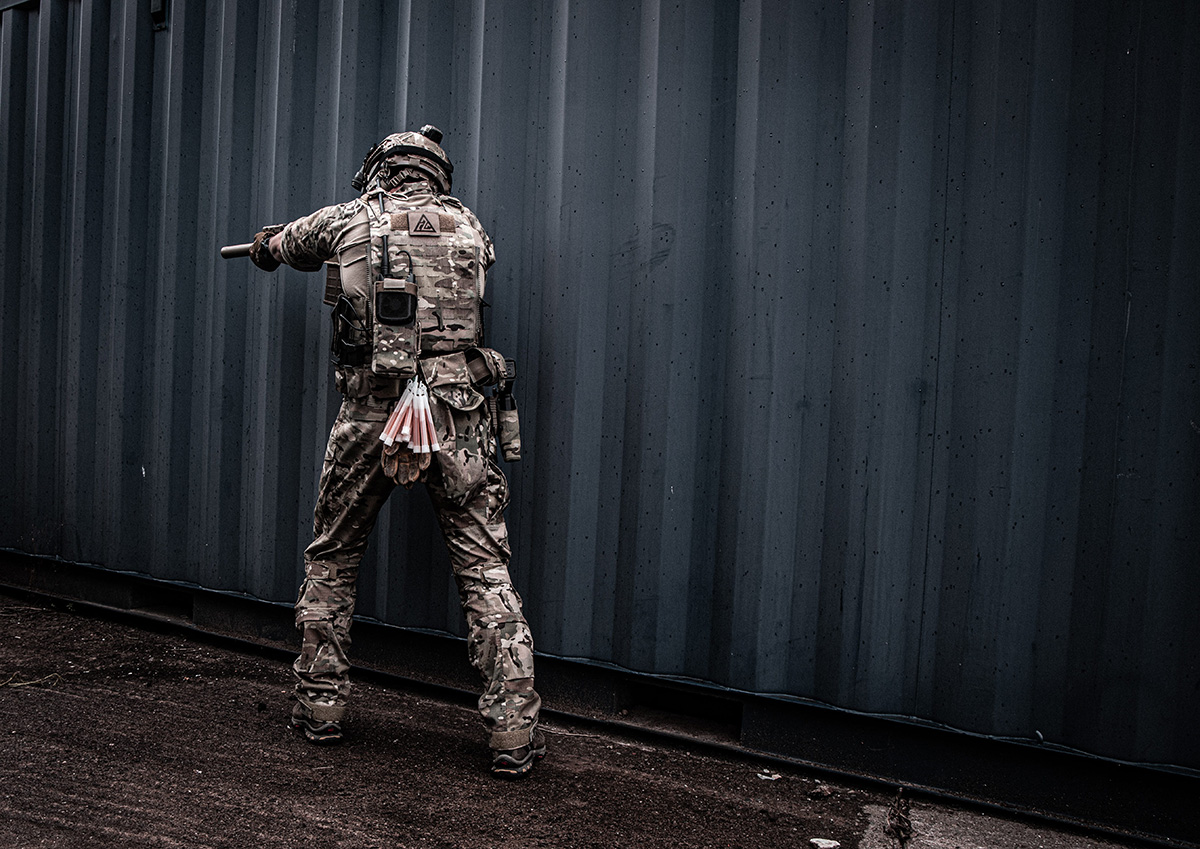
Thales is preparing to launch a new soldier-worn electronic warfare system designed to protect dismounted troops from drones and other radio-frequency threats, reflecting the growing importance of counter-UAS capability at the individual soldier level.
Ahead of the system’s official unveiling at the Future Soldier Technology conference, the UK Defence Journal spoke with Timothy Coley, Product Line Manager for cyber and electromagnetic activities at Thales, about the company’s new Storm 2 system and the operational problem it is intended to address.
Storm 2 is a dismounted cyber and electromagnetic activities (CEMA) node designed to be worn by individual soldiers. Built around a software-defined radio with onboard processing capability, the system is intended to detect and disrupt hostile radio signals used by drones or radio-triggered explosive devices. The device weighs around two kilograms, significantly less than many traditional electronic countermeasure manpacks, which can be substantially larger and heavier.
According to Coley, the system was designed to provide protection against radio-frequency enabled threats without placing additional strain on soldiers already carrying heavy loads. “Storm 2 protects soldiers from RF-enabled threats in a small form factor that doesn’t impose a large burden on them, allowing them to retain mobility and achieve their primary mission on the battlefield,” he said.
The system traces its origins to counter-IED operations, where electronic countermeasures are used to prevent radio-controlled improvised explosive devices from being triggered remotely. Coley explained that the system was later adapted rapidly in response to the growing drone threat on modern battlefields.
“The genesis of Storm 2 was for counter radio-controlled IED use cases, equipping dismounted troops with protection from radio-triggered devices,” he said. “We pivoted that at the request of a customer in a matter of weeks to address a counter-UAS use case by jamming the link between the ground controller and the drone.”
Storm 2 operates across a broad radio spectrum from 20 MHz to 6 GHz, allowing it to detect and disrupt a variety of radio signals. Many commercial drones operate in the 2.4 GHz and 5.8 GHz ISM bands, but the system can also be configured to target other frequencies. This flexibility reflects the evolving tactics used by drone operators, who increasingly alter the operating frequencies of ground control stations to avoid known countermeasures. “Different threat actors are changing the centre frequencies of their ground control stations to avoid established jamming capability,” Coley said. “Having the ability to participate in that cat-and-mouse cycle of countermeasures and counter-countermeasures is important.”
The system employs reactive jamming, meaning it remains passive until a threat signal is detected. Asked how this differs from traditional jammers, Coley explained that many systems transmit continuously, consuming power and potentially revealing their presence. “An active jammer is always on, which means that it’s going to be effective, but it will consume more power and it is more easily detected,” he said. “A reactive jammer comes to life when the threat signal is detected, reducing power consumption and making it less conspicuous on the battlefield until it is actually required.” In practical terms, the system detects radio emissions associated with drone operations, including both control links and video transmissions. These signals can effectively act as a trigger for the system to activate its jamming capability.
Storm 2 can generate up to 10 watts of output power. When asked what kind of protection radius that might provide for a dismounted soldier, Coley said precise figures were difficult to provide because electronic warfare performance depends heavily on environmental conditions. “It genuinely depends upon the nature of the threat signal and the environment,” he said. “Other RF emissions, terrain, weather conditions and the position of the antenna relative to the receiver all influence the range that can be achieved.” Battery endurance is quoted at up to four hours.
Asked how long the system could realistically operate during a patrol, Coley noted that the figure varies depending on how frequently the device needs to activate its jamming capability. “Because the system is reactive, the duty cycle depends on how often threat signals are detected and how long the system needs to jam them,” he said. “You might not necessarily want to use the full ten watts of output power depending on the mission.”
Thales has also conducted a series of customer demonstrations and evaluation trials. When asked about interest from potential buyers, Coley said several armed forces are already exploring the system. “We have had a number of successful customer trials and demonstrations across both counter-IED and counter-UAS use cases,” he said. “We also have live enquiries with several armed forces.”
Storm 2 reflects a broader shift in how militaries are thinking about electronic warfare on the battlefield. Traditional electronic countermeasures have often been mounted on vehicles or carried in large manpacks by specialist operators. Storm 2 instead distributes electronic protection across individual soldiers, allowing the capability to move with troops and reducing reliance on a single jammer within a unit. When asked how the system might be deployed operationally, Coley said the exact approach would depend on the concept of operations adopted by each armed force. “Traditionally a manpack device might be worn by a couple of members of a section,” he said. “Storm 2 can provide individual protection to each member of the section, but not every soldier necessarily carries the same equipment or role.”
The concept may be particularly relevant in modern conflicts where forces operate in smaller and more dispersed groups. “Operations in Ukraine don’t necessarily lend themselves to large section or platoon-level groupings,” Coley said. “The sensor-to-shooter cycle means large gatherings of people are quickly detected and targeted.” Storm 2 has also been designed to minimise the burden placed on the soldier using it. Asked about training requirements, Coley said the system has been deliberately designed to require minimal user interaction. “The operator simply switches it on,” he said. “We’ve designed it to be passive and omnidirectional because the threat could come from anywhere. The soldier’s job is to focus on the mission rather than operating electronic countermeasures equipment.”
Thales believes the combination of wide frequency coverage, reactive jamming capability and a two-kilogram form factor sets Storm 2 apart from competing systems. “There are larger systems that can provide similar capability but impose a much greater burden on the soldier,” Coley said. “There are also smaller systems that only operate in fixed frequency bands. Providing reactive capability across a wide frequency range in a two-kilogram device is a unique proposition.”
Storm 2 is expected to be formally unveiled at the Future Soldier Technology conference, where Thales will present the system as part of its broader electronic warfare and counter-drone portfolio.









Great idea, ECM from N.I. was always first class and world leading, nice see it put other uses.
Oh those were the days, White Sifter, Antler, Violet Joker etc
Bad place, but I enjoyed the tours if that makes sense?
Yep, know exactly where you are coming from.
Let’s hope this doesn’t become another golf ball finder scandal.
I know it’s a stretch, but it’s a lot to promise.