

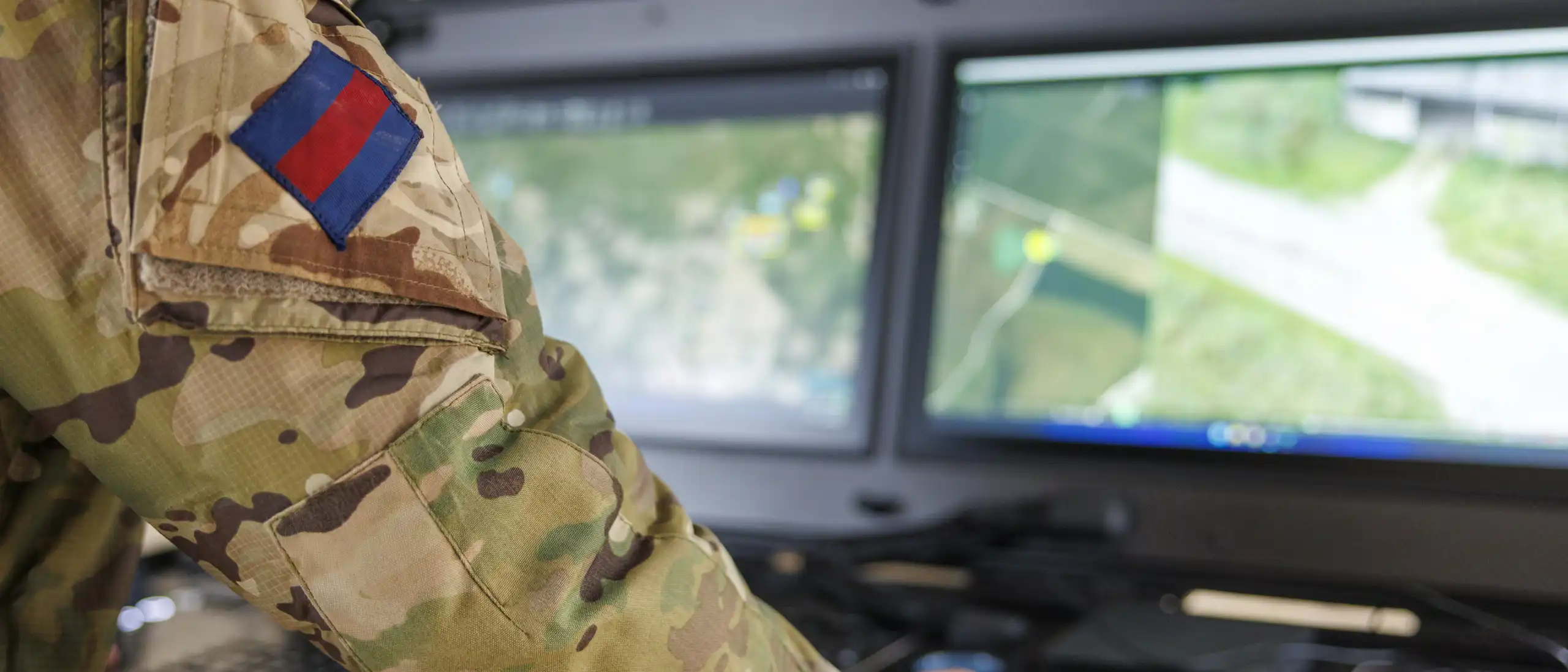
Troops from the United Kingdom, United States and Australia have tested drone swarm technologies during the British Army’s Warfighting Experiment 2026, focusing on improving interoperability and data sharing between allied systems, say the British Army.
The annual experiment, held near Copehill Down, brought together soldiers, scientists, industry and academia to trial emerging capabilities, with this year’s activity centred on the use of coordinated drone swarms.
A key outcome, the Army said, was the development of a system enabling British, American and Australian drone swarms to share data in near real time. The aim is to allow intelligence gathered by one nation’s systems to be rapidly distributed across allied networks.
A British Army project lead said: “Just as we speak English to one another, machines need common languages to work together effectively. Finding those languages is vital.”
The work involved linking national systems so that information collected by drones could be transmitted via national servers and shared across partners, allowing for more coordinated operations.
The experiment also examined how to maintain human oversight when using increasingly autonomous systems. Establishing clear rules governing how drone swarms operate was identified as a central requirement, particularly when coordinating activity between multiple nations.
A drone pilot from the Irish Guards highlighted the scale of the challenge in training these systems, saying: “We’ve inputted a significant number of images of battlefield items so far. It’s a mammoth task, but all the time you’re improving the capability.”
The role of artificial intelligence was another focus, particularly in improving target recognition. Systems rely on large volumes of training data to distinguish between objects and identify potential threats, with participating teams working to pool and refine datasets.
The trial ran over three weeks, with initial planning followed by live missions designed to test how effectively systems could operate together. Further work is planned, including expanding the scale of future experiments by combining live and virtual drone swarms to simulate more complex operational scenarios.






It’s very good news that serious tests are being carried out on this most terrifying weapon of our age. In WW1 we had the Wizzbang, and then in the second war, parachute grenades, some of which had delayed fuses. As I mentioned yesterday on this site, the most pressing issue facing Britain is the threat of drones of all sizes and ballistic missiles, and we better believe it when the experts tell us there is a real risk to our homeland. Maybe the somewhat preoccupied chancellor and defence minister might just recognise the danger!
I can see how many might think that the British military’s excellence in military training, strong relationships with the Ukrainian armed forces and good experience of achieving coalition C2 interoperability will allow it to move at pace towards excellence in drone/counterdrone operations. Evidence from the Middle East, particularly in counterdrone operations, after perhaps rather a slow start, would seem to bear this out. Nevertheless, as SDR 2025 makes clear, drone warfare capability is an adjunct to rather than a replacement for a verifiably credible conventional deterrent.
It is clearly taking Whitehall/Westminster some time to get their heads around this.
Army is talking about a mix of 20% conventional, 40% on attritable, and 40% on disposable/one-way. I expect the measurement is a bit handwavey; however, it doesn’t look like drones will be some kind of bolt-on to me.
SDR 2025 ‘Deter and defend in the Euro-Atlantic’
The SDR strongly underlines the importance of a verfiably credible conventional deterrent. As the Ukrainians (and Britain, Falklands 1982) discovered, if your conventional military deterrent is not known about or is underestimated, a particularly stupid opponent will make the mistake of taking you on. Much cheaper and more effective to shout about your military capability from the rooftops. That means that force multiplier technologies like drones, coalition interoperable digital C2 etc have little to contribute to deterrence other than as enablers of swift, slick and obvious large scale demonstrator manoeuvres.
‘The Army will continue to need armoured platforms and attack helicopters to confront a major state adversary, fighting to take and hold ground. Armoured platforms improve the survivability of personnel in an increasingly transparent battlefield…A ‘20-40-40’ mix is likely to be necessary: 20% crewed platforms to control 40% ‘reusable’ platforms (such as drones that survive repeated missions), and 40% ‘consumables’ such as rockets, shells, missiles, and ‘one-way effector’ drones…
Recommendations:
‘The Army must modernise the two divisions and the Corps HQ that it provides to NATO as one of the Alliance’s two Strategic Reserves Corps (SRC). The SRC should be led by the Corps HQ (Allied Rapid Reaction Corps) and enabled by, and command, Corps-level capability. The first division should comprise a fully deployable Headquarters, three manoeuvre brigades with armoured and mechanised capabilities, support brigade, and associated enablers…The Army must accelerate the development and deployment of its new ‘Recce-Strike’ approach—combining existing capabilities and technologies, such as armoured platforms, with constantly evolving technologies…’
The treasury, foreign office, No.10 will always clutch at opportunities for ‘doing defence’ on the cheap. Drones offer them just such a life raft. The two recent invasions of Ukraine (and the Falklands, should we really need to be reminded) and associated expense in blood and treasure have, over and over again, illustrated with stark clarity that deterrence is the only true victory.
And a verifiably credible NATO deterrent in the Euro Atlantic requires, from Britain, a two Division Army Corps with at least one fully constituted Armoured Division (including integral drone capabilities across the piece, in numbers; a recce/strike Brigade; recce/strike elements within each combined arms battlegroup)
Ukraine has by default become a leader in remote battlefield systems, and our strong partnership should help in the UK developing advanced drone and anti-drone systems. Of course we require more conventional kit, but my instincts tell me the UK is more likely to experience a drone raid from a number of agencies, and not in years but months. I doubt Russia will directly launch but will use agencies along with Iran and, considering the current situation, could lash out at many nations linked to the USA. One factor that is encouraging is the awareness of the need to address this issue and the ability for the UK to manufacture these weapons in large numbers.
So much time indeed that one successful drone manufacturer Skycutter despite successfully selling their drones to the US military and the Middle East helped by collaborating with Ukraine’s Skyfall, are having to wait patiently for the DIP to reveal if they will sell any to the UK forces. Meanwhile as their next sales to the US will necessitate manufacturing there and/or foreign investors or a take over may dictate matters they are having to consider moving abroad. How very British, we really don’t truly appreciate site success stories here… certainly far too often until its too late.
I’ve gained $17,240 only within four weeks by comfortably working part-time from home. Immediately when I had lost my last business, I was very troubled and thankfully I’ve located this project now in this way I’m in a position to receive thousand USD directly from home. Each individual certainly can do this easy work & make more greenbacks online by visiting
following website——>>> http://www.giftpay7.vip
Doubtful at best 💩🪰👍🏿
Reading this, I’m just glad to know that we actually have a drone swarm to be testing alongside our US and Australian allies!
It’s amazing how low our expectations have fallen.
Just how many is “a swarm”?
Do I read it correctly that this is an intelligence gathering/ sharing thing rather than operating hundreds of the drones that we will have in 2030?
AA
Apparently Starmer hasn’t been told how many represent a swarm so will in the meantime be telling us we have numerous swarms ready to go…. We know how that ends.
Apparently, nobody has told Starmer that he’s PM.
I will tell him he SHOULDNT be PM…
On 2nd thoughts I might need to organise a committee first.
A swarm of drones is probably “up to ” a number…
AA
Everybody can earn $250+ daily… You can earn from $19845-$38514 a month or even more if you work as a full time job…It’s easy, just follow instructions on this page, read it carefully from start to finish… It’s a flexible job but a good earning opportunity..
go to this site home tab for more detail thank you…… Jobathome1.com
Is a swarm of drones, equivalent to the two boots on the ground we had in Greenland?